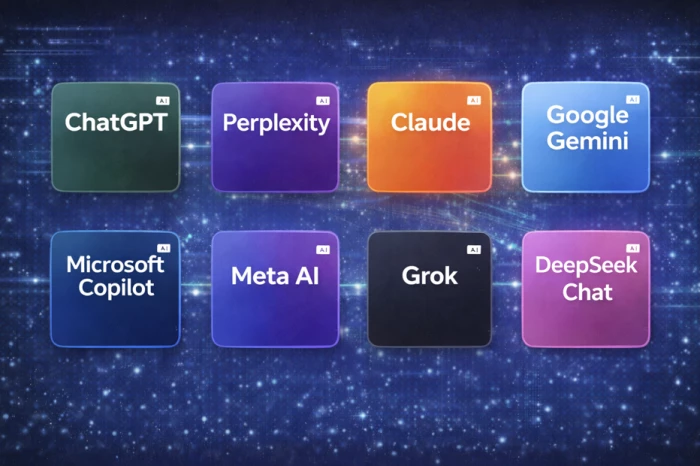
AI chatbots in 2026 have moved far beyond simple question-answer tools. They are now being used to write marketing copy, analyze large documents, generate code, automate workflows, and assist with real business decisions. For many teams, choosing the right AI assistant can directly impact productivity and output quality.
However, the market has become crowded and confusing. Different chatbots excel in different areas. Some are better for creative writing, others for real-time research, and some are deeply integrated into enterprise ecosystems. There is no single tool that dominates every use case.
Industry comparisons consistently show that general assistants like ChatGPT and Claude lead in reasoning and writing quality, while tools such as Perplexity stand out for live research. Meanwhile, Gemini and Copilot gain strength through tight ecosystem integration.
Because of this fragmentation, the smartest approach in 2026 is not asking which chatbot is universally best. It is understanding which one fits your workflow.
Below are eight of the most capable AI chatbot tools available right now, along with quick performance snapshots to help you evaluate them faster.

ChatGPT continues to be the most balanced and widely used AI chatbot in 2026. It performs strongly across writing, brainstorming, coding assistance, and multimodal tasks, which is why it remains the default starting point for many users.
One of ChatGPT’s biggest advantages is consistency. While some competitors may outperform it in specific niches, few match its overall reliability across everyday tasks. Marketers use it for copy and campaign ideas, developers use it for debugging support, and founders rely on it for rapid ideation.
Another major strength is its expanding ecosystem. Integrations, custom tools, and multimodal capabilities have made it more than just a chat interface. For many users, it functions as a general productivity engine.
Best for: creators, marketers, founders, and general productivity users.
Performance snapshot:
Reasoning: ██████████ 9/10
Creativity: ██████████ 10/10
Coding: █████████░ 8/10
Research: ████████░░ 7.5/10
Ease of use: ██████████ 10/10
Perplexity AI has quickly become the preferred choice for users who care deeply about accuracy and source-backed answers. Unlike traditional chatbots that primarily generate text, Perplexity operates more like an AI-powered research assistant that pulls in live web information and cites sources directly.
This makes it especially valuable for analysts, students, journalists, and anyone doing fact-heavy work. Instead of manually cross-checking claims, users can quickly verify information within the same interface.
Another advantage is speed. For straightforward factual queries, Perplexity often feels faster and more grounded than general-purpose assistants.
Best for: researchers, students, analysts, and fact-checking workflows.
Performance snapshot:
Reasoning: ████████░░ 8/10
Creativity: ███████░░░ 7/10
Coding: ███████░░░ 7/10
Research accuracy: ██████████ 10/10
Speed: █████████░ 9/10

Claude has built a strong reputation among professionals who need thoughtful, structured output. Many users report that Claude produces more natural and human-like long-form writing compared to most competitors.
One of its standout capabilities is handling very large context windows. This allows Claude to process long reports, research papers, legal documents, or entire project files in a single conversation without losing coherence.
Because of this strength, it is increasingly popular in legal, research, and knowledge-heavy environments where depth matters more than speed.
Best for: long documents, research synthesis, legal and analytical work.
Performance snapshot:
Reasoning: ██████████ 9.5/10
Creativity: █████████░ 8.5/10
Coding: █████████░ 8.5/10
Research depth: █████████░ 9/10
Long-context handling: ██████████ 10/10
Google Gemini’s biggest advantage is its deep integration with the Google ecosystem. For users who spend most of their time in Gmail, Docs, Sheets, and Drive, Gemini can feel naturally embedded into daily workflows.
It performs particularly well at summarization, document understanding, and multimodal tasks involving text and images. While it may not always lead in pure creative writing, its productivity value inside Google Workspace is significant.
For corporate teams already standardized on Google tools, Gemini often reduces friction compared to standalone chatbots.
Best for: Google Workspace users and document-heavy workflows.
Performance snapshot:
Reasoning: █████████░ 8.5/10
Creativity: ████████░░ 8/10
Coding: █████████░ 8.5/10
Research: ████████░░ 8/10
Integrations: ██████████ 10/10

Microsoft Copilot is less flashy in public comparisons but extremely powerful inside the Microsoft ecosystem. Organizations that rely heavily on Excel, Word, Teams, and Azure often see meaningful productivity gains when Copilot is deployed properly.
Its strongest use cases include document drafting in Word, data analysis in Excel, meeting summaries in Teams, and developer assistance within Microsoft environments.
For enterprise environments, Copilot’s security posture and workflow automation capabilities make it particularly attractive.
Best for: enterprises, Microsoft 365 users, and developer workflows.
Performance snapshot:
Reasoning: ████████░░ 8/10
Creativity: ███████░░░ 7/10
Coding: ██████████ 9.5/10
Enterprise workflows: ██████████ 10/10
Automation: █████████░ 9/10
Meta AI is expanding rapidly across WhatsApp, Instagram, and Facebook, giving it one of the largest built-in user bases of any AI assistant.
Its main advantage is accessibility. Millions of users can interact with AI directly inside apps they already use daily. While it may not yet match the deepest reasoning models, it performs well for casual conversations, quick questions, and basic creative tasks.
Meta’s distribution strategy suggests its influence could grow significantly over the next few years.
Best for: everyday users and social-platform AI access.
Performance snapshot:
Reasoning: ███████░░░ 7/10
Creativity: ████████░░ 8/10
Coding: ██████░░░░ 6/10
Accessibility: ██████████ 10/10
Speed: █████████░ 9/10
Grok positions itself as a more real-time, internet-aware chatbot. It is designed to stay closely connected to live conversations and trending topics, particularly within the X ecosystem.
Its tone is often more conversational and less formal than enterprise-focused assistants. While still evolving, it shows strong potential for users who prioritize fresh information and dynamic responses.
Grok is best viewed as an emerging contender rather than a fully mature enterprise tool.
Best for: real-time insights and X platform users.
Performance snapshot:
Reasoning: ████████░░ 8/10
Creativity: ████████░░ 8/10
Coding: ███████░░░ 7/10
Real-time awareness: ██████████ 10/10
Maturity: ███████░░░ 7/10

DeepSeek has gained attention primarily because of its strong performance-to-cost ratio. It delivers competitive reasoning and coding capabilities while remaining significantly more affordable than many Western models.
This has made it especially attractive for developers, startups, and teams running large-scale workloads where inference cost matters.
While its ecosystem is still developing, DeepSeek is increasingly being watched as a serious budget-friendly alternative in the AI chatbot space.
Best for: developers, startups, and cost-sensitive teams.
Performance snapshot:
Reasoning: █████████░ 8.5/10
Creativity: ███████░░░ 7/10
Coding: █████████░ 9/10
Cost efficiency: ██████████ 10/10
Speed: █████████░ 8.5/10
The AI chatbot market in 2026 is no longer dominated by a single winner. Instead, the landscape has fragmented into specialists.
ChatGPT remains the safest all-around choice for most users. Claude excels when deep thinking and long documents matter. Perplexity leads for research-heavy workflows. Gemini and Copilot become significantly more valuable inside their respective ecosystems.
The most effective users are not choosing just one tool. They are combining two or three depending on the task.
That multi-tool strategy is quickly becoming the real productivity advantage in the AI era.
Why AI Subtitle Generators Are Now EssentialVideo content has exploded across Yo...
Samuel Osei2 days ago
Customer service automation is no longer a future ambition. For many companies,...
Grace Howard2 days ago
CrushOn AI has quietly built momentum among users searching for character based...
John Nyarko1 week ago
AI companionship platforms are advancing rapidly, but not every tool lives up to...
John Nyarko1 week ago
AI coding tools are transforming how developers write software. If you’re search...
John Nyarko1 week ago

When Suno AI first started appearing in conversations, expectations were low. Ma...
John Nyarko3 weeks ago
Discussion