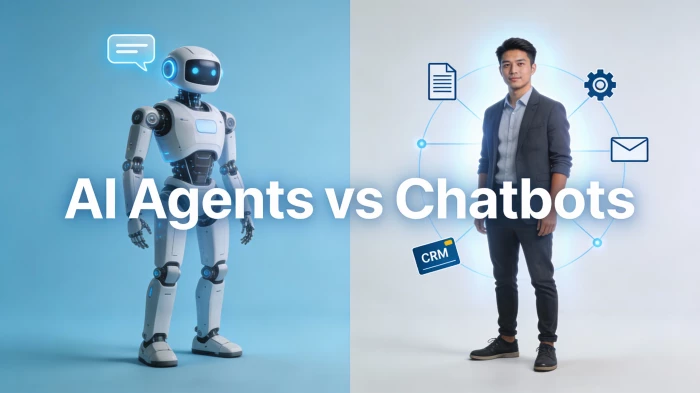
AI agents and chatbots may look similar on the surface, but they’re built for very different levels of intelligence, autonomy, and impact on real workflows. Choosing between them or intentionally combining both comes down to how complex your use cases are and how much freedom you’re comfortable giving AI inside your systems.
In practice, this isn’t a philosophical debate. It’s an operational one.

A chatbot is a program that chats with you but mostly answers questions and passes messages along.
It either:
So in real-world terms, a chatbot is like the front desk receptionist who has a binder of standard answers and a form to send your details to the right department.
An AI agent is software that can understand a goal, decide what to do, and take actions across systems not just chat.
Example:
You type, “My internet has been dropping all week; I work from home and I need a more stable plan.”
Chatbots work best when:
The interaction often feels like navigating a menu:
“Choose 1, 2, or 3.”
In one support organisation I worked with, a chatbot successfully deflected simple “how do I” questions but stalled on anything involving judgment. Tickets still bounced between humans for prioritisation, summaries, and follow-ups.
| Dimension | Chatbots | AI Agents |
|---|---|---|
| Core logic | Rules, flows, intents | LLM reasoning + tools |
| Task complexity | Simple, predictable | Multi-step, decision-heavy |
| Context handling | Limited | Long-term, adaptive |
| Data usage | FAQs, static KBs | CRM, tickets, docs, unstructured data |
| Training effort | Manual scripting | Data connections + policies |
| Control vs flexibility | High control | High flexibility with guardrails |
| Best for | Tier-1 support, FAQs | Copilots, ops, sales, complex service |
Most mature teams don’t choose one exclusively they layer them intentionally.
A chatbot is usually the right choice if:
AI agents become essential when:
The most effective pattern I see is:
This balances safety with real productivity gains.
From a buyer’s perspective, the labels matter far less than outcomes. “Bot” and “agent” are often marketing terms.
The real questions are:
If you’re choosing between AI agents and chatbots, the wrong question is “Which is more advanced?”
The right one is “How much judgment and action does this task require?”
Chatbots are excellent at containing complexity.
AI agents are powerful because they absorb it.
Most organisations need both, and the real competitive advantage comes from knowing exactly where each belongs.
Anthropic has accused three prominent Chinese AI companies of systematically “mi...
Sandra Campos5 days ago
In what might be the most unexpected AI benchmarking milestone of 2026, Elon Mus...
Peter Woods1 week ago
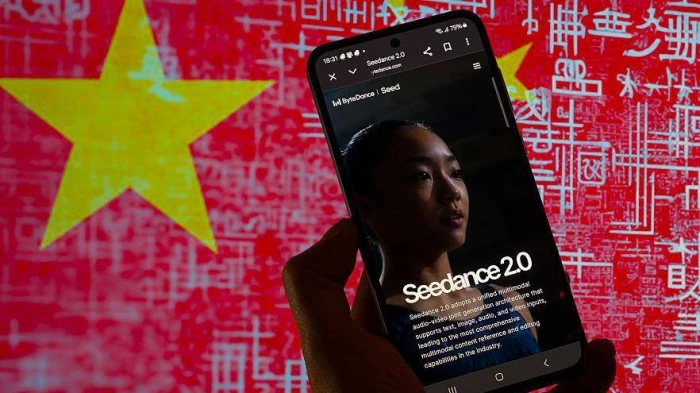
A powerful new Chinese artificial intelligence video app is igniting alarm acros...
Peter Woods1 week ago

The Legal Industry Didn’t Suddenly “Go AI” — It Was Forced ThereIn 2026, AI in l...
John Nyarko1 week ago
AI talking head tools have made it possible to create studio‑style presenter vid...
Ina Gupta2 weeks ago
Leetcode prep is crowded with tools that promise shortcuts, streaks, and “guaran...
Ina Gupta2 weeks ago
Discussion