Akool AI is one of those tools that rarely inspires indifference. People either credit it with saving them time and money or criticize it sharply for billing friction and unmet expectations. That split is visible across review platforms, where strong ratings sit next to detailed complaints.
That contrast makes Akool worth examining properly. Not as a feature checklist or a marketing pitch, but as a working product used by marketers, creators, educators, and small teams who rely on it for real output. This article looks at what Akool AI is built to do, how it performs in practice, what users consistently praise or challenge, and how to decide whether it fits your workflow.

Akool AI positions itself as an all-in-one generative video platform. The core idea is simple. Instead of filming people, hiring studios, or stitching together multiple tools, users generate videos through AI avatars, face swaps, automated editing, and translation.
The platform targets teams that need speed and scale more than cinematic perfection. Marketing teams producing short campaigns, e-commerce brands creating product visuals, educators localizing content, and creators who do not want to appear on camera all show up repeatedly in reviews.
This positioning explains much of Akool’s appeal. It lowers the barrier to video production and compresses workflows that normally take days into minutes.
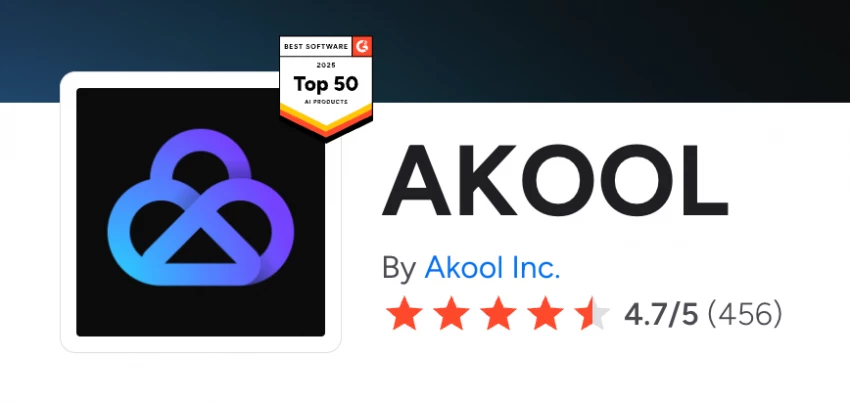
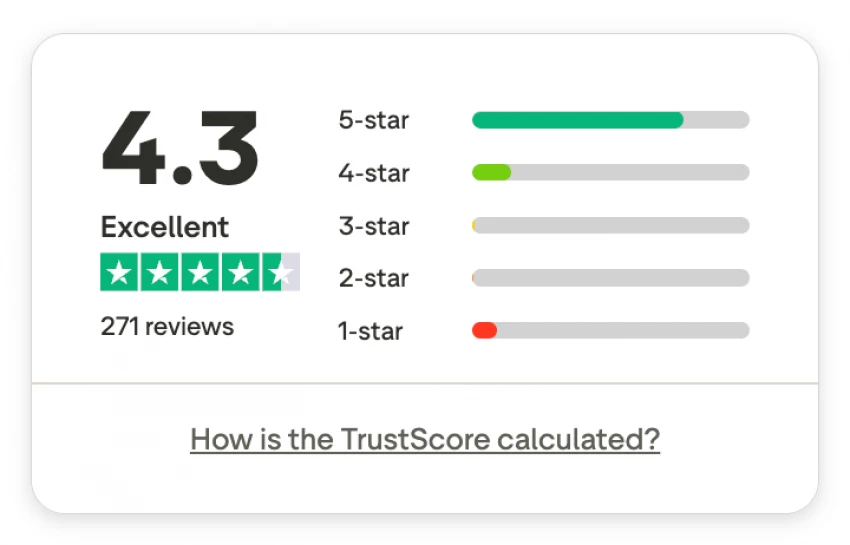
Across G2 and Trustpilot reviews, several strengths appear again and again.
Users frequently praise how quickly they can produce usable videos. Templates, automated scenes, and prebuilt avatars allow people with little video experience to create professional looking content without a long setup phase.
Face swap is one of the most talked-about features. Reviewers describe it as realistic enough for marketing and regional personalization, especially when lighting and angles are controlled. Several teams mention using a single base video and swapping faces to localize campaigns, which reduces production costs.
Video translation with lip sync is another area where Akool earns credit. Users working across languages note that the lip sync quality is strong for business use, even though final proofreading is still necessary.
Ease of use is a recurring theme. Many reviewers explicitly say Akool feels more approachable than competitors that offer deeper control but require more technical effort.
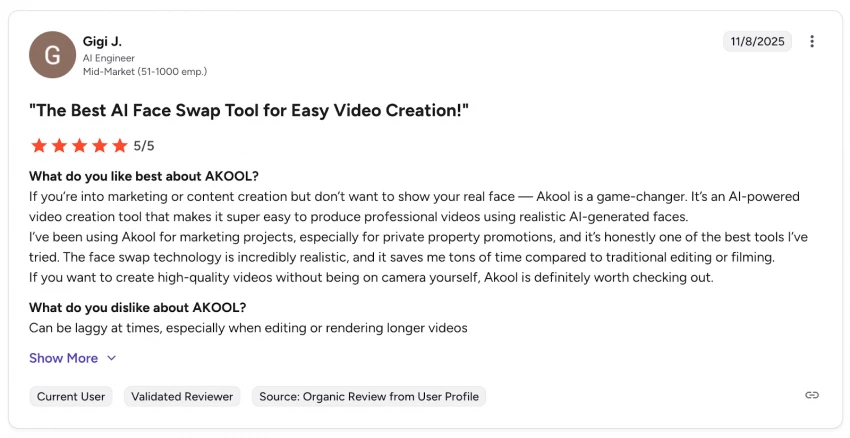
Positive experiences tend to cluster around specific use cases.
Marketing teams use Akool for short ads, outreach videos, and personalized campaigns where speed matters more than perfection. E-commerce sellers rely on image-to-video and background tools to create catalog visuals without hiring models. Educators and trainers use avatars and talking photos to produce consistent lessons across languages. Small businesses and solo creators often see Akool as a replacement for freelancers or studios they cannot afford.
In these contexts, Akool delivers what it promises. It reduces friction, shortens production cycles, and keeps output consistent.
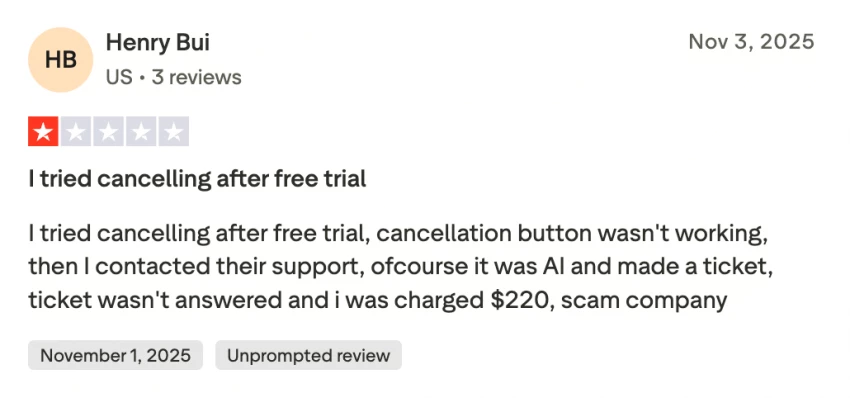
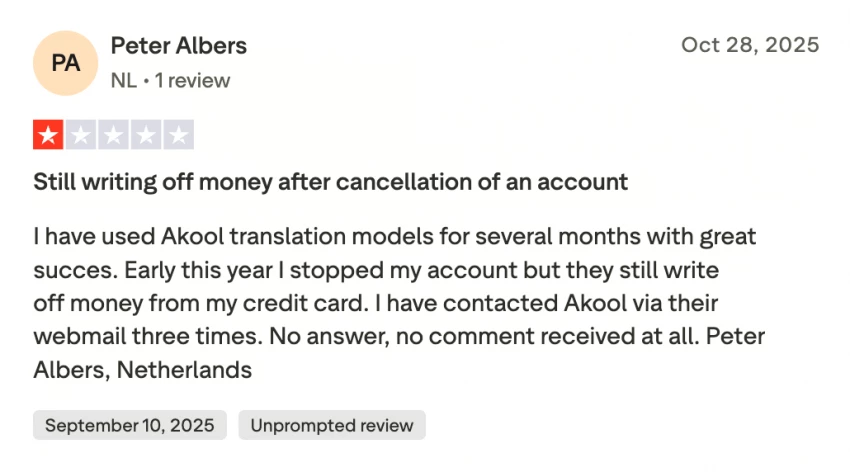
Negative reviews follow clear and repeated patterns.
Billing and subscription management are the most common sources of frustration. Several users describe unexpected charges, confusion around trial periods, or difficulty canceling subscriptions. Even when refunds are issued, the experience leaves a mark.
Credit consumption is another recurring issue. Akool uses a credit-based system layered on top of subscription tiers. Many users report that credits run out faster than expected for high-resolution video, face swaps, or longer outputs. This creates a gap between perceived price and actual cost.
Performance complaints appear less frequently but still matter. Rendering can slow down on complex jobs, particularly for users on lower-tier plans.
Finally, some dissatisfaction comes from expectations rather than defects. Users sometimes assume features will behave like traditional video tools or like demos they have seen online, only to find real-world limits.
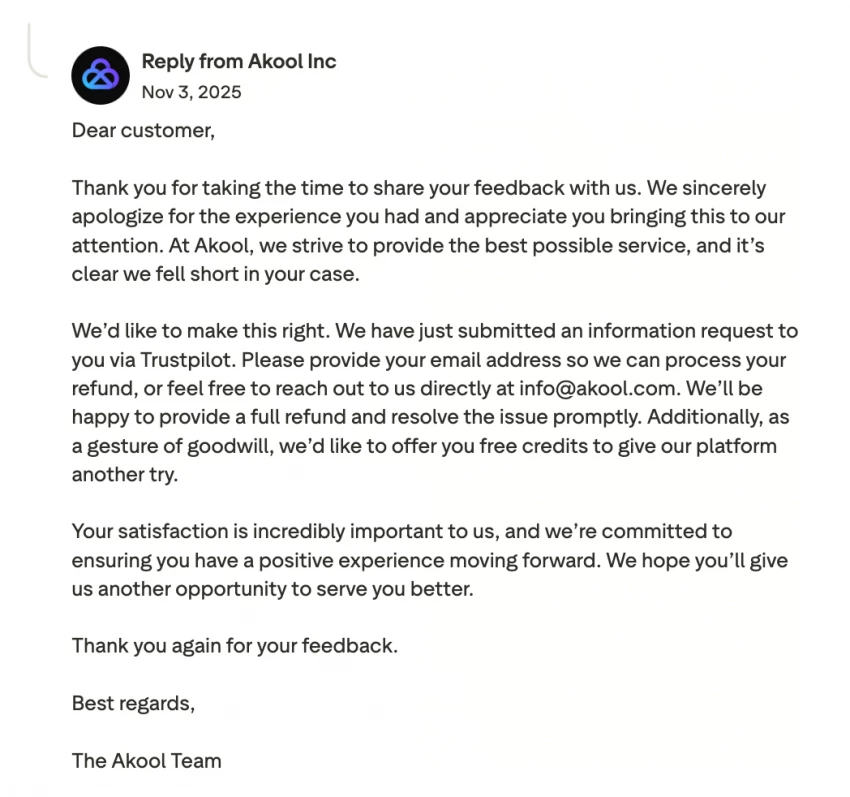
One notable pattern across Trustpilot is Akool’s public engagement. The company replies to nearly all negative reviews, usually acknowledging the issue and offering refunds or credits while requesting direct contact.
This suggests an active support approach, but it also signals operational strain. The volume of billing-related complaints indicates that the experience around pricing and cancellation still needs clarity, even if the company is willing to resolve individual cases.
Akool’s pricing model rewards planned usage and penalizes experimentation. For users who track output and credit consumption closely, the platform can be cost-effective. For users who expect unlimited exploration on a flat monthly fee, frustration is more likely.
Lower tiers work best for testing workflows or light production. Higher tiers make sense for teams that already know how much they will generate and want API access or higher resolution output. The challenge is not the price itself, but predictability.

Akool competes with tools like HeyGen, Synthesia, and other AI video platforms. Its differentiation is breadth rather than specialization.
Some competitors offer more realistic avatars or more polished enterprise experiences. Akool’s advantage is that it bundles many capabilities into one interface, reducing the need for multiple subscriptions and integrations.
For users who value consolidation and speed, that trade-off is acceptable. For users who need best-in-class quality in one specific area, a specialized tool may feel stronger.
By this point, a pattern becomes clear. Akool AI succeeds or struggles depending on alignment between expectations and design.
To make that clearer, it helps to summarize the trade-offs in one place.
| Area | What Akool Does Well | Where Users Push Back | Who This Matters For |
| Video creation speed | Produces usable videos quickly without filming | Rendering slows on complex jobs | Marketers, small teams |
| Feature breadth | Combines avatars, face swap, translation | Not best-in-class at one feature | Users valuing consolidation |
| Ease of use | Low learning curve | Interface feels dense initially | Beginners, solo creators |
| Personalization | Scales localized videos | Credits deplete quickly | Campaign-driven teams |
| Pricing model | Affordable entry | Cost predictability issues | Budget-sensitive users |
| Support response | Public replies and refunds | Resolution can take time | Reliability-focused users |
| Output quality | Strong for business use | Inconsistent edge cases | Not for studio perfection |
Seen this way, the reviews stop contradicting each other. Positive experiences come from users whose needs align with speed, convenience, and breadth. Negative experiences come from users who need tighter control, clearer cost ceilings, or more predictable workflows.
Akool AI is not a miracle tool, and it is not an outright failure. It is a fast-moving platform designed to make video creation accessible and scalable, and it largely succeeds at that goal.
Its strengths are speed, consolidation, and approachability. Its weaknesses are billing clarity, credit transparency, and performance limits at scale. Neither side cancels out the other.
For marketers, educators, and small teams who want to produce video content quickly without filming, Akool can be genuinely useful when used intentionally. For users who expect unlimited experimentation, studio-grade output, or perfectly predictable costs, expectations need adjustment.
The decision is not about whether Akool AI is good or bad. It is about whether the way it works matches the way you work.

Late at night, after the usual AI companion ads blur together, PepHop AI shows u...
Funke Ogunleye1 day ago

Imagine you open a new tab, type “opendream.ai”, and instead of being greeted by...
Samuel Osei2 days ago

Grubby AI is one of those tools that only exists because of a very 2025 problem:...
Funke Ogunleye2 days ago
Meet Muke AIMuke AI is an AI‑powered image manipulation suite best known for two...
Sandra Campos3 days ago

If your marketing currently lives in a chaotic mix of ChatGPT, Canva, random sch...
Samuel Osei3 days ago

Janitor AI doesn’t feel like “a chatbot platform.”It feels like walking into a l...
Sandra Campos4 days ago
Discussion