For more than a decade, businesses have invested in automation, data analytics, and workflow systems, yet most still struggle to make timely, context-aware decisions. Dashboards multiply, but insight rarely converts into action fast enough. Supply networks react slower than consumer sentiment, and operational plans collapse under real-world friction. The issue isn’t technology adoption, it’s the dependence on systems that can only respond, not reason.
The rise of Agentic AI, autonomous, goal-driven AI systems capable of self-directed decision-making, signals a turning point. It’s not just another wave of automation; it’s the dawn of an era where machines can act with strategic intent, augmenting human creativity and efficiency like never before.

Agentic AI represents a shift from AI as a reactive tool to AI as an active participant in business operations. At its core, agentic AI refers to AI systems designed with agency—the ability to pursue goals independently within defined constraints.
Unlike traditional AI models that respond only when prompted, agentic systems:
These agents often possess memory, reasoning capabilities, and access to enterprise software, APIs, and data sources. More importantly, they operate continuously, not episodically.
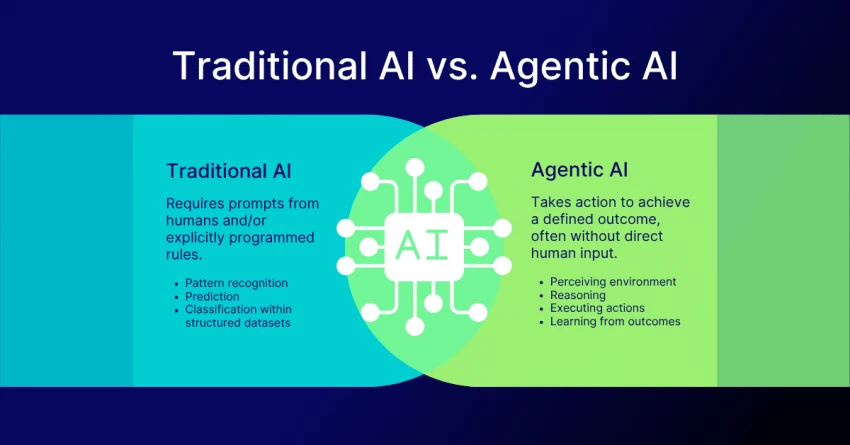
Traditional AI is task-driven which is effective at pattern recognition, classification, or prediction. It answers questions; it doesn’t set goals. Agentic AI, conversely, operates with a sense of agency — it can initiate actions, adjust objectives, and dynamically plan across systems.
Key differentiators include:
● Autonomy: Agentic AI decides its own tasks based on high-level goals.
● Adaptability: It adjusts to changing business parameters instantly.
● Collaboration: Agents can negotiate, share data, and orchestrate processes collectively.
● Learning loops: Continuous self-improvement through reinforcement learning.
In essence, Agentic AI transforms AI from being a “smart assistant” to a strategic co-pilot.
| Aspect | Traditional AI | Agentic AI |
| Nature | Task-driven model | Goal-oriented system |
| Core Function | Predict or classify | Reason, plan, and act |
| Execution Model | Follows rules or scripts | Creates and adapts plans dynamically |
| Human Involvement | Constant supervision | Minimal, strategic oversight |
| Learning Pattern | Static or supervised training | Continuous, real-time self-learning |
| Output Type | Recommendations | Actions and decisions |
Most enterprises today rely on operational models designed for a slower, more predictable world. These models are increasingly misaligned with reality.
Common challenges include:
● Siloed teams and systems, leading to fragmented decision-making
● Manual handoffs that introduce delays and errors
● Static workflows that fail when conditions change
● Decision latency, where insights arrive faster than organizations can act
Operational friction has tangible consequences:
● Missed revenue due to slow responses
● Higher operating costs from inefficiencies
● Increased error rates and compliance risks
● Employee burnout from cognitive overload
At scale, these issues limit growth and erode competitiveness. Incremental optimization is no longer sufficient. What businesses need is a fundamentally different operational paradigm.
Agentic AI reimagines every operational layer , from supply chain to finance to customer experience by combining autonomy with intelligence.
In a fully agentic enterprise, humans define high-level priorities, while autonomous AI ecosystems handle execution — scaling strategic decisions effortlessly.

Agentic AI is poised to revolutionize multiple sectors:
Each vertical experiences the same macro-effect — decision latency drops dramatically, leading to faster, data-driven execution across the enterprise.
One of the most profound shifts in agentic systems is the transformation of human roles. Instead of operational control, humans move into strategic orchestration.
This creates a new kind of workforce, one augmented, not displaced, by AI which is capable of scaling creativity alongside autonomous efficiency. In effect, organizations become hybrid ecosystems of intelligence, where human judgment and AI precision continuously feed each other.
Despite its promise, Agentic AI introduces complex governance challenges. Enterprises must establish responsibility frameworks, ensuring that agents operate transparently, ethically, and securely.
Governance involves:
Building trust in Agentic AI is pivotal to enterprise adoption — automation must always serve humanity’s and the business’s greater good.
To quantify Agentic AI’s effectiveness, organizations can track:
Toward Fully Agentic Organizations
Future enterprises will resemble living digital organisms — composed of interlinked agents, continuously learning and optimizing for shared goals. Humans will shape strategies, while AI entities execute them fluidly across global infrastructures.
The next frontier isn’t automation — it’s autonomy at scale. Businesses that embrace Agentic AI today are not just improving efficiency; they’re reengineering the DNA of enterprise success.

YouTube Shorts has shifted from a side experiment to one of the fastest ways to...
Samuel Osei1 day ago

Digital advertising has become brutally competitive: users scroll faster, acquis...
Samuel Osei4 days ago

AI image generators have shifted from experimental toys to core creative tools....
Peter Woods5 days ago

AI-powered image editors are now central to modern content creation, marketing,...
Alexander Hughes6 days ago
AI text-to-speech (TTS) has evolved from robotic audio to almost human‑sounding...
Samuel Osei1 week ago
IntroductionGraphic design is no longer limited to people who know Photoshop sho...
Funke Ogunleye1 week ago
Discussion