
I’ve spent a fair amount of time on Uhmegle.com lately, and my honest take is that it’s a fast, addictive Omegle‑style chat site for adults that delivers exactly what it promises on the surface instant random video and text chats but hides some uncomfortable realities around bans, privacy, and trust that you only feel once you actually use it.
I originally landed on Uhmegle.com while looking for a modern replacement for Omegle, something that worked in the browser, didn’t force sign‑ups, and still had that “talk to a stranger in 5 seconds” feel. The homepage immediately sold that idea: “chat with strangers,” free, anonymous, no account required, just pick video or text and go.
As someone who likes to test platforms deeply, I didn’t just do one or two sessions; I spread my sessions across multiple days, different times, and both desktop and mobile to see how consistent the experience really was. What I discovered is a platform that is incredibly easy to start using, genuinely capable of delivering interesting conversations, but also frustrating and even worrying once you hit its limits around bans and moderation.
My first impression of Uhmegle was how fast it is to get into a chat. Here’s what it looked like for me:
● I opened uhmegle.com on Chrome; the site loaded a clean, minimal interface.
● I chose video chat; the browser asked for camera and mic permissions, as expected for a WebRTC‑style site.
● I added a few interests and selected a couple of countries I was comfortable chatting with, then hit start.
Within seconds, I was connected to a random stranger, and from there it was classic “Next” culture: if the vibe is off, you hit the skip button and get a new person. On both desktop and mobile, I was able to start a conversation in under a minute from first visit, which matches the “quick start, no account” promise the site and independent reviews mention.
When it works, Uhmegle is fun. I’ve had:
● Casual conversations with people from Europe, North America, and Asia, thanks to the multi‑country selector that lets you choose multiple countries at once.
● Light‑hearted chats where people just wanted to kill time, share music, or talk about random topics.
● A mix of text‑only chats (when I didn’t feel like being on camera) and full video chats that felt surprisingly personal for complete strangers.
The interface helps with this: it’s uncluttered, with a big video window, clear “Start,” “Stop,” “Next,” and a visible report icon. There’s no heavy onboarding, no profiles, and no endless form—Uhmegle really is designed to get you into a conversation fast, and it delivers on that design promise.
Like any anonymous random chat platform, Uhmegle has its rough edges.
● You will run into explicit content, even though the platform says it’s moderated and 18+ only.
● There are people who skip immediately or show up clearly looking for adult content rather than conversation.
● Some connections are laggy or drop unexpectedly, especially during peak times or on weaker networks.
This aligns with what other reviewers and safety guides describe: anonymous video chat is inherently unpredictable, and no AI or rule page can completely filter what users do with a live camera.
From actually using the site, a few features matter more than they look on paper.
Adding interests feels like a small detail, but it does improve the odds of not getting completely random, mismatched chats. I noticed better conversations when I used interests and picked a smaller subset of countries, which aligns with descriptions of Uhmegle as “interest‑based” and “multi‑country” in editorials.
You can use Uhmegle without registering, and it actively leans into that anonymity. The site discourages sharing personal data, and there’s no visible public profile tied to you, everything is session‑based. That’s liberating if you just want quick chats, but it also means there’s not much in the way of reputation or long‑term accountability.
The report flag is right there in the interface, and as a user you’re encouraged to use it against suspected minors, harassment, or explicit content. Over time, you get used to the rhythm: uncomfortable situation → click report or just “Next.” It’s not perfect, but it’s better than platforms that bury the report feature.
Uhmegle clearly markets itself as an 18+ platform and expects users to report minors. It’s written in the Chat Rules and reinforced in safety‑oriented reviews: this is not a site for teenagers or kids.
From my experience, you can still come across people who look or act underage, which is exactly why the reporting tools exist. The platform claims to use AI and human moderators to catch and remove violations, but as a user, you only see the front‑end: you report, and the person disappears from your session.
The disconnect between how strictly the rules are written and what you actually see in sessions is typical of this whole category, Uhmegle is not uniquely bad here, but it definitely isn’t uniquely safe either.
Initially, I treated Uhmegle like any anonymous chat site: camera on, no personal info. But once I dug into the Privacy Policy, it changed how I thought about my sessions.
The policy explicitly says:
● For banned users, Uhmegle keeps “limited chat logs, IP addresses, and identifiers” to enforce bans, and deletes that data if the user is unbanned.
● For all users, it “temporarily store[s] webcam screenshots during live sessions to facilitate moderation,” which are deleted after the session.
That means that even if your chat feels ephemeral, snapshots of your camera may be stored (temporarily) on their systems, and some information connected to your device/IP can stick around longer if a ban is involved.
On top of that, independent reviewers point out that Uhmegle does not clearly disclose its governing law or the full identity of the company behind the site on reviewed pages. As a user, that gives me mixed feelings: the technical disclosures are unusually detailed, but the real‑world “who is behind this and under what law?” part is blurred.
Practically, it pushed me to:
● Avoid showing anything identifiable in the background.
● Use a separate browser profile and clear cookies regularly.
● Treat every chat as if it could be captured or recorded.
This is where my perspective really changed.
I had one session where nothing felt particularly risky, I was just chatting normally and later discovered I’d been banned when I tried to reconnect. I wasn’t shown a detailed explanation, just a generic message that I’d violated terms and couldn’t re‑enter.
When I started researching, I saw that I wasn’t alone:
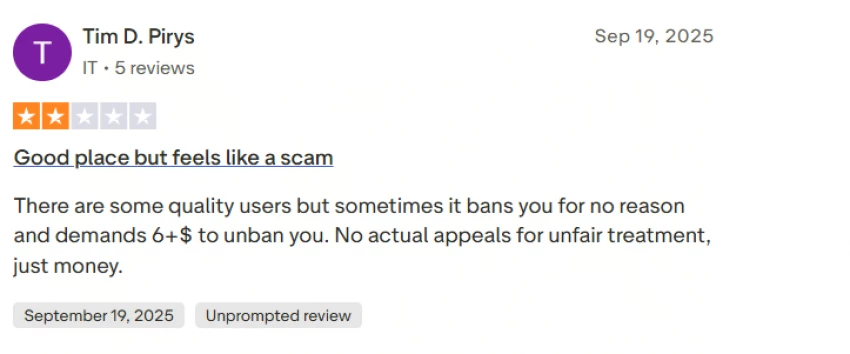
● A Trustpilot reviewer described Uhmegle as a “good place but feels like a scam” because they were banned “for no reason” and then asked to pay 6+ USD to be unbanned, with “no actual appeals” available.
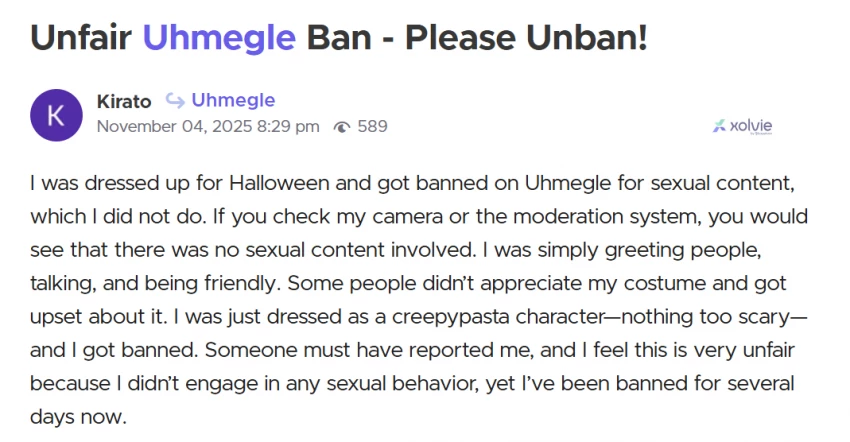
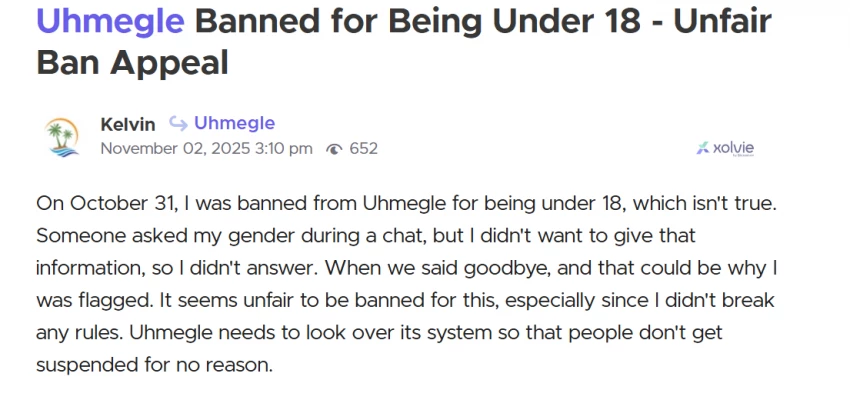
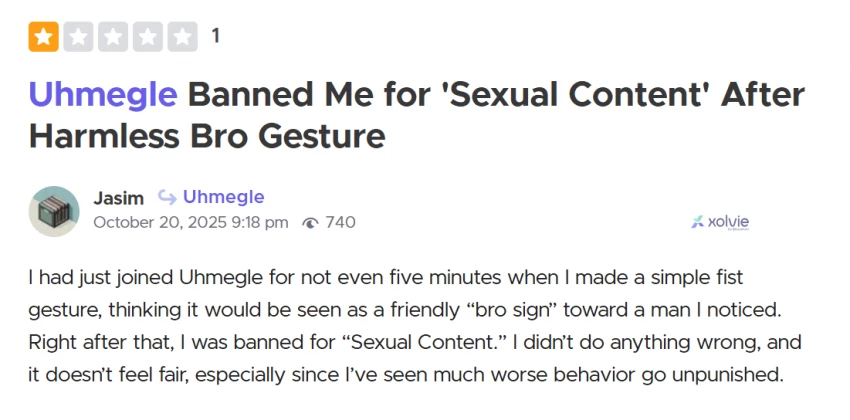
● Complaint platforms like Xolvie have multiple stories of people being banned after just a few minutes, often for alleged “sexual content” or being “under 18,” even when they insist they did nothing wrong.
● Some users report seeing an “instant unban for $X” option (around 2.99–6 USD), which many call a red flag and even compare to a scam pattern.
As a user, this feels harsh: the moderation is automated enough that innocent gestures, costumes, or misunderstood behaviour can trigger bans, and your path back in seems to involve paying rather than having a transparent, well‑documented appeal process.
I personally chose not to pay for an unban, especially after reading similar stories; the whole model feels like a tension between genuine enforcement and monetization.
From actually using Uhmegle and then reading what others say, I’d summarise the community and sentiment like this:
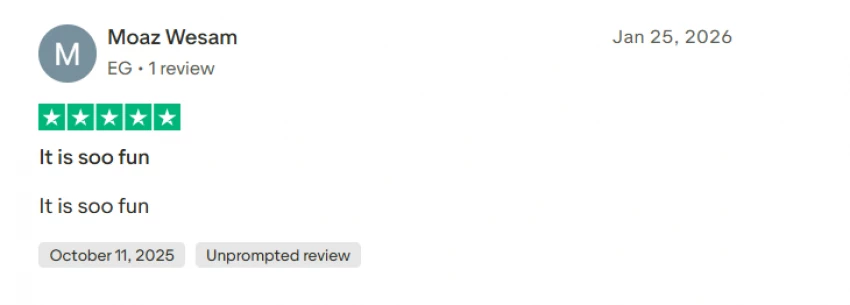
● There are genuinely interesting people and good chats enough that one Trustpilot reviewer explicitly says there are “some quality users” on the site.
● The problem is inconsistency: your session can go from fun to awkward or explicit in one click, which is typical for anonymous chat but still emotionally tiring.
● Outside reviews and complaints repeatedly highlight unfair bans, pay‑to‑unban practices, and lack of clear support responses as major trust killers.
In other words, the community itself is not the problem anonymous humans will always be a mixed bag but how the platform handles that community is where the friction lies.
I’ve tried a few other Omegle‑style platforms, and Uhmegle sits in an interesting middle ground.
● It’s more polished and goal‑driven than basic knock‑offs that barely load or are flooded with bots.
● It offers clearer safety messaging and more detailed privacy disclosures (screenshots, banned‑user data) than many small clones.
● But it also has more negative noise around bans and unbans than some rivals, at least from what’s visible on complaint platforms and review sites.
| Platform | Sign‑up needed | Anonymity | Safety / bans | Profiles | Overall vibe (short) |
| Uhmegle | No | Very high | 18+ rules, reports, but many complaints about bans/unbans. | None for basic use | Fast, simple, fun but ethically grey. |
| Emerald Chat | Yes (for most) | Medium‑high | Strong safety messaging, more structured moderation. | Yes | Feels safer and more “community” oriented. |
| Chatroulette | Optional | High | Established brand, active moderation but still wild. | Optional | Classic random chat, chaotic but familiar. |
| Roulette.Chat | No | Very high | Basic rules, little public safety detail. | None | Rougher, more bots, less polished. |
| Small clones | No | Very high | Minimal moderation info. | None | Often buggy/spammy; Uhmegle is more refined. |
If you want strict anonymity and quick chats, Uhmegle absolutely delivers that, probably better than some competitors. If you care more about verified identities, clear appeals, and long‑term reputations, you’ll likely be more comfortable with platforms that invest more in profiles and transparent governance.
● Speed and simplicity: Getting into a chat takes seconds; no account, no app.
● Interest and country filters that actually make a difference to the quality of matches over time.
● Clear report button so I feel I can act quickly when something feels wrong.
● Honest-ish privacy details about screenshots and ban‑enforcement data, which many platforms never admit to explicitly.
● The emotional whiplash of jumping between normal chats and explicit or uncomfortable encounters.
● The sense that moderation can be both strict and opaque, with sudden bans and no proper explanation.
● Reports (and my own experience with a ban) suggesting that paying for unbans is part of the model, which feels ethically off.
● Lack of visible information about who exactly runs the platform and under what legal jurisdiction, despite detailed technical privacy notes.
Based on using it and reading around it, I’d say Uhmegle makes the most sense if you:
● Are 18+ and understand exactly what anonymous video chat entails: unpredictability, explicit content risk, and possible unfair moderation.
● Want quick, low‑commitment conversations without creating profiles or connecting real‑world identities.
● Are careful with privacy, comfortable staying on the safe side of rules, and willing to walk away rather than argue with bans.
On the other hand, I would not recommend Uhmegle if you:
● Are under 18 or are looking for something even remotely family‑friendly or teen‑safe.
● Need clarity around data jurisdiction, robust appeals processes, or corporate transparency.
● Are uncomfortable with the idea that temporary screenshots and identifiers may be stored and that bans can be both automated and monetized.
If I had to sum up Uhmegle from a user’s perspective: it’s a slick, modern, anonymous chat tool that can give you genuinely memorable conversations but you have to accept that it lives in a grey zone. It’s neither a full‑on scam nor a squeaky‑clean, fully transparent platform; it’s a place where good UX and questionable enforcement policies coexist.
I still think Uhmegle has value if you’re an adult, privacy‑aware, and willing to treat it as a disposable, “use carefully and don’t get attached” type of service. But if you’re looking for a platform you can trust deeply with your time, identity, or money, my experience and the pattern of other users’ complaints—suggests you should approach it with caution, set strict personal boundaries, and always be ready to hit “Next,” close the tab, and move on.
Discussion