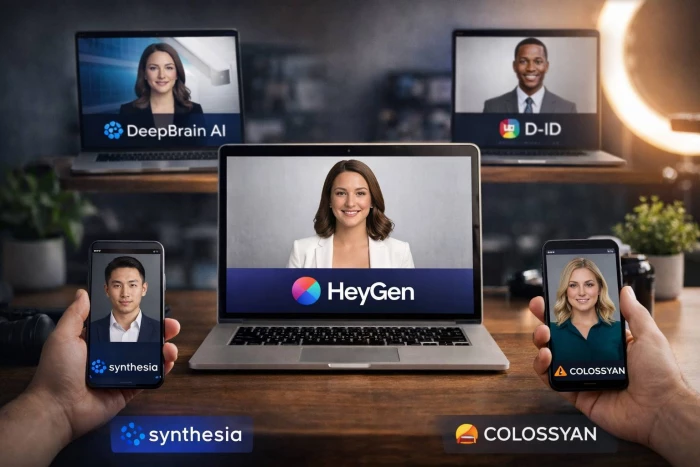
HeyGen is one of the most popular AI avatar video tools right now, but it is not perfect for every use case. Many teams outgrow its editor, want more realistic avatars, or need deeper workflows for training, marketing, or social content.
Below are six solid, real alternatives to HeyGen – Synthesia, Colossyan, D‑ID, DeepBrain AI, VEED, and Pictory with what they do best, where they fall short, and how each one beats (or fails to beat) HeyGen in practice.
| Tool | Best For | Main Edge Over HeyGen | Main Limitation vs HeyGen |
| HeyGen | General avatar videos & translation | Big language library, all‑in‑one workflow | Editor is limited, avatars not “top‑tier” |
| Synthesia | Corporate training & onboarding | L&D workflows, templates, enterprise focus | Less flexible for casual/social content |
| Colossyan | Scenario‑based learning content | Role‑play, doc‑to‑video training flows | Fewer languages, more niche use case |
| D‑ID | Face‑focused, talking‑photo content | Quick “photo to talking avatar” videos | Less suited to multi‑scene, full videos |
| DeepBrain AI | High‑end, ultra‑realistic presenters | 4K avatars, broadcast‑style production | Expensive, overkill for small teams |
| VEED | Editing & social video repurposing | Full editor, media library, social outputs | Avatars & translation weaker than HeyGen |
| Pictory | Turning text / long content into video | Strong for repurposing blogs and scripts | Avatars less central, translation lighter |
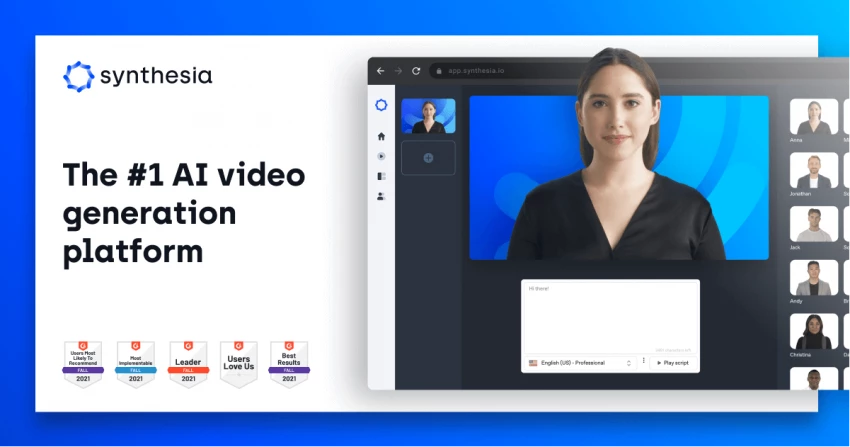
Synthesia is built with training and internal communication in mind. The interface, templates and project structure are oriented around lessons, modules and updates rather than casual social clips. You typically start with a script or policy document, select an AI presenter, drop it into a training‑style layout and export a video that looks consistent with other learning material.
The big advantage over HeyGen is structure. Synthesia makes it easier to standardize onboarding, compliance training and internal announcements across teams and regions. You feel like you’re building “courses” rather than one‑off videos. That’s exactly what L&D and HR teams usually want.
On the flip side, Synthesia is less exciting for YouTube, TikTok or highly creative marketing content. Its templates lean formal and corporate, and the editor remains simpler than a full timeline, so you won’t get frame‑level control. If training and onboarding are your main focus, Synthesia is usually the better fit. If you need one flexible tool for training, marketing and various multilingual promos, HeyGen can still be more convenient.
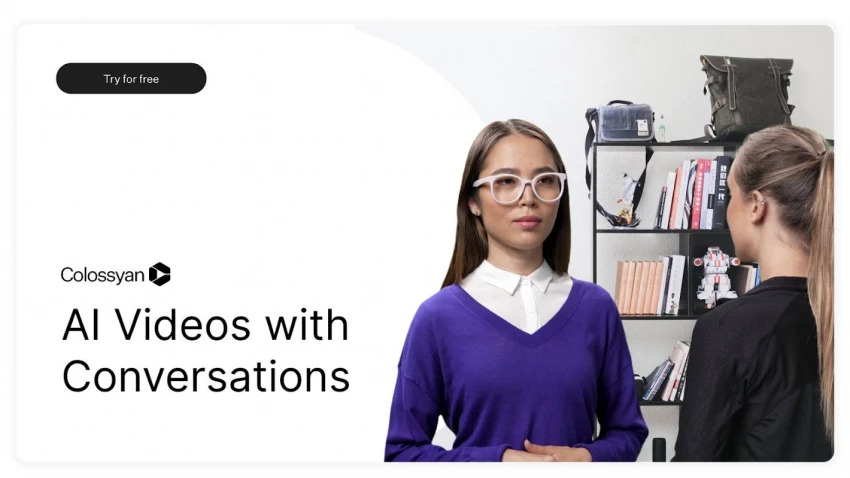
Colossyan targets learning and development as well, but with a stronger emphasis on realistic scenarios. Instead of only single presenters reading scripts, it’s designed for conversations, role‑plays and “what would you do in this situation?” style training. That makes it a good match for customer service, sales, soft‑skills and compliance simulations.
A useful capability is its document‑to‑video approach. Many organizations have long SOPs and policy docs nobody reads. Colossyan helps convert those into structured training videos with characters and situations, which is more engaging without throwing away existing material.
Compared to HeyGen, Colossyan shines when your training is about behavior and decision‑making, not just information transfer. You can build more lifelike scenarios and role‑plays with less manual effort. The trade‑offs: it usually supports fewer languages than HeyGen and is more niche, so it’s not ideal as your only tool for marketing and general content. Choose Colossyan if “scenario‑based training” describes most of your roadmap. Stick with HeyGen if you need broad language coverage and a wider mix of content types in one place.
D‑ID is very focused: it turns photos into talking avatars. You upload an image, add text or audio, and D‑ID generates a short talking‑head video with lip‑sync. This works well for intros, landing‑page explainers, historical characters, brand mascots and other situations where a single face is the star of the show.
Its main strength over HeyGen is speed and simplicity when the input is a photo. If your idea is “make this picture talk”, D‑ID is usually faster and more direct. You don’t have to pick from a library of pre‑made avatars; you just animate your own image.
The limitations become clear if you try to use it like a full video creator. D‑ID is not ideal for long, multi‑scene productions, complex training paths or heavy use of B‑roll and overlays. HeyGen gives you more structure around scenes, templates and translation, so it still wins for complete, presenter‑led videos. Reach for D‑ID when you need quick, photo‑based talking heads; reach for HeyGen when you want an all‑round avatar and translation platform.
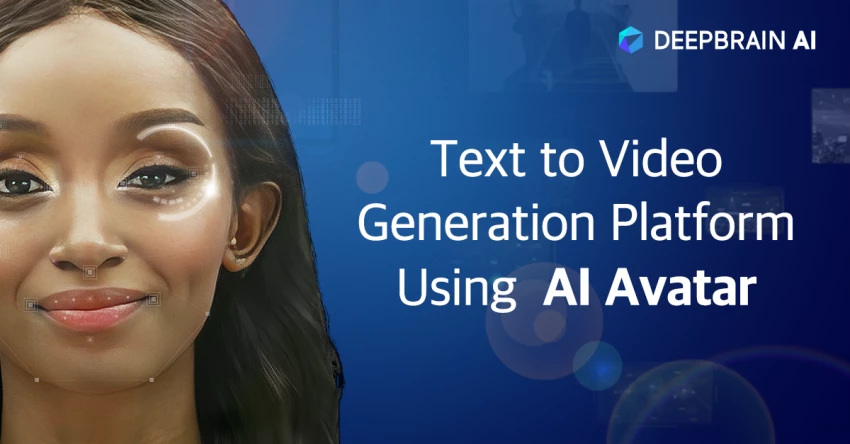
DeepBrain AI operates at the premium end of this market. Its goal is to deliver virtual presenters that look and move closer to real humans, often in 4K, suitable for executive updates, investor messages, news‑style segments and other high‑stakes video.
The avatars are more detailed, with better facial motion, lighting and studio‑like environments. This makes them fit for large screens, corporate events and even broadcast contexts where “AI‑ish” visuals would look unprofessional. If your CEO or spokesperson can’t always be on camera, DeepBrain AI helps create a believable digital double.
Compared with HeyGen, DeepBrain AI’s advantage is clearly realism. HeyGen’s avatars are good for web and internal use, but they still look synthetic when scrutinized. DeepBrain reduces that gap, at the cost of being more expensive and more enterprise‑oriented. Small teams and casual creators may find the overhead too high. So, think of DeepBrain AI as the choice for high‑visibility, premium content, and HeyGen as the more practical option for everyday explainer and training work.
VEED is a full online editor first, with AI features layered on. You get a real timeline, multiple tracks, stock footage, auto‑subtitles, text overlays and presets for TikTok, Reels, YouTube, LinkedIn and more. It’s designed for people who work with “real” video – screen recordings, interviews, UGC, podcast clips – and need to cut, caption and resize content for different channels.
Its edge over HeyGen is editing power and social workflow. If your day is spent trimming webinars, turning long videos into shorts and adding captions and branding, VEED is simply more capable. You can still mix in AI voices and some automation, but the core feeling is a proper editor in the browser.
Where it falls behind HeyGen is in avatars and translation depth. VEED does not try to compete as a pure avatar platform, so if your whole strategy is presenter‑led content in many languages, HeyGen is more aligned. In short: choose VEED when you’re an editor or social team first and an avatar user second. Choose HeyGen when avatars and multilingual presenter videos sit at the center of your workflow.
Pictory specializes in transforming long‑form text into video. You feed it blog posts, articles or scripts, and it extracts key points, matches them with stock visuals and text overlays, and builds short videos you can refine and publish. This is particularly useful for content‑heavy brands that already publish regularly but want more video output without writing everything again from scratch.
The tool’s main strength versus HeyGen is leverage on existing written content. If you have hundreds of posts and want to turn them into social clips, YouTube shorts or simple explainer videos, Pictory handles that pipeline more directly. It is optimized for “blog‑to‑video” rather than avatar‑first creation.
Its weaker side is avatar‑led, presenter‑driven content. Pictory is more about narrated visuals than digital presenters with detailed lip‑sync in multiple languages. HeyGen is better if you care about a consistent AI presenter in different markets. So, Pictory is a smart choice when your challenge is content volume and repurposing; HeyGen remains stronger for avatar‑centric communication.
If your primary work is training and onboarding, Synthesia will usually feel like the most natural step up, because it thinks in lessons and modules the way L&D teams do. For behavior‑focused training that relies on realistic situations and conversations, Colossyan is more suitable than either Synthesia or HeyGen.
When you only need short, face‑centric clips from images, D‑ID is more direct and efficient than HeyGen. For high‑stakes, brand‑critical videos where appearance matters as much as the message, DeepBrain AI is the better fit. If you spend most of your time editing real footage and slicing content for multiple channels, VEED is the tool that frees you up the most. And if you’re sitting on a library of articles and want to turn that into a constant stream of videos, Pictory is the one that scales with your content.
| Tool | Core Role | Ideal User / Team | Main Reason To Pick It Over HeyGen |
| HeyGen | General avatar + translation | Teams needing one flexible avatar tool | Broad use, strong translation |
| Synthesia | Training video builder | L&D, HR, internal comms | Structured training workflows |
| Colossyan | Scenario and role‑play training | L&D designing simulations | Better for realistic scenarios |
| D‑ID | Photo‑based talking avatars | Anyone animating faces from images | Fast, simple talking heads |
| DeepBrain | High‑end virtual presenters | Enterprise, finance, broadcast teams | 4K realism and premium look |
| VEED | Social‑first online editor | Creators and marketers repurposing video | Strong editing and multi‑channel output |
| Pictory | Text / blog to video converter | Content‑heavy brands and publishers | Scales long‑form content into video |
HeyGen is a solid starting point, but it’s a generalist. Once you decide whether your real priority is training depth, scenario‑based learning, quick photo avatars, premium realism, editing power or content repurposing, one of these six tools will give you a cleaner, more focused solution than HeyGen can.
I’ve used both Replika and Chai AI side by side for a while, and the longer I ke...
Grace Howard3 hours ago
AI subtitle generators have matured from “nice-to-have” add-ons to essential inf...
Sandra Campos3 days ago
AI has transformed motion graphics by automating time-consuming tasks like keyfr...
Noura Belkacem5 days ago
AI video generation has gone from experimental to essential, powering everything...
Peter Woods5 days ago
The gap between “I recorded something” and “I’m proud to publish this” used to b...
Alexander Hughes1 week ago

Character AI did something remarkable: it proved that people don’t just want “a...
Peter Woods1 week ago
Discussion