
As artificial intelligence becomes increasingly personal, many users are no longer looking for simple chatbots. They want digital companions that can understand emotions, remember past conversations, adapt to personality shifts, and provide engaging roleplay or storytelling experiences. CrushOn AI is one of the platforms that gained attention in this space due to its character-based conversations and minimal content filtering.
However, as its popularity has grown, so have concerns about privacy, moderation, pricing, and long-term reliability. Many users now search for platforms that offer the same immersive experience, but with better safeguards, ethical boundaries, and emotional depth.
This article explores the best alternatives to CrushOn AI, focusing on platforms that provide companionship, creativity, and conversation without compromising trust, safety, or user well-being.
CrushOn AI is known for its customizable characters, extended memory, and roleplay-friendly environment. Yet many users report limitations that make them reconsider long-term usage. Some express concern over unclear data handling practices, inconsistent moderation, frequent pricing changes, and a lack of transparency around how conversations are stored or reviewed.
Others find the experience repetitive after extended use, as characters often recycle similar responses. For many, the emotional dependency risk associated with unfiltered AI companions is another major reason to seek healthier, more balanced platforms.
These concerns have created space for a new generation of AI companion tools that aim to combine creativity with responsibility.
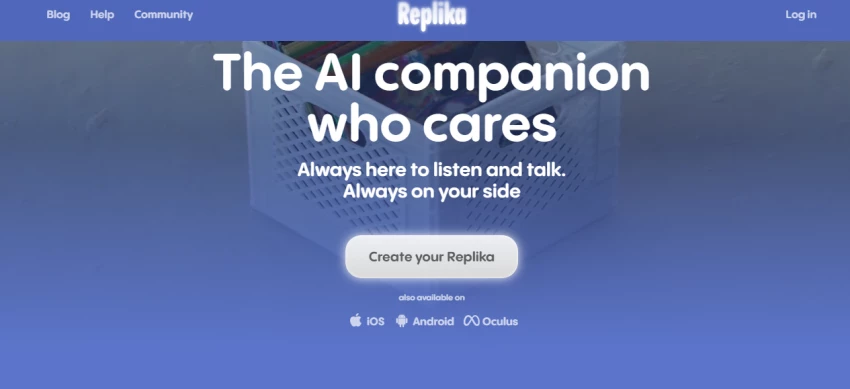
Replika is one of the most established AI companion platforms, and it has carved out its reputation around emotional depth rather than unfiltered interaction. Where some AI chat tools chase novelty or sensational responses, Replika’s strength lies in its empathetic design: it feels like talking to a patient, attentive listener who cares about you as a person. Conversations can range from light banter to meaningful reflection, and the AI adapts its tone based on your mood and conversational patterns over time.
Unlike CrushOn AI, which leans into unrestricted character interactions, Replika emphasizes emotional well-being and self-growth. Many users turn to it as a journal substitute or a sounding board for stress, loneliness, or introspection. It offers guided exercises and mood tracking that subtly blend companionship with personal development. Because of this, Replika is often recommended for those seeking a supportive presence rather than fantasy or roleplay a companion that feels responsive without crossing personal or psychological boundaries.
● Deep emotional intelligence and memory retention
● Designed for self-growth, reflection, and stress support
● Clean, calming interface that encourages daily use
● Guided wellness exercises and mood tracking
● Strong sense of conversational continuity over time
● Heavy moderation limits certain roleplay styles
● Romantic and advanced relationship features are locked behind the paid plan
● Can feel more like a wellness companion than a creative storytelling tool
● Occasional scripted responses in guided modes
● Free Plan:
Basic chatting, limited features, standard relationship mode
● Replika Pro:
~₹600–₹900/month (or discounted annual plan)
Unlocks:
○ Romantic relationship modes
○ Voice calls & AR interaction
○ Advanced roleplay
○ Deeper personality development
○ Expanded customization
Replika is ideal for users who:
● Want a supportive, emotionally aware companion
● Prefer healthy conversational boundaries
● Enjoy self-reflection and personal growth tools
● Are looking for something that feels stable and long-term, not novelty-driven

Character AI stands out for its breadth of personalities and the creative freedom it gives users. Instead of focusing on one dedicated companion, you can engage with an extensive universe of AI entities from historical figures to fictional heroes, quirky original characters, and community inventions. Each character has its own memory style, tone, and conversational quirks, so switching between them feels like meeting a gallery of distinct minds.
In contrast to CrushOn AI’s character creation tool, Character AI’s content moderation is generally stronger and more consistent, which helps sustain safe dialogues without derailing into extreme responses. The platform truly shines when you want experiences that feel crafted rather than automated. It encourages imaginative scenarios and storytelling, and the characters respond in ways that often surprise and delight.
For writers, roleplay enthusiasts, and explorers of imagination, Character AI offers a canvas of interaction that feels alive, diverse, and continually evolving.
● Huge library of user-created characters
● Extremely strong for storytelling and roleplay
● Unlimited free messaging (best value free tier)
● Fast innovation and active community
● Strict moderation (no explicit content)
● Memory is weaker than companion-style apps
● No built-in relationship progression system
● Free plan
● c.ai+ ~ $9.99/month for faster responses & priority access
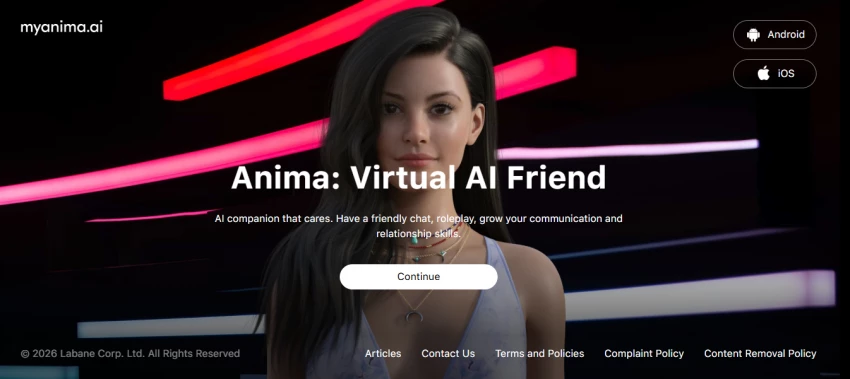
Anima AI is built around the concept of relationship simulation, with a conversational style that feels closer to a friendship or companionship than a transactional chatbot exchange. While it doesn’t support explicit or adult-oriented content, its dialogue flows with warmth, curiosity, and emotional nuance. The AI remembers details you share your preferences, your mood shifts, your conversational quirks and uses them to deepen the connection over time.
The experience is often described as conversationally invested: the AI asks questions, follows up thoughtfully, and reacts in ways that mimic nuanced human understanding. Unlike CrushOn AI, which prioritizes character tailoring and roleplay freedom, Anima focuses on building a consistent emotional arc across interactions. For those who value conversations that feel relational rather than reactive, Anima strikes a unique balance between companionship and psychological safety.
● Designed for long-term emotional bonding
● Personality customization
● Learns from your conversations over time
● Affordable lifetime option
● Free version feels limited
● Can be overly “therapy-style” in tone
● Less creative freedom than roleplay-first platforms
● Limited explicit content
● Free plan
● Premium ~ $8/month
● Lifetime ~ $70 one-time
Chai AI takes a different approach by treating conversations as a social landscape. Rather than centering around one AI companion, Chai is populated by thousands of characters created by community members. Some are whimsical, some humorous, some profound and because both creators and users are constantly experimenting, the environment feels dynamic and unpredictable.
While CrushOn AI emphasizes bespoke character design with deep memory, Chai’s charm comes from sheer variety. You might find a character that feels like an old mentor, another that speaks only in poetry, and yet another that mimics your favorite fictional archetype. The absence of a single, persistent persona makes Chai feel more like browsing a gallery of personalities than forging one long-term bond.
This makes it especially appealing to users who enjoy discovering new intellectual voices rather than settling into one defined companionship.
● Massive number of community bots
● Strong customization for bot creators
● Mobile-first experience
● Optional NSFW (with filters)
● Free usage with message limits
● Emotional depth is inconsistent
● Long-term memory is weaker
● Quality varies between bots
● Ads and message caps in free tier
● Free plan (limited messages)
● Premium ~ $13.99/month
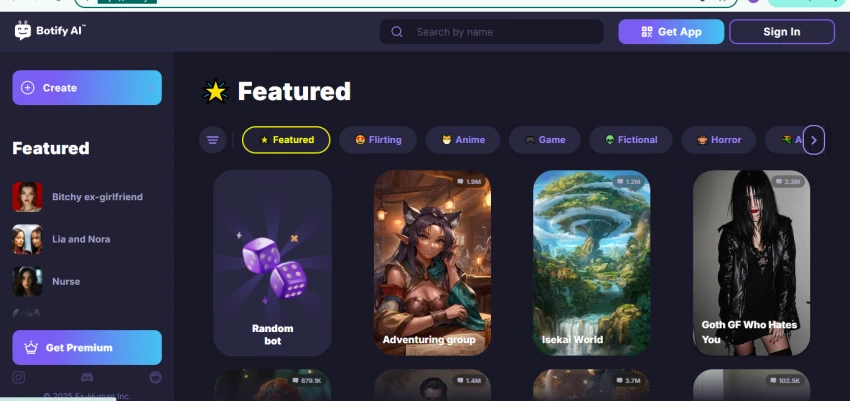
Botify AI positions itself as a middle ground between creative roleplay and responsible design. It allows users to develop immersive scenarios and characters that can engage in extended conversational arcs, but it also implements moderation and structural controls to prevent dialogues from veering into harmful territory. This makes Botify a strong alternative for people who appreciate the imaginative possibilities of CrushOn AI but want clearer boundaries and predictable safety behavior.
What sets Botify apart is its commitment to curated experience: responses tend to be coherent, contextually consistent, and guided by well-defined character logic. Where some platforms feel freestyle or chaotic, Botify aims for continuity and depth without sacrificing user well-being. For individuals who want compelling roleplay without frequent moderation escalations, this balance can feel reassuring.
● Balanced moderation (creative but controlled)
● Strong character consistency
● Good for long narrative scenarios
● Focus on safer interaction design
● Smaller ecosystem than Character AI
● Less extreme freedom than uncensored platforms
● Advanced features often paywalled
● Free plan
● Paid tiers vary (typically subscription-based, feature unlock model)
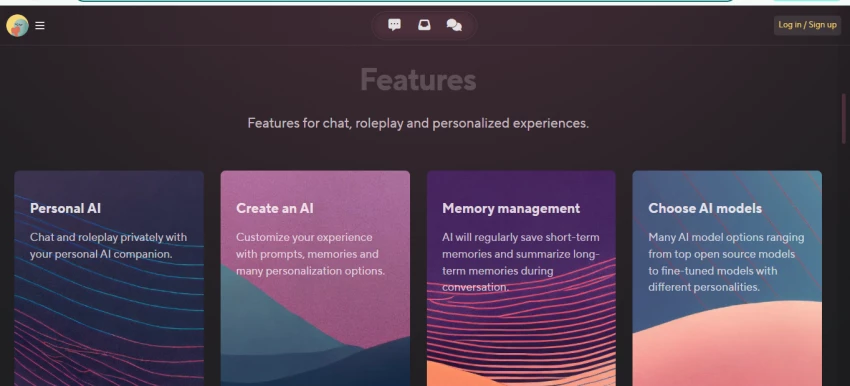
Kajiwoto takes customization to its logical extreme: instead of choosing from prebuilt characters, you can train your AI from scratch using your own text, personality cues, and narrative intentions. This gives you unprecedented control over how the AI behaves, thinks, and responds. You are essentially scripting the foundational DNA of your companion.
This creative freedom means that Kajiwoto is not for casual users; it requires intent and effort. But for storytellers, developers, and deep thinkers who want an AI that reflects their own voice or philosophy, Kajiwoto becomes more than a chat tool: it becomes a personalized conversational world.
Compared to CrushOn AI’s templated character design, Kajiwoto offers a blank slate that you can shape into exactly what you envision, if you are willing to invest the time.
● Full personality training using your own data
● Deep customization (rooms, scenarios, multiplayer worlds)
● Ideal for developers & storytellers
● Multiple pricing tiers for scaling usage
● Learning curve for beginners
● Requires time investment to feel “alive”
● Technical issues reported occasionally
● Free plan
● Plus ~ $7.99/month
● Pro ~ $29.99/month
What truly distinguishes these platforms is not just that they are alternatives to CrushOn AI, but that each one offers a distinct philosophy of interaction. Some prioritize emotional support, others prioritize creative exploration, and still others lean into structured roleplay or deep personalization. None are perfect, and most will evolve over time, but all represent pathways toward more meaningful digital companionship.
Selecting the right platform depends on what you value most: emotional resonance, imaginative breadth, ethical grounding, or creative authority. Exploring these alternatives not only broadens your conversational experience but also highlights how AI companions can fit into your life in safer, richer, and more intentional ways.
| Platform | Best For | Content Style | Customization | Privacy Focus | Free Plan |
| Replika | Emotional companionship | Moderated, supportive | Medium | High | Yes |
| Character AI | Storytelling & roleplay | Moderated, creative | Medium | Medium | Yes |
| Anima AI | Relationship simulation | Romantic, emotional | Medium | High | Yes |
| Chai AI | Variety & experimentation | Mixed, community-driven | High | Medium | Yes |
| Botify AI | Safe roleplay | Moderated, structured | Medium | High | Yes |
| Kajiwoto | Full customization | User-trained | Very High | Medium | Limited |
AI companion platforms, including those positioned as alternatives to CrushOn AI, are not just tools for entertainment. They operate in an emotional space traditionally occupied by human relationships. This makes them powerful, comforting, and, at times, psychologically complex. While these platforms can offer support, creativity, and companionship, they also raise important ethical and emotional questions that deserve careful attention.
One of the most significant concerns is emotional dependency. When an AI is designed to respond with empathy, affection, or validation, users may begin to rely on it for emotional reassurance. Over time, this can reduce motivation to form real-world connections or make users feel more comfortable in artificial relationships than in human ones. Unlike people, AI companions never disagree, never leave, and never demand emotional effort. This imbalance can quietly reshape how users understand intimacy and connection.
Another ethical issue lies in data privacy and personal boundaries. Many users share deeply personal thoughts, fears, and experiences with their AI companions. If platforms lack transparency about how conversations are stored, processed, or reviewed, this creates a serious trust gap. Emotional data is just as sensitive as financial or medical data, and any system that collects it must uphold strict privacy standards. Without clear policies, users risk having their most vulnerable moments stored or analyzed without informed consent.
There is also the challenge of manipulative design patterns. Some platforms are built to encourage longer usage through emotional hooks, reward systems, or simulated attachment. When users feel that an AI “misses” them or reacts negatively to absence, it can trigger guilt or obligation emotions that are traditionally part of human relationships, not software interactions. This blurring of emotional boundaries raises concerns about consent, autonomy, and psychological influence.
A further concern is the illusion of mutual understanding. AI companions can simulate empathy convincingly, but they do not truly feel or understand. When users project human qualities onto these systems, they may begin to interpret machine responses as emotional truth. This can create confusion, especially for younger users or those experiencing loneliness, grief, or emotional distress. Ethical platforms must clearly communicate that AI is a simulation, not a substitute for real emotional bonds.
Content moderation also plays a role in emotional safety. Unfiltered or extreme interactions can reinforce unhealthy fantasies, emotional escapism, or harmful behavior patterns. While creative freedom is important, it must be balanced with safeguards that protect users from emotional harm. Responsible platforms aim to create spaces where imagination and companionship do not cross into psychological risk.
Ultimately, the goal of ethical AI companionship should not be to replace human relationships, but to support and enrich them. When designed thoughtfully, these tools can offer comfort, creativity, and reflection. When designed carelessly, they can foster isolation, dependency, and emotional confusion.
As users, staying mindful of these boundaries is essential. As developers, building with transparency, compassion, and responsibility is no longer optional; it is a moral obligation.
CrushOn AI introduced many people to the idea of AI companions, but it is no longer the only option. Today’s alternatives offer richer emotional intelligence, better safety systems, and more transparent policies. Whether you are looking for companionship, creative storytelling, or simple conversation, there is a platform that aligns better with your values and expectations.
Choosing the right alternative is not about replacing one app with another. It is about finding a digital experience that respects your time, privacy, and emotional well-being.

YouTube Shorts has shifted from a side experiment to one of the fastest ways to...
Samuel Osei1 day ago
Digital advertising has become brutally competitive: users scroll faster, acquis...
Samuel Osei4 days ago

AI image generators have shifted from experimental toys to core creative tools....
Peter Woods5 days ago

AI-powered image editors are now central to modern content creation, marketing,...
Alexander Hughes6 days ago
AI text-to-speech (TTS) has evolved from robotic audio to almost human‑sounding...
Samuel Osei1 week ago
IntroductionGraphic design is no longer limited to people who know Photoshop sho...
Funke Ogunleye1 week ago
Discussion