
If your marketing currently lives in a chaotic mix of ChatGPT, Canva, random schedulers, and half‑finished Google Docs, Blaze AI claims to be the all‑in‑one fix: an AI‑powered platform that plans, writes, repurposes, and posts your content across channels while you get back to running the business. It pitches itself less as a generic AI writer and more as “AI that does marketing for you,” turning strategy into content and content into consistent distribution.
Blaze AI is an AI‑driven content and marketing automation platform that helps you plan, create, repurpose, and schedule content for social media, blogs, email, and basic landing pages from a single dashboard. It combines AI writing, brand voice modeling, calendar‑based scheduling, collaboration tools, and light analytics into one environment designed primarily for solo founders, small businesses, and lean marketing teams.
Unlike standalone AI writers, Blaze is built around ongoing campaigns and content operations. You define your themes, goals, and brand voice, then use Blaze to generate ideas, drafts, and platform‑specific posts and to publish them across your connected channels. For many users, it effectively replaces a patchwork of tools (AI writer + scheduler + partial analytics) with a single “content OS.”
| Aspect | Details |
| Type | AI content creation + marketing automation platform |
| Best for | Solopreneurs, small teams, agencies managing multiple brands |
| Content types | Social posts, blogs, emails, ads, short scripts, landing pages |
| Core value | Plan, write, repurpose, and schedule content from one system |
Getting started with Blaze AI is straightforward but benefits from doing a proper setup instead of rushing.
After sign‑up (often with a 7‑day free trial available), you’re guided to:
● Create a brand profile with your brand name, website, logo, colors, and tone preferences.
● Connect social accounts (e.g., Instagram, Facebook, LinkedIn, X, TikTok) and sometimes email or website tools.
● Optionally feed Blaze existing content (site copy, posts, emails) so it can learn your brand voice.
Once this is done, the main dashboard behaves like a hybrid of a social scheduler and a content studio. You see a calendar, content queues, and entry points for creating blog posts, social posts, emails, and campaigns. Most users can realistically go from sign‑up to first scheduled posts in under an hour if assets and logins are handy.
The learning curve is moderate: if you’ve used AI writers and scheduling tools before, the UX feels familiar, but there are enough modules (Autopilot, campaigns, repurposing, analytics) that you’ll want a couple of focused sessions to unlock everything.
Blaze’s biggest draw is social media automation. You define your posting frequency per channel, content pillars (e.g., educational, promotional, behind‑the‑scenes, testimonials), and key offers or campaigns. Blaze then generates a content calendar populated with post ideas mapped across days and platforms.
From there, you can:
● Open each slot to see AI‑generated drafts tailored to specific platforms.
● Adjust tone, regenerate, or lightly edit the copy.
● Schedule posts directly to connected accounts.
Posts are typically adapted by platform shorter, hook‑driven content for X, more descriptive captions for Instagram and Facebook, and more professional framing for LinkedIn. Users on Trustpilot frequently praise how Blaze “streamlines their social media strategies” and saves “hours of planning and brainstorming content.”
Autopilot works best when you bring clarity on who you’re talking to and what you want to say. If you expect Blaze to invent your positioning from scratch, outputs can feel generic; if you feed it clear positioning and let it handle the volume and formatting, it becomes incredibly effective.
Blaze also supports creating long‑form content such as blog posts and articles. You usually start with a topic or keyword, sometimes specifying audience and goal, then let Blaze generate an outline which you can refine before producing a full draft.
Strengths:
● Fast generation of structured articles with headings, subheadings, and intros.
● Decent coverage for educational, how‑to, and thought‑leadership pieces.
● Ability to turn outlines, bullet points, or transcripts into readable drafts.
Limitations:
● It isn’t a full SEO platform; you still need separate tools for deep keyword research, SERP analysis, and technical optimization.
● You’ll still have to inject unique insights, original data, and personal experience to stand out.
In other words, Blaze is a strong drafting and repurposing engine for long‑form, not a complete SEO strategy solution.
One of Blaze’s most practical features is its ability to repurpose content. You can feed it a blog post, video transcript, podcast summary, or long‑form document and ask it to create:
● Multiple social posts in different tones and formats.
● Email newsletter snippets or launch emails.
● Short video script ideas or hooks.
This turns “one hero asset per week” into a full week of content across channels, which is exactly what many founders and small teams need. Trustpilot reviewers often mention that Blaze helps them “stay consistent” and makes it easier to “streamline marketing” and “create content with consistency.”
While the repurposing is generally strong at preserving the core message, there can be occasional context gaps if the source material is highly nuanced. A quick human review still pays off, but you start far ahead of a blank page.
Blaze also supports:
● Single campaigns and multi‑email sequences (e.g., welcome series, nurture flows).
● Basic ad copy for platforms like Meta or Google.
● Simple landing page copy—headlines, subheadings, bullet benefits, CTAs.
These features become more powerful when combined with your existing email service provider or ad accounts through integrations. Blaze can give you multiple variations quickly, making it easier to A/B test hooks and messages, but you still need to supply clear offers and understand your funnel.
Blaze invests heavily in brand voice. During setup, it encourages you to:
● Provide links or text samples from your site and socials.
● Set tone sliders (e.g., casual vs formal, playful vs serious).
● Specify do’s and don’ts, such as forbidden phrases or style preferences.
Once trained, Blaze applies this voice across social posts, blogs, and emails, aiming for consistent tone and vocabulary. Many users praise how Blaze “stays aligned with my brand voice” and feels “natural” rather than robotic when generating content.
That said, no system is perfect. You can still get outputs that feel generic or slightly off, especially when the prompt is vague. The best results come when you:
● Feed Blaze strong input samples.
● Consistently edit and refine outputs (the AI learns from your behavior).
● Maintain a library of signature phrases, stories, and proof points you weave into content.
For teams, this brand voice layer is crucial, it gives everyone a common baseline and reduces the risk of wildly inconsistent tone across multiple contributors.
Blaze’s bigger promise is that it’s not just a writer, it’s an AI marketer that keeps your content engine running.
On the automation side, Blaze can:
● Handle recurring post types and campaigns (“Tip Tuesday,” “Customer Story Friday”).
● Schedule content across multiple channels from a single calendar.
● Help maintain consistent posting frequency even when you’re busy.
Analytics depend on your integrations but typically include:
● Post volume and schedule adherence.
● Reach and engagement metrics.
● In some cases, link performance and clicks.
Trustpilot reviewers frequently highlight that Blaze “has been great,” is “simple to use,” and lets them “all but forget about it” once configured, noting that it sends reminders when posts go live and keeps things on track.
However, the “AI marketer” label has limits. Blaze is not going to design complex multi‑stage funnels, advanced attribution models, or high‑granularity experiments for you. It excels as an execution engine and consistency machine, not as a full growth team in a box.
Blaze AI uses a tiered SaaS model with plans aimed at individuals, teams, and agencies, plus trials and discounts.
| Plan | Monthly (approx) | Annual (approx) | Users | Ideal for |
| Free | $0 | – | 1 | Testing core features, low volume |
| Creator | $34/mo | $312/yr | 1 | Solo creators & small brands |
| Pro | $49/mo | $444/yr | 1 | Power users with higher volume |
| Startup/Team | $79/mo | $708/yr | 3 | Small teams, 1–3 brands |
| Agency | $200/mo | $1,800/yr | 5 | Agencies managing multiple clients |
| Enterprise | Custom | $4,788+/yr | Custom | Larger organizations |
● Starting price: around $34/month for the Creator plan, often with 1 user, 1 brand kit, and limits like 30 scheduled posts and 100k AI words.
● Higher tiers increase user limits, brand count, content limits, and collaboration features.
● Free trial: typically a 7‑day free trial to test the platform before paying.
● Discounts: up to ~25% off on annual billing, and around 30% off for eligible non‑profits and educational institutions.
Value assessment:
● For solo founders and small businesses who would otherwise pay separately for an AI writer, scheduler, and light analytics, Blaze can be very cost‑effective.
● For agencies, the agency/enterprise tiers make sense if you standardize client workflows inside Blaze and actually use the collaboration/automation features.
● If you only use Blaze as a writer and still rely on other tools for scheduling and analytics, the value drops.
Any AI tool that touches your brand content and connected accounts needs to be judged on safety and transparency, not just features.
Blaze.ai’s privacy policy outlines how it collects and uses personal information, including account data, usage data, and content processed through the platform. It describes retention practices, data is kept only as long as necessary for the purposes stated, with deletion or anonymization once no longer needed, and secure storage of any backups until they can be deleted.
Blaze states that if data is anonymized so it can no longer be associated with you, it may be used indefinitely without further notice, which is a common practice among SaaS providers and analytics‑driven platforms.
Under GDPR, Blaze details the legal bases it relies on for processing personal information (e.g., performance of a contract, legitimate interests, consent). It provides a table specifying which legal basis applies to which processing purpose, giving users more transparency into why their data is being processed and on what grounds.
The policy notes that Blaze does not engage in automated decision‑making or profiling that produces legal or similarly significant effects, which is relevant for users concerned about automated judgments impacting them directly.
On security, Blaze states it has procedures to handle personal data breaches and to work with regulators, and in certain circumstances it will notify affected users. While specific technical details (encryption standards, certifications) are not all spelled out on this main policy page, the presence of explicit breach‑response procedures and regulator‑coordination language is a positive sign for serious users.
If you’re in highly regulated industries (e.g., healthcare, finance), you should still perform your own due diligence:
● Review Blaze’s latest security documentation and any available certifications.
● Check what commitments are made regarding data location, sub‑processors, and third‑party AI providers.
● Confirm whether content is used for training models or only for real‑time generation if this matters to you.
Overall, Blaze provides a reasonably detailed privacy policy explaining what data it collects, how long it keeps it, and the legal bases for processing, plus clear statements on security procedures and the absence of impactful automated decision‑making. For most SMBs, this level of transparency will be satisfactory, but data‑sensitive enterprises should dig deeper and may consider a DPA (Data Processing Agreement) as part of procurement.
Trustpilot is one of the most telling sources of real‑world sentiment for Blaze AI.
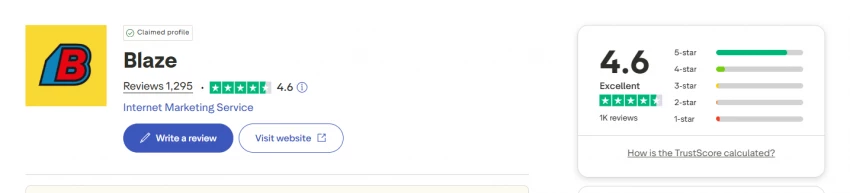
Blaze has over 1,100–1,200 reviews on Trustpilot with a score around 4.6 out of 5, indicating a strong overall satisfaction level. Blaze is categorized under “Internet marketing service,” and recent review summaries describe reviewers as “really happy” or having had a “great experience” with the platform.
From the analyzed reviews, several consistent praises emerge:
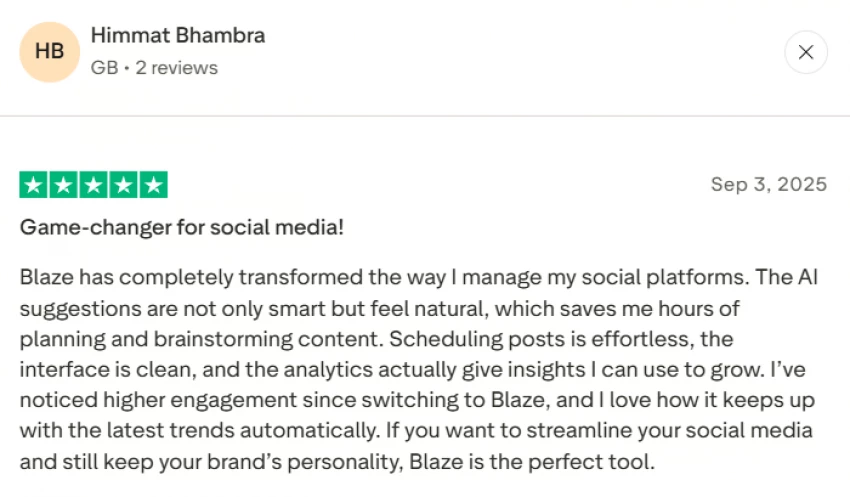
1. Time savings and productivity: Users repeatedly call Blaze a “game‑changer for productivity,” stating that it has “freed up so much time” and lets them focus on core work while Blaze handles content.
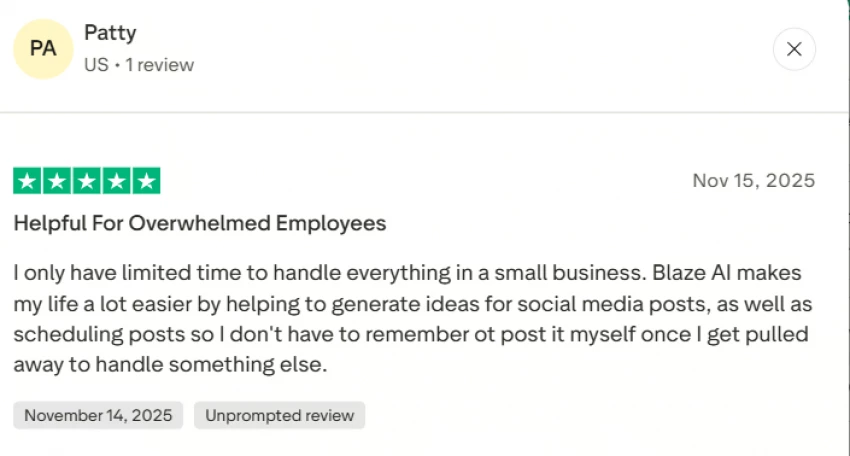
2. Ease of use and onboarding
Many reviewers say Blaze is “simple to use” and easy to get started with after an initial setup, especially for non‑technical founders or creators.
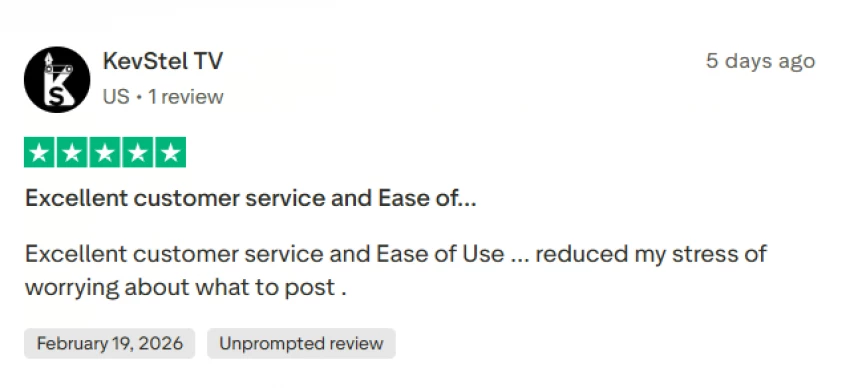
3. Content quality and brand alignment
Users often mention that Blaze’s AI suggestions feel “natural” and that content stays aligned with their brand voice, giving them confidence to publish more frequently.
4. Social media automation and consistency
Customers highlight how Blaze “streamlines their social media strategies,” suggests content ideas and posting times, and makes consistent posting across platforms achievable.
One reviewer, for example, noted that once everything is set up, they can “let it do its job and all but forget about it,” with Blaze sending reminders each time it posts, and described the content as “clean and professional” and “definitely worth the investment.”
Trustpilot reviews also surface some recurring issues:
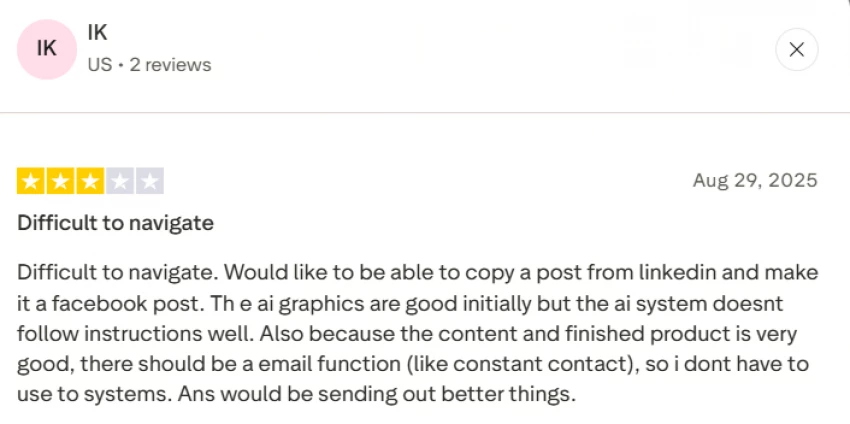
1. Navigation and UX quirks: Some users find Blaze “difficult to navigate” and mention that certain actions like copying a post from LinkedIn to Facebook are not as smooth as they’d like.
2. AI limitations and responsiveness: A subset of reviewers say the “functionality is blah” for their needs, asking for better site speed and “better and faster AI,” indicating that performance and responsiveness can vary by expectation and use case.
3. Graphics and instruction following: A few users note that while the AI graphics are initially good, the system “doesn’t follow instructions well” over time, suggesting room for improvement in visual generation and prompt adherence.
4. Not a perfect fit for everyone: Some reviews come from users who ultimately “cancelled service,” concluding Blaze wasn’t right for them often because they needed more advanced functionality or had higher expectations from the automation layer.
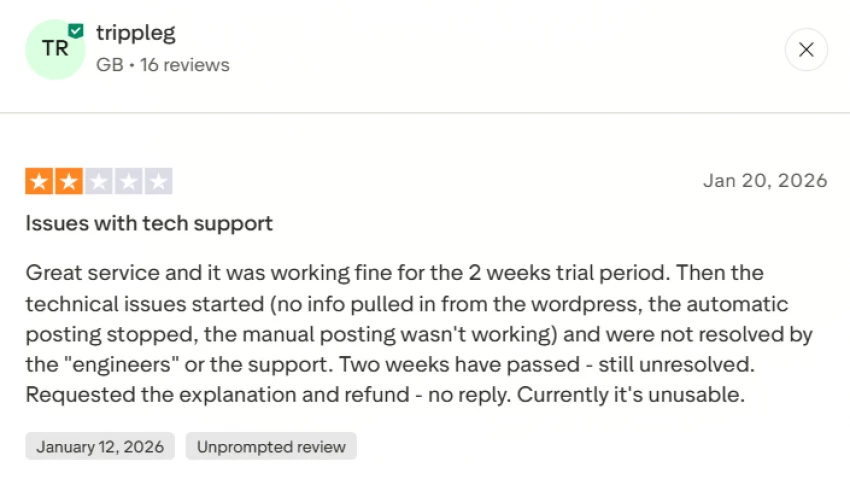
The Trustpilot picture is clear: most small businesses and creators feel Blaze delivers on its core promise, saving time and simplifying content management while a minority of more demanding or niche users find limitations in navigation, AI responsiveness, or advanced features.
In a crowded market of AI content and marketing tools, Blaze’s main competitors include:
● Pure AI writers (e.g., Jasper): strong for long‑form and templates but require separate scheduling and analytics tools.
● Agent‑style marketing automation tools (e.g., Sintra, Needle): deeper in workflows and orchestration but more complex and less approachable for small teams.
● Traditional schedulers (e.g., Hootsuite‑like tools): great for scheduling and analytics but no integrated AI content creation.
Blaze’s differentiator is the combination of AI writing + brand voice + scheduling + basic analytics in one interface, especially attractive to solo founders and small teams who don’t want to manage multiple subscriptions and workflows.
If your priority is deep SEO or hyper‑complex funnel automation, a specialized stack will beat Blaze. If your main problem is “I need to produce and publish more good content, more consistently, with less mental load,” Blaze lands in a very comfortable sweet spot.
Blaze AI is a strong fit if you are:
● A solo founder, creator, or consultant who wants a reliable, semi‑automated content engine.
● A small business that needs to be visible and consistent on social and via email but lacks a full marketing team.
● A small agency looking for a standardized way to produce and schedule content across clients.
Blaze may be less suitable if you are:
● An enterprise with complex multi‑team processes and rigid compliance needs (though Enterprise plans exist, you’ll need deeper due diligence).
● An SEO‑first publisher where ranking on difficult keywords is the primary goal.
● A growth team deeply invested in advanced analytics, experimentation, and custom automation.
Blaze AI is best seen as a marketing execution and consistency engine rather than a fully autonomous CMO. It won’t replace the need to understand your market or craft a real strategy, but it can dramatically reduce the friction of executing that strategy week after week.
If you bring clear positioning and basic content ideas, Blaze will turn them into structured posts, blogs, and emails. It will keep them aligned with your brand voice and schedule them across your channels to help you post more consistently with less manual effort.

Late at night, after the usual AI companion ads blur together, PepHop AI shows u...
Funke Ogunleye1 day ago

Imagine you open a new tab, type “opendream.ai”, and instead of being greeted by...
Samuel Osei2 days ago

Grubby AI is one of those tools that only exists because of a very 2025 problem:...
Funke Ogunleye2 days ago

Meet Muke AIMuke AI is an AI‑powered image manipulation suite best known for two...
Sandra Campos3 days ago

Janitor AI doesn’t feel like “a chatbot platform.”It feels like walking into a l...
Sandra Campos4 days ago

MyImg AI is one of the most aggressive NSFW‑focused AI image and video editors o...
Samuel Osei5 days ago
Discussion