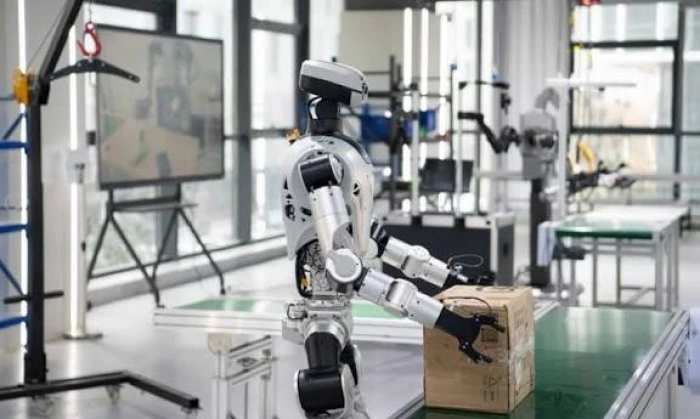
China's humanoid robots are stepping out of the lab and onto the factory floor, and Wall Street is taking notice. This week, Morgan Stanley sharply raised how many of these machines it thinks China will ship this year. The reason is simple: the move from flashy product demos to real, paying customers is happening faster than almost anyone predicted.
Morgan Stanley now expects China to ship about 50,000 humanoid robots in 2026. That is nearly twice what the bank forecast just a few months earlier.
The growth does not stop there. The bank values China's humanoid robot market at roughly $2 billion this year and expects it to reach about $15 billion by 2030. By the end of the decade, yearly shipments could hit 446,000 units. That kind of climb works out to a growth rate of more than 100 percent a year.
One detail is worth keeping in mind. These figures count only robots sold to outside buyers. They leave out test models, units handed over for early trials, and machines the manufacturers keep for their own use. In other words, the numbers reflect real commercial demand, not internal experiments.
What makes this update striking is how often the bank has had to revise it. Morgan Stanley started the year expecting around 14,000 robots. It then bumped that to 28,000, and now it has raised the figure again to roughly 50,000. That is two doublings in a matter of months.
The pace becomes clearer with a quick comparison. China shipped an estimated 12,000 humanoid robots in 2025. Hitting 50,000 this year would mean growth of about 133 percent in just twelve months.
The bank's industrials analyst, Sheng Zhong, points to three forces driving the upgrade. Each one is reinforcing the others.
Beijing has made "embodied AI" a national priority for the next five years. The term simply means artificial intelligence placed inside a physical machine, such as a robot that can see, move, and handle objects. To push the field forward, local governments are being encouraged to hand young companies cheap land and office space, while banks have been told to offer them friendly loan terms. The effect is a crowded, fast-moving home market full of competitors racing to scale up.
Demand is no longer hypothetical. One of the biggest signals came from State Grid, the giant state-owned power company, which placed an order worth about 6.8 billion yuan, or close to $1 billion. The deal covered hundreds of humanoid robots plus thousands of other robotic models.
Delivery firms are moving too. SF Express and China Post have started using humanoid robots from the maker Robotera for repetitive work like sorting and moving packages. Morgan Stanley expects many of these early trials, which usually take a few months to prove out, to turn into much larger orders in the second half of the year.
Costs are falling as parts become cheaper and factories run at higher volumes. That matters because lower prices make it far easier to justify buying a robot in the first place. The same pattern, where prices drop and then adoption takes off, has played out before in other technologies.
The types of robots being sold are changing as well. Full-size humanoids, the larger and more capable machines, are expected to take up a growing share of shipments. Their slice of the market could rise from about 30 percent this year to roughly half in 2027, and as much as 70 percent the year after that.
Some of the clearest winners are not the robot makers themselves but the companies that supply their parts. Morgan Stanley highlighted Leaderdrive, a precision component maker based in Suzhou, as a standout. The bank lifted its twelve-month price target on the stock to 464 yuan from 269 yuan.
Leaderdrive builds reducers, a key part that controls how a robot's joints move, and it already supplies major Chinese robot builders such as Ubtech and Galbot. The bank thinks the company could capture roughly 40 percent of the global market this year. To keep up with demand, Leaderdrive has been ramping production hard, raising its monthly capacity from about 50,000 units early in the year toward a target of well over 100,000 by year end.
The ambition reaches beyond China's borders. Seer Intelligent, a Shanghai-based robotics company that recently started trading in Hong Kong, has been selling abroad since 2021. A meaningful portion of its revenue now comes from dozens of countries outside China, a sign that these companies are not content to stay in their home market.
The rest of the year is packed with events that could move the sector. A series of major artificial intelligence and robotics conferences are scheduled through the summer, and several Chinese manufacturers are preparing to go public. Global rivals are part of the picture too, with new hardware expected from companies such as Tesla that could shape how investors feel about the whole industry.
The direction is hard to miss. China is pushing humanoid robots out of the demo stage and into warehouses, factories, and stores, backed by government support, real orders, and falling costs. The big open question is whether the machines can reliably handle the messy, unpredictable tasks of the real world at large scale. For now, though, the momentum is clearly pointing toward everyday commercial use.

Seedance 2.5, MiniMax H3, and Wan 3 all promise something bigger than the old pr...
Grace Howard1 month ago

Anthropic’s chatbot is attracting more consumer attention, but ChatGPT still rem...
Samuel Osei3 months ago

Meta is testing a redesigned Creator Studio app with AI tools for content planni...
Benjamin Clark3 months ago

Social media platforms are beginning to give users more direct control over the...
Peter Woods3 months ago

Google has officially released Android 17, bringing a wider set of multitasking...
Noura Belkacem3 months ago

NewCore has emerged from stealth with $66 million in funding and a new identity...
Peter Woods3 months ago
Discussion