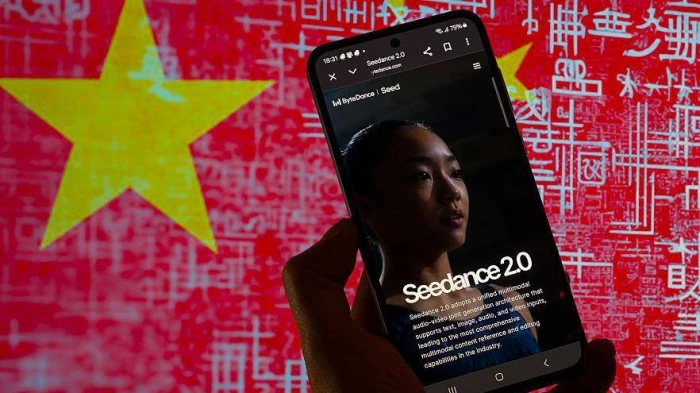
A powerful new Chinese artificial intelligence video app is igniting alarm across Hollywood, as studios, unions and creators warn it could upend the economics and ethics of the film industry. The tool, called Seedance 2.0 and developed by ByteDance, the company behind TikTok, can generate short, cinema‑style clips with realistic characters, motion, sound effects and dialogue from only a few lines of text.
Seedance 2.0 is a text‑to‑video model that lets users type prompts such as “Tom Cruise fighting Brad Pitt on a rooftop at sunset” and receive a fully rendered, high‑resolution sequence that looks like a scene from a blockbuster film. Viral samples circulating online show AI‑generated versions of Spider‑Man, Deadpool and other well‑known characters performing new scenes that were never produced by their studios. Industry analysts note that the tool combines visual generation, voice synthesis and sound design in a single pipeline, bringing capabilities closer to what only large studios could achieve just a few years ago.
Major studios and rights holders say Seedance 2.0 has crossed a red line by enabling mass creation of realistic “deepfake” clips that appear to use protected characters, franchises and the likenesses of famous actors without permission. In the days after its latest update, mock fight scenes featuring AI versions of Tom Cruise and Brad Pitt, alternative endings to popular series and parody scenes involving superhero IP spread rapidly across social platforms. The Motion Picture Association and companies such as Disney have raised copyright concerns, warning that viewers could easily confuse fan‑made AI clips with official content, diluting brands and undermining licensing revenues.
Legal experts say Seedance 2.0 sits at the center of unresolved questions over how existing copyright and portrait‑rights laws apply to AI‑generated media. While ByteDance has said it will strengthen safeguards to limit copyright misuse, including filters designed to detect and block obvious IP violations, rights holders argue that early viral clips show enforcement is still struggling to keep pace with user behavior. Deepfake concerns extend beyond studios: past controversies around Chinese apps like Zao demonstrated how easily users can insert themselves, or others, into film scenes, raising privacy and consent issues when faces are reused without clear permission.
The backlash comes as Chinese regulators try to tighten control over AI‑generated content at home, even as local firms push the technology’s boundaries abroad. The Cyberspace Administration of China has recently cracked down on AI‑powered impersonations of celebrities used in live‑streams and short videos, removing thousands of non‑compliant posts and dealing with more than 11,000 accounts accused of misusing public figures’ likenesses. China’s “Artificial Intelligence Generated Content Labeling Measures,” in force since September, require AI‑generated material to be clearly marked, but officials and platforms admit that bad actors can still hide or remove watermarks and distribute clips via multiple accounts.
For Hollywood’s creative workforce, Seedance 2.0 has revived anxieties that fueled the 2023 strikes by actors and writers over AI. Unions representing performers and screenwriters warn that as tools like this improve, studios or independent producers could rely more heavily on synthetic actors, AI‑generated extras and machine‑written scenes, eroding traditional employment and residual income streams. Veteran filmmakers and critics caution that while AI may become a powerful production aid, unchecked deployment risks flooding the market with cheap, derivative content and weakening the bargaining power of human talent.
ByteDance has said it does not intend Seedance 2.0 to be used for copyright infringement and is working on additional controls to prevent misuse of famous IP and celebrity likenesses. However, American studios and trade groups remain wary, arguing that once high‑quality AI video tools are released at scale, they are almost impossible to fully contain, and that platforms should assume stronger legal responsibility for moderating what users create and share. Behind the scenes, major entertainment companies are reportedly exploring both legal and technical responses, from takedown campaigns and new licensing frameworks to watermarking standards that could help distinguish human‑shot footage from AI‑synthesized scenes.
The emergence of Seedance 2.0 has also become part of a broader debate over technological competition between China and the United States. Policymakers and industry figures in Washington see the app as evidence that Chinese companies are rapidly catching up with, and in some areas surpassing, Western rivals in generative video, a field with both commercial and geopolitical implications. As regulators on both sides consider rules for AI, Seedance 2.0 is likely to be cited in arguments over export controls, data security and whether foreign‑developed media tools should face additional scrutiny in the US market.
Anthropic has accused three prominent Chinese AI companies of systematically “mi...
Sandra Campos5 days ago
In what might be the most unexpected AI benchmarking milestone of 2026, Elon Mus...
Peter Woods1 week ago
The Legal Industry Didn’t Suddenly “Go AI” — It Was Forced ThereIn 2026, AI in l...
John Nyarko1 week ago
AI talking head tools have made it possible to create studio‑style presenter vid...
Ina Gupta2 weeks ago
Leetcode prep is crowded with tools that promise shortcuts, streaks, and “guaran...
Ina Gupta2 weeks ago
If you searched “Gening AI”, you probably ran into a site/app that promises some...
Ina Gupta1 month ago
Discussion