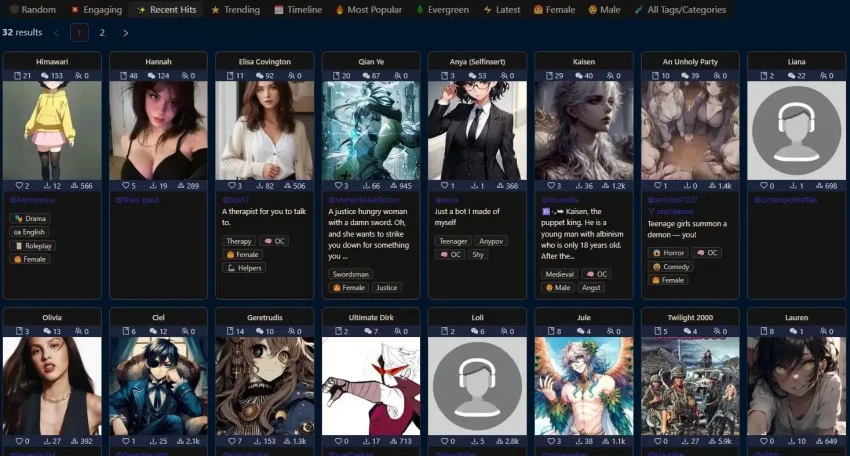
Chub Venus AI, accessible at venus.chub.ai, represents the interactive layer of the broader Chub.ai platform, which provides API-based character chat interfaces. It evolved from CharacterHub.org, an earlier repository that only hosted static character data without live interactions.
When CharacterHub’s original site was discontinued, developers released its open-source components. Those materials became the foundation for Venus, Chub’s chat-focused frontend. Over time, both projects consolidated into one domain, forming the current ecosystem recognized as Chub Venus AI.
Community archives and technical threads confirm that Venus now serves as the main entry point for Chub’s character library. Legacy forks still circulate, occasionally causing confusion for users unsure which version is official.
Venus Chub functions as a browser-based interface for interacting with customizable AI characters. The environment supports over 60,000 user-created personas built using metadata templates that include descriptive tags, dialogue examples, emotional traits, and memory contexts.
Users can connect their own API keys from third-party language model providers such as OpenAI, Anthropic, or Mistral, depending on preference and resource availability. Free-tier users operate on communal nodes with strict limitations.
Core modules include:
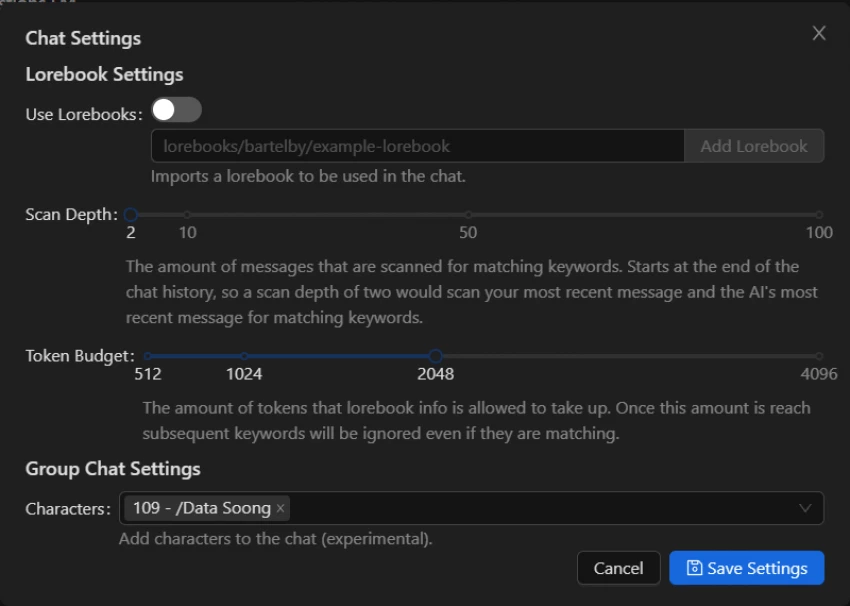
● Lorebooks: Databases of contextual details used to preserve narrative consistency.
● Prompt Macros: Custom commands that modify dialogue structure during runtime.
● Chat Trees: Predefined branching logic for scenario variation.
● Group Sessions: Multiple characters interacting simultaneously under user control.
This modular design makes Venus suitable for long-term story simulations but also vulnerable to heavy server load, throttling, and API dependency errors.
Venus AI’s open framework prioritizes customization over speed. Free-tier users often face throttling, delayed responses, and server-side quota exhaustion. Reported latency averages from 30 seconds to several minutes per message during peak hours.
Those who subscribe to priority plans or integrate paid APIs experience smoother exchanges and unrestricted context length. However, this configuration demands technical literacy. Setting up API credentials, adjusting token limits, and resolving prompt errors require familiarity with model parameters.
Users frequently describe the learning curve as steep, especially for those transitioning from filtered systems like Character.AI, which automate most backend settings.
Feedback across Reddit and specialized forums indicates polarized user sentiment. Experienced roleplayers and developers appreciate Venus for its freedom from censorship, advanced memory behavior, and compatibility with multiple models.
However, new users express frustration over inconsistent reliability, long wait times, and a user interface that occasionally breaks after updates.
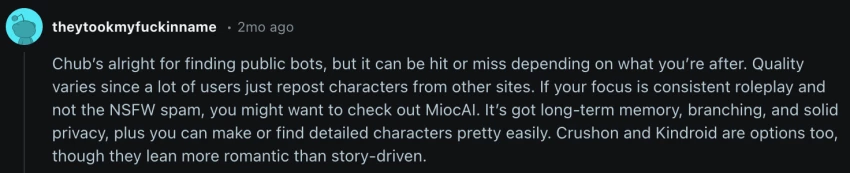
A Reddit user summarized the mixed impression:
“Chub’s alright for finding public bots, but it can be hit or miss depending on what you’re after. Quality varies since a lot of users just repost characters from other sites.”
Another participant reported:
“If you don’t like JanitorAI, you won’t like Chub either. The limitations feel similar.”
A recurring theme is content imbalance. Many public bots focus on explicit interactions, creating difficulties for those seeking neutral or story-based roleplay. Others highlight that while the uncensored model improves freedom, it also reduces consistency, leading to unstable role continuity.
| Dimension | Strengths | Weaknesses |
| Flexibility | Customizable characters, macros, and lorebooks | Requires manual setup; minimal tutorials |
| Content Freedom | Unrestricted prompts; multiple API models | Exposure to harmful or illegal content |
| Performance | Strong with paid APIs | Slow, error-prone for free users |
| Community | 60k+ shared characters | Many duplicates, reposted assets |
| Ethical Safeguards | None (by design) | Risk of abuse and policy violations |
The absence of moderation, while intentional, places full responsibility on the user. This structure appeals to developers and advanced creators but alienates casual participants who expect built-in safety filters.
Venus AI’s permissive structure has sparked ethical and legal scrutiny. Its lack of restrictions enables the creation of any scenario, including those replicating harmful or illegal contexts. Several monitoring blogs have raised concerns about simulated exploitation content.
The platform’s founder publicly defended this policy, comparing the system to a fan-fiction archive where users assume accountability for what they create. Critics counter that the analogy fails under generative automation, where models may replicate explicit material unintentionally.
In addition to moral debates, Venus has faced technical instability. Documented DDoS attacks temporarily disrupted access to Chub servers throughout 2024 and 2025. Users also report intermittent data loss in stored chat sessions after updates.
Unofficial mirrors and clones of Venus further complicate the situation. Many replicate the interface without authorization, introducing phishing risks.
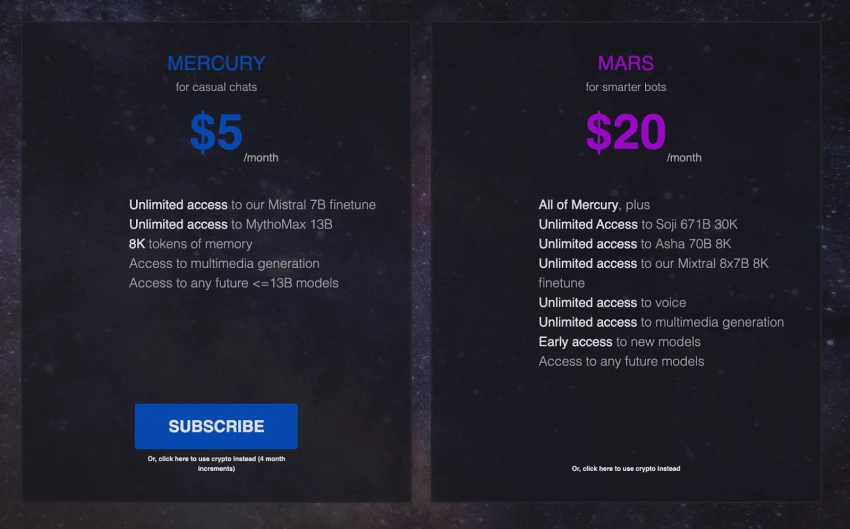
Venus Chub maintains a hybrid economic structure:
● Free tier with strict quotas and queueing delays.
● Entry-level paid plans (~$5/month) for faster response allocation.
● Direct API integrations where the cost is handled externally by the user through OpenAI, Anthropic, or other providers.
Because the architecture offloads computation to third-party models, operational costs depend on external API usage, not the Chub platform itself. Users must monitor their token consumption carefully to prevent unexpected billing.
Reddit and GitHub threads list recurring operational challenges:
1. Quota loss through errors, where failed requests still consume tokens.
2. Prompt degradation after updates, leading to incoherent responses.
3. Mobile compatibility gaps, where editing tools malfunction on Android browsers.
4. Overwritten character data during synchronization events.
Advanced users mitigate these problems through local prompt backups and manual reconfigurations. However, most note that such workarounds reduce usability for non-technical participants.
Chub Venus AI’s defining feature—its unfiltered nature—is also its primary liability. Without moderation, harmful or illegal content can appear in shared libraries.
Ethical analysts describe this as a “self-regulated creative ecosystem”, but the approach introduces unpredictable exposure, especially for minors or sensitive users.
From a regulatory perspective, the absence of centralized control shifts compliance responsibilities entirely to individuals. This mirrors open-source hosting environments rather than consumer-facing platforms.
Chub Venus continues to attract technically skilled users who prioritize control over moderation. The community remains active in developing custom scripts, shared characters, and optimization plugins.
Roadmaps released by affiliated developers mention upgrades in memory consistency, integration with new multimodal APIs, and mobile redesigns focused on accessibility.
Yet, the platform’s sustainability depends on balancing creative freedom with functional stability. Without structural moderation or better onboarding, adoption among mainstream audiences will likely remain limited to enthusiasts familiar with LLM frameworks.
Chub Venus AI represents a transitional phase in AI roleplay platforms—one that bridges open-source flexibility with high technical demand. Its openness invites innovation but also reproduces the same vulnerabilities observed in early unmoderated internet systems: unreliable infrastructure, blurred accountability, and fragmented clones.
Ultimately, the platform embodies a broader dilemma in generative AI: the tradeoff between freedom and governance. For Chub Venus, that tension defines both its strength and its ongoing instability.

Late at night, after the usual AI companion ads blur together, PepHop AI shows u...
Funke Ogunleye1 day ago

Imagine you open a new tab, type “opendream.ai”, and instead of being greeted by...
Samuel Osei2 days ago

Grubby AI is one of those tools that only exists because of a very 2025 problem:...
Funke Ogunleye2 days ago
Meet Muke AIMuke AI is an AI‑powered image manipulation suite best known for two...
Sandra Campos3 days ago

If your marketing currently lives in a chaotic mix of ChatGPT, Canva, random sch...
Samuel Osei3 days ago
Janitor AI doesn’t feel like “a chatbot platform.”It feels like walking into a l...
Sandra Campos4 days ago
Discussion