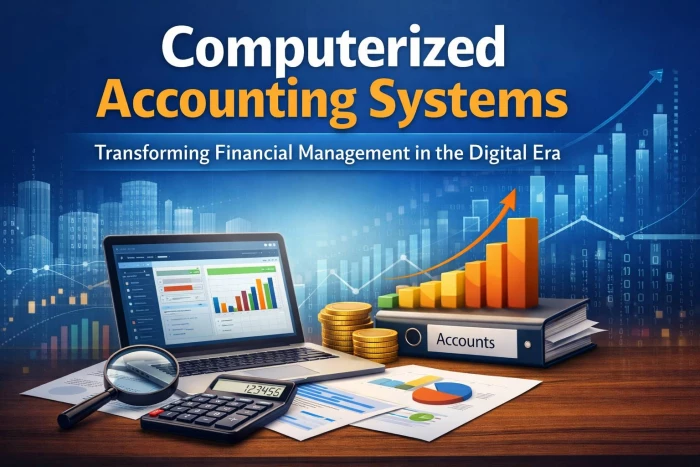
As businesses grow more data-driven, traditional pen-and-paper accounting struggles to keep pace with modern demands. Accuracy, speed, compliance, and real-time insights are no longer optional; they are essential. This shift has made Computerized Accounting Systems (CAS) a cornerstone of efficient financial management across industries. By combining accounting principles with digital automation, these systems redefine how financial information is recorded, processed, and analyzed.
A Computerized Accounting System refers to the use of specialized software to record, store, and manage financial transactions electronically. While the fundamental accounting concepts such as double-entry bookkeeping, debit and credit rules remain unchanged, the method of execution becomes faster, more accurate, and significantly more reliable.
Consider a growing e-commerce business managing hundreds of daily transactions. Manually tracking sales, returns, taxes, and inventory would be nearly impossible. A computerized system seamlessly integrates all these activities, ensuring that every transaction is reflected across the books in real time.
One of the most powerful features of computerized accounting is end-to-end automation. Once a transaction is entered, the system automatically updates related accounts, eliminating repetitive tasks such as posting to ledgers or balancing trial accounts. This automation not only saves time but also ensures uniformity across financial records.
Another defining feature is real-time financial visibility. Business owners and accountants can instantly access updated profit figures, cash positions, outstanding receivables, or liabilities. For example, a finance manager can quickly assess whether the company has sufficient cash flow to invest in new inventory.
Computerized accounting systems also excel in data accuracy and validation. Built-in checks help reduce inconsistencies and calculation errors, which are common in manual accounting. Even complex computations like tax calculations or depreciation schedules are handled effortlessly.
Secure digital storage and backups further strengthen these systems. Financial data can be stored locally or on cloud platforms, protecting it from physical damage and enabling easy recovery in case of system failures.
In addition, these systems offer customized and analytical reporting. Users can generate financial statements, tax reports, or performance summaries tailored to business requirements, making analysis both faster and more meaningful.
The most immediate advantage of a computerized accounting system is significant time efficiency. Tasks that once took days such as preparing final accounts or reconciling ledgers can now be completed in minutes.
Another major benefit is enhanced accuracy and reliability. Since calculations and postings are automated, the margin for human error is drastically reduced, leading to more dependable financial statements.
Computerized systems also support better financial planning and decision-making. With instant access to accurate data, businesses can monitor expenses, evaluate profitability, and respond quickly to financial challenges.
From a compliance perspective, these systems simplify taxation and regulatory adherence. Many accounting software solutions are designed to align with GST and other statutory requirements, reducing the risk of penalties or reporting errors.
Scalability is another noteworthy advantage. As a business expands, the accounting system can handle increased transaction volumes without requiring a complete overhaul of the accounting structure.
Despite their strengths, computerized accounting systems are not without limitations. The initial investment including software licensing, hardware, and training can be a barrier for very small businesses.
There is also a strong dependence on technology and infrastructure. Power outages, software bugs, or system crashes can temporarily disrupt accounting operations, making backups and technical support essential.
Data security and privacy risks must also be considered. Without proper access controls, encryption, and cybersecurity measures, sensitive financial information may be vulnerable to unauthorized access.
Additionally, while the system reduces calculation errors, it cannot eliminate data entry mistakes. Incorrect inputs can still affect multiple reports, emphasizing the need for skilled users and regular reviews.
Selecting the right computerized accounting system is a crucial decision because it directly affects how smoothly a business manages its finances. A well-chosen system simplifies daily accounting tasks, improves accuracy, and supports long-term growth, while the wrong choice can create confusion, inefficiency, and unnecessary costs. Therefore, the selection should always be based on actual business needs rather than trends or popularity.
The first and most important factor is the size and nature of the business. A small retail store or freelance professional does not require the same level of complexity as a large manufacturing or multinational company. For example, a small business dealing with limited daily transactions may benefit from a simple and easy-to-use system like TallyPrime or Zoho Books. In contrast, a large organization with multiple departments and branches may need an advanced system such as SAP or Oracle NetSuite to handle complex financial operations.
An accounting system should be user-friendly and intuitive, especially for users who may not have a strong accounting background. Software that is too complex can slow down work and increase the chances of errors. Ideally, the system should offer clear navigation, simple data entry processes, and helpful tutorials or support. A system that employees can learn quickly saves time and reduces training costs.
Another critical consideration is statutory and tax compliance. In countries like India, businesses must comply with GST and other regulatory requirements. Choosing software that automatically calculates taxes, generates compliance-ready reports, and stays updated with changing regulations can significantly reduce legal risks and stress during audits or tax filings.
A good computerized accounting system should not only meet current needs but also support future expansion. As a business grows, transaction volumes increase, and additional features such as payroll, inventory management, or multi-branch accounting may become necessary. Selecting scalable software ensures that the business does not need to switch systems frequently, which can be costly and time-consuming.
Financial data is highly sensitive, making data security a non-negotiable factor. The chosen system should offer strong security measures such as password protection, user access controls, and data encryption. Regular backup options either cloud-based or local are equally important to prevent data loss due to technical failures or cyber threats.
While cost is an important factor, it should be evaluated in terms of value rather than price alone. Some systems may appear inexpensive initially but lack essential features or support, leading to additional expenses later. On the other hand, a slightly higher investment in reliable software can deliver long-term efficiency, accuracy, and peace of mind.
Businesses should also decide whether they prefer a cloud-based or desktop-based accounting system. Cloud-based systems allow access from anywhere and are ideal for remote work or multi-location businesses. Desktop-based systems, however, may be preferred by businesses that require offline access or have strict data control policies.
Reliable technical support and regular software updates play a vital role in the smooth functioning of a computerized accounting system. Software providers that offer timely updates, customer assistance, and troubleshooting resources ensure uninterrupted operations and compliance with evolving standards.
Choosing the right computerized accounting system is not about selecting the most popular or advanced software, it is about selecting the most suitable one. When the system aligns with business requirements, user capabilities, and future goals, it becomes a powerful asset rather than just a tool. Taking time to evaluate options carefully ensures long-term efficiency, accuracy, and confidence in financial management.
In my view, a computerized accounting system is not merely a technological upgrade it is a strategic investment in clarity, control, and confidence. While the transition from manual to computerized accounting may feel challenging at first, the long-term benefits far outweigh the initial effort. When used thoughtfully, these systems do more than maintain records; they empower businesses to understand their financial health and make smarter, forward-looking decisions.
In an era where data drives success, computerized accounting stands as an indispensable partner in sustainable business growth.

YouTube Shorts has shifted from a side experiment to one of the fastest ways to...
Samuel Osei1 day ago

Digital advertising has become brutally competitive: users scroll faster, acquis...
Samuel Osei4 days ago

AI image generators have shifted from experimental toys to core creative tools....
Peter Woods5 days ago
AI-powered image editors are now central to modern content creation, marketing,...
Alexander Hughes6 days ago

AI text-to-speech (TTS) has evolved from robotic audio to almost human‑sounding...
Samuel Osei1 week ago

IntroductionGraphic design is no longer limited to people who know Photoshop sho...
Funke Ogunleye1 week ago
Discussion