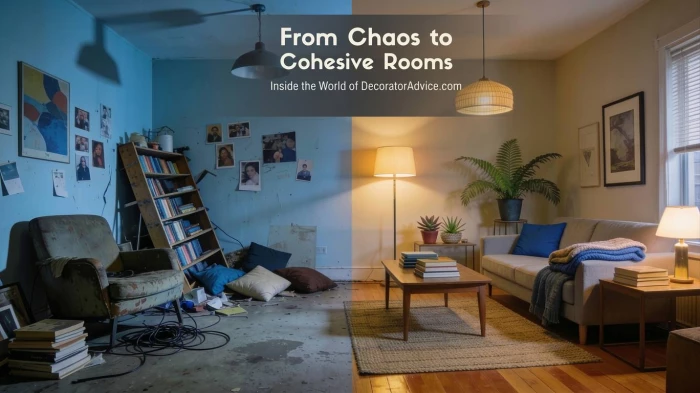
Let’s take a scenario that you’ve hired a house‑whisperer, not a full‑blown architect, not a celebrity designer, but someone who quietly stands in the background and says, “Shift that sofa, change that light, don’t waste money there.” That’s the role DecoratorAdvice.com is trying to play.
It doesn’t present itself as a glossy magazine or a portfolio site. It feels more like a practical companion: the tab you keep open while scrolling through paint colours and product pages. It promises to help you stop guessing, to make design decisions feel less like gambling and more like informed choices, and it does that with a mix of layout logic, style translation, DIY realism and product guidance.
DecoratorAdvice.com is very clear about its self‑image. It wants you to see it as:
● A guide for “normal homes,” not showrooms.
● A place where design rules are translated into plain language.
● A bridge between professional interior know‑how and everyday decisions.
The messaging is all about democratising design. The site positions itself as the platform that explains why things work, why that rug size matters, why that wall needs a different colour, why that light placement feels off so you can start making those calls on your own rather than copying Pinterest with your fingers crossed.
In practice, when you move around the site, you can feel that orientation. The writing rarely assumes you know the jargon. It doesn’t force you to learn the names of obscure styles before you’re allowed to choose a sofa. Instead, it frames decisions around questions you’re already asking: “Where should this go?”, “Why does this look wrong?”, “What can I do on this budget?”

One of the most interesting ways to look at DecoratorAdvice.com is as a map of the problems people bring to it.
You don’t just get a menu of “Living Room / Bedroom / Kitchen.” You get an experience built around moments:
● You’ve just moved in and everything is blank.
● You’ve lived in a space for years and it’s never felt “right.”
● You’re about to spend real money and you’re scared of choosing wrong.
The room‑based sections catch you in the second and third scenarios. They address very specific types of spaces: narrow living rooms, boxy bedrooms, rental kitchens, micro bathrooms, awkward corners. Instead of pretending every room is a rectangular box, the content leans into real‑life weirdness and shows you what to do with it rather than around it.
The fundamental design content is for those “blank page” moments. It lays out the invisible rules: proportion, circulation, sightlines, focal points, layering light, building a colour palette. It doesn’t try to teach you everything a designer knows, but it gives you enough to stop breaking the easiest rules by accident.
The style and trend pieces act like translators. Rather than treating “Scandi” or “industrial” as gatekeeping labels, they decode them into ingredients you can actually recognise in a shop: types of wood, shapes of furniture, metal finishes, fabric textures. The tone is less “you must be this aesthetic to enter” and more “here’s how this look works if you like it.”
The DIY and budget content acknowledges that most people are not hiring contractors every time they want a change. Projects are described with the kind of honesty that matters: how messy it gets, what skills you really need, which tools are essential, and where the hidden costs live. It’s very deliberately written for people who get things done between work, kids and life, not for full‑time renovators.
Finally, product guides and reviews recognise that decisions often come down to, “Which one of these do I actually buy?” Instead of only talking in abstract terms about “quality,” the content gets into size, material, maintenance, comfort, and how a piece behaves once it’s in a real room.
If you treat the site like a person, it has a particular personality.
It is calm rather than breathless. It does not shout about trends, and it does not insult your current choices. It talks to you as if you’re capable of making good decisions, you just haven’t been given a framework yet. This shows up in three ways:
First, it explains instead of dictating. Instead of, “Never do X,” you more often get, “Here’s why X usually doesn’t work, and here’s when it might be okay.” That nuance is valuable when you’re working with a space that doesn’t obey textbook rules.
Second, it respects constraints. There is very little of the “just knock this wall down” attitude that dominates renovation TV. It talks about budget, rental rules, family needs and time as parameters to design within, not obstacles to bulldoze.
Third, it is opinionated enough to be useful. You’ll find clear preferences like favouring the right sofa size over a trending style, or prioritising light and circulation over one more storage unit but they are justified. You get reasons, not just verdicts.
From a user perspective, this matters because design content can easily drift into two unhelpful tones: either scolding (“you did everything wrong”) or vague aestheticism (“follow your heart”). DecoratorAdvice.com generally avoids both.
Let's take a look at the tension between content and commerce.
DecoratorAdvice.com is upfront, by its behaviour, that it lives in both worlds. On the teaching side, it invests heavily in explanatory content, multi‑section guides, breakdowns, before‑and‑after logic, design fundamentals. You can spend a lot of time on the site learning without being pushed toward a purchase.
● Affiliate‑style recommendations inside buying guides and “best of” lists.
● Sponsored or collaborative pieces with brands.
● Partner showcases where certain businesses are highlighted and linked.
The important thing is how these two modes intersect. In many places, the commercial layer rides on top of solid advice: you are taught how to think about a decision (sofa size, rug placement, task lighting), and then you see products that fit that logic. The content rarely feels written purely to fill a price‑point grid.
The healthy approach is to treat the educational layer as the real value, and the product layer as curated options rather than commands. If you adopt that mindset, the commercial side becomes a convenience instead of a threat: a shortlist you can start from, rather than a fixed shopping list.
If you’ve noticed DecoratorAdvice.com popping up again and again when you search décor questions, that’s not an accident.
The site is built with a very clear sense of how search works now. Articles are:
● Focused: one clear promise per page, unpacked thoroughly.
● Clustered: related topics interlinked so that you can go deeper organically.
● Structured: headings, intros and sub‑sections match the way people phrase queries.
What this means in practice is that the site is good at answering specific questions: “what size rug for my sofa,” “how to layout a small living room,” “how to mix wood tones,” “budget bedroom refresh ideas.” When you click through, you generally find more than a shallow listicle. There’s a sense that the article was written to be read and re‑read, not just to catch a search click.
From an SEO perspective, this gives the site staying power. From a reader perspective, it makes it a reliable first stop, because the pattern is consistent. Once you notice that, you start typing your next décor question and quietly hoping one of the results is from the same place.
Looking at DecoratorAdvice.com as a whole, a few strengths stand out.
The first is pattern recognition. The site is very good at spotting recurring problems too‑small rugs, bad lighting, wrong‑scale furniture, cluttered surfaces and building content that helps you avoid them. If you read enough of its guides before a big shopping trip, you can feel your odds of regret dropping.
The second is translation ability. It takes big, abstract design ideas and translates them into concrete moves: move this, swap that, add this, don’t buy that yet. It gives you language to describe what feels wrong and tools to fix it.
The third is respect for constraints. It doesn’t make you feel like you’re failing because you don’t have a giant open‑plan space or a five‑figure budget. Instead, it treats constraints as the starting point, and much of the advice is framed around “given this reality, here’s the best move.”
A fair review also needs to say what DecoratorAdvice.com is not trying to be.
It is not an architecture school. You won’t find detailed structural diagrams, formal calculations, or technical code commentary. Advanced professionals will quickly outpace the depth available.
It is not a pure inspiration feed. If you only want editorial‑level photography and aspirational, unattainable spaces, the practical tone may almost feel too grounded.
It is not a video‑driven educational platform. There may be visuals and images, but if your brain only engages with video walkthroughs and reels, you’ll end up pairing this site with more visual channels.
In other words, it has chosen its lane deliberately: deep enough for serious home improvers, not so deep that it becomes a textbook.
Zoomed out, DecoratorAdvice.com lives in a middle lane that most big décor platforms don’t really occupy. It is more structured and teaching‑focused than pure inspiration sites, but more everyday and budget‑aware than polished, magazine‑style brands.
Compared with a giant like Houzz, which is part image search, part marketplace, part pro‑directory, DecoratorAdvice.com feels much more like a “do‑it‑yourself, but smarter” coach. Houzz is great when you’re ready to hire a designer or contractor; DecoratorAdvice.com is better when you’re trying to make confident decisions without building a full renovation team.
Lifestyle‑heavy blogs like Apartment Therapy or personality‑driven projects like Young House Love lean on stories, tours and community. DecoratorAdvice.com borrows the “real home” sensibility but keeps its centre in explanation and structure, behaving more like a calm tutor than a house‑tour magazine.
Against more high‑end, design‑purist sites, it comes off as intentionally grounded. It cares about aesthetics, but equally about whether the sofa fits, the rug survives kids, and the plan works on a real budget. That combination, plus its tightly focused décor content clusters, often gives it an SEO edge on practical “how to fix this room” queries, where people want a clear answer more than endless inspiration.
You can almost draw a profile of the ideal reader.
They are likely someone in a transition: first apartment, first house, a new baby, a move to a different city, or a decision to finally “fix” that room that has always bothered them. They’ve probably spent too much time on Pinterest and Instagram and now feel more confused than energized.
They are willing to do some work themselves measuring, moving, painting, planning but they don’t want to waste money or weekends on mistakes that could have been avoided with a bit of guidance. They care about aesthetics, but they care just as much about comfort, function and longevity.
For that person, DecoratorAdvice.com behaves like a long‑term ally. Every time a new project appears, you can come back, skim a few key guides, and feel your decisions sharpen.
DecoratorAdvice.com is less like a glossy magazine you flick through on a coffee table and more like a smart notebook you keep in a drawer. You pull it out whenever you’re stuck: when the room feels wrong, when the cart is full and you’re not sure you’re buying the right things, when you’re tempted by a trend you don’t fully understand.
It won’t turn you into an architect. It will, however, make you noticeably better at making the thousands of small decisions that quietly shape how your home feels. And in the world of décor content where so much energy goes into showing you impossibly perfect rooms that alone makes it worth paying attention to.

In recent months, CrossMarket.ai has quietly gained attention across social medi...
Ina Gupta1 day ago

HINAI Web is an enterprise‑grade, web‑based Hospital Information / Health Inform...
Noura Belkacem1 week ago

TL;DRTwelve Labs is a developer‑first video intelligence platform that provides...
Grace Howard1 week ago

FaceCheck ID sits at a strange intersection of online safety, facial recognition...
Funke Ogunleye1 week ago

A student opens their laptop in exam season, looks at the stack of PDFs, s...
Grace Howard1 week ago

ThinkWave is trying to solve a very specific problem: schools drowning in spread...
Noura Belkacem2 weeks ago
Discussion