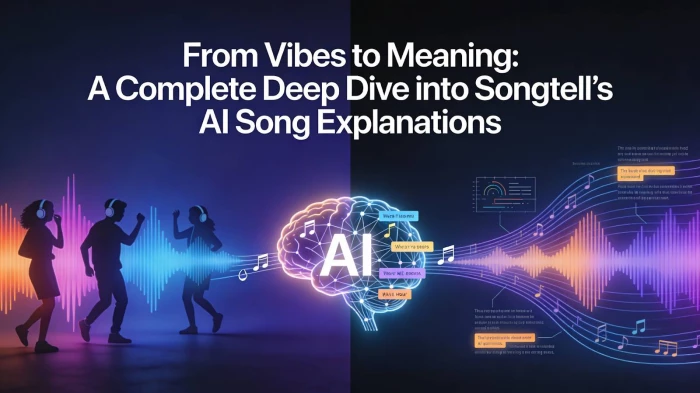
Imagine walking into a music library where nothing is sorted by genre, artist, or year only by “what this song does to your brain.” That, in spirit, is what Songtell is trying to be: not a lyrics site, but a meaning machine.
If Songtell walked into a room, it wouldn’t be the DJ. It would be the friend who pauses the track and says, “Wait, do you realise this line is actually about control, not love?” It’s an AI‑powered explainer that:
● Reads lyrics like literature, pulling out themes, metaphors, and emotional arcs.
● Adds context—culture, history, artist background—whenever possible.
● Serves those insights through a web platform and mobile apps, with a catalog that runs into six figures of songs.
So you’re not just getting “lyrics with footnotes.” You’re getting something closer to a short essay on each track, written by an AI that has been edited, nudged, and occasionally corrected by humans.
Think of one song travelling through the system. Its journey looks something like this:
1. The lyrics arrive: The text is fed into language models trained to recognise narrative structure, sentiment, motifs, and literary devices.
2. The model starts reading between lines: It flags themes like heartbreak, addiction, identity, or protest, and links them to particular lines or sections.
3. Context seeps in: The system cross‑references musical culture, history, and, when available, artist‑related information to understand references and allusions.
4. Humans step in: Editors polish, reorganise, and sanity‑check the AI’s output so that what reaches you looks like a coherent, readable interpretation not raw model spill.
5. You see the final form: On screen, that transforms into: a summary (“This song explores…”), main themes, key metaphors, sometimes verse‑specific commentary, and related song suggestions.
Put differently: the track enters as data and exits as a mini‑story with footnotes.
Under a very simple interface lies a surprisingly dense stack of “music intelligence.” Instead of listing features, let’s map what a power user can actually do with the platform.
You can:
● Interrogate a single song: Search any track that’s in the catalog and treat it like a text in a literature class: plot, narrator, subtext, symbolism, and emotional arc all laid out for you.
● Trace a theme across songs: Move from one interpretation to others recommended because they share themes such as grief, fame, rebellion even if the genre changes from pop to hip‑hop.
● Browse an AI‑curated “canon”: Land on featured and trending songs that the platform surfaces not only because they’re popular but because they’re interesting to explain.
● Treat it as a syllabus: For classrooms and workshops, you can effectively build lesson plans around songs using the interpretations as starting points for analysis, debate, and comparison.
● Use it as a songwriting microscope: Songwriters can read how the system decomposes narrative, imagery, and tension in successful tracks and then reverse‑engineer patterns.
The surface looks like “search + article,” but underneath you have recommendation logic, educational scaffolding, and cross‑song thematic mapping at work.
Instead of “Target Audience,” imagine the five kinds of people you’ll meet in Songtell’s ecosystem.
1. The Late‑Night Listener: This person hears a song on a playlist, looks up the meaning, and discovers it’s not a love song at all, it’s about control or addiction. Songtell flips casual listening into intentional listening in a couple of clicks.
2. The Teacher in Sneaker Mode: They bring contemporary tracks into class and say, “Let’s see what this AI thinks the song means and then argue with it.” Songtell becomes both a teaching aid and a foil, powering discussions about metaphor, tone, and bias.
3. The Reviewer on a Deadline: A critic needs a fast thematic overview of an unfamiliar song or artist. Songtell gives them a structured first pass that they then test against their own listening and research.
4. The Songcraft Nerd: They’re dissecting how other writers build verses, pre‑choruses, and hooks. Songtell’s commentary on narrative perspective, imagery, and motif recurrence becomes reference material, like a constantly updated craft book.
5. The Language Hacker: They love songs in languages they only half understand. Songtell’s interpretations bridge the gap between literal translation and real meaning, explaining idioms, emotional subtext, and cultural signals.
The same engine, very different outcomes.
Instead of saying “it has X entries,” it’s more interesting to ask, “How much of your listening life does it actually cover?”
● The catalog runs into well over 100,000 interpreted songs, with some sources placing the broader repository into the hundreds of thousands.
● Coverage is deepest where global listening habits are densest: English‑language pop, rock, hip‑hop, R&B, and widely streamed genres.
● There is multi‑language support, but English is clearly first‑class; other languages are supported with increasing but uneven depth.
So if your taste lives roughly inside the global streaming mainstream, Songtell will often feel “complete.” The further you live in micro‑scenes, local languages, or underground catalogs, the more you will run into gaps or thinner interpretations.
On paper, Songtell is “web + mobile + AI.” In practice, the experience has a very specific flavour.
● The good part: you search a song and, within seconds, see a clean, article‑style breakdown that reads more like a blog post than a database entry.
● The intense part: the page is dense—meaning, context, related songs, themes—especially if you’re expecting a simple lyric sheet. New users sometimes call it overwhelming.
● The friction: on free plans, ads cut into that reading experience, which is particularly noticeable because you’re trying to follow a narrative, not just skim a line.
It’s less like scrolling a feed, more like opening a mini‑essay with pop‑ups. Power users love that density; casual users may bounce or stick to shorter visits.
There is no clear, officially published pricing page is publicly visible on Songtell’s site. It runs on a freemium model. Songtell’s business model is simple:
● Free gets you in the door: large catalog access, core interpretations, search, and trending sections—funded by ads and some feature limits.
● Paid removes friction and adds depth: richer analyses, more context, fewer or no ads, and extra educational / community perks depending on the plan.
If you’re the late‑night listener, you can probably live on the free tier forever.
If you’re a teacher, student, critic, or songwriter using it weekly, the value of premium is less about “more songs” and more about “better signal and fewer distractions.”
In that sense, the pricing question becomes: How often do you argue with lyrics? The more you do, the more the paid tier feels like a subscription to an interpretive library, not just another app.
The question that hangs over any tool like this isn’t “Does it work?” but “Should we let it tell us what songs mean?”
● Songtell is very good at pattern‑spotting: emotions, recurring imagery, topical clusters.
● It is weaker at culturally specific slang, irony, satire, and deeply local references.
● It can “over‑interpret” minimalism, building an elaborate theory where the songwriter may have been intentionally vague—or just vibing.
● It doesn’t claim to be the artist’s voice; interpretations are framed as readings, not official statements.
● Users retain standard data rights (access, correction, deletion), and the privacy policy explicitly talks about using personal/usage data to run and improve the service rather than selling it off.
Used thoughtfully, Songtell nudges listeners toward more critical engagement with music. Used lazily, it risks becoming a crutch where people outsource all interpretation to a model. The difference is in how you approach it.
User sentiment around Songtell has a pattern: warm enthusiasm wrapped around a core of healthy scepticism.
● Overall scores landing in the “very good” band (around 4+ out of 5), with praise for how it deepens listening and helps non‑native speakers connect with songs.
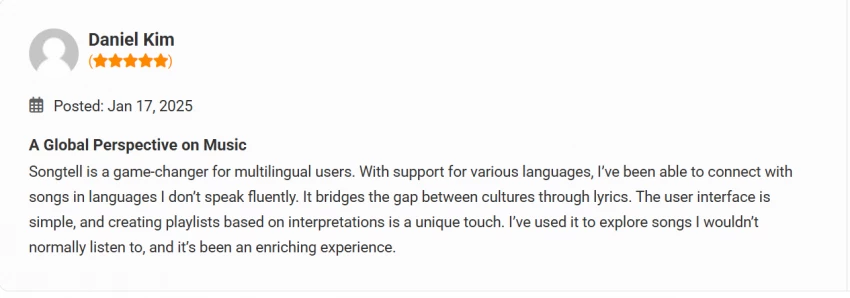
● Comments describing it as an “eye‑opener” that makes familiar tracks feel new again, especially when it surfaces emotional or social layers listeners hadn’t named for themselves.
● Teachers and educators reporting that it helps students engage with lyric analysis, even if they occasionally have to “translate” the AI’s dense phrasing into simpler classroom language.
● Some users bluntly say they don’t trust AI interpretations, but still use Songtell because it’s a good conversation starter.
● Others roll their eyes at readings that feel like “word salad” or like something a student would write to over‑explain a straightforward line.

● Free‑tier users complain about the ad load; they’re not wrong—ads and longform text are uneasy roommates.
Net result: most people like having Songtell in their toolkit, as long as they treat it as an opinionated, occasionally overexcited friend rather than a gospel.
To understand where Songtell fits, it helps to compare it with familiar names like Genius, Musixmatch, and song‑ID tools.
| Tool | Core focus | AI use | Community strength | Best for | Typical entry cost |
| Songtell | Song meanings & lyric interpretations | Extensive AI | Basic community, | Fans, students, educators, songwriters | Free tier; paid for advanced features |
| Genius | Annotations & crowd explanations | Limited | Very strong, artist‑driven | Community debate, official notes | Free (ad‑supported) |
| Musixmatch | Lyric display & syncing | Minimal | Moderate contributions | Karaoke, multilingual lyric access | Free + low‑cost premium |
| Shazam etc. | Song identification | None | Low | Finding song titles from audio | Free (ad‑supported) |
You don’t replace the others with Songtell. You use it alongside them when the question is no longer “What is this?” but “What is this saying?”
You won’t see architecture diagrams on the homepage, but the key technical choices show through the behaviour:
● Large‑scale NLP models doing text understanding and multi‑language interpretation.
● Near real‑time catalog updates and lyric ingestion so new songs don’t stay “blind spots” for long.
● A hybrid pipeline where human quality control sits on top of AI output; this is crucial for keeping the explanations readable and mostly coherent.
In other words, it behaves less like a static database and more like an evolving interpretive engine.
Most users never read the privacy policy, but for a complete review you should know what’s in the small print.
● Songtell collects the usual suspects: account details (like email), usage logs (IP, browser, pages visited), and interaction data to keep the service running and improve recommendations.
● It explicitly states that data is used for operating, securing, and enhancing the platform, and can be shared with service providers where necessary—but you retain rights to access, correct, and request deletion of your data.
● Data retention is bounded by operational and legal needs; it’s not “keep everything forever by default.”
So it broadly aligns with standard SaaS practice. Privacy‑sensitive users will still want to read the full policy, but there’s nothing wildly out of line with typical AI‑powered web tools.
If you strip away the branding, Songtell is essentially this:
A large‑scale, AI‑assisted attempt to turn the world’s lyrics into readable, browsable, debatable interpretations.
It’s worth it if you:
● Regularly wonder what songs are really about.
● Teach, write, or create around music and need fast, structured starting points.
● Enjoy arguing with interpretations rather than just accepting them.
It’s less compelling if you:
● Only need lyrics for sing‑along purposes (Musixmatch is better there).
● Want artist‑verified explanations and fan debates (Genius will feel richer).
● Rarely stop to ask “why” about a track.
Songtell is worth using if you treat it as an intelligent reading companion for lyrics, not as an all‑knowing oracle. It excels at quickly surfacing themes, emotions, and metaphors across a very large catalog, making it especially valuable for curious listeners, students, teachers, writers, and songwriters who regularly interrogate what songs mean. At the same time, its AI occasionally over‑interprets, non‑English coverage is uneven, the free tier is ad‑heavy, and it lacks the human debate and artist‑verified insight you’ll find on more community‑driven platforms, so its explanations are best seen as thoughtful hypotheses you argue with not final answers you blindly accept.

Late at night, after the usual AI companion ads blur together, PepHop AI shows u...
Funke Ogunleye1 day ago
Imagine you open a new tab, type “opendream.ai”, and instead of being greeted by...
Samuel Osei2 days ago
Grubby AI is one of those tools that only exists because of a very 2025 problem:...
Funke Ogunleye2 days ago
Meet Muke AIMuke AI is an AI‑powered image manipulation suite best known for two...
Sandra Campos3 days ago

If your marketing currently lives in a chaotic mix of ChatGPT, Canva, random sch...
Samuel Osei3 days ago

Janitor AI doesn’t feel like “a chatbot platform.”It feels like walking into a l...
Sandra Campos4 days ago
Discussion