Artificial Intelligence
11 min read
Inside Leeco AI: The Invisible Layer That Connects Your Problems, Videos, and Notes

Leetcode prep is crowded with tools that promise shortcuts, streaks, and “guaranteed” offers but very few try to fix how you actually think while you learn. Leeco AI doesn’t market itself as a magic wand; it slips into your existing tabs and quietly changes the conversation you have with problems, videos, and yourself.
Most nights of DSA prep look the same: LeetCode in one tab, YouTube in another, a couple of blogs open, and an AI chat window on standby for when frustration peaks. You’re not short on content; you’re short on a thread that ties it all together.
Leeco AI behaves like that missing thread. It doesn’t ask you to ditch LeetCode or stop watching tutorials; it climbs into those spaces and adds a persistent, opinionated voice that follows you around:
It’s less “new tool” and more “new layer” sitting on top of everything you already do.
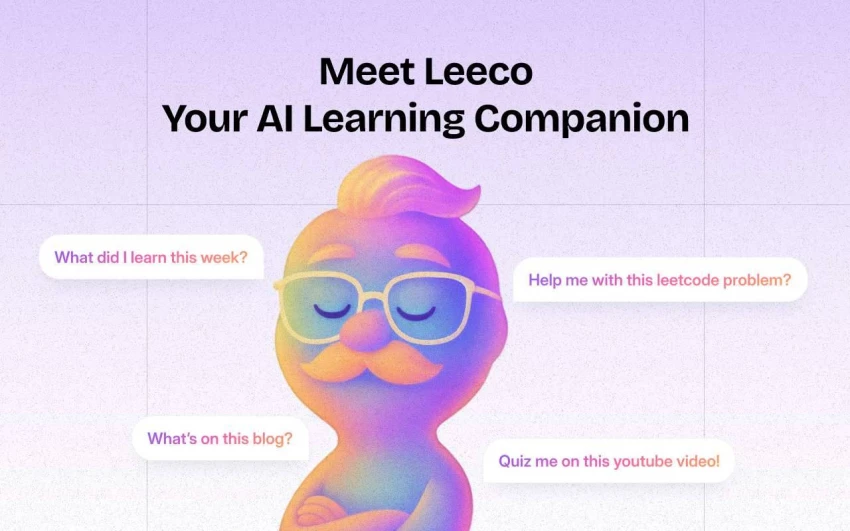
At the surface, Leeco is a browser‑based AI mentor that lives inside a slim panel on the side of your screen. Underneath, it combines large language models with its own logic about how a good mentor should behave.
Instead of being a generic chat window where you paste problems, Leeco is designed to:
Crucially, it has a strong point of view: you should think before you’re shown; you should explain before you’re corrected; you should connect what you watch and what you solve.
Your first half hour with Leeco usually tells you whether its personality matches yours.
You install the extension, open LeetCode as usual, and notice a new companion waiting on the right. You click it, and the mentor gently asks what you’re working on.
Within that first 30 minutes, you’ll know: this is not a vending machine for answers. It’s a conversational partner that refuses to let you coast on autopilot.
The core of Leeco’s design philosophy is simple: real understanding comes from wrestling with an idea, not just seeing the final code.
On LeetCode, that translates into a very specific behavior pattern:
If you’re used to pasting the entire prompt into a generic AI and copying back a pristine answer, Leeco will feel slower. That’s intentional. It’s not trying to win the race to Accepted; it’s trying to slow you down just enough that your brain actually rewires.
YouTube is where a lot of learning begins—and where a lot of learning dies. You watch a brilliant explanation, nod along, and then realize later you can’t reconstruct a single step without re‑watching.
Instead of letting videos wash over you, Leeco forces friction: you pause, paraphrase, and prove to yourself that you understood something before clicking “Next.”
The scariest part of interview prep is often the moment when you stop practicing alone and start rehearsing under pressure. Leeco leans into this by offering interview‑style interactions that are deliberately less comfortable than regular tutoring.
You can think of it as a mirror that talks back. It won’t replace a tough human interviewer, but it chips away at the gap between “I can solve problems alone” and “I can perform under scrutiny.”
Most roadmaps exist as static checklists somewhere you rarely open. Leeco’s roadmap strategy is more parasitic: it embeds itself into your actual routine.
Then, instead of handing you a heroic 90‑day master plan you’ll abandon in a week, it makes small, context‑aware suggestions:
The roadmap isn’t something you “go to.” It’s something that quietly shows up wherever you are.
The true test of a tool like Leeco isn’t whether it can solve problems; it’s whether you’re different after using it.
Over time, you may notice you’re less tempted to paste problems into random AI chats. You start initiating your own checks: “What’s the brute‑force here?” “How would I justify this choice in an interview?” That shift is subtle but huge; Leeco is nudging your internal monologue toward the way good interviewers and strong engineers think.
On paper, you might argue that any powerful AI model could do what Leeco does if you prompt it correctly. The difference is that Leeco bakes those “correct prompts” into the experience, so you don’t have to babysit the AI.
It’s like the difference between hiring a general consultant and working with a dedicated coach who knows your history.
In daily use, Leeco settles into the background. That’s a good sign: the best tools become part of the furniture.
Of course, it’s still a browser extension. If your machine is already struggling, you’ll want to be mindful of how many heavy tabs you keep open. But in terms of cognitive overhead, Leeco’s goal is the opposite: fewer context switches, fewer fragmented study attempts, more continuity.
Leeco’s value isn’t in how many features it advertises, but in how it fits into the economics of your effort.
A free‑ish or limited tier is usually enough to test whether its mentorship style clicks with you. If you’re dabbling in DSA, just exploring, or not on a tight interview timeline, you can treat Leeco like a smart assistant you occasionally call in for tough spots.
In that context, you’re not really paying for “AI answers”; you’re paying for structured friction, focused feedback, and reduced wasted time.
Every tool that promises to “upgrade your learning” carries two quiet dangers: dependence and over‑trust.
Leeco will absolutely make your journey smoother if you cooperate with its goals. But it cannot sit the interview for you; it cannot internalize patterns for you. You still have to do the uncomfortable part: deciding to struggle a bit longer before reaching for help.
If you’re building a modern interview‑prep stack, Leeco doesn’t replace everything; it orchestrates.
Leeco’s role is to stand at the junction of those pieces and say, “Okay, but are you actually learning from any of this?” It keeps asking you to connect dots: the problem you solved to the pattern you learned, the video you watched to the code you wrote, the roadmap on paper to the hour you have tonight.
Leeco AI is not the hero of your story; you are. That’s precisely what makes it powerful.
Instead of trying to dazzle you with one‑click solutions, it sits next to you night after night as you wrestle with arrays, trees, graphs, and your own doubts. It refuses to do your homework for you but it refuses just as strongly to let you feel alone with your confusion.
For the casual user who wants fast green ticks, Leeco will feel like overkill. For the serious learner who wants to walk into an interview knowing they understand why their code works, not just that it compiles, Leeco is closer to a silent co‑author of that confidence.
Treat it like a mentor you invited into your browser: question it, challenge it, lean on it when needed, and, most importantly, let it change how you think not just what you solve.
1. Can Leeco AI see which LeetCode problem or YouTube video I’m on?
Yes. It reads the page context so it can tailor hints, summaries, and questions to the exact problem or video you’re viewing.
2. Will Leeco AI always give me the full solution if I keep asking?
It’s designed to push hints and reasoning first, but if you insist, it can eventually reveal a full solution—so using it wisely is important for real learning.
3. How many questions can I ask on the free plan?
The free tier is meant for light daily use, with a small cap on interactions (roughly a handful of prompts per day) before you hit limits.
4. Does Leeco AI’s Interview Mode cost extra?
Interview Mode is currently available to all users, but advanced usage and higher limits are tied to paid plans.
5. Can Leeco AI follow me beyond LeetCode—like blogs or docs?
Yes. Whenever you’re on supported sites (blogs, docs, video pages), you can select text or refer to on‑screen content and ask Leeco to explain, simplify, or quiz you on it.

The Legal Industry Didn’t Suddenly “Go AI” — It Was Forced ThereIn 2026, AI in l...
John Nyarko7 hours ago

AI talking head tools have made it possible to create studio‑style presenter vid...
Ina Gupta4 days ago

If you searched “Gening AI”, you probably ran into a site/app that promises some...
Ina Gupta4 weeks ago

Apple has officially confirmed that Google’s Gemini models will power the next g...
John Nyarko1 month ago

In this review, we’re taking a clear, honest look at one such platform Unlucid A...
John Nyarko1 month ago

Automating phone calls has become a game-changer for businesses that want to eli...
John Nyarko1 month ago
Discussion