
Janitor AI doesn’t feel like “a chatbot platform.”
It feels like walking into a late‑night arcade where every cabinet is a different personality and some of them look back at you a little too long.
This isn’t a homepage you visit once. It’s a place people live inside: roleplay addicts, lonely insomniacs, fanfic writers, small hustler teams trying to bend it into a support bot, and a few cautiously curious businesses wondering if this chaos can be tamed.
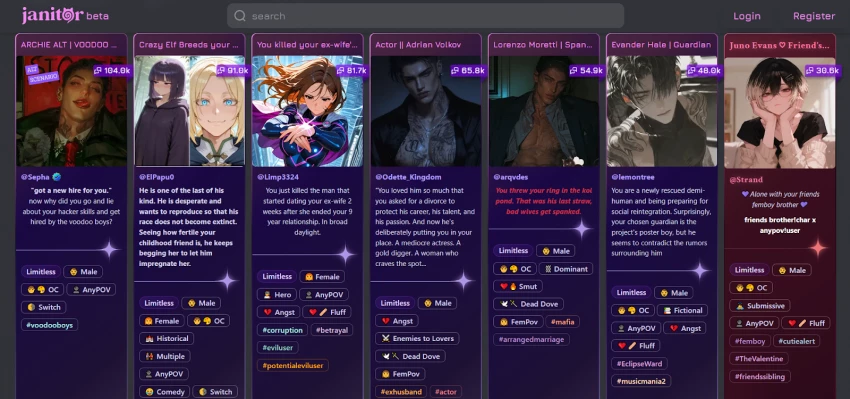
Most platforms sell you “AI.” Janitor AI sells you people who don’t exist but answer instantly.
You don’t “use” Janitor AI the way you use a search engine. You enter it.
● The door is a standard sign‑up form.
● The first hallway is a gallery of characters that already know who they are.
● The exit is… not obvious.
The core idea is deceptively simple:
Instead of one generic bot, Janitor AI lets you create and talk to personas characters with backstories, moods, soft spots, bad habits. They don’t sit in a settings screen; they sit in your chat history like recurring characters in a show you accidentally started binging.
Some users come for a single reason: “a place where NSFW and adult roleplay isn’t treated like a bug.” Others want a flexible front‑end for different language models and even business chatflows. The tension between those two worlds is what makes Janitor AI fascinating and hard to fit into a neat “SaaS review” box.
Janitor AI’s onboarding feels less like “enterprise software” and more like installing a game you saw on TikTok.
You register, click through the usual terms, and if you’re anywhere near the NSFW side of the building, you’ll meet the 18+ warning sooner rather than later. It’s there, but like many online age gates, it relies heavily on the user choosing honesty over curiosity.
Once you’re in, the platform doesn’t over‑explain itself:
● A library of faces, names, and tags stares back at you.
● Filters split “safe” from “not safe,” but the adult energy is easy to sense.
● The UI looks familiar: sidebar of chats, central conversation, toggles and options tucked away.
It’s a very “zero tutorial” environment. You click a character, type something, and the character answers like they’ve been waiting all day.
From a UX standpoint, that’s smart. The complexity models, API keys, advanced settings stays backstage. On stage, everything feels approachable, chatty, immediate.
The character builder is where Janitor AI stops being “a site” and becomes a tool you can bend.
You’re not filling a boring form; you’re doing casting and script work in the same breath:
● Name, avatar, and a short description: this is the movie poster.
● Personality traits and backstory: these are the writer’s notes.
● Speaking style and example dialogues: this is the rehearsal.
A good character sheet reads like a carefully engineered prompt, but the platform makes it feel like creative writing:
“She’s an ex‑assassin turned café owner who refuses to talk about her past unless you push her too far.”
Under the hood, that’s metadata and instruction text. On screen, it’s an invitation. The more intentional you are, the more the character “behaves” consistently staying in tone, remembering emotional beats, reacting with distinct flavor.
Once you hit publish, that persona can be:
● Your private confidant.
● A public character anyone can talk to.
● A piece of social currency—your creation becoming someone else’s favorite chat.
In a very real sense, Janitor AI is a multiplayer prompt‑design game with feelings.
The question isn’t “Does Janitor AI reply?” It’s “How convincing does it get before you remember it’s code?”
When a character is well‑designed and powered by a strong model, conversations hit an eerie sweet spot:
● They remember what you said 20 messages ago.
● They adjust mood when you push boundaries.
● They maintain persona even when you change topics.
Short and medium‑length chats often feel tight and coherent. You can build story arcs, fight, flirt, reconcile, and spin entire fanfic scenarios in a single session.
Then you push it too far:
● Very long threads start to drift; details get fuzzy.
● Lore you established earlier sometimes gets rewritten on the fly.
● Emotional arcs can snap back to a default tone if the context window overflows.
This isn’t unique to Janitor AI, it’s physics for large language models. But because the platform sells relationships, not utilities, the impact is felt more sharply. When your calculator forgets a number, it’s a bug; when your “partner” forgets your trauma backstory, it feels like a betrayal, even if you know it’s just tokens sliding out of context.
Janitor AI lives in a space many big platforms tiptoe around: adults who want AI companions and roleplay without aggressive censoring. That is part of why it’s popular and part of why it’s controversial.
On the “freedom” side:
● Erotic and romantic roleplay isn’t automatically shut down.
● Characters can be designed specifically for adult fantasies.
● Users feel less infantilized than on platforms that constantly red‑flag their prompts.
On the “this is complicated” side:
● Age gates are only as strong as a birth date field.
● Moderation has to catch illegal, abusive, or non‑consensual content in a sea of “grey.”
● Emotional dependency becomes more intense when NSFW and intimacy are involved.
Moderation layers exist for banned categories, detection of obviously illegal content, filters for certain phrases and scenarios but they are fighting a constantly shifting battle in a model‑agnostic environment. Different model backends behave differently; clever users can rephrase; edge‑cases multiply.
It’s not enough to say “It allows NSFW.”
A more accurate line is: Janitor AI positions NSFW content as a feature for adults and then tries to build a moderation fence around the worst cliffs. The fence isn’t perfect, and anyone writing a serious review should say that out loud.
Janitor AI uses a familiar playbook: free to get hooked, paid when you start living there.
The free tier is your trial drug:
● Enough messages to get emotionally invested.
● Access to public characters and baseline models.
● Just enough limitation to make you notice friction once you’re attached.
Paid tiers—often labeled something like Pro or similar—tilt the trade‑off:
● Higher or practically unlimited messages.
● Faster responses and access to better models.
● Unlocks or expands NSFW, integrations, extra customization.
Beyond that, you might find “team” or “business”‑style tiers where the pitch shifts from “chat with a vampire” to “build a support bot”:
● Multiple users or agents under one account.
● Integrations, analytics, or custom workflows.
● Potential SLAs or tailored deals if you’re big enough.
The catch isn’t that it’s overpriced; it’s that the fine print moves. Limits, caps, and feature gating can change over time, and users often complain less about the numbers and more about the confusion: “What exactly am I paying for, and why did this thing I relied on suddenly move behind a paywall?”
Technically, Janitor AI is a conductor rather than the orchestra. The models doing the heavy lifting may come from different providers, and sometimes your own key if that’s supported.
That gives you:
● Flexibility: pick creativity vs control; pick cheap vs high‑end.
● Variability: not every combination behaves or breaks the same way.
On a normal day:
● Simple chats respond quickly enough to feel real‑time.
● Narrative sessions and intense roleplay flow without obvious lag.
● Occasional slowdowns signal that you’re riding real infrastructure, not magic.
On a bad day:
● Peak load turns replies into a loading bar.
● Downtime, error messages, or forced model switches remind you that experimentation is baked into the platform’s DNA.
● Very long conversations can hit technical and cognitive limits at once: context overflow plus user frustration.
For casual users, it’s tolerable. For someone trying to build a reliable support bot or a paid “AI companion” service on top of Janitor AI, these are not minor details—they’re business risks.
If you strip away marketing copy, Janitor AI sits in three emotional buckets:
1. The Enthralled
These users talk about characters like they’re real people:
● “This AI understands me better than my ex.”
● “I lost track of time and suddenly it was 3AM.”
● “I built a character and now hundreds of people are chatting with them.”
For them, Janitor AI is not a tool. It’s a parallel life.
2. The Uneasy
They see the appeal and the danger:
● The NSFW freedom feels empowering but also… too easy to fall into.
● The emotional realism makes them question their own boundaries. reddit
● They worry about younger users wandering in despite warnings.
They talk about it the way you talk about a bar you like but wouldn’t recommend to everyone.
3. The Pragmatic Tinkerers
They treat Janitor AI as infrastructure:
● A convenient front‑end to test different models.
● A cheap way to prototype a custom bot.
● A playground for prompt engineering and persona design.
For them, everything is a trade‑off chart: cost vs latency, control vs safety, UI vs raw APIs.
Imagine a street of AI platforms:
● At one end, you have strict, school‑safe bots: no NSFW, no flirting, everything sanitized.
● In the middle, “relationship” AIs that allow romance but wrap it in soft, careful guardrails.
● At the other end, the neon‑lit corner where Janitor AI lives.
Against stricter, school‑friendly bots:
● Janitor AI wins on creativity, roleplay depth, and adult autonomy.
● It loses on guaranteed safety, consistency, and institutional acceptability.
Against “relationship” AIs that are heavily curated:
● Janitor AI offers more customization, more edge, more weirdness.
● Those competitors often offer more predictable emotional arcs, more curated content, and fewer shocking surprises.
The simple summary:
If you want control and compliance, Janitor AI is the wrong neighbor. If you want freedom and experimentation, you won’t stay in the safe end of the street very long.
● You’re an adult (18+) who wants roleplay and companions unconstrained by school‑safe filters.
● You enjoy building characters as much as talking to them.
● You’re curious about tweaking models, prompts, and behaviors instead of just typing one‑off questions.
● You can self‑regulate: log off when it’s 4AM, maintain boundaries, remember that “they” are tokens, not souls.
● You’re a parent looking for a wholesome homework assistant.
● You’re an enterprise security lead who has nightmares about shadow IT and NSFW leakage.
● You want a purely factual productivity bot with zero temptation to wander into emotional or adult territory.
● You’re under 18—full stop. The platform may show warnings; the culture is still not designed for you.
Most reviews try to decide if Janitor AI is “good” or “bad.” A more honest conclusion is: What kind of world are you looking for?
As a playground for AI characters, Janitor AI is one of the most flexible, expressive environments you can enter right now. As a NSFW‑friendly space, it gives adults autonomy many mainstream platforms refuse to risk. As a technical front‑end, it’s an intriguing, if sometimes unstable, way to orchestrate different models and personas without writing your own UI.
But it is not a neutral appliance.It’s closer to a nightlife district built on top of language models. If you walk in knowing that and you’re the kind of person who can enjoy the lights without falling off the balcony, Janitor AI can be thrilling, creatively empowering, and weirdly comforting. If you need something safe, boring, predictable, and HR‑approved, you shouldn’t be here long enough to finish this sentence.

Late at night, after the usual AI companion ads blur together, PepHop AI shows u...
Funke Ogunleye1 day ago

Imagine you open a new tab, type “opendream.ai”, and instead of being greeted by...
Samuel Osei2 days ago
Grubby AI is one of those tools that only exists because of a very 2025 problem:...
Funke Ogunleye2 days ago
Meet Muke AIMuke AI is an AI‑powered image manipulation suite best known for two...
Sandra Campos3 days ago

If your marketing currently lives in a chaotic mix of ChatGPT, Canva, random sch...
Samuel Osei3 days ago

MyImg AI is one of the most aggressive NSFW‑focused AI image and video editors o...
Samuel Osei5 days ago
Discussion