Human resource management has evolved far beyond spreadsheets and manual tracking. Today, organisations expect their HR systems to automate workflows, provide real-time insights, and support decision-making at scale. PeoplesHR presents itself as a unified solution built to meet these expectations. But how well does it perform in real-world usage?
PeoplesHR is a cloud-based Human Resource Information System (HRIS) created to manage the complete employee lifecycle within a single, connected environment. From onboarding new hires to processing payroll and analysing workforce performance, the platform aims to eliminate fragmented HR tools and replace them with one integrated system.
According to official information, PeoplesHR serves over 1,700 organisations across more than 40 countries, positioning itself as a scalable HR solution for growing and established enterprises alike. Its modular architecture allows companies to activate only the functionalities they need, while its low-code and no-code configuration tools enable HR teams to adapt workflows without heavy reliance on IT support.
PeoplesHR positions itself as a platform built around centralisation and automation. The software is designed to store employee information within a single, unified repository, which the company states helps maintain data consistency across departments and reduce administrative workload. Features such as attendance tracking, leave management, and payroll are presented as interconnected modules, intended to allow seamless data flow and minimize payroll-related discrepancies.
The platform also claims to support performance and talent management through structured appraisal frameworks, goal-setting tools, and performance analytics. According to PeoplesHR, these capabilities are designed to help organisations move beyond traditional annual reviews and gain ongoing visibility into employee development and workforce trends.
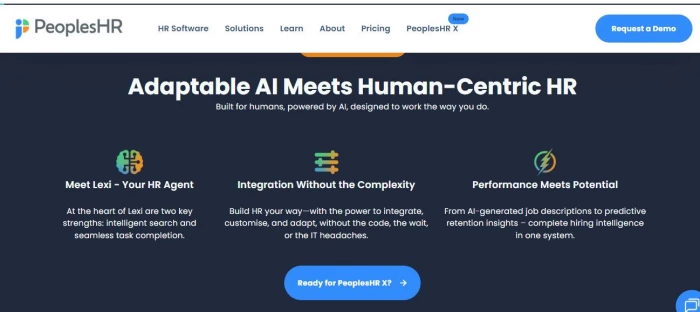
To further streamline HR operations, PeoplesHR highlights its use of AI-powered assistance. The AI features are promoted as tools to help users navigate the system, automate routine HR tasks, generate job descriptions, and extract insights from workforce data. The company suggests that this AI layer enhances efficiency and makes everyday HR processes more intuitive.
One of the most frequently cited advantages of PeoplesHR is its all-in-one approach. Instead of maintaining separate systems for attendance, payroll, and performance management, organisations can manage everything through a single platform. This consolidation saves time, reduces errors, and improves data accuracy.
Automation plays a significant role in improving efficiency. Approval workflows, real-time data updates, and employee self-service features allow HR teams to focus on strategic initiatives rather than repetitive administrative work. Employees also benefit from transparency, as they can independently access payslips, submit leave requests, and update personal information.
For organisations operating across regions, PeoplesHR’s support for multi-country payroll and compliance adds further value. Its configurability allows businesses to align HR processes with local regulations while maintaining central oversight.
Unlike many entry-level HR tools, PeoplesHR does not publish fixed pricing on its website. Instead, the platform follows a custom, quote-based pricing model, where costs depend on organisational needs and usage scale.
This approach is common among enterprise and mid-market HRIS platforms, especially those offering modular features, multi-country payroll, and advanced analytics.
Pricing is typically influenced by factors such as the number of employees, selected modules, geographic coverage, and implementation complexity.
Note: The figures below are indicative estimates based on user discussions, HR software benchmarks, and industry comparisons. Actual pricing may vary and must be confirmed directly with PeoplesHR.
| Pricing Factor | How It Impacts Cost |
| Number of Employees | Pricing usually scales per employee, per month |
| Selected Modules | Core HR, Payroll, Performance, Analytics, AI tools may be priced separately |
| Geographic Coverage | Multi-country payroll and compliance increase costs |
| Implementation & Onboarding | One-time setup or implementation fees may apply |
| Customization Level | Advanced workflow or reporting customizations can add to pricing |
| Support & SLA Tier | Premium support plans may cost extra |
From a user perspective, PeoplesHR’s pricing tends to make sense for organisations that:
● Need multiple HR functions under one platform
● Operate across regions or countries
● Want automation and analytics, not just record-keeping
For very small teams or startups seeking minimal HR features, lighter tools may offer better value. However, for growing organisations, PeoplesHR’s pricing aligns with the depth of functionality it delivers.
To evaluate PeoplesHR beyond marketing claims, it is essential to consider feedback from verified, third-party review platforms.

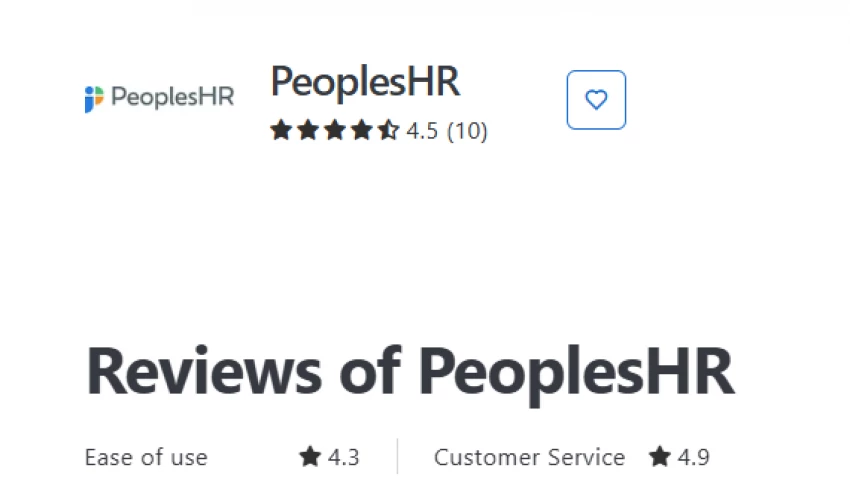
On G2, PeoplesHR maintains an average rating of approximately 4.3 out of 5, based on reviews from verified business users.
Many reviewers highlight the platform’s structured workflows, real-time dashboards, and ability to centralise HR operations effectively. Users often note that once the system is properly configured, daily HR tasks become significantly easier to manage.
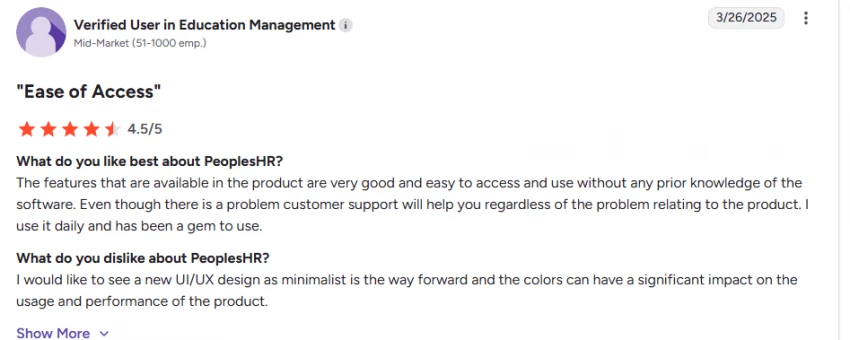
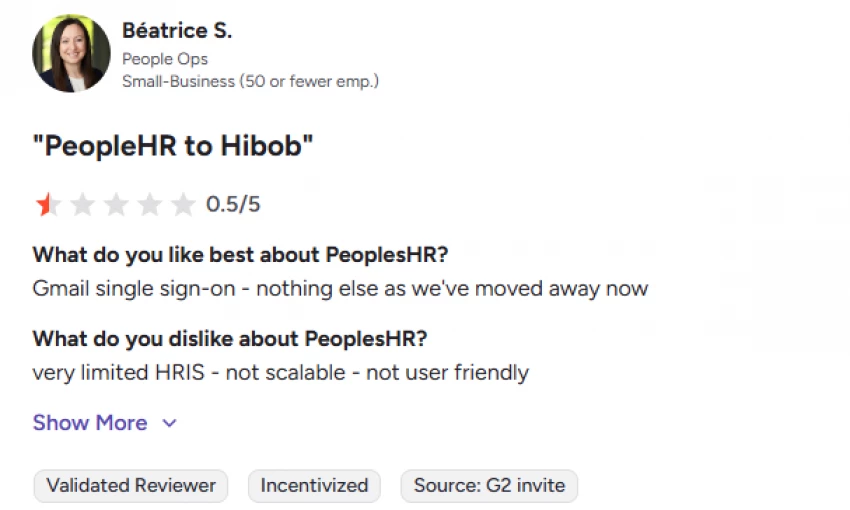
Some users, however, mention a learning curve during the initial setup phase and feel that the interface could be more modern compared to newer HR platforms.
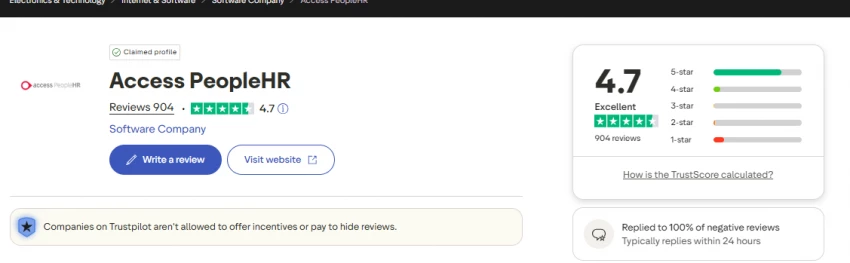
Trustpilot presents an even stronger sentiment, with PeoplesHR achieving a TrustScore of around 4.7 out of 5.
A large portion of reviews praise the responsiveness and professionalism of the customer support team, often describing quick resolutions and clear guidance during onboarding.
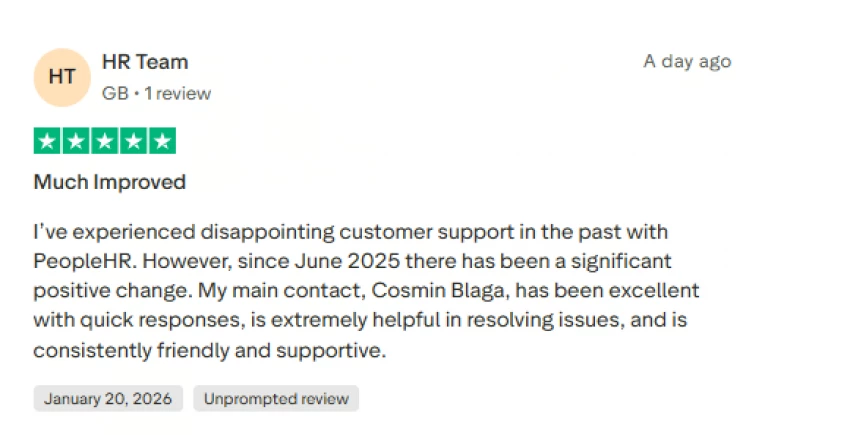
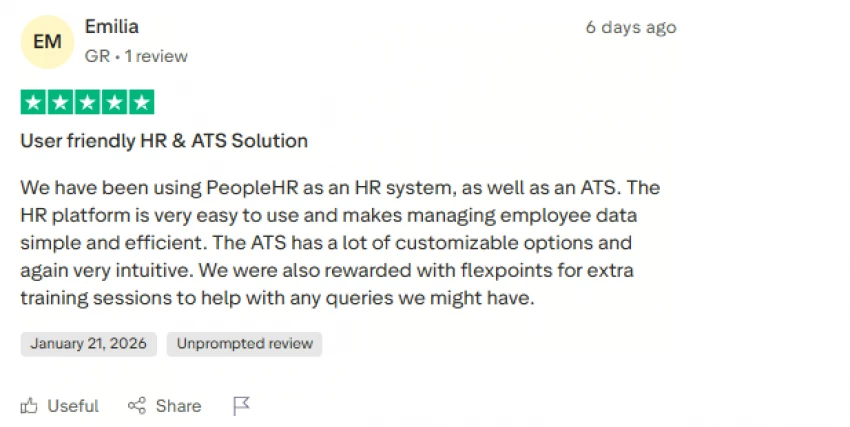
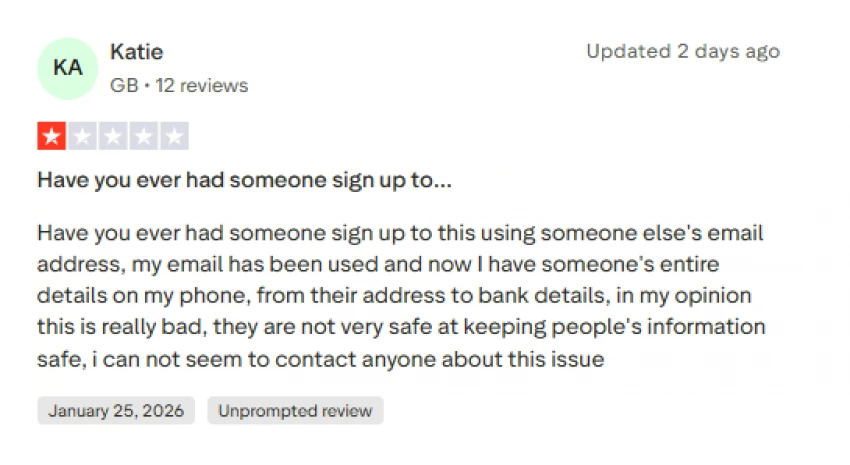
That said, a smaller number of reviews point to inconsistencies in support experiences and challenges related to contract or billing processes.
On platforms such as Capterra and Software Advice, users generally acknowledge PeoplesHR’s functional depth and flexibility. Some older reviews reference usability and interface limitations, though these concerns are commonly associated with earlier versions of enterprise HR software.
Public forums and social platforms show limited discussion around PeoplesHR, which often suggests a lower level of controversy compared to widely debated enterprise HR tools.
When viewed collectively, PeoplesHR demonstrates a consistent reputation across multiple review platforms. Its long-term presence in the HR software market, global customer base, and transparent customer testimonials contribute to its credibility.
As with most enterprise-grade HR systems, the quality of the implementation process plays a critical role in user satisfaction. Organisations that invest time in proper onboarding and configuration are more likely to experience the platform’s full benefits.
PeoplesHR is a capable, all-in-one HRIS platform, but it’s not the only choice available. Depending on your organisation’s size, budget, and priorities (ease of use, global payroll, advanced analytics, integration ecosystem), there are credible alternatives worth considering from small business-friendly platforms to enterprise-grade systems.
Below is a curated comparison of strong PeoplesHR competitors, what they’re best at, and how they differ from PeoplesHR.
Who it’s ideal for: Teams that want a simple, intuitive HR system that’s easy to administer with minimal training.
● Known for its clean, user-friendly interface and smooth onboarding experience.
● Core HR functions include employee database, time-off tracking, performance management and reporting.
● Frequently praised for employee self-service and mobile accessibility.
● Pricing starts at around $10/user/month (varies by region and plan).
Why choose BambooHR over PeoplesHR: Easier to use and set up for smaller teams; excellent for core HR without heavy enterprise complexity.
Who it’s ideal for: Growing organisations that want powerful automation, HR + IT integration, and centralized workforce management.
● Combines payroll, HR, benefits, time tracking, compliance, and even device/app management.
● Noted for automation and strong third-party integrations.
● Pricing is quote-based but starts modestly and scales with modules chosen.
Why choose Rippling: Offers broader workforce management that extends beyond HRIS (e.g., IT asset provisioning), great for tech-savvy and operationally complex businesses.
Who it’s ideal for: Organisations already using Zoho apps or needing flexible modular workflows.
● Offers transparent pricing tiers, including a free plan for small teams and affordable paid plans.
● Handles time off, attendance, onboarding, performance reviews, and HR analytics.
● Integrates deeply with Zoho ecosystem (Recruit, Vault, Expense, etc.), expanding functionality.
● Known for strong value and scalability.
Why choose Zoho People: Excellent value option with clear pricing and flexible modules great for mid-sized companies or those expanding their software footprint.
Who it’s ideal for: Larger organisations prioritising payroll, compliance, benefits and global HR admin.
● ADP offers robust payroll, benefits administration, analytics, and compliance features suitable for large and distributed teams.
● Integrates well with accounting and benefits carriers.
● Pricing is generally quote-based, reflecting enterprise positioning.
Why choose ADP: A powerhouse for organisations that want enterprise-grade payroll and HR capabilities from a trusted global provider.
Who it’s ideal for: Medium and large enterprises seeking powerful scheduling and labor optimisation on top of HR functions.
● Known for deep workforce time management and scheduling features.
● Strong HR analytics and reporting.
● Suitable for industries with complex shift patterns and labor rules.
Why choose UKG Ready: Best for businesses with complex workforce scheduling needs.
Below are platforms that also compete with PeoplesHR in various segments of human capital management:
| Alternative | Best For | Key Strength |
| HiBob | Modern mid-large HR | Intuitive UI + global HR features |
| Oracle PeopleSoft | Large enterprises | Deep payroll + HR customization |
| Workday HCM | Global corporations | Enterprise-grade HR + finance |
| Zimyo | Growing companies | Modular HR + payroll + engagement |
| factoHR | Small/Medium businesses | Easy automation + attendance & compliance |
| Keka | India-focused HR & Payroll | Strong payroll and employee experience |
| Platform | Ease of Deployment | Best For | Notable Strengths |
| PeoplesHR | Medium | All-in-one HRIS | Integrated HR, payroll, analytics |
| BambooHR | Easy | SMBs | Best UI + simplicity |
| Rippling | Medium | Scalable teams | HR + IT automation |
| Zoho People | Easy | Cost-conscious teams | Affordable + modular |
| ADP Workforce Now | Complex | Large enterprises | Compliance + payroll dominance |
| UKG Ready | Complex | Workforce-heavy industries | Scheduling + labor management |
PeoplesHR stands out as a comprehensive HRIS platform built for organisations that value integration, automation, and data-driven HR management. Its strengths lie in unifying HR functions, offering global payroll support, and maintaining a strong reputation for customer service.
While it may require a thoughtful onboarding process and does not publicly disclose pricing, its consistent performance across trusted review platforms suggests it is a reliable option for organisations seeking a long-term HR solution.

Late at night, after the usual AI companion ads blur together, PepHop AI shows u...
Funke Ogunleye1 day ago

Imagine you open a new tab, type “opendream.ai”, and instead of being greeted by...
Samuel Osei2 days ago

Grubby AI is one of those tools that only exists because of a very 2025 problem:...
Funke Ogunleye2 days ago
Meet Muke AIMuke AI is an AI‑powered image manipulation suite best known for two...
Sandra Campos3 days ago

If your marketing currently lives in a chaotic mix of ChatGPT, Canva, random sch...
Samuel Osei3 days ago

Janitor AI doesn’t feel like “a chatbot platform.”It feels like walking into a l...
Sandra Campos4 days ago
Discussion