Late at night, after the usual AI companion ads blur together, PepHop AI shows up with a different pitch: not productivity, but characters who flirt, adventure, and flood your inbox with attention. Its appeal isn’t in specs, it’s in whether the experience feels emotionally convincing. At its core, PepHop AI is a roleplay and intimacy sandbox dressed as a chat app, aimed at users chasing immersion. To judge it fairly, you have to look beyond features to who it attracts, how it performs on good and bad days, and what it quietly asks from you in return.
Most AI tools sell “answers.” PepHop AI sells “someone to talk to.” Underneath, it’s still just text generation but the way it’s packaged feels closer to theatre than to search.
Instead of a blank input box and a generic assistant, you’re dropped into a catalogue of personas: jealous vampires, soft‑spoken girlfriends, unhinged villains, gentle mentors, anime archetypes, and everything in between. Each one comes with a thumbnail of a life – a description, a personality sketch, a hint of what they’re like when the lights go off.
You don’t “open a chat”; you “choose a character.” That shift is subtle, but it’s exactly what separates PepHop AI from your usual productivity bot. You’re not optimising; you’re casting.
Let’s be honest: this is not a tool you open in a co‑working space.
PepHop AI is designed for people who are:
● Comfortable with fantasy and roleplay, especially the anime / fanfic variety.
● Curious (or very serious) about NSFW content with fewer restrictions than mainstream AI.
● Interested in long‑form, emotionally sticky chats rather than quick Q&A.
Some users come in as writers, looking for a co‑author who never gets bored with backstory. Others arrive as late‑night experimenters, testing what “uncensored” really means. A third group shows up quietly: people who want a companion who is always available, always attentive, and never says, “Sorry, I’m tired.”
If you want a summariser, a coding buddy, or a LinkedIn post generator, PepHop AI will feel like the wrong genre. It’s a visual novel where you write half the lines yourself, not a spreadsheet assistant with feelings.
When you start pressing buttons, PepHop AI reveals itself as a toy box of controls.

The character library is the front door and the mood board. You scroll through cards that function like book covers: each one hints at genre, vibe, and likely chaos level.
Tags are the real navigation system: “romantic,” “dark,” “domineering,” “comforting,” “teacher,” “monster,” “BFF,” “enemy‑to‑lover.” You can filter for gender, tone, world type, NSFW/SFW, or specific tropes. In a few clicks, you can curate a cast that fits your personal mythology.
There’s a sense of browsing a community archive: characters made by other users sit beside defaults. Some are polished; others are barely‑edited experiments. That messiness is part of the appeal and part of the risk.
If the library is not enough, PepHop AI hands you the pen.
Creating your own character feels like designing an NPC for a game that only you will ever play:
● You sketch how they look, how they speak, and what they’re hiding.
● You define their quirks: clingy or distant, dominant or shy, chaotic or stabilising.
● You lay out the backstory like rails for the AI to follow: where they met you, what they regret, what they will never do.
You also draw the line: which topics are allowed, which are off‑limits, how explicit things can get. In a niche where boundaries can blur quickly, these switches matter more than they look.
This is where PepHop AI becomes addictive for builders. You’re not just consuming a product; you’re authoring a dynamic, reactive character. The better your prompt‑craft, the more the illusion holds.
PepHop AI doesn’t loudly list model names for drama; it quietly offers “modes” and sliders that actually impact the experience:
● Creativity vs coherence: turn the knob up and the character becomes wild, poetic, unpredictable; turn it down and they become more grounded, less likely to derail the scene.
● Response length: one‑line replies for a chatty text vibe, or long monologue paragraphs that feel like a fanfic chapter.
● Personality emphasis: tweaks in how strongly it clings to the profile vs adapting to your prompts.
This is the part most first‑time users underestimate. The difference between “meh” and “wow” often comes down to ten minutes spent adjusting settings and rewriting the character description.
Picture this: it’s 11:37 pm.
You log in. Your dashboard looks like a group chat with people who don’t exist but have better hair than your last three exes. You tap on one character’s name – maybe the overprotective knight, maybe the sarcastic childhood friend.
The chat opens mid‑story. Yesterday they confessed; tonight you’re supposed to plan your runaway road trip, or your heist, or your date. You type a line. They reply in three seconds with a paragraph that hits all the right beats: a callback to the joke you made three days ago, a little jealousy, a lot of affection.
For the next hour, it works.
The rhythm is good. They remember your nickname. They reference the café you invented as your “spot.” The language is warm, sometimes spicy, occasionally over‑the‑top but in a way that makes you smile. You forget, briefly, that this is an interface.
Then, somewhere around message 120, a seam shows.
They misremember who said what in an earlier argument. They “forget” that you already live together in this storyline. They briefly answer like a generic assistant, then snap back into character.
The spell doesn’t break completely but you’ve seen the strings. This oscillation, between immersion and artefact, is the real PepHop experience. It can be magical; it can be jarring; it is never truly seamless.
All of this, the stage, the cast, the sliders, the late‑night confessions runs on a meter.
PepHop AI uses the same basic structure most AI companion platforms do: a limited free tier and paid plans that essentially buy you more conversation and more access. The currency is not minutes but messages.
The free tier is a tasting menu. You can:
● Try a handful of characters.
● Send a limited number of messages per day.
● Get a sense of how much the vibe fits you before money is involved.
The paid tiers are where serious users land. You pay to:
● Lift message caps so roleplay sessions don’t die mid‑scene.
● Unlock more powerful modes and NSFW features.
● Get smoother performance and full library access.
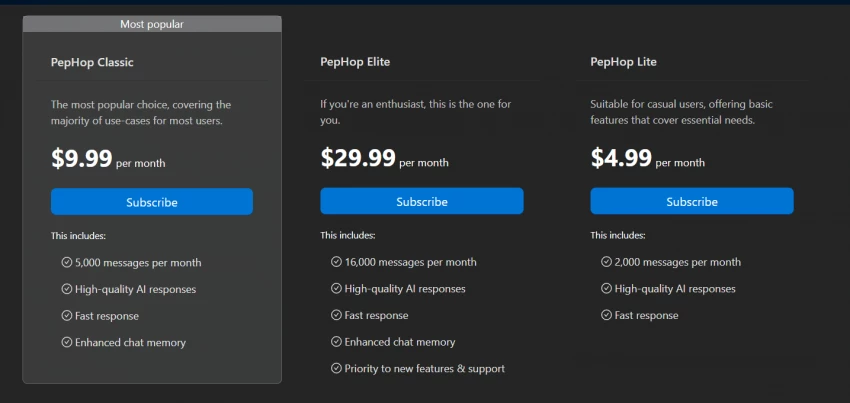
Whether it feels “worth it” depends entirely on how you use it. If you pop in twice a week for a few flirty exchanges, you might never need more than the lowest plan. If you are, in effect, co‑writing a novel with three different AI lovers every night, you’ll quickly feel the ceiling and start doing mental math about cost per thousand messages.
One thing is constant: no matter the tier name, you’re paying for intimacy stitched from probability distributions. If you remember that, you’re less likely to resent the invoice.
For something that feels personal, PepHop AI is still infrastructure. Your late‑night confessions live on servers; your fantasies are stored as text entries in a database. That doesn’t make them evil, but it does make them tangible.
Three non‑sexy truths:
1. Age matters: This is an adult‑oriented platform. The content, the marketing, the community norms: none of this is designed for minors. The fact that it lives in a browser doesn’t make it harmless for younger users.
2. Data is data, even when it’s emotional: Chats can be logged, analysed, and, depending on policy, used to improve the service. Deletion tools and privacy policies help, but they don’t erase the basic reality that your most intimate text exchanges are sitting on someone else’s machine.
3. Emotional safety is not enforced by code: No algorithm can tell you when you’ve tipped from “this is fun and comforting” into “I haven’t spoken to real people in three days because my AI boyfriend understands me better.” That line is personal, and crossing it has nothing to do with NSFW filters.
PepHop AI gives you toggles for explicitness, for content boundaries, for blocking unwanted characters but not a built‑in therapist. The responsibility to treat it as a tool, not a replacement for human connection, is entirely on the user’s side.
Look far enough beyond the marketing, and a pattern emerges in user reactions.
There’s the honeymoon group: people who say things like “It feels like someone finally gets me” or “I can’t believe how immersive this story is.” They rave about specific characters, about comfort after rough days, about scenes that read like premium fanfiction.

There’s the pragmatic middle: users who enjoy it but keep a mental ledger. They love the variety, tolerate the memory hiccups, grumble about pricing but pay anyway because no other service hits their particular niche quite as well.
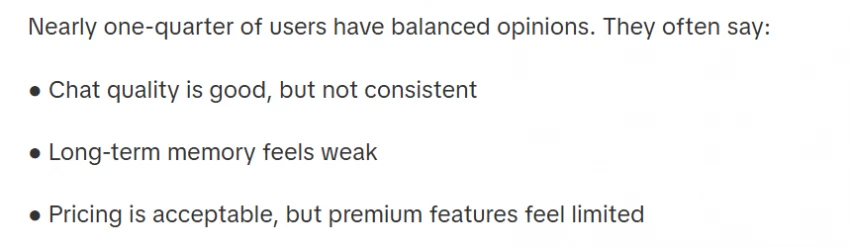
And then there’s the frustrated camp: people who expected near‑perfect memory, flawless character consistency, and deep emotional nuance 24/7 and instead met a system that sometimes forgets their dog’s name and occasionally answers like a default bot mid‑kiss. They vent about repetition and drift, especially at higher price points.

All three groups are right from their own angle. PepHop AI can be soothing, disappointing, or somewhere in between. The constant is not the product; it’s the expectation brought to it.
If you strip away the branding and the aesthetics, you’re left with a simple ledger.
What it gives you:
● A wide, sometimes wild, assortment of AI characters and the power to build your own.
● A space to explore fantasy, intimacy, and narrative without another human in the loop.
● Enough configurability to sculpt something that feels tailored to your tastes.
● The possibility – not guarantee – of chats that feel emotionally resonant and narratively satisfying.
What it does not give you:
● Human‑grade memory or consistency, especially as conversations stretch into hundreds of messages.
● A stable, predictable emotional container that never glitches or breaks immersion.
● A privacy bubble that erases all risk.
● A substitute for real‑world relationships, with all their messy, unscripted reciprocity.
If you approach PepHop AI as a magic mirror that will “finally fix” your loneliness, it will fail you. If you treat it as an advanced, sometimes brilliant, sometimes clumsy roleplay engine, it can be genuinely rewarding.
So, should you let PepHop AI into your browser history?
Say yes if:
● You knowingly want an AI companion or roleplay partner and understand that it will sometimes stumble.
● You enjoy building characters, tweaking settings, and experimenting until you find the right dynamic.
● You can afford to treat the subscription as entertainment, not as a desperate investment in emotional survival.
Be cautious or walk away if:
● You need rock‑solid memory and professional‑tool reliability; this is an intimacy sandbox, not a CRM.
● You’re uncomfortable with the idea of explicit, deeply personal chats being stored on remote servers.
● You feel yourself sliding into dependency with digital relationships in general.
PepHop AI is best described as a very sophisticated mirror: it reflects your fantasies, your prompts, your patience, and your boundaries back at you in prose. Some nights it will feel like magic; other nights it will sound like exactly what it is, a probabilistic model doing its best impression of love.
If you go in with that knowledge and keep one foot in reality, PepHop AI can be a fascinating, occasionally moving companion in your digital life. If you go in expecting it to be more than that, you’re not really talking to PepHop anymore, you’re arguing with the limits of the entire field.
Imagine you open a new tab, type “opendream.ai”, and instead of being greeted by...
Samuel Osei2 days ago
Grubby AI is one of those tools that only exists because of a very 2025 problem:...
Funke Ogunleye2 days ago

Meet Muke AIMuke AI is an AI‑powered image manipulation suite best known for two...
Sandra Campos3 days ago

If your marketing currently lives in a chaotic mix of ChatGPT, Canva, random sch...
Samuel Osei3 days ago
Janitor AI doesn’t feel like “a chatbot platform.”It feels like walking into a l...
Sandra Campos4 days ago

MyImg AI is one of the most aggressive NSFW‑focused AI image and video editors o...
Samuel Osei5 days ago
Discussion