Customer service automation is no longer a future ambition. For many companies, it has become a financial requirement. As conversational AI continues expanding into a multi-billion-dollar market, businesses are searching for systems that don’t just answer calls but actively enhance customer experience.
PolyAI positions itself as one of those systems.
But there’s an important clarification many people miss at first: the PolyAI name represents two completely different products. One is an enterprise-grade voice automation platform. The other is a free consumer chatbot app built for creative interaction.
Understanding that distinction is essential before evaluating whether PolyAI is worth the investment.
PolyAI operates in two separate categories.
PolyAI Enterprise is a premium voice AI solution built for large call centers and corporations. Its focus is automation, performance, and customer service optimization.
PolyBuzz, on the other hand, is a creative AI companion app aimed at casual users. It prioritizes entertainment, flexibility, and open conversation rather than business productivity.
Although they share branding, they serve entirely different audiences and goals.
PolyAI’s flagship product is its enterprise voice AI platform. It is designed for organizations that manage high volumes of customer support calls and want to automate those interactions without sacrificing quality.
The most talked-about feature of PolyAI Enterprise is its voice realism. Unlike traditional interactive voice response systems that sound robotic and rigid, PolyAI delivers speech that feels conversational and expressive.
It combines advanced speech synthesis with strong natural language understanding, allowing customers to speak freely instead of navigating rigid menu structures. This shift significantly improves user experience, as many customers avoid automated systems because they feel impersonal or frustrating.
The ability to hold more natural, nonlinear conversations sets PolyAI apart from older automation systems.
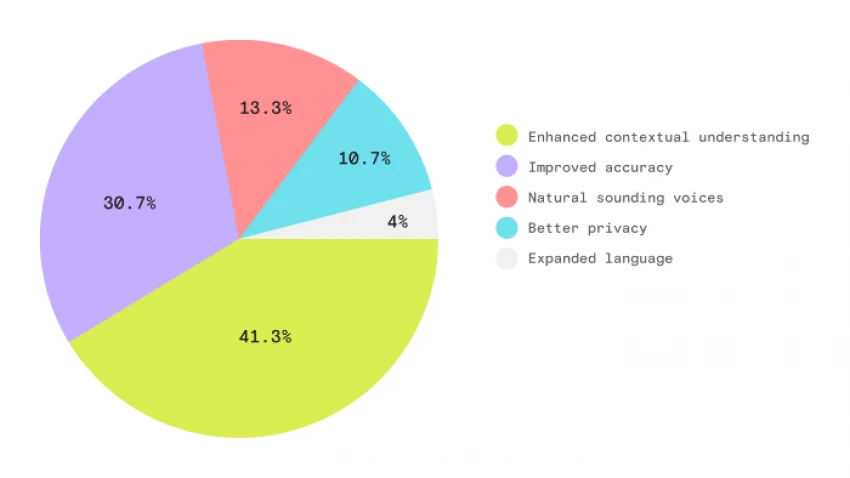
Voice quality alone does not justify enterprise pricing. The true business value comes from automation performance.
Some deployments report that PolyAI can automate up to 90 percent of routine transactional calls without human intervention. That level of automation reduces pressure on live agents and improves efficiency across the board.
For large enterprises, this translates into reduced staffing costs, shorter call handling times, and improved first-contact resolution. Customers receive faster answers, while companies maintain consistent service regardless of call volume or time of day.
This scalability is one of PolyAI’s strongest advantages.
PolyAI Enterprise is built to operate within complex corporate ecosystems. It integrates with major CRM systems and backend platforms, allowing businesses to maintain existing workflows without major disruption.
Security is also a priority. The platform adheres to enterprise-grade compliance standards such as SOC 2 Type II, which is critical for industries that manage sensitive information. Banking, telecom, healthcare, travel, and retail companies require this level of compliance before adopting AI automation tools.
From an infrastructure standpoint, PolyAI is designed for serious enterprise deployment rather than small-scale experimentation.
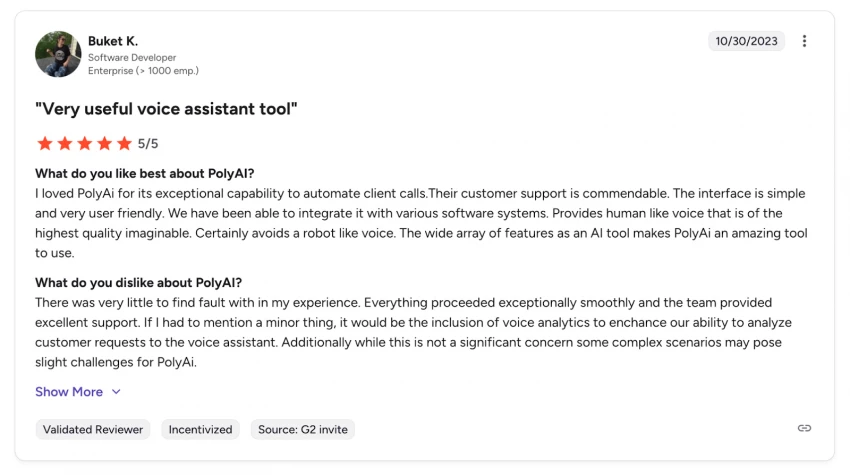
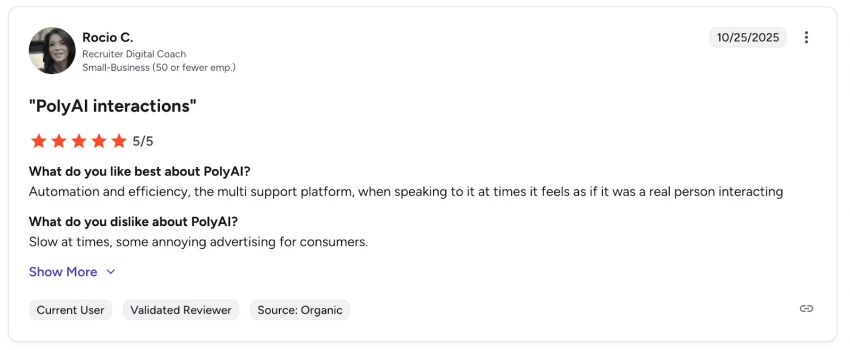
Feedback from enterprise users tends to follow consistent themes.
Many users praise the remarkably natural voice quality, often describing it as “shockingly human.” The system’s ability to understand accents and manage complex conversational flows is frequently highlighted. Businesses also appreciate the professional support provided during integration.
However, criticism exists as well. Some companies report long implementation timelines, sometimes describing the rollout process as slower than expected. Others mention that analytics tools may require additional support to fully utilize. And consistently, the pricing is cited as a barrier for smaller organizations.
The technology earns strong praise, but the investment required is significant.
PolyAI Enterprise is not a budget-friendly product. Annual contracts commonly exceed six figures, and deployment can take several months.
This makes it suitable primarily for enterprises with massive call volumes and long-term automation strategies. Companies must be prepared not only for financial investment but also for operational planning and system integration.
For smaller businesses, the cost-to-benefit ratio may not justify adoption.

PolyBuzz represents the opposite end of the spectrum. It is a free AI chatbot app designed for entertainment rather than enterprise productivity.
While PolyAI Enterprise focuses on efficiency and automation, PolyBuzz focuses on creativity and conversational freedom.
PolyBuzz attracts users who feel constrained by mainstream AI chat platforms. It allows creative storytelling, character-driven dialogue, and exploration of mature or complex themes.
The platform features a wide library of user-generated AI companions, giving users the ability to engage in diverse conversational scenarios. For individuals looking for immersive role-play or casual chat, this freedom is appealing.
It positions itself as a space where conversation flows without heavy filtering.
However, PolyBuzz is not built for reliability. Users report inconsistent factual accuracy, shallow reasoning, and occasional emotional flatness during longer conversations.
Memory can weaken in extended chats, and advertising is present throughout the experience. It is not designed for research, productivity, or professional use.
It functions best as a creative entertainment tool rather than a serious AI assistant.
Evaluating PolyAI without acknowledging its dual nature can be misleading.
PolyAI Enterprise is a premium automation system designed for large-scale corporate environments. Its strengths lie in voice realism, high automation rates, enterprise integration, and security compliance.
PolyBuzz is a casual chatbot app designed for creative interaction. Its strengths lie in openness and accessibility, not precision or structure.
They share branding but operate in entirely separate categories.
The answer depends entirely on which PolyAI product you are considering.
If you are a large enterprise managing millions of customer interactions annually, PolyAI Enterprise is one of the strongest voice AI platforms available today. Its performance and realism can generate significant return on investment for high-volume operations.
If you are an individual user seeking creative, open-ended AI conversations, PolyBuzz offers a free and flexible experience. Just approach it with the understanding that it prioritizes entertainment over reliability.
Ultimately, PolyAI is not one solution but two distinct tools serving two different purposes. Your decision should align with your goals, budget, and expectations.
Why AI Subtitle Generators Are Now EssentialVideo content has exploded across Yo...
Samuel Osei2 days ago
AI chatbots in 2026 have moved far beyond simple question-answer tools. They are...
Alexander Hughes6 days ago

CrushOn AI has quietly built momentum among users searching for character based...
John Nyarko1 week ago
AI companionship platforms are advancing rapidly, but not every tool lives up to...
John Nyarko1 week ago
AI coding tools are transforming how developers write software. If you’re search...
John Nyarko1 week ago

When Suno AI first started appearing in conversations, expectations were low. Ma...
John Nyarko3 weeks ago
Discussion