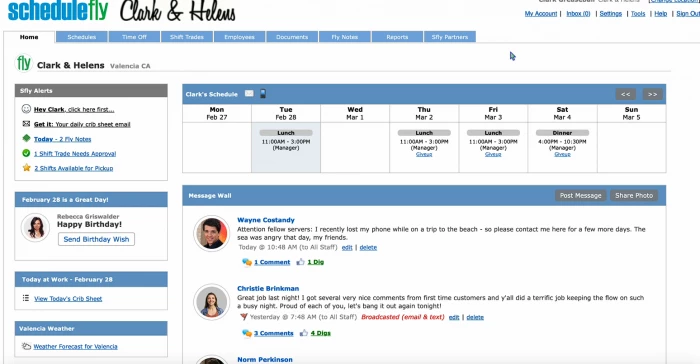
Managing staff schedules in restaurants and hospitality businesses is never simple. Between shift swaps, time-off requests, and last-minute changes, managers need tools that reduce chaos, not add to it. Schedulefly has been in this space for years, offering a straightforward scheduling and communication platform designed mainly for restaurants and small hospitality teams.
In this detailed 2026 review, we take a close look at what Schedulefly offers, how it performs in real-world use, what customers genuinely like about it, where it struggles, and whether it still makes sense compared to modern scheduling tools.
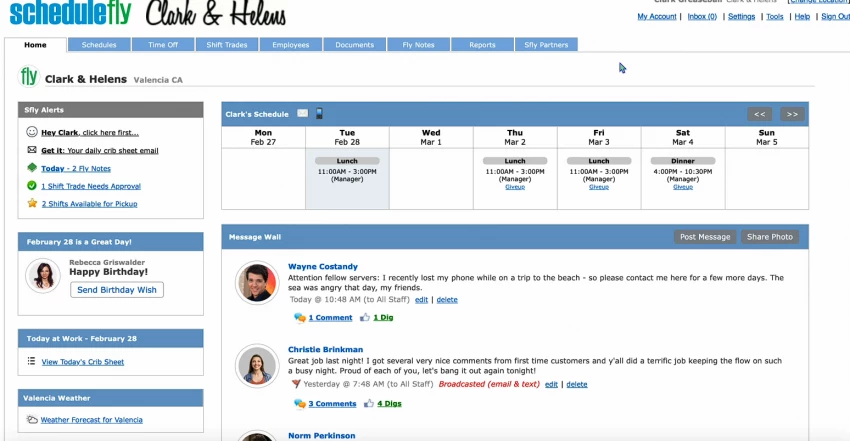
Schedulefly is a cloud-based employee scheduling tool focused on making shift planning and staff communication simple. It helps managers publish schedules, collect time-off requests, send messages, and allow employees to pick up available shifts without endless calls or texts.
Unlike enterprise workforce systems, Schedulefly keeps things intentionally simple. It does not try to manage payroll, deep analytics, or complex labor forecasting. Instead, it focuses on helping teams stay informed and organized with minimal setup.
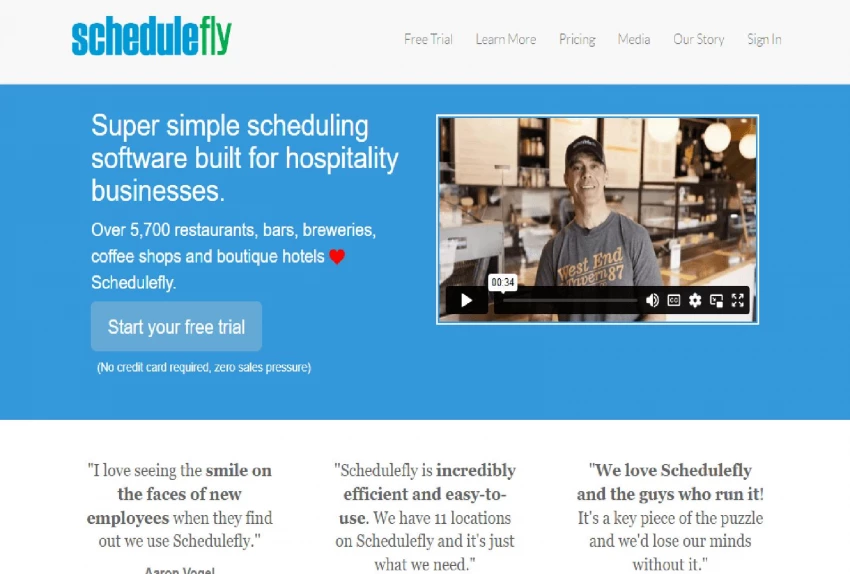
This makes it especially popular with restaurants, cafés, bars, and independent hospitality businesses that want reliable scheduling without technical complexity.
Schedulefly tends to work best for:
Long-time users often mention that the platform feels stable and familiar, making it easy for new employees to adapt without long training sessions.
However, businesses with complex labor compliance needs, advanced reporting requirements, or multi-location corporate structures may find it too limited.
Turning Weekly Scheduling into a Faster Task
Managers can build weekly schedules directly in the platform and publish them instantly. Employees receive notifications when schedules go live, reducing confusion and follow-up questions.
For many restaurants, this replaces physical notice boards and spreadsheet files, making schedule access much easier for everyone involved.
Keeping Everyone in the Loop with Built-In Communication
Schedulefly includes internal messaging and announcement features. Managers can post updates about policy changes, shift reminders, or important notices that all staff can see in one place.
This reduces the need to rely on group chats or personal messaging apps, which often lead to missed updates or mixed information.
Making Time-Off Requests Less Stressful
Employees can submit time-off requests directly through the platform instead of texting managers or filling out paper forms. Managers can approve or decline requests while viewing the full schedule context.
This helps avoid double bookings and reduces scheduling conflicts before they become emergencies.
Giving Employees Flexibility with Shift Pickups
Schedulefly allows staff to offer up shifts and let others claim them. This feature is especially helpful in restaurants where personal schedule changes are common.
Managers still maintain oversight, but the workload of rearranging shifts becomes much lighter.
Staying Connected Through Mobile Access
Employees can check schedules, request time off, and read announcements using mobile devices. While the experience is generally smooth, some users report that the mobile interface is not as polished as the desktop version.
For teams that rely heavily on phones, this can be a minor frustration, especially during busy service hours.
Sharing Notes and Documents Across Shifts
Managers can attach notes to shifts or share documents that help teams prepare for upcoming workdays. This can include event details, menu changes, or special instructions.
It helps create continuity between shifts and keeps everyone aligned without constant verbal reminders.
Schedulefly uses flat monthly pricing based on the number of employees rather than per-user billing. This keeps costs predictable and easier to plan for.
Current pricing generally follows this structure:
There is usually a free trial available, allowing teams to test the system before committing.
Many restaurant owners appreciate this pricing style because costs do not increase unexpectedly as staff turnover happens.
Ease of use is one of the most common compliments across review platforms. Many users say their entire team can learn the system quickly without training sessions.
This is especially important in hospitality environments where staff turnover is high and time is limited.
Many reviewers highlight how responsive and helpful Schedulefly’s support team is. Users often describe support staff as friendly and quick to resolve issues.
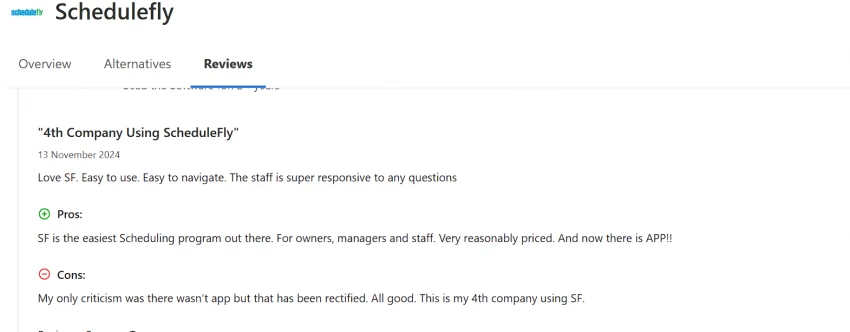
For small business owners who do not have internal IT teams, this level of support can make a big difference.
With affordable flat pricing and core features that cover most daily needs, many users feel Schedulefly offers solid value compared to more expensive workforce platforms.
Businesses that do not need advanced automation find that they are not paying for features they will never use.
Because employees can request time off and manage shift swaps themselves, many managers report fewer scheduling conflicts and fewer last-minute emergencies.
This shared responsibility helps improve overall team coordination.
Users who compare Schedulefly to more modern workforce platforms often point out missing features like labor forecasting, POS integrations, and automated scheduling rules.
For growing businesses, these missing tools can become limiting over time.
While mobile access exists, some users mention slower performance or navigation issues on phones. For teams that rely heavily on mobile devices, this can affect daily usability.
Businesses managing multiple locations sometimes struggle with switching between accounts or managing staff across different branches. The system works best when focused on single-location operations.
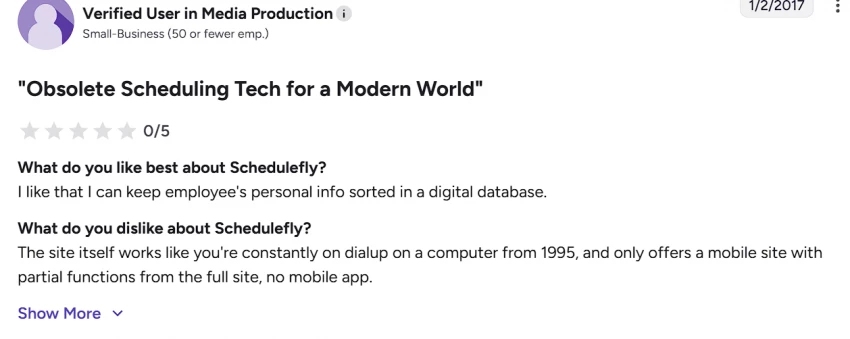
Schedulefly offers limited reporting compared to more advanced scheduling systems. Managers who want detailed labor cost analysis or productivity tracking may find the reporting tools insufficient.
Compared to platforms like 7shifts, Homebase, or When I Work, Schedulefly focuses more on simplicity and less on automation or deep analytics.
Competitors often provide:
However, these platforms can also feel more complex and require more setup time.
Schedulefly remains appealing for teams that want reliable scheduling without dealing with feature overload.
This pattern shows that Schedulefly delivers well on its promise of simplicity but does not try to compete with enterprise-level workforce management systems.
Schedulefly continues to be a practical solution for restaurants and hospitality teams that want a straightforward scheduling and communication platform.
It is not designed to be an all-in-one workforce management suite. Instead, it focuses on doing a few things well: scheduling, communication, and staff coordination.
If your business needs complex reporting, deep integrations, or predictive scheduling tools, you may want to explore more advanced platforms.
But if your priority is keeping schedules organized, reducing daily communication stress, and working with a tool that your entire team can easily understand, Schedulefly remains a strong and dependable choice in 2026.

Late at night, after the usual AI companion ads blur together, PepHop AI shows u...
Funke Ogunleye1 day ago

Imagine you open a new tab, type “opendream.ai”, and instead of being greeted by...
Samuel Osei2 days ago

Grubby AI is one of those tools that only exists because of a very 2025 problem:...
Funke Ogunleye2 days ago

Meet Muke AIMuke AI is an AI‑powered image manipulation suite best known for two...
Sandra Campos3 days ago

If your marketing currently lives in a chaotic mix of ChatGPT, Canva, random sch...
Samuel Osei3 days ago

Janitor AI doesn’t feel like “a chatbot platform.”It feels like walking into a l...
Sandra Campos4 days ago
Discussion