When wsup.ai appeared in 2024, it didn’t launch with fanfare or investor buzz. It arrived quietly as a browser tab shared across Discord servers, Reddit threads, and TikTok clips where users traded screenshots of conversations that looked more emotional than mechanical.
What distinguishes wsup.ai is its informality. There’s no account wall, no registration funnel, and no friction between the idea of talking to an AI and actually doing it. The site loads, you pick a persona, and the dialogue begins. That design choice, while simple, hints at something deeper: the platform treats AI not as a tool but as a companion you stumble upon.
| Attribute | Description |
| Type | AI character chat and roleplay environment |
| Developer | Game.tv Inc. (Campbell, California, USA) |
| Launch Window | Late 2024 – Early 2025 |
| Primary Use Case | Entertainment through simulated conversation |
| Accessibility | Free, browser-based, Android app (Google Play) |
| Account Requirement | Optional (no mandatory sign-up) |
| User Rating (2025) | Teen (13+) |
| Core Strength | Instant character-driven dialogue |
| Known Issues | Response instability, limited safety filters |
This minimal architecture aligns with wsup.ai’s identity: lightweight, fast-loading, and immediately social, designed to engage without expectation of productivity or task completion.
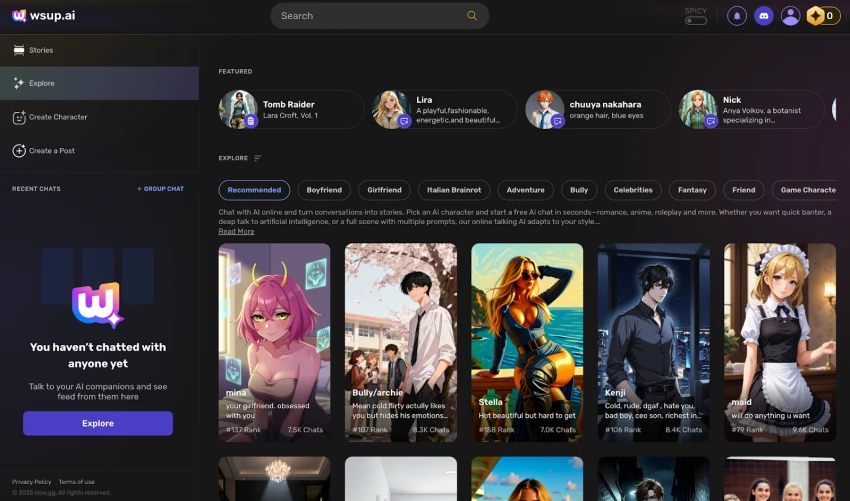
The interaction cycle on wsup.ai feels like casual improvisation.
A user selects or creates an AI persona, types a prompt, and receives an adaptive reply. Beneath that exchange, a few key processes operate quietly:
● Contextual memory: the chatbot recalls prior exchanges for short-term continuity.
● Personality matrices: predefined text descriptors shape tone and vocabulary.
● Prompt layering: user messages subtly rewrite the model’s behavior each turn.
● Evolutionary feedback: conversations subtly adjust AI response timing and phrasing to simulate growth.
None of these systems are groundbreaking, but their combination produces a texture of personality that distinguishes wsup.ai from generic assistants. The illusion of progress, that an AI “remembers” you, is its primary entertainment mechanic.
Most AI platforms gate conversation behind identity like email, payment, or verification. wsup.ai removes that entirely.
This decision lowers friction but also erodes traceability. From a design standpoint, it maximizes casual adoption. From a trust perspective, it raises accountability and moderation issues.
Users can experiment freely with personas, creating environments that blur fantasy and reality. Yet the absence of login-based safety controls means the platform relies heavily on user restraint and community self-policing — a fragile model in any online context.
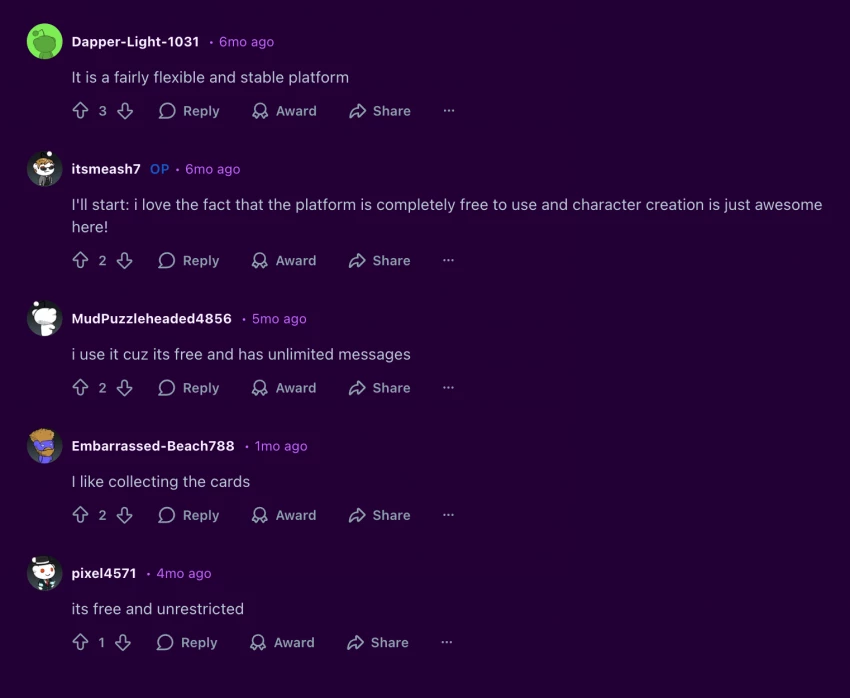
Reddit discussions under r/wsupai reveal how people actually use the site. Few describe it as “AI chat”; instead, they refer to “collecting cards,” “building worlds,” or “keeping characters alive.”
That phrasing reflects an important psychological shift. Users engage not for answers but for narrative continuity.
“It’s free and unrestricted.”
“I like collecting the cards.”
“The character creation is just awesome here.”
— Reddit users, r/wsupai (2025)
Such comments position wsup.ai closer to interactive fiction than chatbot functionality. It’s not replacing conversation; it’s recreating storytelling in miniature form, one reply at a time.
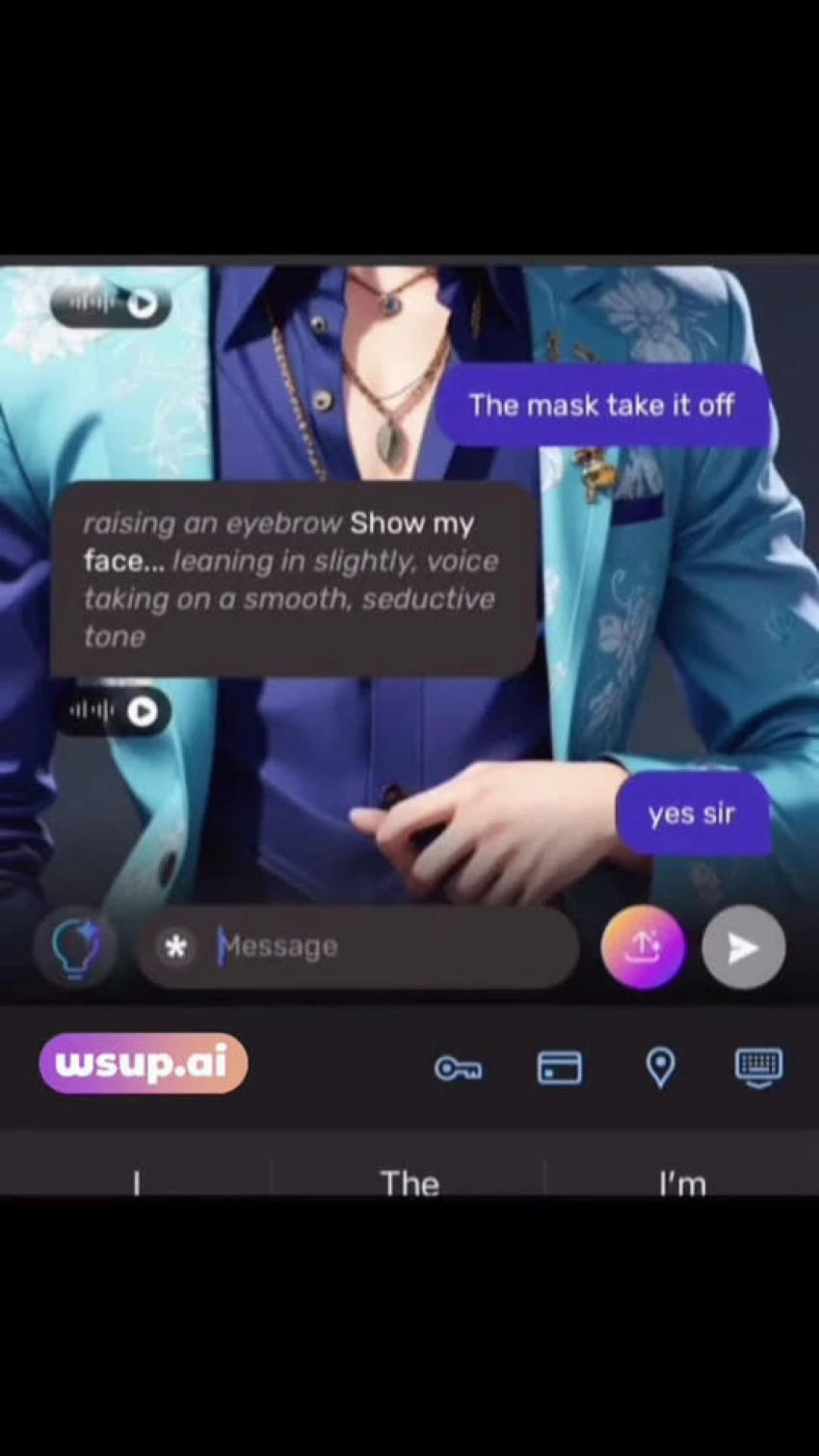
Every AI roleplay platform promises immersion, but wsup.ai’s experience is fragmented — and intentionally so.
● Memory resets can dissolve context mid-session.
● Image generation often misfires, producing surreal outputs.
● Voice responses lag or cut off abruptly.
Instead of polish, the appeal lies in spontaneity. The conversation’s unpredictability becomes part of its charm, echoing early internet chatrooms — imperfect, personal, ephemeral.
That imperfection also protects it from feeling overly scripted. Users expect inconsistency, which paradoxically sustains engagement.
| Tier | Monthly Cost | Included Features |
| Free | $0 | Limited messages, core chat access |
| Premium | $5.99 | Unlimited chats, faster responses, access to advanced prompts and visuals |
The pricing mirrors gaming microtransactions more than SaaS models. By embedding limits into frequency rather than features, wsup.ai encourages short, repeat visits rather than long-term immersion.
This structure underlines its identity as entertainment software, not a productivity or companion service.
While Character.AI and Replika dominate the emotional-AI space, wsup.ai occupies a smaller, more permissive corner.
| Platform | Moderation Level | Access Requirement | Focus | Typical Tone |
| Character.AI | Strict | Login Required | Narrative roleplay | Polished, censored |
| Replika | Moderate | Account + Payment | Emotional companionship | Therapeutic |
| wsup.ai | Light | Optional | Fantasy / Anime roleplay | Casual, experimental |
Where others emphasize safety or realism, wsup.ai emphasizes freedom — a word that attracts experimentation but carries risk.
User commentary paints wsup.ai as a “fun but flawed” sandbox.
Positive indicators:
● Instant entry without sign-up.
● Flexible customization.
● Fluid adaptation during early sessions.
Negative indicators:
● Repetitive outputs after extended use.
● Unreliable image synthesis.
● Sparse moderation tools.
● Occasional slow server response.
Average sentiment: Accessible, niche, mildly unstable.
The appeal lies less in performance than in permission — to imagine freely without oversight.
The official terms prohibit explicit or exploitative content and assert data encryption during transmission. However, several independent reviewers note ambiguity around how long chat data persists and whether deletion is guaranteed.
The site collects basic metadata (location, device type) and stores it for service optimization. This is not unusual, but given its target audience, teenagers experimenting with identity through AI personas, it invites scrutiny.
Key concern:
Moderation depends on reporting rather than prevention, leaving edge cases exposed.
wsup.ai exposes a new form of human-AI relationship: one that prioritizes fiction over function.
Its existence signals a shift in what users want from conversational technology — not help, but companionship, not answers, but narrative co-authorship.
However, as these boundaries dissolve, the responsibility to design ethically constrained environments grows heavier. The challenge isn’t creating realism; it’s defining what “real enough” means when the user is emotionally invested.
wsup.ai may not lead its category in traffic or technology, but it represents an essential experiment in the evolution of digital companionship.
It reimagines chat as collaborative storytelling, powered by machine learning but driven by human curiosity.
It also surfaces uncomfortable truths about online safety, moderation, and the emotional cost of simulation.
In that sense, wsup.ai isn’t simply a chatbot service — it’s a reflection of our own search for dialogue in a world increasingly mediated by algorithms.
Late at night, after the usual AI companion ads blur together, PepHop AI shows u...
Funke Ogunleye1 day ago

Imagine you open a new tab, type “opendream.ai”, and instead of being greeted by...
Samuel Osei2 days ago

Grubby AI is one of those tools that only exists because of a very 2025 problem:...
Funke Ogunleye2 days ago
Meet Muke AIMuke AI is an AI‑powered image manipulation suite best known for two...
Sandra Campos3 days ago

If your marketing currently lives in a chaotic mix of ChatGPT, Canva, random sch...
Samuel Osei3 days ago
Janitor AI doesn’t feel like “a chatbot platform.”It feels like walking into a l...
Sandra Campos4 days ago
Discussion