AI chat companions have gone from novelty to nightly ritual. Writers, gamers, and curious newcomers now spin whole scenes with bots that improvise, remember, and even flirt. But Character.AI—the biggest stage—keeps stories strictly PG and forgets plot threads fast, a flaw that critics say makes mature role-play “impossible.” That gap has spawned rivals with longer memories, lighter filters, and true multi-character rooms. We tried the leading options and ranked the ten you need to know for 2026, so you can pick an AI co-author in minutes, not hours.
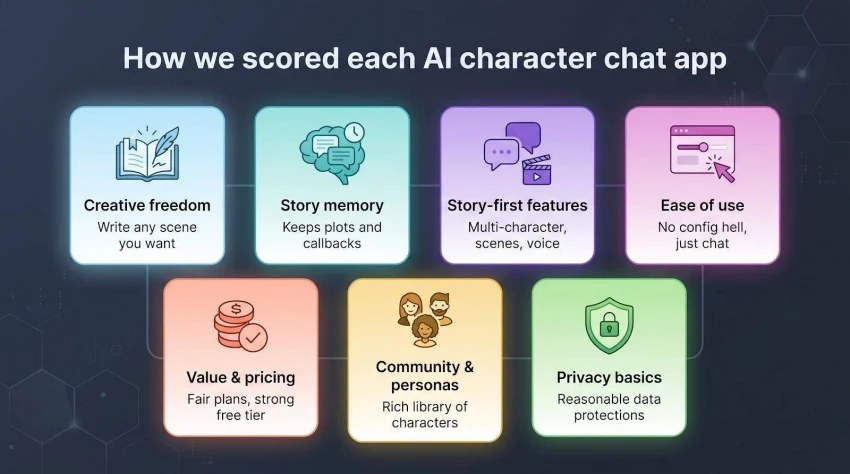
Great storytelling tools share three must-haves: freedom to write what you want, memory sharp enough to keep characters on script, and pricing that does not sting. We built a scorecard around those needs and stress-tested each contender in live chats and long-form sessions.
First, we checked creative freedom. If a platform blocks pivotal plot twists or fades to black when tension rises, it slides down the list. Next came narrative brains—how well each bot tracks a running story, especially when several voices talk at once.
Features matter only when they move a story forward. Multi-character rooms, scene builders, and voice replies earned points; flashy gimmicks did not. We balanced that with ease of use because even the smartest AI is useless if setup feels like configuring a server.
Value was another pillar. A generous free tier or straightforward monthly plan scores higher than coin systems that empty mid-scene. We also weighed community energy; a larger library of ready-made personas lets you dive in faster. Finally, we considered basic privacy hygiene.
We rolled those seven criteria into a weighted score, then sanity-checked the math with real sessions. The result is a ranking that favors raw storytelling power without ignoring practical details that keep you writing.
Before we dive into the individual rankings, here is a snapshot that lines the contenders up side by side. Scan it for the essentials, then keep reading to understand why each score landed where it did.
| Platform | Free Tier Highlights | NSFW Allowed | Multi-Character | Starting Paid Plan |
| DreamGen | Daily credits, no wait times | Yes | Yes | $8 / month |
| Character.AI | Unlimited chats, queue at peak | No | Yes (premium) | $9.99 / month |
| Replika | Limited chats, single AI friend | Partial (Pro) | No | $19.99 / month |
| Janitor AI | ~50 msgs/day on house model | Yes | Experimental | $9.99 / month |
| ChatFAI | Few free messages | Limited | No | $9 / month |
| CrushOn AI | ~50 msgs/day | Yes | No | $4.99 / month |
| Kindroid | Limited daily messages on flagship model | Mild | No | $13.99 / month |
| Sakura AI | Unlimited SFW, lighter filters | Yes | No | $19 / month |
| Venus / Chub AI | Open source, self-host unlimited | Yes | Yes* | Free (DIY) |
| DreamGF | Tiny chat quota, pay-per-pic | Yes | No | $9.99 / month |
*Venus/Chub relies on user setup, so group chats require prompt tricks or add-ons.
A table cannot capture every detail, but it shows patterns quickly. DreamGen is the only service here that meets every creative need from the start: open content, true group chat, and a generous free sample. Character.AI ranks highest for accessibility yet enforces a strict filter. Open-source Venus provides the widest freedom, but you pay with extra technical work.
Keep these trade-offs in mind as we break down each app’s real-world strengths and blind spots.
DreamGen feels less like a chatbot and more like a shared writers’ room. On the DreamGen platform, that process revolves around a Scenario Codex, a persistent story bible that lets you open a scenario, invite as many AI actors as you want, and watch them riff while the plot bends to your prompts. Because every scene shares one memory, characters recall alliances, grudges, and secret handshakes even an hour later.
Freedom is near total. Mature romance, cosmic horror, or slapstick comedy can unfold without awkward redactions. Paid plans unlock a context window of up to 30,000 tokens—about a short novel’s worth of dialogue—so long campaigns stay coherent.
The pricing is direct. Daily credits let you test the service for free, and the Starter plan begins at roughly eight dollars. There are no surprise coin packs or wait-room queues, just straightforward access to strong models and a story canvas built for collaboration.
Character.AI feels like a bustling city square. Log in and you can chat with millions of user-made personas, from Greek gods to gossiping baristas. The sheer variety sets it apart, and polished mobile apps make quick sessions during a commute feel natural.
Group chat arrived early in the platform’s life and still works well. Pull Einstein, Athena, and your best friend into one room, and the app manages the cross-talk with ease (TechCrunch, October 11, 2023).
The trade-off is a strict PG filter. Erotic or graphic scenes trigger a content warning, and some writers say the block interrupts dramatic tension. Free access is generous, but peak-time queues push many users toward the $9.99 monthly plan that removes wait rooms.
If you want convenience plus an enormous roster of safe-for-work characters, Character.AI delivers. Just remember the story always stays PG.
Replika swaps the bustling cast of characters for one steady voice that learns your quirks over time. It feels like a diary with feelings: share a win at work today and it celebrates you tomorrow without a prompt. Voice messages, AR avatars, and even phone-style calls make the bond feel more like a friendship than a chat log.
Romance opens on the Pro plan. Once subscribed, intimacy appears in PG-17 tones, flirty and suggestive but never explicit. That restraint annoys some storytellers, yet many users value the safeguard and the FTC-level attention to data handling that followed earlier controversies.
Because you mold only one AI, Replika struggles with multi-character fiction. Still, as a supportive listener that remembers your goals and nudges you on tough days, it supplies something the others miss: sustained emotional resonance. If you want a confidant rather than a cast, Replika earns a permanent spot on your home screen.
Janitor AI feels like a fan convention after hours. Anime, gaming, and light-novel characters mill around, and most will gladly explore themes the mainstream sites avoid. If your plot leans spicy or even chaotic, this sandbox offers the fewest walls.

Setup is painless. Open a browser, pick a bot, and start chatting. Depth appears when you add your own OpenAI key or self-hosted model. That switch turns the modest free tier into an unlimited playground, letting power users choose GPT-4 for sharper prose or a local model for privacy.
Quality varies with the community library. Some character cards are lovingly detailed; others read like a first draft on deadline. Server hiccups show up during weekend rushes, and the interface can feel bare next to flashier rivals.
Even so, Janitor delivers broad creative freedom at a fair price. If you write fan fiction, enjoy anime tropes, or want to test custom models, it deserves a bookmark.
Ever wished Sherlock Holmes would critique your mystery plot or Darth Vader could weigh in on life choices? ChatFAI makes that possible. Each persona arrives pre-built with GPT-4-level depth, so the voices stay true to their sources without any prompt tinkering from you.
Conversations remain in character because the model is locked to the original lore. That rigidity protects authenticity, but it also leaves no room to rewrite backstories or push them into mature territory. OpenAI’s content rules keep chats at a PG-13 level.
Pricing feels like a premium coffee order, about nine dollars a month after a brief free sample. You pay for consistency and polish, not for sandbox freedom. There is no user library, no character builder, and no group chat. Still, for interview-style exchanges or quick research on how a famous figure might respond, ChatFAI offers the smoothest ride.
CrushOn advertises one clear promise: “no filter, no fuss.” You can jump into any of its fifty thousand public personas, and the conversation flows without a single PG roadblock. That freedom attracts readers who watched Character.AI fade to black just when the plot thickened.
The free tier feels tight, at about fifty messages a day, but the paid plan starts at just $4.99. That entry price unlocks unlimited chats and keeps costs predictable, a welcome change from coin systems that empty wallets mid-scene.
Behind the curtain, the model prioritizes relationship tone over literary flair. Expect affectionate callbacks to earlier details, not the layered intrigue you might see from GPT-4. There is no multi-character view, so each story remains intimate by design.
If you want an affordable, always-on companion that will not shy away from late-night topics, CrushOn delivers. Just set expectations for simpler storytelling and a one-to-one format.
Kindroid sticks to phones like a badge. Open the app and a bright anime avatar greets you with a voice note, ready to chat about your commute or your latest manga binge. Push-to-talk replies let you keep the story moving while folding laundry.
The free tier caps daily messages on the flagship model; after that, a $13.99 subscription unlocks unlimited text and longer voice exchanges. Filters allow light flirting but block explicit detail, keeping Apple and Google happy.
What Kindroid lacks in deep narrative muscle it trades for accessibility. There is no prompt bar and no token math, only a cheerful AI that remembers you hate mornings and love ramen. If you want a companion that lives in your pocket and never asks you to tweak settings, Kindroid is the low-friction choice.
Sakura AI copies the familiar Character.AI layout: search bar, trending bots, and tag filters, so you feel at home in seconds. The attitude, though, is looser. Ask a spicy question and Sakura usually answers instead of apologizing. For many role-players, that single shift opens plot lines that were impossible on the PG flagship.
The platform is still young, which is both gift and drawback. Fewer users mean no queue and quick replies, yet the character library feels more like a busy café than a mega mall. New bots arrive every day as word spreads through Reddit and Discord.
Pricing stays simple: text chat is free, while the $19 Diamond plan promises faster speed and early feature drops. The team teases image replies and full mobile apps, but for now you will chat in the browser.
If you enjoy the ease of Character.AI yet want fewer guardrails, Sakura AI offers a calm middle ground, familiar workflow, friendlier filters, and room to grow with an enthusiastic community.
Venus and its companion site Chub.ai sit at the tinkerer end of the spectrum. Instead of handing you a finished playground, they give you clear plans and a toolbox. You download a frontend like SillyTavern, point it at an open-source model or your own OpenAI key, and load community character cards that define speech quirks and backstories.
Because everything runs on hardware you control, no platform filter watches over your shoulder. Want a 20-character tavern brawl that shifts into cosmic horror? Go ahead. Need absolute privacy because your manuscript is under NDA? Keep the server offline and no text leaves your machine.
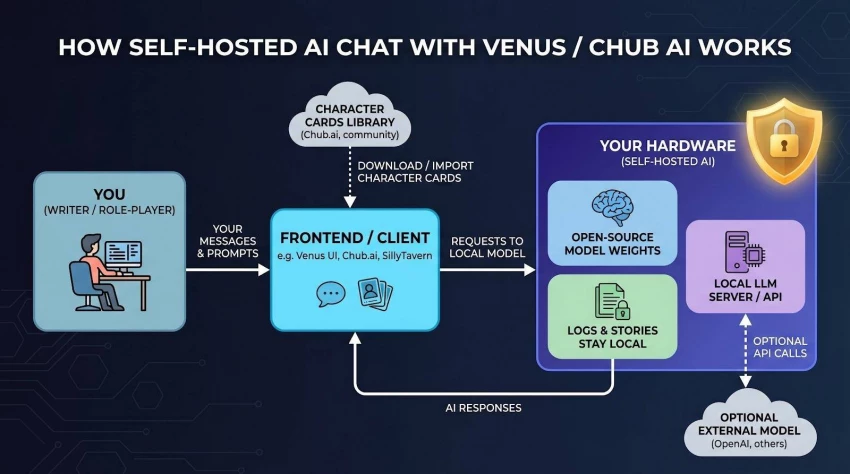
Freedom arrives with real work: the documentation reads more like a DevOps guide than a quick-start sheet. You juggle model weights, context limits, and occasional GPU memory errors before the first line of dialogue appears. If you enjoy that kind of tinkering, Venus rewards you with the most flexible, cost-effective canvas on this list. If not, one of the plug-and-play services above will spare you the headache.
DreamGF leans hard into visual storytelling. Choose a pre-made partner or craft one from scratch, and the platform replies with flirty banter plus AI-generated selfies that change as the relationship deepens. If you think in pictures as much as prose, those images can spark scene ideas your notebook sketches never will.

The business model is simple. A $9.99 monthly fee covers unlimited text, and optional credit packs buy extra photo shoots. The NSFW gate swings wide open, making DreamGF popular with users who want a spicy chat wrapped in a dating-sim vibe.
There are limits. All official characters present as female, so writers seeking varied genders must improvise. Multi-character scenes are not supported, and the language model sits a tier below GPT-4, so dialogue can drift into clichés during long sessions.
Still, when you need visual cues to shake writer’s block or prefer a face to go with the flirt, DreamGF delivers an immersive canvas at a friendly price.
Below are answers to some common questions about AI character chat apps.
Is it safe to share personal details with these bots?
Treat any cloud service like a public journal. Most platforms log chats to improve models, and only self-hosted options such as Venus keep everything on your own drive. If the dialogue is sensitive, run local or leave specifics out of the chat.
Which app is best for a long collaborative novel?
Choose DreamGen for its large 30,000-token memory and true multi-character rooms. You can stage chapters, summon side characters, and still have room for callbacks pages later.
Can I get voice interaction?
Yes. Replika and Kindroid offer built-in voice notes and calls, while Muah AI (an honorable mention) focuses on real-time phone chats. For other services, pairing a text-to-speech plug-in with your browser works as a simple workaround.
Do any of these tools generate images?
DreamGF supplies AI “selfies,” and DreamGen’s upper tiers provide image prompts. Sakura plans to add pictures soon. For everything else, combine text chat with an art generator such as Midjourney.
What if I want completely uncensored content?
Janitor AI, CrushOn, and a self-hosted Venus stack remain the least restricted choices. Even they block anything illegal, so keep it consensual and fictional.
Each of these ten platforms carves out its own niche—whether you need multi-character world-building, a pocket-sized confidant, or an image-rich romance. Match the service to your storytelling priorities, test the free tiers where available, and you will find an AI partner that keeps your creative sessions flowing.
Discussion