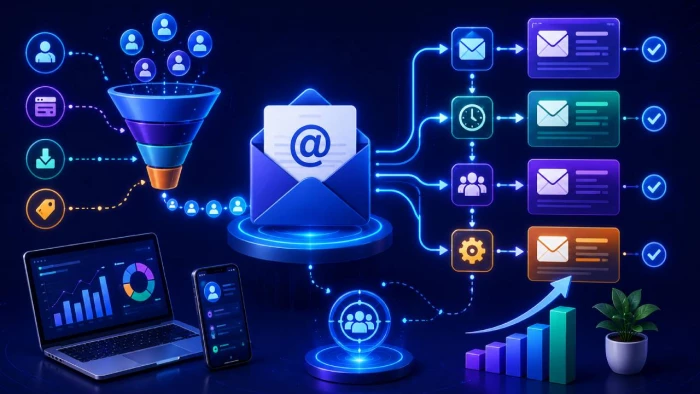
Most marketing teams are sitting on an underused asset. They have a list, some tools, maybe a welcome email that fires when someone signs up. But somewhere between that first automated message and actual pipeline, the whole thing stalls. Leads go quiet. Sequences run out. Deals don't close.
The problem usually isn't the channel. Email still has one of the highest ROIs in B2B marketing. The problem is the setup.
A lot of teams confuse automation with scheduling. Queuing up a newsletter three days in advance isn't automation, it's just time-shifted manual work. Real automation responds to behavior, adapts to context, and keeps running whether or not anyone is watching the dashboard.
A trigger is what starts a sequence. Without a reliable trigger, automation is just guesswork.
The most effective triggers in lead generation aren't time-based; they're behavior-based. A prospect downloads a guide, visits a pricing page three times in one week, or clicks a specific link in a previous email. Each of those actions says something about where that person is in their thinking and a well-built sequence responds to that signal rather than treating everyone the same. According to Salesforce's State of Marketing report, high-performing marketing teams are 3.2x more likely to use behavior-based triggers than average teams.
Running automation on an unsegmented list is one of the most common reasons sequences fail.
The VP of Engineering who signed up for a technical whitepaper needs a completely different conversation than the Marketing Director who came through a paid ad. When both receive the same nurture sequence, one of them disengages immediately. At the same time, segmenting by job function, company size, or acquisition source before any sequence starts is what turns a generic drip into something that actually feels relevant. It takes more setup upfront and saves a lot of re-work later.
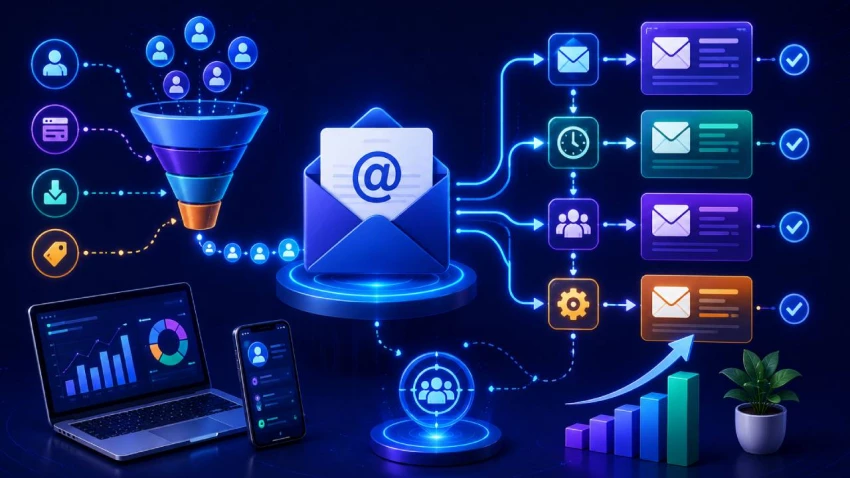
Not all email sequences serve the same purpose. Knowing which type to use at which stage is what separates teams that generate pipeline from teams that just generate opens.
The first 72 hours after someone joins a list are the highest-engagement window in the entire relationship.
Open rates on welcome emails average around 50%, compared to 20-25% for standard campaigns, per Mailchimp's benchmark data. Despite this, a lot of companies send a single "thanks for signing up" message and then nothing for two weeks. A four-to-five email welcome sequence that progressively educates, builds credibility, and guides the subscriber toward a specific next step converts significantly better than a single confirmation. The goal isn't to sell immediately — it's to make the person feel like staying subscribed is worth their time.
Not every lead is ready to buy when they first show up. Roughly 96% of website visitors aren't ready to purchase on their first visit, which means the nurture sequence is doing most of the actual work.
The mistake here is treating nurture as a series of product reminders. Genuinely useful content — case studies, practical guides, industry data, worked examples — keeps a lead warm far more effectively than bi-weekly "just checking in" emails. In addition, nurture sequences work best when they branch: a lead who clicks a link about pricing gets a different follow-up than one who reads a how-to article. That kind of conditional logic is now standard in most email platforms and worth the setup time.
A subscriber who hasn't opened anything in 90 days isn't necessarily gone. They might just be waiting for something relevant.
A short re-engagement sequence of two or three emails, with a subject line that acknowledges the silence directly ("Still interested? Here's what you've missed"), tends to outperform continuing to send regular content to an unresponsive segment. This is where a platform like EmailOctopus earns its keep — you can automate the whole sequence to trigger after a set window of inactivity, so the right message goes out at the right moment without you having to monitor the list by hand. Those who don't re-engage after the sequence get suppressed, which also keeps bounce rates and spam complaints low, protecting deliverability for the active portion of the list.
Sequences are only as good as the data feeding them. This is where most automation strategies fall apart quietly — bad data means wrong triggers, misfired segments, and emails going to addresses that stopped existing six months ago.
B2B contact data decays at roughly 22% annually. That means one in five contacts on a list becomes invalid every year just through natural churn: job changes, company rebranding, domain migrations.
Teams that run automation on unverified lists see bounce rates creep above 2%, which triggers deliverability penalties from Gmail and Outlook. Once domain reputation takes a hit, even well-targeted emails to valid contacts start landing in spam. Verification before importing any list, and periodic re-verification on active segments, is the maintenance work that keeps the whole system running cleanly.
For teams doing outbound alongside inbound automation, the quality of the initial contact list matters just as much as the sequence design.
A good lead generation platform handles both sides: finding verified business email addresses from a domain or LinkedIn profile, and confirming those addresses are active before they enter any sequence. That combination — find and verify in the same workflow — cuts down on the manual steps that slow most outreach teams down and keeps bounce rates below the threshold where deliverability starts to suffer.
Most email dashboards surface open rates and click rates by default. Both are useful. Neither tells you whether automation is actually generating leads.
A sequence with a 45% open rate but a 0.3% conversion rate is underperforming. A sequence with a 22% open rate and a 4% conversion rate is doing its job.
Conversion here means whatever action moves a lead forward: booking a call, starting a trial, requesting a demo, downloading a bottom-of-funnel asset. Tracking this at the sequence level, not just the individual email level, shows which flows are generating pipeline and which are just generating clicks. The table below summarizes where to focus based on the numbers:
| Metric | Healthy Range | What Low Numbers Usually Mean |
| Open rate | 20-35% | Subject lines or sender name needs work |
| Click-to-open rate | 15-25% | Content or CTA relevance |
| Conversion rate | 2-5%+ | Sequence structure or offer alignment |
| Unsubscribe rate | Below 0.5% | Segmentation or frequency issues |
| Bounce rate | Below 2% | Contact data quality |
Individual email metrics are useful for optimization. Sequence-level metrics are what drive strategy decisions.
If a five-email nurture sequence converts at 1.2% but the first two emails have strong engagement and the last three are ignored, the answer isn't to rewrite everything. It's to test a shorter sequence, or to trigger a branch after email two rather than continuing to the same path for everyone. That kind of iteration is what separates teams that keep improving results from those that set something up and leave it running until it stops working.
Email marketing automation generates leads on autopilot only when the underlying system is built right: clean data, behavior-based triggers, sequences that match the subscriber's context, and metrics tracked at the level that actually informs decisions. Get those pieces in place and the channel earns its reputation. Skip any of them and you end up with a lot of activity and not much pipeline.
Discussion