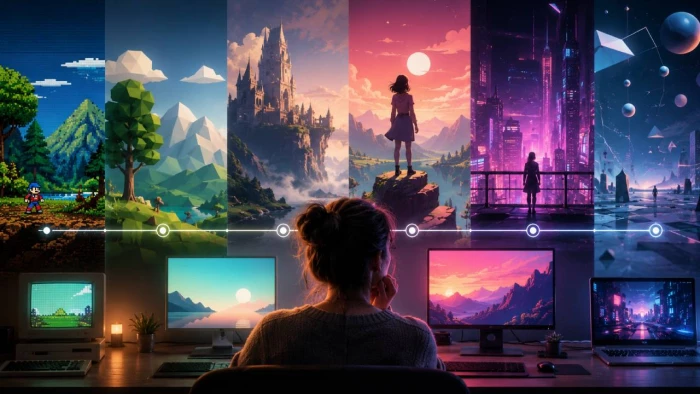
Open any random corner of the internet today and you can usually tell, within seconds, roughly when the visual style you're looking at first took hold. That's not an accident. Digital aesthetics move in waves, each one shaped by the technology available at the time, the platforms hosting it, and the audiences pushing back against whatever came before. Tracing that evolution says less about design trends in isolation and more about how the internet itself has changed.
The earliest era of web design wasn't really aesthetic in any intentional sense. Rather, it was a byproduct of limitation. Dial-up speeds meant small file sizes. Browser support was inconsistent. The result was a chaotic visual language of tiled backgrounds, animated GIFs, marquee text, and clashing colors, all stitched together by people learning HTML from scratch.
It looked the way it looked because that's what the tools of the time allowed, not because anyone was chasing a particular vibe.
What's interesting is how much affection that era still gets decades later. The "Geocities aesthetic" has been deliberately revived by artists and designers as a kind of anti-minimalism. It is a reaction against the polished, templated look that dominates most of the modern web. Nostalgia turned a technical limitation into a style choice.
It's worth noting that this revival pattern repeats constantly throughout internet history. Almost every aesthetic eventually gets resurrected once it's distant enough to feel novel again rather than dated. The cycle isn't linear so much as it's a slow spiral. The styles return, but never quite in their original form, usually filtered through whatever new tools and platforms exist at the moment of revival.
As broadband, social platforms, and smartphone cameras became standard, the aesthetic shifted from chaotic to curated. Blogging platforms and early social networks introduced the idea that your page, profile, or feed was an extension of your identity.
And identity, once it's on display, gets refined.
This is the era that gave us heavy photo filters, oversaturated color grading, and the specific visual grammar of platforms like Tumblr and early Instagram: soft-focus film looks, grainy VHS textures, and an obsession with "authenticity" that was, ironically, often achieved through careful staging.
Subcultures formed around specific aesthetic identities during this period in a way that hadn't really existed before. Vaporwave took 1980s corporate design, Greek statuary, and glitch art and turned it into a deliberately uncanny, nostalgic visual genre. Cottagecore romanticized rural simplicity as a quiet rebellion against hustle culture.
None of these needed a manifesto. They spread because a visual style, once it has a name and a hashtag, becomes something people can opt into and signal membership in.
When short-form video platforms took over the cultural center of gravity, the pace of aesthetic change sped up dramatically. A look that might have taken years to spread through blogs and forums could now saturate a platform's entire feed within days.
This compressed timeline changed what an aesthetic even is. It's no longer just a style. Instead, it became a trend with a built-in expiration date, designed to be consumed, replicated, and replaced in a tight loop.
This is also where editing software started shaping the aesthetic itself rather than just supporting it. Color grading presets, transition effects, and specific filter looks became as much a part of an aesthetic's identity as the subject matter in front of the camera.
"Clean girl" makeup, "indie sleaze" grain, and the deliberately washed-out tones of certain film-emulation filters all became recognizable on sight, often before a viewer even processed what was actually being shown.
The newest chapter in this evolution is the strangest one: an aesthetic built around images that were never photographed at all. AI-generated visuals have developed a recognizable look of their own. They’re hyper-detailed, slightly too smooth, lit in ways that don't quite map to how real cameras behave. For a while, that "AI look" was instantly identifiable and, for many viewers, instantly off-putting.
What's changed is how deliberately creators now move between synthetic and photographic styles, sometimes within the same piece of content. A portrait generated through a tool like the ai photo generator by Artlist can be pushed toward a specific film stock, lighting setup, or color grade that mimics analog photography closely enough that the synthetic origin stops being the point. The aesthetic conversation has shifted from "does this look like AI" to "does this look intentional."
This is a much more interesting question, and one that puts the same creative judgment AI-skeptics once thought only photographers had access to back in the hands of anyone willing to learn how to direct a generation rather than just accept the first output.
This matters because it suggests AI imagery isn't settling into one fixed aesthetic the way earlier internet eras did. Instead, it's becoming a flexible visual layer that can be pointed at any aesthetic that already exists and rendered without a camera, a location, or a model ever being involved.
Look across every one of these eras and a pattern holds: technology sets the boundaries, and people immediately start pushing against them, either by exploiting limitations creatively or by chasing whatever looks distinct from the mainstream.
The Geocities chaos, the Tumblr filter obsession, the trend-cycle speed of short video, and the synthetic-but-intentional look of AI imagery are all the same impulse wearing different clothes. They all showcase the desire to make a visual statement that says something about a moment in time, and about the person making it.
If there's a throughline worth taking away from all of this, it's that digital aesthetics have never really been about the tools themselves. They're about what people choose to do with whatever constraints and capabilities they're handed. The tools keep changing. The instinct to turn those tools into identity hasn't changed at all.
I started exploring Redeepseek.io because the name itself creates curiosity. At...
Grace Howard4 months ago

Nomi AI isn’t just another chatbot; it’s a full‑blown AI companion platform buil...
Alexander Hughes7 months ago

Artificial intelligence was originally built to support human decision-making. E...
Peter Woods7 months ago

Speech-to-text technology has matured significantly over the past few years. Wha...
Grace Howard7 months ago

Anthropic has accused three prominent Chinese AI companies of systematically “mi...
Sandra Campos7 months ago

In what might be the most unexpected AI benchmarking milestone of 2026, Elon Mus...
Peter Woods7 months ago
Discussion