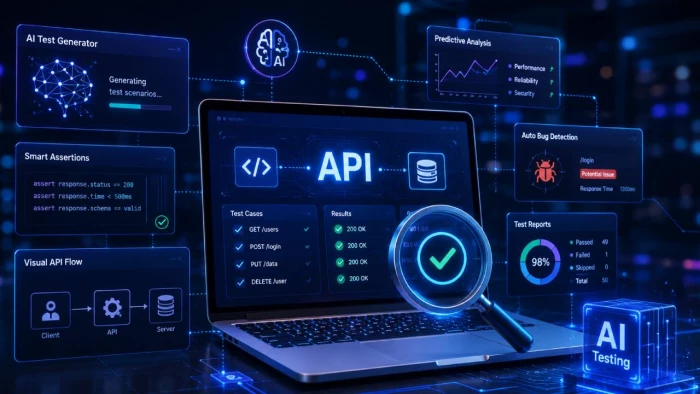
At first glance, API testing may seem like just another technical process happening quietly behind the scenes. But the reality is, APIs have become the foundation of modern digital experiences. From payment gateways and e-commerce checkouts to healthcare portals and fintech applications, APIs are responsible for keeping systems connected and data flowing seamlessly.
The challenge? API ecosystems are becoming far more complex than they were even a few years ago.
Today’s businesses operate in fast-moving environments powered by microservices, cloud-native architectures, third-party integrations, and continuous deployments. That sounds manageable, until growth happens. Suddenly, teams are responsible for testing dozens, sometimes hundreds, of interconnected APIs that constantly evolve.
And honestly, this is where traditional testing approaches begin to struggle.
Manual scripting, repetitive test maintenance, unstable dependencies, and delayed testing cycles can slow down development teams significantly. In many cases, organizations aren’t facing testing bottlenecks because of poor engineering. The reality is, modern software simply moves faster than traditional testing methods were designed to handle.
This is exactly why AI in API testing is becoming one of the biggest shifts in software quality engineering in 2026.
Instead of relying only on reactive testing, businesses are using artificial intelligence to automate repetitive tasks, improve testing accuracy, identify risks earlier, and streamline releases without sacrificing quality.
Let’s take a closer look at how AI is transforming API testing and why it matters more than ever.
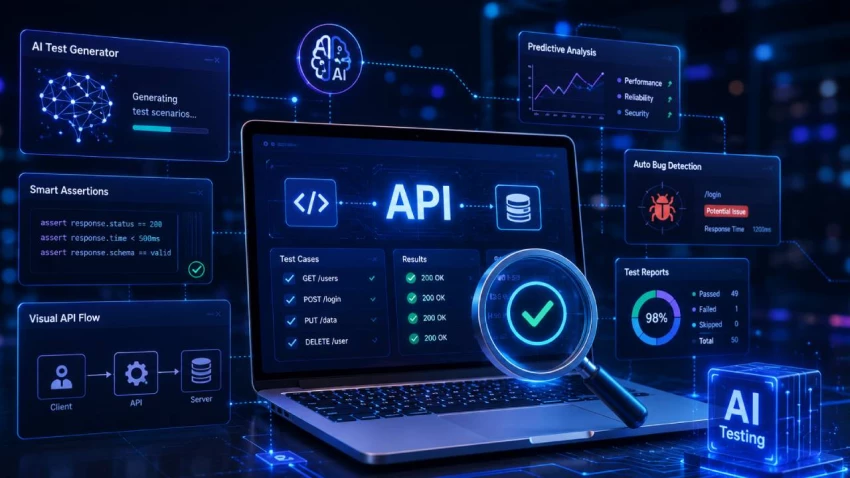
For years, API testing followed a fairly predictable process. Teams would manually create test scripts, define expected responses, validate endpoints, execute tests, and update everything whenever APIs changed.
On paper, that sounds straightforward. But modern APIs rarely stay static.
Payload structures evolve. Authentication mechanisms change. Third-party integrations behave differently. Response schemas get updated unexpectedly. And in many cases, even a minor API change can trigger failures across multiple environments.
Anyone who has worked in API testing long enough has seen this happen.
A perfectly functioning test suite suddenly starts failing, not because of bad code, but because one dependency changed somewhere downstream.
This is where things start getting messy.
According to IBM’s AI insights, organizations increasingly rely on artificial intelligence to automate operational workflows and improve efficiency. That shift is becoming especially visible in software testing, where speed and accuracy are no longer optional.
Instead of spending hours reacting to failures, teams are increasingly turning to AI-powered API testing to anticipate issues before they disrupt releases.
Artificial intelligence is not replacing testers. That’s an important distinction.
What AI is doing instead is reducing repetitive work and helping engineering teams make smarter decisions faster.
In many cases, testing teams are moving away from manual-heavy workflows and toward intelligent systems that can adapt as APIs evolve.
One of the biggest pain points in traditional API testing has always been creating test cases. Historically, testers needed to manually identify possible inputs, define expected outputs, consider edge cases, and write validation scenarios from scratch. It works, but it takes time. And honestly, it becomes increasingly difficult to maintain when release cycles accelerate. This is where AI in API testing delivers immediate value.
Modern testing systems can analyze API specifications, historical defects, and usage patterns to automatically generate meaningful test scenarios. Rather than starting with a blank slate, teams can quickly identify:
At first glance, this may sound like a simple productivity boost. But the reality is, better test coverage early in development often leads to fewer defects later in production. That’s a win that most engineering leaders care about.
Now this is where things get really interesting. What if we could use testing tools to figure out when something is going to go wrong before it actually does? This idea used to sound like something from a movie. In 2026, it is becoming more and more possible.
We are now using intelligence systems to look for patterns in things that have gone wrong in the past, like defects, problems with websites, failures when we put out new updates, and bugs that keep happening over and over.
Of waiting for problems to show up when we are testing, or even worse, after we have already released something to the public, artificial intelligence can tell us which areas are most likely to have problems.
For example, if the part of our service that handles authentication keeps failing after we make updates, the artificial intelligence system can automatically make sure we test that part thoroughly. This can save us a lot of time when we are trying to fix problems.
To be honest, it is usually cheaper to prevent problems from happening in the first place than it is to fix them after they have already happened. Because the truth is, most of the time when our engineering teams get slowed down, it is because they are spending much time dealing with problems that they could have found and fixed earlier, and that is using up time they could be spending on testing and making sure our artificial intelligence systems are working properly to predict failures before they happen with our testing tools.
If there’s one thing most testing teams would gladly spend less time doing, it’s maintaining broken test scripts. APIs change constantly. Endpoints evolve. Payloads shift. Authentication requirements get updated. Suddenly, tests written only weeks ago stop working. This sounds manageable until engineers start spending hours fixing brittle scripts instead of building new features. Fortunately, AI is helping reduce that burden.
Modern AI-powered API testing platforms can automatically detect API changes and recommend updates to existing tests. Some advanced systems can even self-heal broken tests by recognizing modifications in requests, responses, or endpoints. In fast-paced DevOps environments, this can significantly reduce maintenance overhead. And honestly, fewer broken scripts usually means happier engineers.
One of the biggest blockers in API testing happens when dependencies are unavailable. Maybe a third-party service is unstable. Maybe a backend system hasn’t been completed yet. Or perhaps external APIs are experiencing delays or rate limitations. In the past, teams often had no choice but to wait.
Today, intelligent API mocking solutions are helping teams move faster by simulating realistic API behavior without depending on live systems. By creating virtual services that closely mimic production environments, development and QA teams can continue testing earlier in the lifecycle. This helps organizations:
In my view, this is one of the more underrated advancements in API testing today. Because faster delivery isn’t just about writing better code, it’s often about removing blockers. And unavailable APIs have historically been a major blocker.
Of course, faster testing means very little if APIs aren’t secure. And the reality is, APIs have become one of the most targeted attack surfaces in modern applications. The OWASP API Security Project continues to highlight growing risks such as broken authentication, authorization failures, and excessive data exposure.
Traditional security testing usually depends on predefined rules and static attack simulations. AI changes that dynamic. Modern systems can analyze API traffic, identify unusual behavior, detect vulnerabilities faster, and simulate evolving attack patterns more intelligently. In many cases, this helps organizations strengthen security before issues reach production. And honestly, preventing breaches will always be less expensive than responding to them.
Generating realistic test data has always been harder than it sounds. Using production data creates privacy and compliance concerns. Creating synthetic datasets manually often produces unrealistic testing environments. Neither option is ideal.
This is where AI offers a smarter alternative. Modern tools can generate realistic, privacy-safe synthetic datasets that closely mirror real-world behavior. This becomes especially valuable in industries like healthcare, banking, and e-commerce, where compliance matters just as much as accuracy. Better data leads to better testing. Simple as that.
Let’s clear up one misconception first: AI is not replacing testers. At least, not in the way many people feared. Human expertise still matters, especially when it comes to strategy, business logic, exploratory testing, and making judgment calls. What AI is doing instead is helping teams spend less time on repetitive work and more time solving meaningful problems. And honestly, that shift feels overdue.
As APIs become increasingly interconnected, relying entirely on manual testing simply isn’t sustainable anymore. Organizations embracing AI in API testing are likely to move faster, reduce defects, and release software with greater confidence.
API testing in 2026 looks very different from what it did just a few years ago. Artificial intelligence is reshaping everything, from automated test generation and predictive defect detection to smarter security validation and intelligent API simulations.
No technology solves every problem. But if one thing feels increasingly clear, it’s this: The future of API testing won’t just be automated. It will be intelligent.
I started exploring Redeepseek.io because the name itself creates curiosity. At...
Grace Howard4 months ago

Nomi AI isn’t just another chatbot; it’s a full‑blown AI companion platform buil...
Alexander Hughes7 months ago

Artificial intelligence was originally built to support human decision-making. E...
Peter Woods7 months ago
Speech-to-text technology has matured significantly over the past few years. Wha...
Grace Howard7 months ago

Anthropic has accused three prominent Chinese AI companies of systematically “mi...
Sandra Campos7 months ago

In what might be the most unexpected AI benchmarking milestone of 2026, Elon Mus...
Peter Woods7 months ago
Discussion