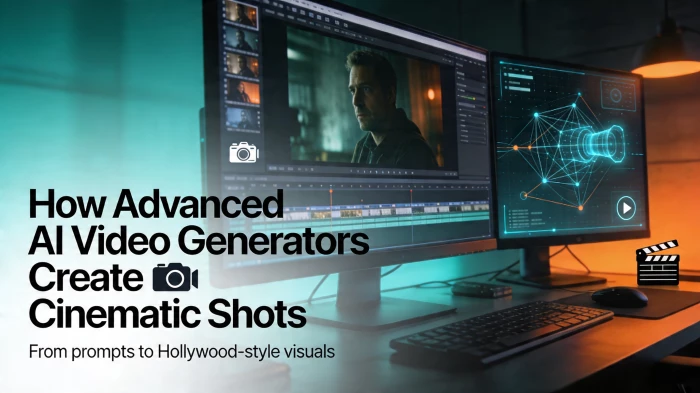
For a long time, producing a cinematic shot meant renting a camera rig, hiring a director of photography, carefully blocking actors, and spending hours in post-production. The mechanics behind a single 10-second tracking shot were expensive, labour-intensive, and deeply technical. What is happening now in AI video generation flips that equation entirely, and it is worth understanding why the outputs look the way they do rather than just marvelling that they exist.
Modern AI video generators do not simply string together still images. The best systems today are trained on enormous corpora of film footage and are built on diffusion transformer architectures that have been specifically designed to model temporal continuity, physics, camera language, and lighting coherence over time. The result is not animation in the traditional sense. It is something closer to learned cinematography, where the model has absorbed the grammar of professional filmmaking and can reproduce it from a text prompt or a reference image.
This article unpacks the key technical mechanisms that make cinematic AI video possible, examines how the most capable models structure their generation pipelines, and looks closely at two systems that represent the current leading edge: Seedance 2.0, developed by ByteDance's Seed research team, and HappyHorse 1.0, an open-source 15B-parameter model that has ranked first on the Artificial Analysis video leaderboard.
Early AI video attempts used straightforward extensions of image diffusion models. The approach worked by generating a keyframe and then interpolating between frames, treating temporal progression as a kind of visual smooth-out operation. The problem was immediately apparent: objects flickered between frames, physics broke down, and characters morphed unpredictably. The models had no actual sense of what time meant in three-dimensional space.
The breakthrough came with Diffusion Transformer (DiT) architectures applied to video natively. Rather than treating video as a series of images, DiT-based video models tokenise space and time together, encoding every patch of every frame as part of a unified three-dimensional token sequence. This architecture means the model is not guessing what happens between frames. It is learning a consistent representation of the full clip from the moment generation begins.
Temporal attention is the mechanism that allows the model to relate any given frame to every other frame in the sequence simultaneously. In standard image generation, self-attention operates over spatial patches within a single image. In video generation, temporal attention extends that relationship across the time axis. A frame at the two-second mark can directly attend to information at the zero-second and four-second marks during the denoising process. This is what produces motion that feels continuous rather than stitched.
Seedance 2.0 implements what its developers describe as Enhanced Temporal Attention specifically to maintain consistent quality across full clip durations. The practical effect is that fine detail, such as the texture of a fabric or the position of light on a face, does not drift as the scene progresses. The model is continuously cross-referencing each moment against the temporal context of the entire generation.

| Mechanism | What It Does | Effect on Cinematic Output |
| Temporal Self-Attention | Allows each frame to attend to all other frames in the sequence during denoising | Prevents flickering, drift, and object morphing across the clip |
| Enhanced Temporal Attention (Seedance 2.0) | Extended cross-frame attention tuned for full clip duration stability | Consistent lighting, character detail, and texture throughout 15-second clips |
| Dual-Branch DiT (HappyHorse 1.0) | Parallel transformer branches process video and audio tokens jointly | Synchronized motion and sound without post-production alignment |
| 3D VAE Encoding | Encodes spatial and temporal dimensions together in the latent space | Maintains spatial coherence as the camera moves through a scene |
| DMD-2 Distillation (HappyHorse 1.0) | Reduces denoising steps to 8 through distillation training | Full 1080p generation in approximately 38 seconds |

The jump from text-to-video to what the field now calls asset-directed generation represents one of the most significant shifts in how these tools are actually used. Early models accepted a written prompt and returned whatever the model inferred. Current top-tier systems accept a structured combination of text, reference images, existing video clips, and audio files simultaneously, then reason about the role each input plays in the intended output. This also makes room for tools like an AI image detector when there is a need to assess whether reference visuals or generated assets are synthetic or real.
Seedance 2.0, for instance, accepts up to 12 reference assets in a single generation pass: up to 9 images, 3 video clips, and 3 audio files. The model interprets each element using natural language references rather than requiring the user to specify technical parameters. A creator can describe a scene in prose and attach a short video demonstrating the camera movement they want, and the model will replicate that movement logic while applying it to completely different characters and environments.
This is not template substitution. The model is doing something more nuanced: extracting the kinetic grammar of a reference clip, such as the arc of a tracking shot or the rhythm of a dolly move, and applying that grammar to new visual content. It treats cinematography as a learnable style that can be transferred independently of the original subject matter.
One of the most technically demanding aspects of cinematic AI video is shot design: making sure that a close-up cuts coherently to a medium shot, that a tracking shot does not snap or judder, and that a scene photographed from multiple angles reads as a single continuous space. Human cinematographers spend years learning these conventions. AI models learn them statistically from millions of real productions, then must apply them in a single forward pass during generation.
HappyHorse 1.0 approaches this through its unified transformer architecture that processes text, image, video, and audio tokens in the same self-attention space. The model does not have separate vision and language encoders that communicate via a bottleneck. Every modality contributes to the same representational space, which means reference images, motion cues, and audio rhythm all influence shot design simultaneously rather than in sequence.

Cinematic AI video generators have developed a remarkable ability to interpret camera direction written in natural language. Phrases like 'extreme low angle pushing into the subject', 'overhead crane shot descending to ground level', or 'handheld follow shot with natural sway' are now understood by leading models with a level of fidelity that was completely absent even two years ago. This is because these models were trained on footage that was captioned at the shot level — platforms like Higgsgield AI Video Generator exemplify this approach — teaching them to associate specific language with specific visual behaviours
The practical result for creators is a form of written cinematography. A well-structured prompt that includes subject, action, camera angle, camera movement, focal length suggestion, and mood will typically yield a result that reflects all of those elements simultaneously. The model is not executing them as separate instructions in sequence. It generates the entire clip as a unified expression of all those constraints combined.
Perhaps the most cinematically significant capability in current AI video is multi-shot storytelling: the ability to generate a clip that contains multiple distinct camera angles, transition between them cleanly, and maintain a coherent character and environment across all of them. This is what separates a visual demo from an actual narrative tool.
Seedance 2.0 handles this through what its development team calls cross-shot consistency. The model maintains character identity, clothing detail, lighting style, and environmental mood across shot cuts without requiring manual stitching. A scene can open on a wide establishing shot, cut to a medium shot of a character speaking, cut again to a close-up of their reaction, and all three shots will share the same person, the same space, and the same atmospheric quality. This is not achieved by assembling three separately generated clips. The model generates the temporal logic of the full sequence together.
| Shot Type | Prompt Language AI Recognises | Technical Requirement in Generation |
| Extreme Close-Up | ECU, macro shot, tight close-up, detail shot | High spatial resolution at small scale, motion blur on micro-movements |
| Tracking Shot | Follow shot, tracking, camera tracks with subject | Temporal motion consistency tied to subject velocity, background parallax |
| Crane / Overhead | Aerial descent, overhead crane, bird's-eye to ground | Vertical axis transformation with ground texture sharpening across frames |
| Dutch Angle | Canted frame, tilted, oblique camera | Rotational offset applied to the entire frame with consistent horizon skew |
| Dolly Zoom | Vertigo effect, dolly zoom, trombone shot | Simultaneous focal length shift and camera translation requiring depth modelling |
| Handheld | Handheld, naturalistic camera, documentary-style | Procedural micro-motion noise applied to the camera position consistently |
Motion realism in AI video goes well beyond making a person's arm move smoothly. It requires the model to understand the physics of how cloth deforms under movement, how hair responds to velocity, how water ripples when an object enters it, how dust behaves in light when feet strike a dry surface, and how gravity interacts with every object in the frame at every moment. Human viewers are highly sensitive to physics violations. A subtle error in how a garment moves during a sprint, or how a person's weight shifts when they turn, registers as uncanny even if the viewer cannot articulate why.
Seedance 2.0 specifically addresses this through what its creators describe as physics-based audio generation, where sound is treated as physically integrated with the visual environment rather than layered on top after the fact. The model understands that footsteps on marble produce a different acoustic response than footsteps on carpet, and generates audio that reflects the material properties of the virtual environment. This is not just an audio feature. It signals a deeper representational shift in which the model holds a physical model of the scene, not just a visual one.
Facial performance is the hardest technical challenge in AI video generation. The human face is an object that viewers are evolutionarily primed to scrutinise. Minor deformations, asymmetries that shift between frames, or lip movements that do not align with phonemes are immediately noticed and strongly undermine immersion. HappyHorse 1.0 targets this specifically, with its training focused on achieving ultra-low word error rate lip-sync across seven languages including English, Mandarin, Cantonese, Japanese, Korean, German, and French. The model generates lip movement as part of the joint audio-video generation process, meaning the visual phoneme sequence and the audio phoneme sequence are produced in a single unified pass.
Full-body motion presents a different set of challenges. The skeletal structure of the human body has specific constraints: joints have ranges of motion, weight distribution shifts predictably with certain actions, and contact with surfaces creates forces that propagate through the body in physically plausible ways. Models that produce convincing action sequences, fight choreography, or athletic movement must have learned these constraints deeply from training data that included diverse motion capture and real-world sports footage.

Seedance 2.0 is developed by ByteDance's Seed research team and represents a fundamental rethinking of what AI video generation can accept as input. The system is built on Dual Branch Diffusion Transformer technology and is designed to function not as a text-to-video tool but as a complete video production engine capable of accepting text, images, video references, and audio simultaneously.
The model generates clips up to 15 seconds at 2K resolution with a 24 frames-per-second cinema standard. Its World ID system locks character identity across the full sequence, maintaining consistent facial geometry, clothing, and proportional relationships even as the character moves through varied lighting conditions, changes camera angle, and interacts with other elements in the scene. This is particularly significant for multi-shot work where character consistency across cuts has historically been the weakest point of AI video systems.
One of Seedance 2.0's most technically distinctive features is its physics-based audio generation. The system generates audio as an emergent property of the visual scene, computing how sound should behave given the materials, spaces, and actions present in the video. Dialogue reverberates differently in a stone corridor than in a softly furnished room. Ambient sound shifts with the environment. This is fundamentally different from post-production audio layering, where sound is attached to a finished visual rather than computed alongside it.
Lip-sync is supported across eight or more languages and is generated in the same forward pass as the video, meaning there is no alignment problem to solve after generation. The temporal relationship between phoneme articulation and lip geometry is a learned constraint built into the model's weights rather than a post-hoc matching operation.
Because Seedance 2.0 accepts reference videos as motion guides, creators can essentially direct the model using existing footage. A short clip demonstrating a specific camera movement, a choreography sequence, or a particular visual effect style can be uploaded alongside a text prompt, and the model will apply the extracted motion logic to entirely new content. This means that a creator who has filmed a reference clip on a phone can transfer the motion grammar of that clip to a fully synthesised cinematic scene.
| Feature | Specification / Detail |
| Developer | ByteDance Seed Research Team |
| Architecture | Dual Branch Diffusion Transformer (DiT) |
| Output Resolution | Up to 2K (2048px wide), 1080p Standard mode |
| Frame Rate | 24 FPS cinema standard |
| Maximum Clip Length | 15 seconds per generation |
| Multimodal Inputs | Up to 12 assets: 9 images, 3 video clips, 3 audio files |
| Audio Generation | Physics-based, joint audio-visual synthesis in one pass |
| Lip-Sync Languages | 8+ languages including English, Chinese, Japanese, Korean, Spanish, Portuguese |
| Character Consistency System | World ID across multi-shot sequences and 20+ shots |
| Reference Types | Motion, camera movement, VFX style, character, scene, audio |
| Generation Speed vs Prior Version | Approximately 30% faster than Seedance 1.0 |

HappyHorse 1.0 is a 15-billion-parameter model built on a unified 40-layer self-attention Transformer that processes text, image, video, and audio tokens together in the same representational space. This single-stream architecture is a meaningful departure from models that use separate encoders for different modalities and then fuse their representations at a later stage. When text, visual, and audio information all occupy the same attention space from the beginning, the model can make more nuanced trade-offs between them rather than treating each as a fixed input to be appended to others.
DMD-2 (Distribution Matching Distillation v2) is used to reduce the number of denoising steps required during inference from the hundreds typical in standard diffusion models down to just 8. Combined with MagiCompiler acceleration, this produces full 1080p video in approximately 38 seconds on an H100 GPU. This generation speed has practical implications for creative iteration. When a creator can produce a draft clip in under a minute, the workflow shifts from single-shot generation with long waits to rapid multi-direction exploration with near-real-time feedback.
The design philosophy behind HappyHorse 1.0 is built explicitly around motion quality as the primary criterion. The team's position is that floaty, inconsistent physics and broken transitions are the main reasons AI video fails to read as cinematic, and the model was trained and evaluated with motion coherence as the central benchmark rather than static frame quality. The model targets reduction in the specific failure modes that viewers notice most: objects drifting when they should be stationary, subjects losing weight and ground contact, and transitions that do not match the kinetic energy of the surrounding motion.
In third-party evaluations through Artificial Analysis Arena, HappyHorse 1.0 has achieved an Elo rating of 1333, placing it at the top of publicly evaluated AI video models. This evaluation methodology uses pairwise human preference comparisons rather than automated metrics, which makes it more relevant to real-world cinematic quality perception than technical scores derived from pixel-level accuracy.
HappyHorse 1.0's lip-sync system supports English, Mandarin, Cantonese, Japanese, Korean, German, and French with ultra-low word error rate alignment. The model generates speech phoneme sequences and their corresponding visual articulations in the same pass, meaning there is no alignment step between audio and video. For creators producing content across international markets, this removes one of the most time-consuming elements of post-production: dubbing synchronisation.
Being fully open-source gives HappyHorse 1.0 a different relationship with the development community than proprietary systems. Researchers can inspect the model weights, fine-tune for specific domains, build custom inference pipelines, and integrate it via RESTful API with what the project documentation describes as a five-minute setup and sub-10-second generation for short prompts.
| Feature | Specification / Detail |
| Parameters | 15 billion |
| Architecture | Unified 40-layer self-attention Transformer (single-stream, text+video+audio) |
| Distillation | DMD-2 (Distribution Matching Distillation v2), 8 denoising steps |
| Output Resolution | Native 1080p, up to 2K in extended mode |
| Aspect Ratios Supported | 16:9, 9:16, 4:3, 3:4, 21:9, 1:1 |
| Clip Duration | 5 to 12 seconds per generation |
| Generation Speed | ~38 seconds for 1080p on H100 GPU |
| Lip-Sync Languages | English, Mandarin, Cantonese, Japanese, Korean, German, French |
| Arena Ranking | Elo 1333 on Artificial Analysis leaderboard (ranked #1) |
| Licensing | Open-source; API available with documented setup |
| Prompt Language Support | English and Chinese with full semantic nuance |
Both models represent the leading edge of AI cinematic video generation in 2025-2026, but they approach the problem from different angles and suit different production contexts. The following table compares them across the criteria that matter most in practice.
| Criteria | Seedance 2.0 | HappyHorse 1.0 |
| Primary Strength | Multimodal reference-driven direction | Motion fidelity and open-source flexibility |
| Architecture | Dual Branch Diffusion Transformer | 15B unified 40-layer self-attention Transformer |
| Max Resolution | 2K at 24 FPS | 1080p native, 2K extended mode |
| Max Clip Length | 15 seconds | 5-12 seconds |
| Reference Inputs | Up to 12 (9 images, 3 videos, 3 audio) | Images, video, audio via multimodal workflow |
| Audio Generation | Physics-based joint generation | Joint audio-video synthesis in single pass |
| Lip-Sync Languages | 8+ languages | 7 languages |
| Character Consistency | World ID across 20+ shots | Persistent identity across multi-shot sequences |
| Generation Speed | ~30% faster than Seedance 1.0 | ~38 seconds for 1080p (DMD-2 distillation) |
| Open Source | No (proprietary, ByteDance) | Yes (fully open-source) |
| Best For | Professional multi-shot narratives, ad production, film pre-viz | Motion-critical content, rapid iteration, research, API integration |
The gap between a mediocre AI video and a genuinely cinematic one is often less about the model and more about how the prompt is constructed. These models have learned the grammar of film production from their training data, and prompts that speak that grammar clearly will produce outputs that reflect it. A prompt that says 'a person walking down a street' leaves nearly every cinematographic decision to the model's defaults. A prompt that says 'medium shot, slightly low angle, following a woman in a grey coat as she walks through a rain-slicked Paris street at dusk, tungsten street lights reflecting on wet cobblestones, shallow depth of field, film grain' provides the model with enough information to make specific cinematic choices across framing, motion, lighting, texture, and atmosphere.
| Prompt Element | What to Specify | Example |
| Shot Size | Wide, medium, close-up, ECU, full body | Medium close-up on the subject's face |
| Camera Movement | Static, tracking, dolly push, crane descent, handheld | Slow dolly push in toward the subject |
| Angle | Eye level, low angle, overhead, bird's-eye, Dutch | Slightly low angle to suggest authority |
| Lighting | Quality, direction, colour temperature, source | Warm side lighting from a practical lamp |
| Atmosphere | Time of day, weather, mood, environmental quality | Late afternoon fog with diffused golden light |
| Depth of Field | Shallow, deep, rack focus | Shallow depth of field, background blurred |
| Subject Action | Specific, physically grounded action | Turns slowly, glances to the left, exhales |
| Visual Style | Film grain, colour grade reference, genre aesthetic | Film grain, muted colour palette, noir aesthetic |
The current limitation of most AI video systems is clip length. Producing a coherent narrative across several minutes of screen time requires maintaining character identity, environmental consistency, and narrative logic across a scale that current architecture contexts cannot yet fully support in a single pass. The technical challenge is not solely computational. It is representational: the model needs a form of story memory that can reference character motivation, spatial geography, and causal plot logic as it generates each successive moment.
Work is proceeding on extending temporal context windows in video transformers, improving the efficiency of attention mechanisms at very long sequences, and developing hierarchical generation systems where a high-level story plan is generated first and then instantiated at the frame level. These are not solved problems, but the progress rate in this field means that multi-minute coherent narrative video generation is a near-term rather than speculative capability.
The physics-based audio system in Seedance 2.0 hints at a broader direction: models that hold an explicit physical model of the scene rather than just learning statistical patterns of visual change. If a model genuinely understands that a glass on a table has a certain mass, brittleness, and acoustic resonance, it can generate not just how that glass looks when it falls but how it sounds, how the fragments scatter, and how the light changes as the pieces settle. This level of scene understanding would produce a qualitative shift in how realistic and behaviourally consistent AI video becomes.
Both Seedance 2.0 and HappyHorse 1.0 provide API access, and the trajectory of these tools points strongly toward integration into existing creative production workflows rather than existing as standalone generation interfaces. Video editing timelines, storyboard software, and pre-production planning tools will likely incorporate AI generation as a native capability rather than a separate step. The models will become part of the production infrastructure, allowing directors, editors, and producers to generate reference material, pre-visualise sequences, and iterate on creative ideas at the speed of thought rather than the speed of production.
AI video generators have moved past the point where their cinematic output can be explained away as impressive but hollow. The technical depth behind models like Seedance 2.0 and HappyHorse 1.0 reflects years of serious research into temporal coherence, physical simulation, camera language, audio-visual integration, and multimodal reasoning. These are not tools that imitate the appearance of cinema. They are tools that have, in a meaningful sense, learned how cinema works.
For creators, understanding the mechanisms behind the output is practically valuable. Knowing that these models operate on learned cinematographic grammar means that prompts written in the language of film production produce qualitatively better results than prompts written in the language of description. Knowing that reference videos can transfer motion logic means that directing these systems is a genuine creative act rather than a lottery.
The gap between current capability and professional long-form narrative is real but shrinking. What exists today is already cinematic in the most technically demanding sense of the word, and the pace of development suggests that the remaining gaps will close faster than anyone currently working in production expects.
New Claude Model Targets Agentic AI WorkflowsAnthropic has launched Claude Sonne...
Samuel Osei3 months ago
Gemini’s Image Tools Get a Wider RolloutGoogle is expanding access to Gemini’s p...
Alexander Hughes3 months ago

Two AI video generators, two very different first days. I ran PixVerse through i...
Alexander Hughes3 months ago
Two of the most talked-about AI chat platforms. I opened both, picked a characte...
Alexander Hughes3 months ago

The two-minute versionIf you only read one thing, read this. The rest of the doc...
Alexander Hughes3 months ago
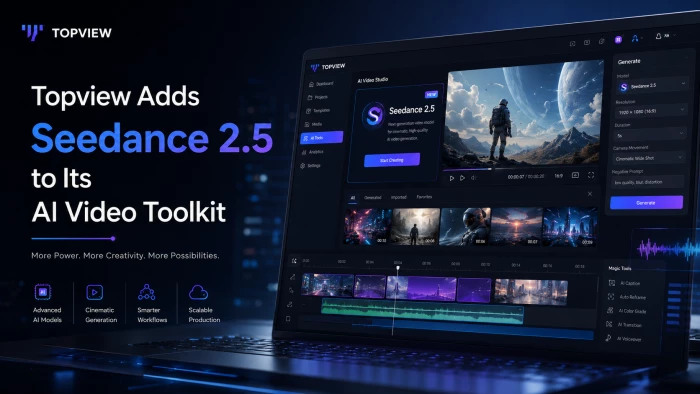
Why Seedance 2.5 mattersSeedance 2.5 is the latest release in ByteDance’s Seedan...
Alexander Hughes3 months ago
Discussion