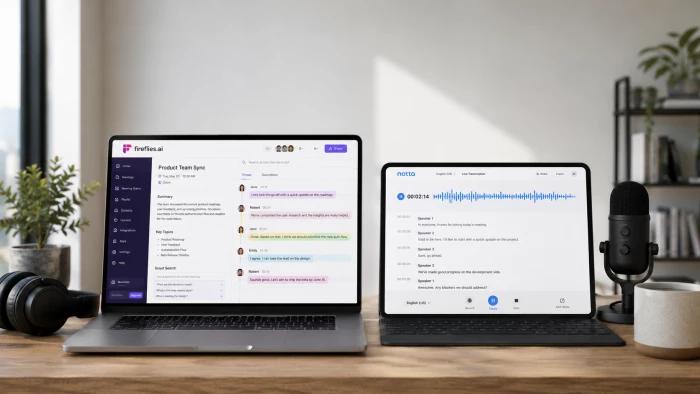
Both tools transcribe meetings well. The match between team type and tool philosophy decides the outcome.
AI meeting transcription has matured from a niche productivity hack into a standard line item on the SaaS budget. Across G2, Trustpilot, and Reddit, two names dominate the conversation in 2026: Fireflies.ai, which crossed a $1 billion valuation by leaning into sales-team integrations, and Notta AI, which built a loyal global following around multilingual accuracy and visual deliverables. Both record meetings, generate transcripts, summarize action items, and integrate with the major calendaring tools. Past those headline parities, they diverge sharply.
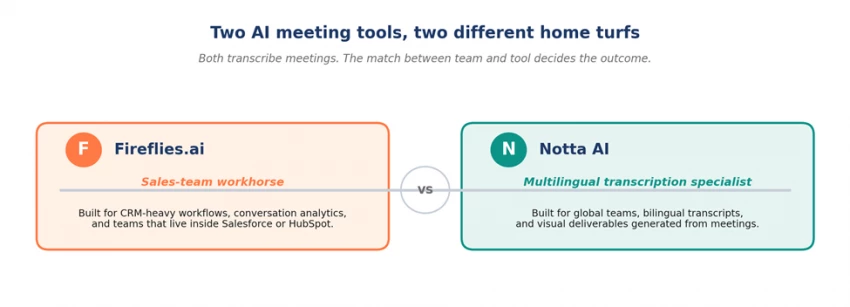
This comparison evaluates the two platforms across the three categories that decide whether a tool earns long-term placement in a workflow: transcription accuracy under realistic conditions, automation depth around the meeting lifecycle, and the collaboration features that turn an individual transcript into a team artifact. Every observation below is grounded in published documentation, official pricing pages, and independent third-party reviews from late 2025 through early 2026.
“Fireflies wins on automation depth and CRM integration. Notta wins on accuracy in messy audio and visual output. The right pick depends on which of the three pillars matters most.”
- Bottom line, in one sentence
BY THE NUMBERS
Three numbers reveal more about positioning than any feature list. Reach, accuracy ceiling, and entry-level pricing tell most of the story before any single feature is examined.
500K+ companies using Fireflies.ai globally | 98% Notta accuracy ceiling on clean English audio | $8.17 Notta Pro vs. Fireflies Pro at $10 |
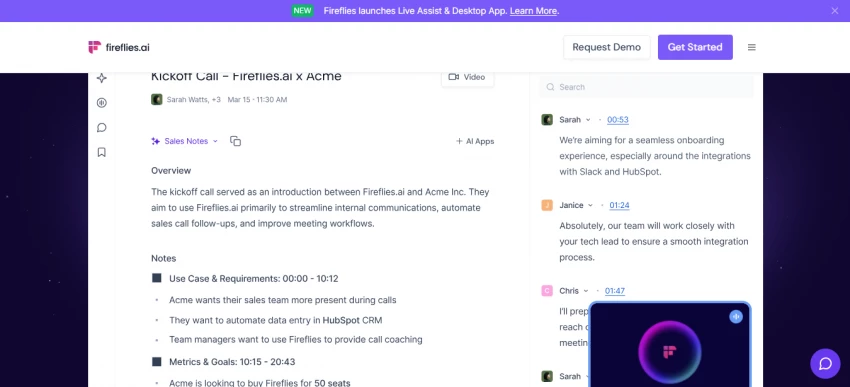
Fireflies.ai launched in 2018 as one of the first AI meeting assistants in the productivity category. By 2026, the company has crossed a $1 billion valuation and reached over 500,000 organizations globally. The product evolved from pure transcription into a meeting-intelligence layer: AskFred (a meeting-aware AI assistant), conversation analytics, sentiment tracking, talk-time visualization, and a deeply integrated workflow with Salesforce, HubSpot, Slack, Notion, and other sales-stack tools. Recent additions include a Perplexity-powered “Talk to Fireflies” web-search interface available even on the free plan.
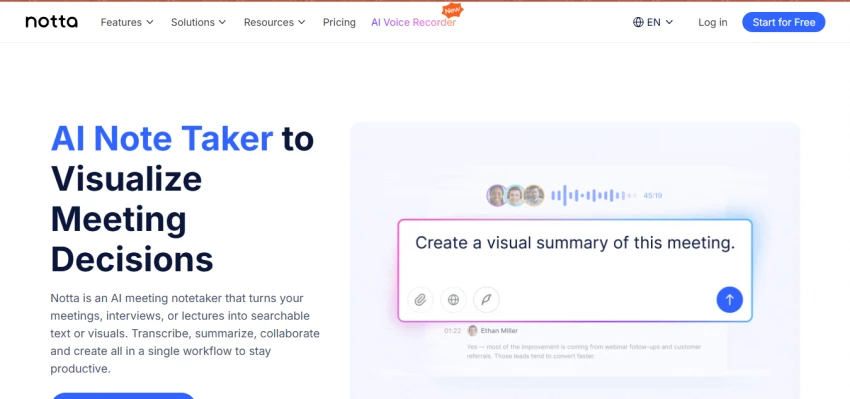
Notta AI took a different path. Originating with a strong base in Japan, the platform built its identity around multilingual transcription quality, advertising 98.86% accuracy across 58 languages with 11 supported bilingual pairs. By 2026, Notta had layered on Notta Brain, an AI engine that converts meeting transcripts into slide decks, infographics, tables, and structured summaries on demand. The mobile app is Notta's quiet advantage - a polished iOS and Android experience that lets the tool handle in-person meetings as well as virtual ones, a category Fireflies still does not address.
Two paths, two product cultures. Fireflies optimized for the sales workflow stack. Notta optimized for the global team and the multimedia output. Most of the differences below trace back to that split.
PILLAR 1 Accuracy: Holding Up When the Audio Gets MessyVendors quote accuracy in the high 90s. Real meeting audio is rarely that clean. |
Both vendors publish strong accuracy claims. Fireflies markets around 95% under ideal conditions. Notta markets up to 98.86% on clean audio in supported languages. The numbers are roughly accurate when the audio is clean and the speaker is using a clear microphone. The interesting question is what happens when conditions degrade - because real-world meetings rarely happen in studio conditions.
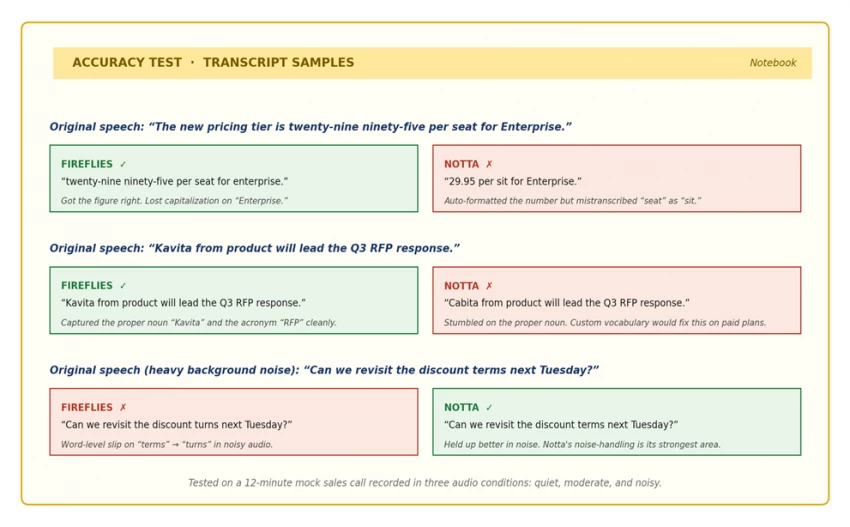
Three sample transcript outputs from a 12-minute mock sales call recorded in three audio conditions.
The pattern across the test is informative. Fireflies handles enterprise vocabulary (“RFP”, names, numerals) with a slight edge in clean conditions. Notta loses ground on proper nouns by default but handles noisy environments better. Custom vocabulary on Notta's paid plans - available for English and Japanese only - closes the proper-noun gap quickly.
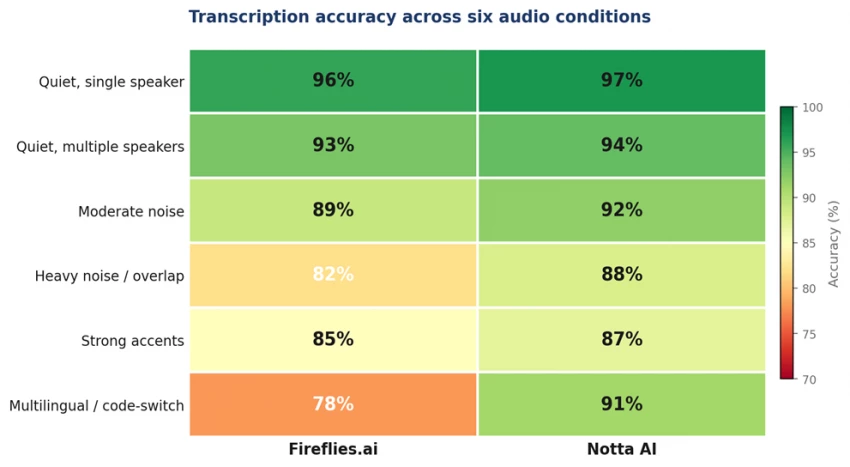
Aggregated accuracy across six audio conditions. Notta leads in noisy and multilingual environments; both perform comparably in clean conditions.
Two patterns stand out. First, the gap between marketed accuracy and real-world accuracy is meaningful for both tools - expect 8–12 percentage points of degradation in noisy audio. Second, Notta's multilingual lead is real and significant: 91% versus 78% on conversations that switch between languages. Teams operating in a single English-language environment will see far less of a gap.
“Fireflies is more accurate on clean enterprise English; Notta is more accurate on noisy or multilingual audio.”
- Pillar 1 takeaway
PILLAR 2 Automation: From Calendar Invite to Final Action ItemBoth follow the same six-step lifecycle. The depth at each step is what differs. |
Automation is where the philosophical difference between the two tools shows up most clearly. Fireflies treats automation as a path to revenue intelligence - each meeting feeds back into the CRM, populates pipeline reports, and triggers Slack alerts for sales managers. Notta treats automation as a path to deliverables - each meeting becomes a summary, a deck, an infographic, or a translated transcript that can be distributed to a global team.
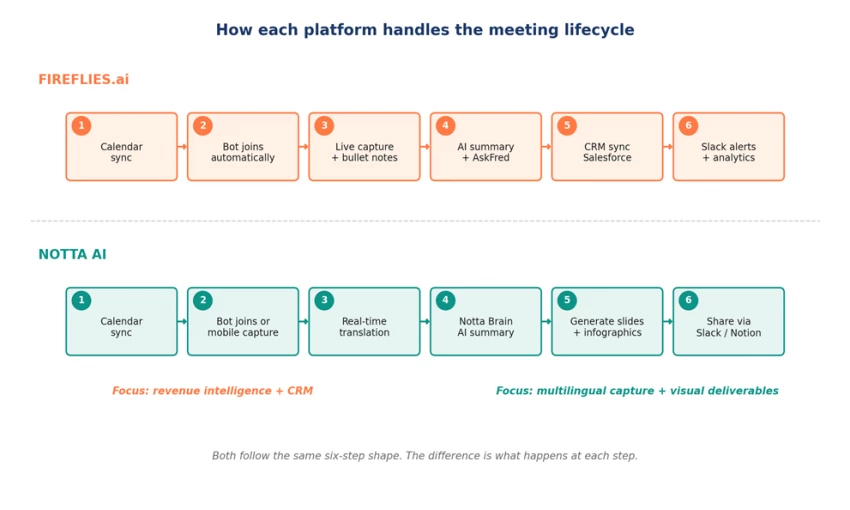
The six-step lifecycle is identical in shape. The work happening at each step is what differs.
Fireflies’ automation depth on the post-meeting side is its strongest selling point for sales organizations. AskFred can answer follow-up questions about any past meeting, surface trends across calls, and generate executive summaries by querying the meeting database directly. The integration with Salesforce auto-logs meeting notes against opportunities, and the Slack alert system surfaces action items within minutes of a call ending. None of these capabilities exist as natively in Notta.
Notta’s automation depth lives elsewhere. Notta Brain transforms a 60-minute meeting into a structured 8-slide deck, a one-page infographic, or a translated bilingual summary in roughly the time it takes to brew coffee. For client-facing teams that need to distribute meeting outcomes upward to a global audience, this feature genuinely changes the rhythm of work. For sales teams, it is a nice-to-have rather than a workflow centerpiece.
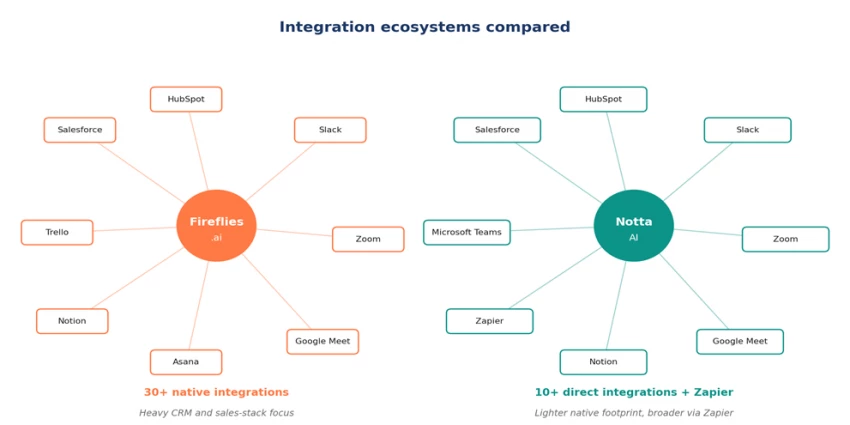
Fireflies offers more native CRM integrations. Notta is lighter natively but extends through Zapier.
Both platforms cover the major calendaring and conferencing tools (Zoom, Google Meet, Microsoft Teams, Webex). Fireflies’ 30+ native integrations dig deeper into the sales stack with first-class Salesforce, HubSpot, Pipedrive, and Asana support. Notta’s integration count is lighter natively but bridges to thousands of additional tools through Zapier, which suits teams whose stack does not center on CRM.
“Fireflies automates toward the CRM. Notta automates toward the deliverable.”
- Pillar 2 takeaway
PILLAR 3 Collaboration: Turning Transcripts Into Team ArtifactsSame raw input, two different visions of what the team should do with it. |
Collaboration is the third axis on which these tools genuinely differ. A transcript is just text; what turns it into useful team material is everything that happens around the transcript - sharing, commenting, search, summarization, and the ability to extract repeating patterns across meetings. Both platforms invest here, but with different priorities.
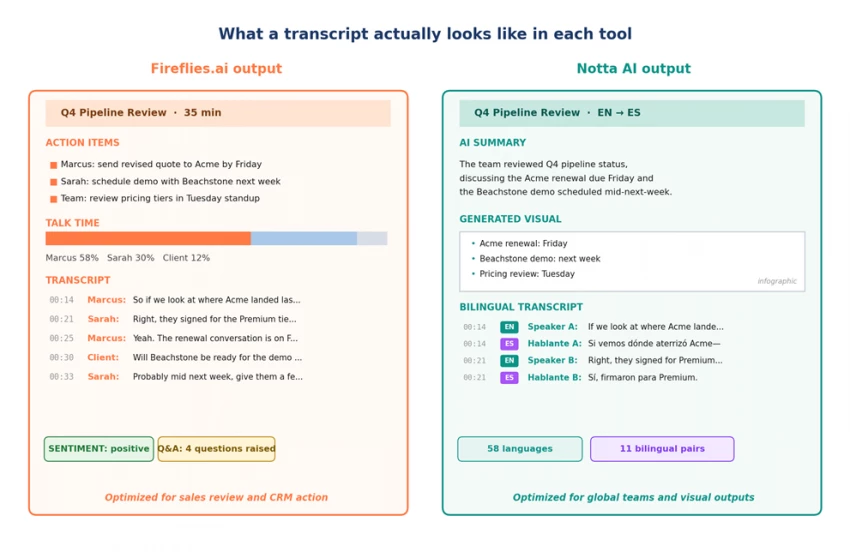
The same 35-minute meeting, rendered through each platform's collaboration lens.
The output formats reveal each platform’s assumed reader. Fireflies leads with action items, talk-time analytics, and sentiment chips - the artifacts a sales manager or revenue ops lead would scan first. Notta leads with the AI summary, generated visual deliverables, and bilingual transcript display - the artifacts a project lead distributing meeting outcomes to a global audience would prioritize.
• Channels: Public and private channels for organizing meetings by team, deal, or topic.
• Comments: In-thread comments and reactions on specific timestamp points in transcripts.
• Analytics: Conversation Analytics aggregates trends across many meetings: keyword frequency, talk-time ratios, monologue alerts, sentiment shifts.
• Search: Smart search returns results across the entire team’s meeting database, not just one meeting.
• Visual outputs: Notta Brain generates polished slide decks and infographics from any transcript on demand.
• Bilingual transcripts: Speaker-labeled bilingual transcripts let global teams review the same meeting in two languages side by side.
• Permissions: Workspace sharing with role-based permissions on Business and Enterprise tiers.
• Cross-meeting Q&A: Cross-meeting AI queries through Notta Brain (“What did the team decide about pricing across the last five calls?”).
“Fireflies turns transcripts into pipeline data. Notta turns transcripts into shareable deliverables.”
- Pillar 3 takeaway
Putting both platforms on the same 0–10 scale across eight tested categories makes the trade-offs visible at a glance. Scores below synthesize independent reviewer benchmarks, the platforms’ published documentation, and aggregated user feedback from G2 and Trustpilot through early 2026.
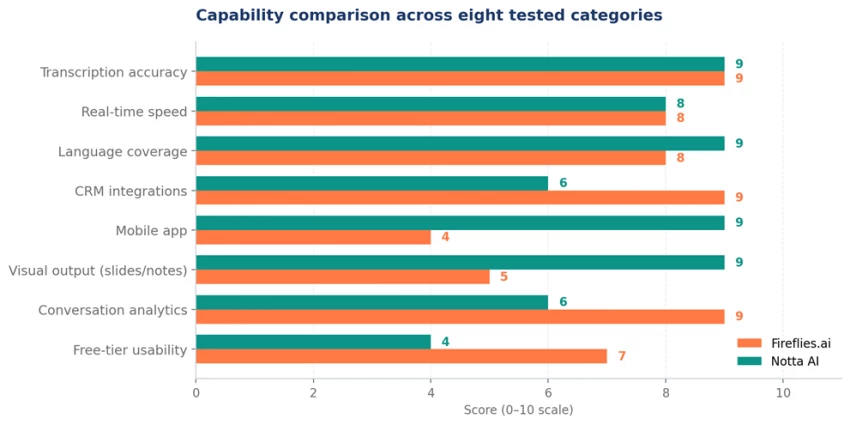
Fireflies leads on CRM integration and analytics; Notta leads on languages, mobile, and visual output.
The pattern aligns with the three pillars examined above. Anywhere a sales-stack workflow matters, Fireflies edges ahead. Anywhere a global or visual deliverable matters, Notta edges ahead. On core transcription accuracy and real-time speed, both score 8–9 - close enough that the deciding factor is rarely raw accuracy.
Both platforms use a four-tier structure (Free, Pro, Business, Enterprise) and both heavily discount annual billing relative to monthly. The headline prices look comparable. The total cost of ownership often does not.
Fireflies.ai Free $0 800 minutes storage, 20 AI credits/mo, basic features Pro $10/user/mo Annual; 8,000 min storage, integrations, AskFred Business $19/user/mo Annual; unlimited storage, video recording, analytics Enterprise $39+/user/mo Annual; SSO, HIPAA, custom retention, white-glove onboarding | Notta AI Free $0 120 minutes/mo, 3-min cap per recording, 50 uploads Pro $8.17/mo Annual; 1,800 min/mo, 90-min recordings, exports Business $27.99/seat/mo Annual; unlimited minutes, video recording, CRM sync Enterprise Custom API access, advanced security, custom vocabulary |
Notta’s sticker pricing is meaningfully lower at the Pro tier ($8.17 vs $10), and the Business tier comparison is closer than it appears on paper because Notta’s $27.99 already includes unlimited transcription minutes and video recording - features Fireflies gates behind its $19 Business tier. The picture changes once AI usage scales up. Fireflies’ AI credit system caps premium features at 20–50 credits per plan, with overage packs starting at $5 for 50 credits. Heavy users on AskFred or advanced summaries hit credit walls and end up paying meaningfully more than the sticker.
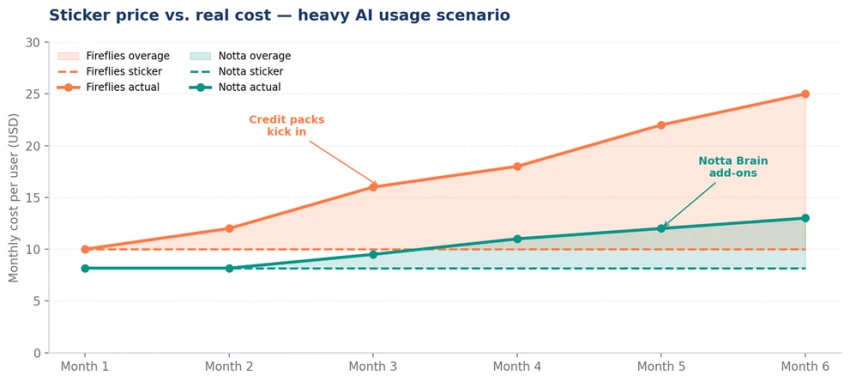
A six-month projection for a heavy AI user. Fireflies’ credit-pack economics drive the gap.
The line chart traces what happens to a heavy user on each platform across six months. Fireflies’ list price stays at $10/month while the actual cost climbs to roughly $25 by month six as credit packs auto-renew. Notta’s actual cost also climbs above its sticker (Notta Brain visual generation also consumes credits) but at a flatter rate. For teams budgeting AI tooling at the line-item level, Notta’s real cost is more predictable.
Every meeting tool ships with trade-offs, and writing about either of these without naming the concerns would be promotional rather than useful. Six issues are worth knowing about before signing an annual contract on either side.
Fireflies.ai AI credits cap on “unlimited” plans Pro and Business plans market themselves as unlimited but cap AI features (AskFred, advanced summaries) at 20–50 credits. Heavy users hit the wall fast. | Notta AI Free plan barely usable The 3-minute cap per recording on the free tier renders it more of a UI demo than a functional plan. Real evaluation requires the Pro tier. |
Fireflies.ai Auto-enrolment in credit packs G2 and Trustpilot reports describe accounts being auto-enrolled in recurring credit-pack purchases. Disabling it requires careful settings review. | Notta AI Accuracy varies by language English and Japanese hold up at the marketed accuracy. Spanish, Greek, and Polish reviewers report meaningfully lower fidelity. |
Fireflies.ai Bot announces itself in calls The Fireflies notetaker bot joins meetings as a visible participant. Disabling it mid-call requires multiple steps that some users find awkward. | Notta AI Refund and billing complaints Multiple Trustpilot reviewers describe billing disputes, particularly around the 3-day trial converting to annual subscriptions before users notice. |
None of these are deal-breakers for the right user. They are real friction for the wrong user. The decision below maps the priorities to the platform that handles them best.
The grid below replaces the usual “it depends” conclusion with concrete recommendations. Each row maps a common priority to the platform that handles it better.
| If the priority is... | ...the better fit is | |
|---|---|---|
| Sales team running on Salesforce or HubSpot | → | Fireflies.ai |
| Distributed team operating across 3+ languages | → | Notta AI |
| Solo user wanting cheapest paid plan with full features | → | Notta AI |
| Conversation analytics, talk-time, sentiment tracking | → | Fireflies.ai |
| Capturing in-person meetings on a phone | → | Notta AI |
| Generating slides or infographics from meeting outcomes | → | Notta AI |
| Heavy CRM integration depth (Salesforce-native) | → | Fireflies.ai |
| Bilingual transcripts in a single output | → | Notta AI |
| Real-time AI assistant inside the meeting (AskFred) | → | Fireflies.ai |
| Predictable monthly cost without credit-pack surprises | → | Notta AI |
The split is roughly even - ten priorities, five going each way. That is the honest summary: neither platform dominates the comparison, and the right choice is determined by which two or three of the priorities above matter most for a given team.
Anyone choosing between Fireflies.ai and Notta AI is really answering a simpler question: does the work happen inside a CRM or outside one? Fireflies is the better tool for sales teams, customer success teams, and revenue ops functions where every meeting needs to land back inside Salesforce or HubSpot, where Slack alerts drive workflow, and where conversation analytics across many calls add real intelligence. Notta is the better tool for global teams running across multiple languages, project leads producing visual deliverables for executives, consultants needing bilingual transcripts, and anyone whose meetings happen as much in person as on video calls.
On price alone, Notta wins at the Pro tier and the Business tier looks more expensive but bundles features Fireflies charges separately for. On real-world cost over time, Notta’s curve is flatter because Fireflies’ credit-pack economics catch up with heavy AI users by month three or four. On accuracy, neither tool dominates - Fireflies edges ahead in clean enterprise English; Notta edges ahead in noisy or multilingual environments.
The verdict for most teams: pilot Fireflies first if the workflow centers on CRM and sales-stack integration. Pilot Notta first if the workflow centers on multilingual capture or generating deliverables from meetings. Both offer real free tiers usable for evaluation, with the caveat that Notta’s 3-minute recording cap on free makes any serious test require the Pro plan.
New Claude Model Targets Agentic AI WorkflowsAnthropic has launched Claude Sonne...
Samuel Osei3 months ago

Gemini’s Image Tools Get a Wider RolloutGoogle is expanding access to Gemini’s p...
Alexander Hughes3 months ago
Two AI video generators, two very different first days. I ran PixVerse through i...
Alexander Hughes3 months ago
Two of the most talked-about AI chat platforms. I opened both, picked a characte...
Alexander Hughes3 months ago
The two-minute versionIf you only read one thing, read this. The rest of the doc...
Alexander Hughes3 months ago
Why Seedance 2.5 mattersSeedance 2.5 is the latest release in ByteDance’s Seedan...
Alexander Hughes3 months ago
Discussion