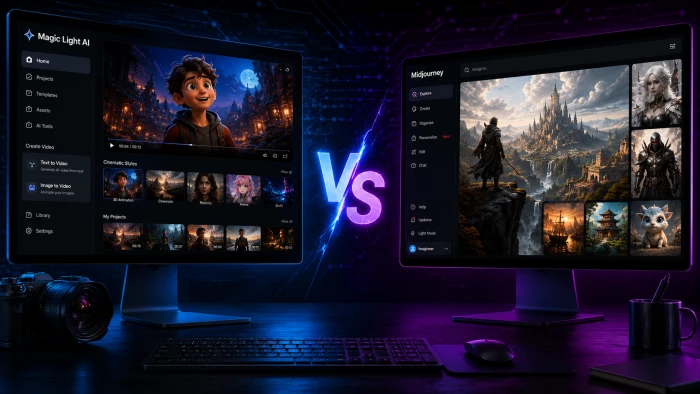
Quick Answer
Magic Light AI wins for animated story videos, multi-scene narratives, and content with characters, voice, and motion. Subscriptions start at $12 per month with a free 300-credit tier.
Midjourney wins for still imagery, photorealism, artistic style, and high-resolution upscaling. Subscriptions start at $10 per month with no permanent free tier.
The most useful answer is rarely "either or." These tools solve different problems and pair well for creators who need both video and signature still imagery.
Most articles that compare Magic Light AI and Midjourney treat them as direct competitors in the same category. That framing is misleading. Magic Light AI is a story-to-video platform that builds animated narratives lasting up to 30 to 60 minutes, complete with characters, scenes, dialogue, and voiceover. Midjourney is a specialist image generator that produces single high-quality frames, with newer features extending into short animated clips.
Both tools create visuals, which is the only category-level connection. Beyond that surface, the workflows diverge sharply, the pricing models reward different usage patterns, and the output formats answer different creative needs. A YouTuber building animated explainers and a graphic designer producing a portfolio cover are not choosing between the same two tools, even if both searches surface the same set of competitor reviews.
The confusion is understandable. Both platforms rank prominently in 2026 search results for terms like "AI visual generation," both ship with frequent updates, and both have active creator communities documenting their workflows on YouTube and Reddit. Surface-level coverage rarely takes the time to clarify that these are different categories of product wearing similar marketing language.
The honest comparison clarifies which platform fits which kind of visual project, rather than forcing an apples-to-apples ranking that misses the point. The sections below break the two platforms apart on workflow, output, model lineup, pricing, and use case, then close with a hybrid approach for creators who genuinely benefit from both.
A story-to-video platform that turns scripts into animated narratives.
| Output | Entry price | Best for | Standout |
|---|---|---|---|
| Animated videos up to 30-60 min | Free or $12 / month (Standard) | Storytellers, YouTubers, educators | 100-plus characters, AI Directing System |
Magic Light AI is built around a fundamentally different question than most image tools answer which we already discussed on Magic Light AI review. Instead of asking "what does this single frame look like," the platform asks "what does this story look like end to end." The user supplies a script, idea, or outline, and the platform automatically generates a storyboard, picks characters from a library of more than 100 culturally diverse personas, plans camera angles through its AI Directing System, renders each scene, and adds multilingual voiceover in over 10 languages.
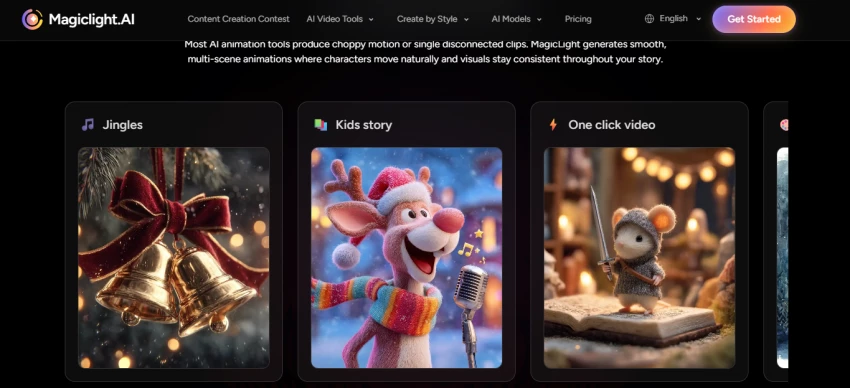
The credit-based pricing structure scales from a free 300-credit tier through five paid tiers. Standard at $12 per month covers 6,000 credits. Plus at $26 brings 15,000 credits. Pro at $35 unlocks 35,000 credits along with access to frontier LLMs including Gemini 3 and ChatGPT 5. Ultra at $90 expands to 120,000 credits, and Max at $120 reaches 180,000 credits with priority processing. Annual billing reduces those prices by roughly 50 percent. Every plan, including the free tier, includes commercial usage rights.
A specialist image generator known for artistic quality and photorealism.
| Output | Entry price | Best for | Standout |
|---|---|---|---|
| Still images up to 2K-4K resolution | $10 / month (Basic) | Artists, designers, photographers | V8.1 model, Style Reference, Omni Reference |
Midjourney has held a consistent reputation as the highest-quality artistic AI image generator since launch in 2022. The May 2026 update to V8.1, released on April 30, brought faster generation, sharper small-detail retention, HD 2K image support, and an improved Raw mode. The previous V7 remains the default model for most accounts. Both versions handle photorealism, artistic styles, and cinematic compositions with a polish that most competing image generators still cannot match.
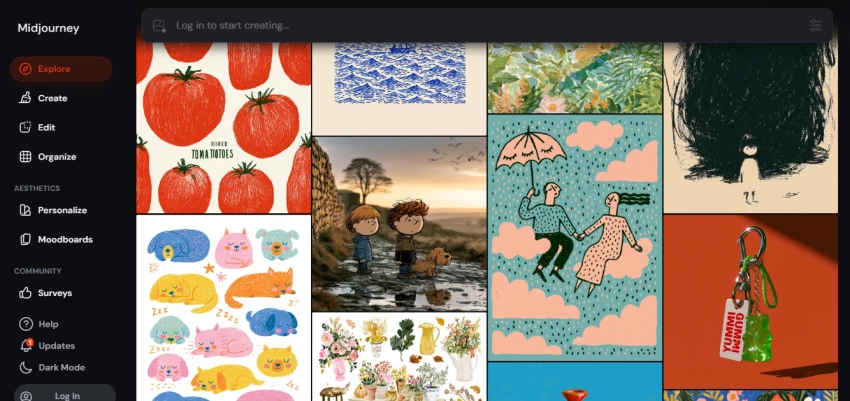
Four subscription tiers govern access. Basic at $10 per month provides roughly 3.3 hours of Fast GPU time, equivalent to about 200 image generations. Standard at $30 adds Relax Mode (unlimited slow generation) and typically delivers 500 to 700 V7 images per month before slow queues. Pro at $60 enables Stealth Mode for private generations and higher concurrency, while Mega at $120 offers maximum throughput for heavy users. Annual billing carries a 20 percent discount across all tiers. No permanent free tier exists in 2026, and all paid plans include commercial usage rights.
The clearest way to understand the difference is to look at what each platform produces. The diagram below maps the input-to-output flow for both tools side by side.
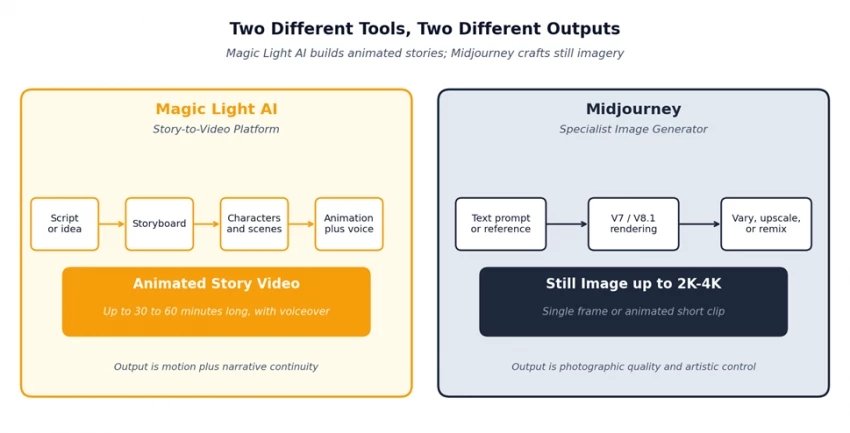
Magic Light AI builds multi-scene animated stories; Midjourney crafts standalone still imagery.
Magic Light AI delivers a finished video asset that includes motion, narrative continuity, characters that persist across scenes, and audio. The platform handles all four of those elements automatically once the user supplies a script or idea. Midjourney delivers a single rendered frame at high resolution that the user can further upscale, vary, or remix into refined versions of the same composition.
Both outputs are valuable, but they answer different creative needs. A faceless YouTube channel building animated children's stories needs the first. A graphic designer creating a magazine cover needs the second. Trying to force either tool to deliver the other category of output produces results that look obviously off-purpose, which is the most common complaint from users who picked the wrong platform for their use case.
The workflow inside each platform reflects the different output goals. Magic Light AI runs a four-stage automated pipeline; Midjourney runs a tighter three-stage cycle focused on iteration.
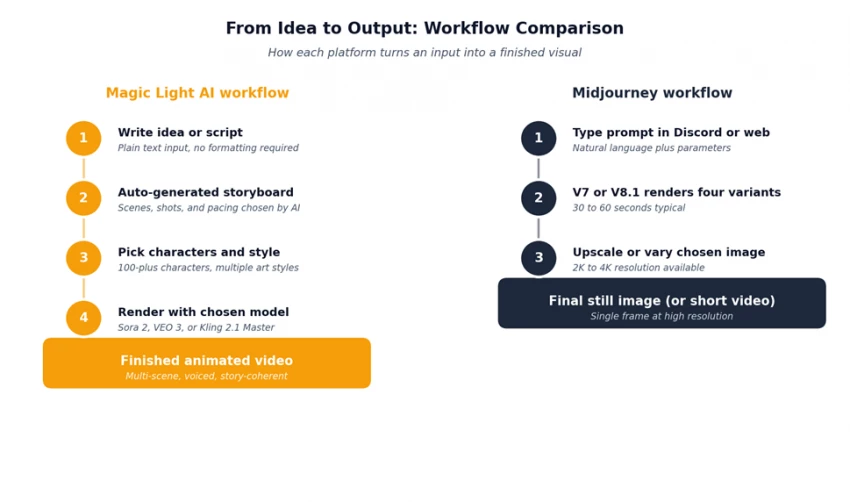
Each platform's input-to-output flow, with stage counts that reflect the complexity of the final asset.
Magic Light AI compresses what would otherwise be hours of storyboarding, animation, and voice production into a single text input. The pipeline handles story expansion, scene generation, character continuity, and voiceover synthesis without user intervention beyond reviewing and regenerating specific scenes. Midjourney optimizes for a different rhythm. A prompt produces four image variants in 30 to 60 seconds, and the iteration loop sits with the creator: vary, upscale, remix, or refine the prompt and run again. Power users often generate dozens of variants before settling on a final image.
Ten capabilities matter for visual creation workflows. The matrix below scores each tool on every dimension.
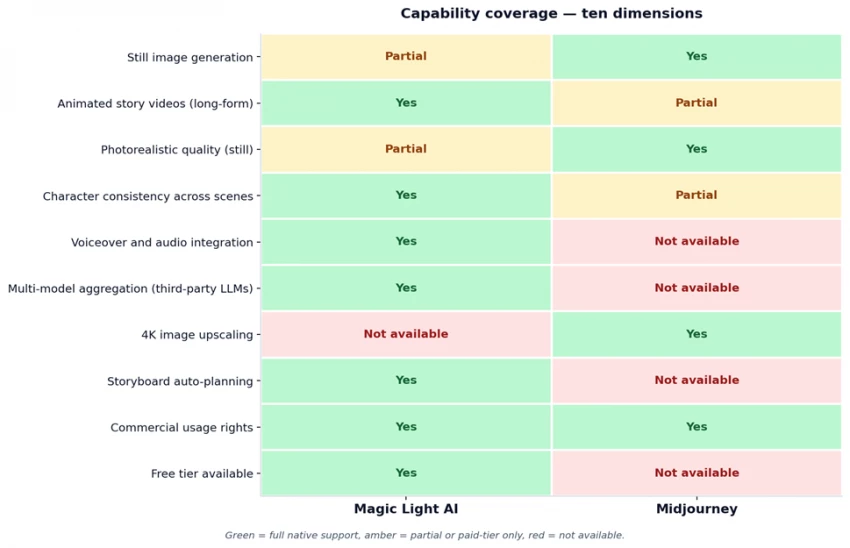
Where each platform offers full support, partial coverage, or no support across ten capability dimensions.
The pattern is consistent with the category split. Magic Light AI leads on story-driven capabilities (long-form video, character consistency, voiceover, multi-model aggregation, storyboard auto-planning). Midjourney leads on image-specific quality and refinement (still photorealism, 4K upscaling). Commercial rights and partial coverage of the opposite category are mostly present, but neither tool replaces the other for its strongest use case.
Pricing comparison gets cleaner when each platform's tiers are aligned by usage intensity rather than by tier name. The chart below groups the closest comparable pairs across four levels.
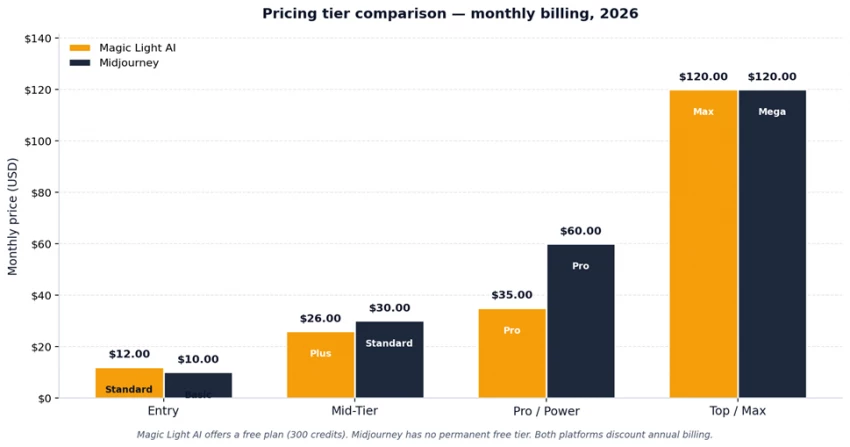
Monthly prices at each comparable usage tier in May 2026.
At the entry level, the two platforms sit within $2 of each other. The middle tiers stay roughly comparable. The Pro tier is where pricing diverges meaningfully: Midjourney's Pro plan costs $60 per month and adds Stealth Mode plus higher concurrency, while Magic Light AI's Pro tier at $35 unlocks the most powerful LLM and video models on its lineup. At the top, both platforms cap at $120 per month.
The total cost of ownership depends on how heavily the credit system or GPU time gets used. Magic Light AI users producing dozens of videos per week can burn through Pro credits quickly; Midjourney users running rapid iterations on a single image campaign can chew through Fast GPU hours just as fast. Annual billing reduces the effective rate by 50 percent on Magic Light AI and 20 percent on Midjourney.
This is one of the most underappreciated differences between the two services. Magic Light AI aggregates multiple frontier models behind a unified interface, while Midjourney runs its own proprietary models exclusively.
| Model category | Magic Light AI | Midjourney |
|---|---|---|
| Image generation | Nano Banana 2 (Gemini 3.0 Pro Image) | Midjourney V7 (default) and V8.1 (latest) |
| Video generation | Sora 2, VEO 3, Kling 2.1 Master, Wan 2-6, Hailuo 2.3 Fast, Seedance 1.5 Pro | Native Midjourney video (animate stills) |
| Language models | Gemini 3, Gemini 3 Flash, ChatGPT 5 | Not exposed to users |
| Music and audio | Suno-powered music video tool | Not supported |
| Style controls | Character library, art style presets | Style Reference, Omni Reference, Raw mode |
| Resolution ceiling | Up to 720p preview, higher on render | 2K standard, 4K via upscaling |
The strategic difference matters in practice. Magic Light AI users benefit from staying current with the broader AI model ecosystem without subscribing to each provider separately. Midjourney users get a single tightly-tuned model trained for one purpose, which is part of why image quality remains the consensus benchmark in the category. Neither approach is universally better; each fits a different creative philosophy.
Quality assessment depends entirely on what the visual needs to do. The table below scores each platform across common visual types.
| Visual type | Magic Light AI | Midjourney | Winner |
|---|---|---|---|
| Photorealistic portrait | Good | Exceptional | Midjourney |
| Stylized illustration | Strong (preset styles) | Exceptional (open style range) | Midjourney |
| Multi-scene animation | Exceptional | Limited | Magic Light AI |
| Character consistency across frames | Built in by design | Requires Omni Reference setup | Magic Light AI |
| Marketing video with voiceover | Exceptional | Not supported natively | Magic Light AI |
| Magazine-quality print artwork | Limited resolution | Up to 4K | Midjourney |
| Children's story video | Exceptional | Not supported natively | Magic Light AI |
| Concept art for games or film | Adequate | Strong (cinematic styles) | Midjourney |
| Social media short-form video | Strong (long-form tilted) | Strong (image animation) | Roughly even |
Six areas where Magic Light AI consistently produces stronger results than Midjourney for the same creative brief.
• Long-form animated story production with cohesive narrative arcs across many scenes.
• Character consistency without manual reference image management or seed reuse.
• Multilingual voiceover synthesis in over 10 languages with emotion-aware narration.
• Aggregated access to frontier video models including Sora 2, VEO 3, and Kling 2.1 Master under one subscription.
• Storyboard auto-planning that removes the need for separate scene-by-scene prompting.
• Free tier with 300 credits that lets new creators test the full workflow before committing.
Verdict: the clear pick when the deliverable is a finished video, especially story-driven content.
Six areas where Midjourney remains the benchmark tool that no story platform has matched.
• Photorealistic still imagery with skin texture, fabric detail, and lighting fidelity that holds up at print scale.
• Artistic style range from oil painting to 3D render to film stills, controlled through Style Reference.
• Omni Reference system for character consistency across separate generations when used carefully.
• 4K upscaling that produces magazine and poster-grade output from the same prompt.
• Raw mode for low-bias rendering that prioritizes prompt fidelity over aesthetic auto-correction.
• Mature prompt engineering community with thousands of documented prompt patterns and parameter recipes.
Verdict: the clear pick when the deliverable is a still image, particularly at professional quality.
Neither tool is without trade-offs. The side-by-side limitations below cover what each platform does not do well.
| Limitation area | Magic Light AI | Midjourney |
|---|---|---|
| Resolution ceiling | Lower than competitor for stills | Limited to 2K native (4K via upscale) |
| Free access | 300-credit demo tier | No permanent free tier |
| Customer support | Reported as unresponsive | Limited support channels |
| Failed-generation cost | Credits consumed even on bad outputs | GPU time consumed on rejected results |
| Interface | Web only | Discord plus web; learning curve |
| Editing tools | Basic timeline editor only | No native editing beyond vary or upscale |
| API access | Not officially documented | Third-party APIs only (no official) |
| Long render times | Multi-minute renders on complex scenes | 5 to 40 minute waits in slow queue |
Both platforms face the credit-or-time anxiety that defines current generative AI pricing. Users who burn through quotas quickly often end up upgrading to higher tiers or budgeting more carefully than they would with flat-rate software.
The most pragmatic answer for creators who produce a mix of visual content is not picking one platform but using both for what each does best.
Generate signature key art and hero imagery in Midjourney where photorealism, artistic polish, and high resolution matter. Use those images as reference inputs for character design or scene mood inside Magic Light AI when building the animated story or marketing video. The Midjourney output gives the project its visual identity; the Magic Light AI output gives the project motion and narrative.
Independent creators using this workflow typically settle into a rhythm where Midjourney handles the establishing shot, key character portraits, and brand-quality stills, while Magic Light AI handles the scene-by-scene animation, dialogue, and pacing. Both outputs land in a video editor for final assembly, with Midjourney stills used as scene transitions or thumbnail art alongside Magic Light AI's animated content.
A reasonable hybrid budget at the entry tier runs $22 per month combined ($10 Midjourney Basic plus $12 Magic Light AI Standard). At the mid-tier, $56 per month combined ($30 Midjourney Standard plus $26 Magic Light AI Plus) covers most independent creator workflows. That figure stays under the cost of a single Pro plan on either platform alone and unlocks both categories of output.
For creators who only need one tool, the choice should follow the dominant deliverable. Producing video content that needs to look polished is Magic Light AI territory. Producing still imagery that needs to look professional is Midjourney territory. Forcing one tool into the other's strength rarely produces a better result than picking the right tool from the start.
The single recommendation depends entirely on what the visual needs to do. The table below maps common use cases to the platform that fits each one best.
| Use case | Recommended pick | Why |
|---|---|---|
| YouTube animated explainer or kids' story | Magic Light AI | Long-form structure with characters, scenes, and voice |
| Marketing campaign hero image | Midjourney | Photorealistic still quality at print resolution |
| Product launch promo video | Magic Light AI | Auto-storyboard plus voiceover delivers polished output fast |
| Concept art for film or game | Midjourney | Style range and cinematic aesthetics are unmatched |
| Educational content with narration | Magic Light AI | Multilingual voiceover in over 10 languages |
| Magazine or book cover artwork | Midjourney | 4K upscaling supports print workflows |
| Social media content (mixed) | Both, in hybrid | Stills from Midjourney, short videos from Magic Light AI |
| Quick prototype or storyboard | Magic Light AI | AI Directing System plans shots automatically |
The closing point is straightforward. Asking which platform creates better visuals is the wrong question. The right question is which kind of visual the project actually needs. Once that clarifies, the choice between Magic Light AI and Midjourney almost makes itself.
New Claude Model Targets Agentic AI WorkflowsAnthropic has launched Claude Sonne...
Samuel Osei3 months ago
Gemini’s Image Tools Get a Wider RolloutGoogle is expanding access to Gemini’s p...
Alexander Hughes3 months ago
Two AI video generators, two very different first days. I ran PixVerse through i...
Alexander Hughes3 months ago
Two of the most talked-about AI chat platforms. I opened both, picked a characte...
Alexander Hughes3 months ago
The two-minute versionIf you only read one thing, read this. The rest of the doc...
Alexander Hughes3 months ago
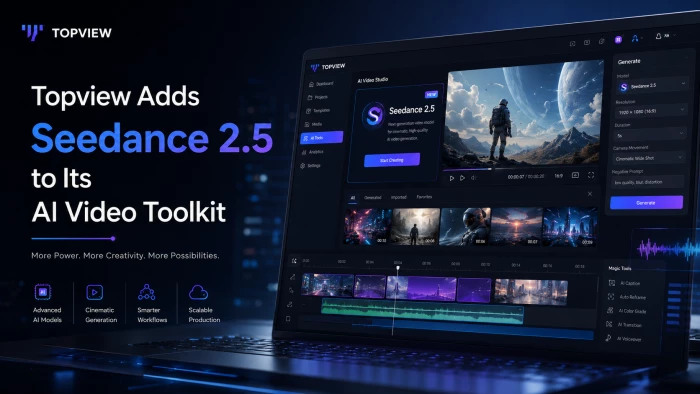
Why Seedance 2.5 mattersSeedance 2.5 is the latest release in ByteDance’s Seedan...
Alexander Hughes3 months ago
Discussion