AI & ML
12 min read
Deevid AI vs Runway: Which Creates Better AI Videos?
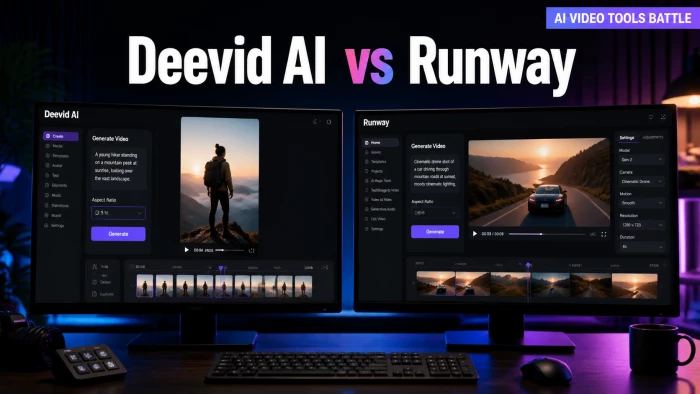
AI video generation went from research curiosity to genuine production tool in less than three years. By mid-2026, the market has stratified. On one side sit specialized professional platforms used by Hollywood post-production teams. On the other sit fast, accessible aggregator tools built for the daily rhythm of social media. Deevid AI and Runway sit at almost the exact center of that divide, which is what makes the comparison worth running.
Runway, founded in 2018 and now valued at $5.3 billion after its February 2026 funding round, defines the professional end of the market. Its Gen-4.5 model currently sits at the top of the Video Arena leaderboard. Deevid AI, founded in 2024 and headquartered in Las Vegas, takes a different bet: instead of building one proprietary model, it bundles access to several of the strongest commercial video models under a single subscription, including Veo 3, Sora 2, Kling, Runway itself, Seedance, and PixVerse.
This breakdown covers feature parity, pricing economics, output quality across ten dimensions, workflow integration, and a use-case decision matrix. Every figure cited comes from vendor documentation, independent reviews published between October 2025 and April 2026, or hands-on test reports.
Different tools, different jobs. Both score well inside their actual lane.
DEEVID AI ★★★½ • 3.6 / 5 Best for speed, social-first creators, and budget-conscious teams testing multiple AI models in one place. Starting price: $10 / month (annual) | RUNWAY ★★★★½ • 4.6 / 5 Best for professional editors, filmmakers, and agencies needing character consistency and Hollywood-grade output. Starting price: $12 / month (annual) |
BOTTOM LINE Runway produces better video on almost every quality benchmark, but Deevid AI delivers more usable output per dollar for short-form social and ad creators who do not need character consistency or 4K export. |
| Snapshot | Deevid AI | Runway |
|---|---|---|
| Founded | 2024 (Las Vegas) | 2018 (New York) |
| Flagship model | Multi-model aggregator (Veo, Sora, Kling, others) | Gen-4.5 proprietary plus partner models |
| Max resolution | 1080p on Pro and Premium plans | Up to 4K via Gen-4 and upscaling |
| Max clip length | Approximately 8 to 10 seconds per generation | 5 or 10 seconds, extendable to 20 seconds plus |
| Free tier | Yes, watermarked outputs | Yes, 125 one-time credits |
| Commercial use | Included on all paid plans | Included on all paid plans |
| Mobile apps | iOS and Android | iOS and Android |
| API access | Not publicly documented | Yes, full Runway API |
| Backed by | Independent startup | Google, Nvidia, Salesforce, Lionsgate |
A multi-model AI video aggregator built for speed, volume, and social-first production.
Deevid AI launched in 2024 with a simple thesis, and that is where any practical DeeVid AI Review has to start: rather than train another proprietary video model in a market already crowded with strong options, package several of the best ones together under a single subscription and a unified interface. The platform now routes generations through Veo 3, Sora 2, Kling AI, Runway itself, Seedance, PixVerse, and Google's Nano Banana, depending on user selection and prompt type.
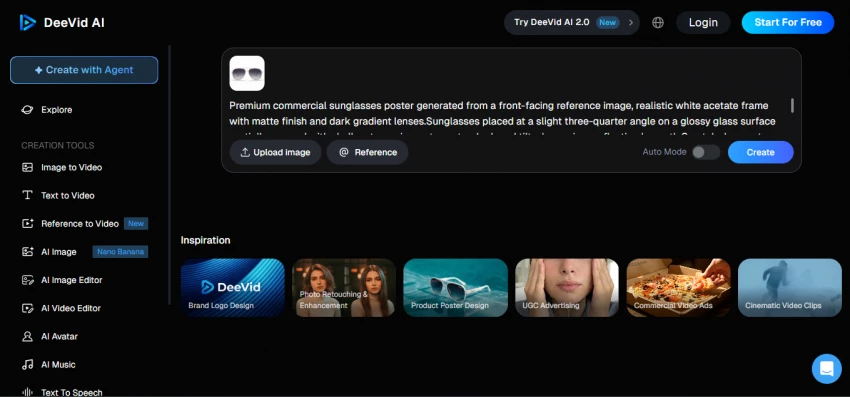
The interface deliberately favors non-technical users. Templates handle most setup choices. Three input modes (text-to-video, image-to-video, and video-to-video restyling) cover the typical short-form creative workflow. Outputs land in roughly one to two minutes, which makes the platform popular for A/B testing ad hooks, generating placeholder visuals, or pumping out social variants without bouncing between five separate AI tools.
Reported user feedback splits sharply along expectation lines. Reviewers who use Deevid for fast, disposable short-form content tend to rate it well. Reviewers who attempt cinematic or character-driven work report quality variance, particularly on text rendering inside videos, hand and finger artifacts, and lip-sync irregularities. The platform also enforces a strict no-refund policy on paid generations, which has drawn complaints on Trustpilot.
The professional-grade AI video platform used by Hollywood studios and serious post-production teams.
Runway started in 2018 as a browser-based machine learning toolkit for creative professionals and pivoted hard into generative video. The company raised more than $630 million across multiple rounds, including a February 2026 round that valued it at $5.3 billion. Investors include Google, Nvidia, and Salesforce. A formal partnership with Lionsgate puts Runway inside actual studio production pipelines.
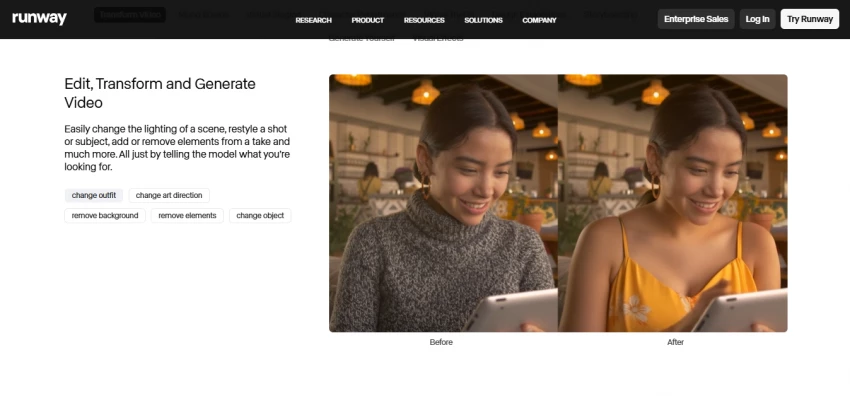
The flagship Gen-4.5 model, released in December 2025, currently holds the top position on the Video Arena leaderboard. Gen-4 (March 2025) introduced the character-consistency breakthrough that solved one of the hardest problems in AI video: keeping the same person looking like the same person across multiple shots, lighting setups, and camera angles. A single reference image is enough.
Beyond the base model, Runway sells an entire production stack. Aleph functions as a prompt-driven in-video editor that can add props, change lighting, or remove elements while preserving temporal consistency. Act-Two captures performance data from any smartphone video and applies it to a generated character. Workflows lets teams build node-based pipelines that chain generation, editing, style transfer, and export into a single automated process. The platform also includes a multi-model marketplace that gives subscribers access to Veo 3.1, Kling 3.0 Pro, Seedance, FLUX, and Seedream alongside the proprietary Runway models.
Capability differences become clearest in a side-by-side comparison. The table below covers every major feature category for both platforms, drawn from official documentation and verified third-party reviews.
| Capability | Deevid AI | Runway |
|---|---|---|
| Text-to-video | Yes, multi-model selection | Yes, Gen-4.5 flagship |
| Image-to-video | Yes, with motion controls | Yes, with reference frame anchoring |
| Video-to-video restyling | Yes, anime and stylized presets | Yes, via Aleph editor |
| Character consistency across shots | Limited, variable results | Strong, single reference image method |
| Lip-sync support | Yes, automated | Yes, custom voice cloning option |
| Motion brush or camera control | Basic motion effects only | Full motion brush and camera path tools |
| In-video editor | Not available | Aleph for prompt-based editing |
| Motion capture from smartphone video | Not available | Act-Two performance capture |
| Custom workflow automation | Not available | Workflows node-based pipelines |
| Native 4K export | Not available | Yes, ProRes 4444 with alpha channel |
| Models included on entry plan | Veo 3, Sora 2, Kling, Nano Banana and more | Gen-4.5, Veo 3.1, Kling 3.0 Pro, Seedance, FLUX |
| Audio and voiceover generation | Yes, with synchronized voice | Yes, custom voice library |
| Template library | Yes, large preset library | Limited template focus, prompt-driven |
| Studio backing or partnerships | Independent | Lionsgate, Nvidia, Google |
The capability gap matters most for professional and narrative workflows. Runway handles character consistency across separate clips, motion capture from phone video, prompt-based in-video editing, and 4K ProRes export with alpha channel for compositing. Deevid AI handles none of those at production grade. What Deevid offers in exchange is breadth of model access at a lower entry price, plus a template library that lowers the learning curve for first-time users.
Both products use credit-based pricing layered on top of monthly subscriptions. Credits get consumed by each generation, and unused credits do not roll over on either platform. That makes plan selection an exercise in estimating monthly volume accurately.
| Tier | Deevid AI | Runway |
|---|---|---|
| Free tier | Watermarked outputs, limited resolution | 125 one-time credits, Gen-4 Turbo image-to-video |
| Entry plan | Lite at $10 / mo annual ($14 monthly), 200 credits, 720p | Standard at $12 / mo annual ($15 monthly), 625 credits, all models |
| Mid tier | Pro at $25 / mo annual ($35 monthly), 600 credits, 1080p | Pro at $28 / mo annual ($35 monthly), 2,250 credits, 10 users |
| Top tier | Premium at $119 / mo annual ($159 monthly), 3,000 credits | Unlimited at $76 / mo annual ($95 monthly), Relaxed Mode unlimited |
| Annual discount | 29 percent off yearly billing | 20 percent off yearly billing |
| Credit per video | ~5 credits per generation | Varies: Gen-4.5 burns ~25 credits per 10 seconds |
| API access | Not publicly documented | Available on Pro and above |
| Refund policy | Strict no-refund policy reported | Standard cancellation policy |
At the entry tier, the two products price within $2 of each other. The economics diverge sharply at the top end. Runway Unlimited at $76 per month (annual) opens up Relaxed Mode, which removes per-clip credit limits for heavy users. Deevid AI Premium at $119 per month (annual) caps at 3,000 credits, which roughly translates to 600 generations before top-ups are required.
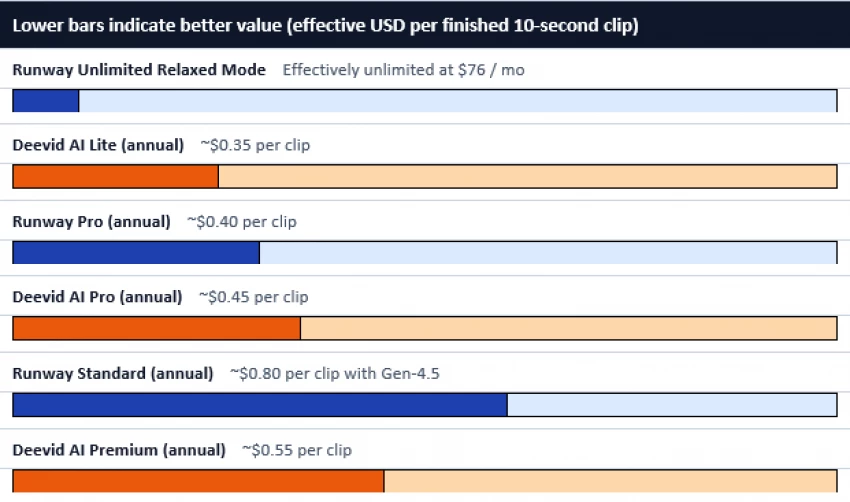
Note that these figures track raw cost per generation, not cost per usable output. Runway's higher per-clip cost partially offsets through fewer required regenerations on complex prompts. Deevid AI users often retry the same prompt three or four times to land an acceptable result, which can quietly double or triple the effective cost.
Output fidelity sits at the heart of every AI video buying decision. Independent benchmarks and side-by-side prompt tests run between January and April 2026 show consistent patterns across both platforms. The ratings below summarize how each tool performs across the dimensions that matter most for production work.
| Quality Dimension | Deevid AI | Runway |
|---|---|---|
| Photorealism | ★★★ | ★★★★★ |
| Character consistency across shots | ★★ | ★★★★★ |
| Motion quality and physics | ★★★ | ★★★★½ |
| Prompt adherence | ★★★½ | ★★★★½ |
| Lip-sync accuracy | ★★★ | ★★★★ |
| Text rendering inside video | ★★ | ★★★½ |
| Hand and anatomy rendering | ★★½ | ★★★★ |
| Stylized output (anime, painterly) | ★★★★ | ★★★★ |
| Short-form social clips | ★★★★ | ★★★★ |
| Long-form narrative footage | ★★½ | ★★★★½ |
Runway pulls clearly ahead on character consistency, photorealism, motion physics, and long-form narrative work. Gen-4.5 holds spatial coherence across camera movements and keeps human anatomy stable through multiple seconds of action. Deevid AI catches up on stylized output and short-form social clips, where viewers tend to forgive artifacts the way they forgive shaky handheld phone footage.
Two specific weaknesses recur across third-party Deevid AI reviews: text rendering inside generated video often produces scrambled or random characters, and human hands frequently show extra or distorted fingers. Both issues exist on Runway as well but at noticeably lower frequency, particularly when reference images guide the generation.
QUALITY TAKEAWAY Runway wins on every traditional quality benchmark. Deevid AI closes the gap only on stylized, short-form, social-tier output where rough edges read as creative choices rather than artifacts. |
Generation speed and workflow integration matter as much as raw quality, particularly for teams producing video at scale. Deevid AI optimizes hard for speed and template-driven simplicity. Most generations land in under two minutes, with some completing in under sixty seconds. The trade-off is limited fine-tuning control once the AI has decided what to produce.
Runway optimizes for production-grade output and creative control. Standard renders take a few minutes per clip on Gen-4.5. Turbo mode produces a five to ten second clip in roughly thirty seconds at lower per-credit cost. Motion Brush, Camera Controls, and reference frame anchoring add several configuration steps before generation, which slows initial setup but compounds value over a multi-shot project.
The workflow ceiling sits much higher on Runway. Aleph allows iterative prompt-based edits to a finished clip without regenerating from scratch. Act-Two transfers facial expressions and body movement from a phone-shot performance directly onto a generated character. Workflows links multiple operations into automated pipelines that agencies use for repetitive production runs across hundreds of clips.
Deevid AI offers nothing equivalent. The platform is built for one-and-done generation, not iterative refinement. That alignment fits its target audience (social creators chasing engagement velocity) but limits use in professional post-production pipelines.
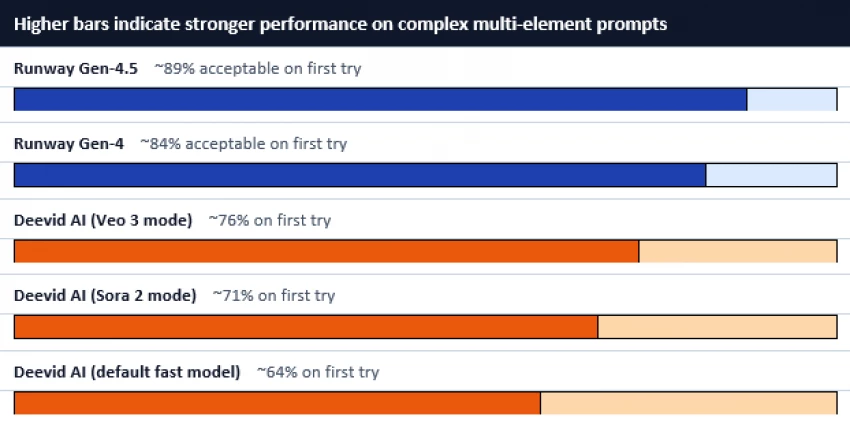
The success rate gap is the single most important number in this comparison. A 25-point spread between Runway Gen-4.5 and Deevid AI's default fast model means roughly one in three Deevid AI generations needs a retry to hit acceptable quality. On the Lite plan at 200 credits per month, that retry burden eats credits fast.
A side-by-side strengths and weaknesses summary reflects the trade-offs documented across all prior sections.
DEEVID AI Strengths • Multi-model access in one subscription • Generates videos in under two minutes • Templates lower the learning curve • Mobile apps for on-the-go creation • Annual discount of 29 percent Weaknesses • Quality variance on complex prompts • Text inside videos often garbled • Anatomy issues like extra fingers • Strict no-refund policy reported • No public API documentation | RUNWAY Strengths • Character consistency across shots • Native 4K with ProRes 4444 alpha export • Aleph in-video prompt editing • Act-Two performance capture from phone video • Hollywood-grade studio backing Weaknesses • Credits do not roll over month to month • $28 to $35 monthly Pro tier prices out casual users • Interface complexity creates onboarding friction • Premium models burn credits faster • Generation queues during peak times |
Buyer profile determines fit more than any benchmark. The decision matrix below maps the most common user types to the better-fitting tool, with a single-line justification for each recommendation.
| User Profile | Recommended Tool | Why |
|---|---|---|
| Solo content creator on TikTok or Reels | Deevid AI | Speed and templates fit short-form rhythm |
| Social media manager running A/B ad tests | Deevid AI | Multi-model access for quick variants |
| E-commerce seller animating product shots | Deevid AI | Fast image-to-video at low credit cost |
| Independent filmmaker building a short film | Runway | Character consistency and Aleph editing tools |
| Marketing agency producing branded campaigns | Runway | Workflows pipelines and 4K export |
| Post-production studio replacing reshoots | Runway | Act-Two motion capture and consistency |
| Educator producing explainer videos | Deevid AI | Templates plus voiceover bundling |
| Music video creator with stylized vision | Runway | Motion brush and reference frame control |
| Hollywood-aligned studio | Runway | Lionsgate partnership and 4K ProRes pipeline |
| First-time AI video user testing the waters | Deevid AI | Lower barrier and gentler learning curve |
The pattern across the matrix is consistent. Use Deevid AI when speed, volume, and budget matter more than per-clip quality. Use Runway when character consistency, 4K output, in-video editing, or commercial post-production polish enter the picture. Hybrid setups are increasingly common in 2026: agencies often use Deevid AI for fast concept tests and storyboards, then switch to Runway for the final delivery cuts.
Runway wins the head-to-head on every benchmark that matters for serious production: photorealism, character consistency, motion quality, prompt adherence, native 4K export, and creative control through Motion Brush and Aleph. Gen-4.5 currently sits at the top of the Video Arena leaderboard for good reason, and the Lionsgate partnership signals genuine adoption inside film and television workflows.
Deevid AI wins on a different axis. The platform is faster, cheaper at the entry tier, and bundles model access in a way that suits social creators producing dozens of variants per week. The quality variance and refund stance limit its appeal for professional buyers, but inside its design lane (short-form, social-first, high-volume creative testing) it earns its price.
Pick Runway if AI video is core to professional output. Pick Deevid AI if AI video is one ingredient in a fast-moving social content pipeline. The two products are not really competing for the same buyer, and treating them as direct alternatives misses the point. The right move for many creative teams in 2026 is to subscribe to both at their lowest tiers and route work to whichever tool fits the specific shot.
New Claude Model Targets Agentic AI WorkflowsAnthropic has launched Claude Sonne...
Samuel Osei3 months ago
Gemini’s Image Tools Get a Wider RolloutGoogle is expanding access to Gemini’s p...
Alexander Hughes3 months ago
Two AI video generators, two very different first days. I ran PixVerse through i...
Alexander Hughes3 months ago
Two of the most talked-about AI chat platforms. I opened both, picked a characte...
Alexander Hughes3 months ago
The two-minute versionIf you only read one thing, read this. The rest of the doc...
Alexander Hughes3 months ago
Why Seedance 2.5 mattersSeedance 2.5 is the latest release in ByteDance’s Seedan...
Alexander Hughes3 months ago
Discussion