AI & ML
13 min read
Akool AI vs Synthesia: Which Is Better for AI Avatars?
If you are choosing an AI avatar tool in 2026, Akool AI and Synthesia both belong on your shortlist, but they are not really the same kind of product. Both turn a script into a polished video with a digital presenter, no camera or studio required. Look closer, though, and one is a broad creative video suite while the other is an enterprise grade avatar platform. So which one is better when avatars are the whole point?
I went through both in detail, comparing their avatars, languages, workflows, pricing, and what thousands of reviewers say on G2, Capterra, and Trustpilot. The short version is that Synthesia makes the most realistic, expressive presenter avatars and is built for business at scale, while Akool is faster, more flexible, and does things Synthesia does not, like face swap and real time avatars. The right pick depends on what you are making and who it is for.
Here is the full, section by section breakdown, with the numbers where they matter, where each tool wins, where it falls short, and my own pick at the end. No hype, just a clear look at both.
Here is the quick side by side before we get into the detail.
| What we are comparing | Akool AI | Synthesia |
|---|---|---|
| Core idea | Versatile AI video suite, avatars plus face swap and live video | Enterprise AI avatar video platform for business |
| Best known for | Face swap, real time avatars, and tool breadth | Realistic, expressive presenter avatars at scale |
| Founded and base | 2022, Palo Alto; 2M+ users | 2017, London; 1M+ users, 90% of Fortune 100 |
| Stock avatars | 200+ 4K avatars, talking and streaming | 240+ avatars built from consenting actors |
| Avatar realism | Strong and fast, emotion can feel neutral | Top tier, Express-2 adds gestures and micro-expressions |
| Custom avatars | From your footage, photos, or talking photos | Personal digital twin, consent verified (KYC) |
| Face swap | A core strength, up to 8K | Not offered |
| Live / real time | Live Camera and streaming avatars | Video Agents (interactive), rolling out on Enterprise |
| Languages | Translation in about 155 to 175 languages | 160+ languages with one click dubbing |
| Editing | Upload to export, basic built in editor | Slide style editor, templates, brand kit |
| Compliance and LMS | Enterprise infrastructure and API, lighter on certs | SCORM, LMS, SOC 2, ISO 27001 and 42001, GDPR |
| Pricing model | Credits (not minutes) | Video minutes per month (do not roll over) |
| Entry price | About $30 / month (Pro) | About $18 / month annual (Starter), plus a free plan |
| Rendering | Fast engine, slower on cheap tiers at peak | A few minutes per minute; edits need a re-render |
| Reviews | G2 4.8, Capterra 5.0, Trustpilot about 3.5 | G2 4.7, Capterra 4.7, Trustpilot 4.0 |
| Best for | Marketing, face swap, live and multilingual video | Training, onboarding, and corporate communication |
Prices and features in this space change often, so treat these as a snapshot and confirm the current details on each site.
It helps to know what each platform is really built to do, because that shapes the avatars you get.
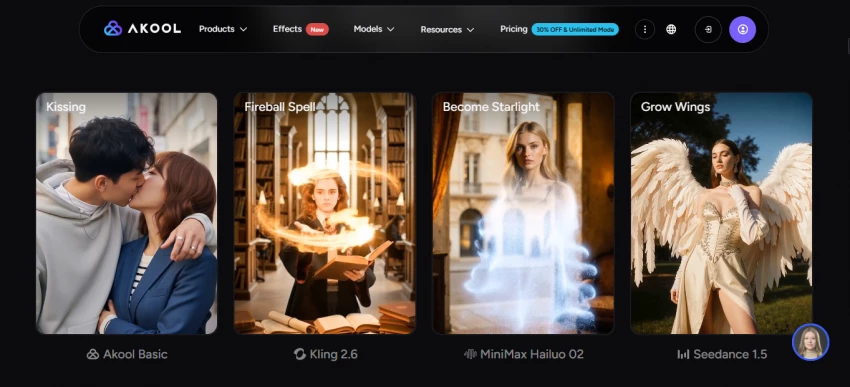
Akool is a broad AI video suite. Avatars are one part of a stack that also includes face swap, talking photos, image to video, real time video, and translation, all in one browser based tool. Its calling card is versatility and speed, and it leans toward marketing teams, agencies, and creators who want to move fast and do more than presenter videos. Founded in 2022 and based in Palo Alto, it reports more than two million users and around ten thousand companies, topped the 2025 Inc. 5000 list, and has run high profile campaigns for brands like Coca-Cola and Qatar Airways. It trains its own models, which is how it ships features like live avatars and face swap ahead of many rivals.
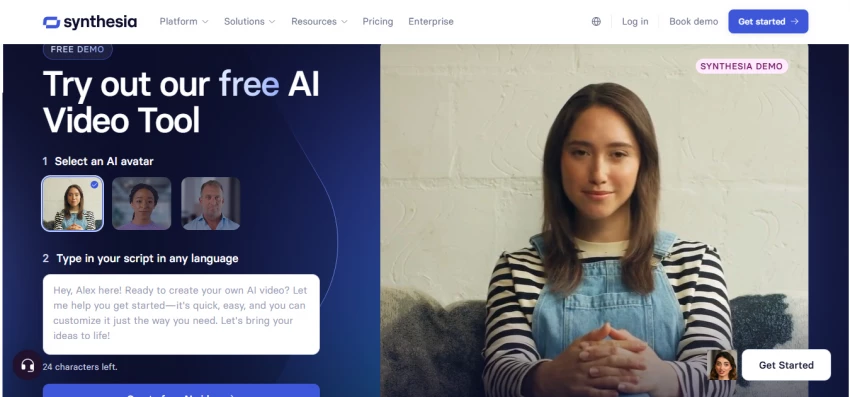
Synthesia is an enterprise AI avatar platform, and avatars are the heart of the product rather than one feature among many. You type a script, pick a realistic presenter, choose a language, and generate a studio quality video, with the whole experience built around security, scale, and ease of use for non technical teams. Founded in 2017 in London, it reports more than a million users and is used by about 90 percent of Fortune 100 companies, with more than 20 million avatar videos generated. It has focused on safe, consented AI from the start, and its recent Express-2 engine pushed avatar realism and expressiveness forward. It is aimed at training, onboarding, and corporate communication.
Since avatars are the whole question here, realism and expression are where this comparison really lives.
Synthesia sets the bar. Its avatars are built from footage of real, consenting, paid actors, and the Express-2 engine adds full body movement, natural hand gestures, and micro-expressions at high definition with no length limit. Reviewers regularly say the avatars are realistic enough that viewers ask whether the presenter is a real person, and in professional contexts they often pass the is this AI test. The newer expressive avatars also react to the tone of your script, which makes longer corporate videos feel less robotic.
Akool's avatars are strong too, and fast. In one blind test, eight of ten people could not tell its avatars from human recorded video when the audio matched, and lip sync is generally reliable. The real gap is in subtle emotional performance, since reviewers note the tone can feel neutral and that longer videos need better pacing control. So for the most lifelike, expressive presenter, Synthesia has the edge today, while Akool gets you a convincing avatar quickly and is improving fast.
Beyond raw quality, the range of avatars and how easily you can make your own matter for real projects.
Synthesia offers 240 or more stock avatars across ages, ethnicities, and styles, plus a custom digital twin you can create from a photo or a short video recording, with consent verified through a know your customer step. That consent first approach is a selling point for cautious enterprises, though creating a custom avatar can take a little time to process.
Akool provides more than 200 4K avatars, including talking and streaming avatars, and lets you build custom avatars from your own footage or images. It also supports talking photos, turning a single still into a speaking presenter. So both give you a deep library and custom options, with Synthesia leaning toward polished, consent verified digital twins and Akool toward fast, flexible avatar and photo based creation.
This is where Akool pulls clearly ahead, because Synthesia does not play here at all.
Face swap is one of Akool's signature features, running at up to 8K, and it has been used at brand scale for things like localizing an ad with a region appropriate presenter. Reviewers call the result good rather than flawless, with some rough edges on high motion, but it is a real, production usable capability. Akool also offers Live Camera, which swaps your face or persona in real time during meetings and live streams, and streaming avatars that can hold real time, interactive conversations.
Synthesia does not offer face swap. Its move toward real time is Video Agents, interactive avatars that can converse with viewers, which are rolling out to enterprise customers through 2026. So if face swap or live, real time avatars are part of what you need, Akool is the clear choice, while Synthesia stays focused on scripted presenter video.
For global teams, language coverage and dubbing quality are a big part of the avatar decision.
Synthesia supports more than 160 languages and voices, with one click translation and AI dubbing that re-syncs lip movements to the new audio, plus voice cloning so a presenter can keep their own voice across languages. With over a thousand voices and a strong localization workflow, it is built for multilingual training at scale.
Akool advertises translation across roughly 155 to 175 languages with lip sync and voice cloning, and reviewers say non English lip sync often performs better than expected, which makes it useful for fast localization. As with most tools, technical jargon still benefits from a human check. Both are strong here, with Synthesia offering the broader, more polished localization pipeline and Akool offering quick, flexible translation inside a wider toolkit.
How quickly you can go from idea to finished avatar video depends on the editor and the workflow.
Synthesia is widely praised for being about as easy as building slides in PowerPoint. You can start from a template, or let its AI assistant turn a document, URL, or PowerPoint into a full video outline, then refine scenes, add brand colors and logos, and collaborate with your team in real time. The trade off is that it is not a deep editor, so advanced scene work usually means exporting and finishing elsewhere, and changing a single word means waiting several minutes for a fresh render.
Akool follows an upload, generate, export flow that gets you to a usable draft fast, with automatic scenes and transitions. Its built in editor is fairly basic, so complex projects often move to a traditional editor, and reviewers sometimes want more in editor control. So both are approachable, with Synthesia feeling more structured and brand consistent and Akool feeling quicker and more freeform for short turnarounds.
For bigger organizations, what happens around the avatars often decides the purchase.
This is Synthesia's stronghold. It carries one of the most complete compliance stacks in the category, including SOC 2 Type II, ISO 27001, the newer ISO 42001 for AI management, and GDPR with EU data residency, plus single sign on, role based access, and watermarking. It exports to SCORM and integrates with learning management systems, which matters for training teams, and it enforces strict consent rules so avatars of real people require verification.
Akool is built for business too, with enterprise grade infrastructure, API access for workflow integration, and hyper personalization for things like name and offer level video variations. It is less focused on formal compliance certifications and LMS export, and leans more toward marketing and creative deployment. So for IT and legal approved training at scale, Synthesia is the safer fit, while Akool is the stronger creative and API driven layer.
The pricing models are different in a way that changes what you really pay, so it is worth comparing carefully.
Synthesia meters by video minutes per month, and unused minutes do not roll over. After a 2025 restructure, its free plan offers a few minutes a month with nine stock avatars and a watermark, Starter is about 18 dollars a month billed annually, around 29 dollars month to month, and Creator is roughly 64 dollars annually, about 89 monthly, which unlocks custom avatar creation. Enterprise is custom and typically lands in the low five figures a year. The common complaint is that the minute caps feel tight once you add multilingual versions and revisions, and small edits burn a fresh render.
Akool meters by credits rather than minutes, starting around 30 dollars a month for Pro and rising to Business near 500 dollars a month, with a free plan that includes daily credits and a watermark. The most cited complaint by far is the credit system, which burns faster than expected on 4K, face swap, and longer videos and makes monthly costs hard to predict, and its per seat pricing gets expensive for teams. There are also reports of billing and trial cancellation friction, so set a reminder if you trial it. So neither model is simple, since Synthesia is more predictable but capped by minutes, while Akool is more flexible but harder to forecast.
Turnaround time matters when you are iterating before a deadline. Akool runs on a fast generation engine and is built for quick iteration, though reviewers report slower rendering on lower tiers and during peak hours, sometimes waiting many minutes for a single longer output. Synthesia renders at roughly a few minutes per minute of finished video, which is fine for planned production, but because edits trigger a re-render, teams that revise copy collaboratively feel that wait. So Akool is generally quicker for rapid drafts, while Synthesia is steady and predictable for scheduled work.
To pull it together, here is the quick tale of the tape.
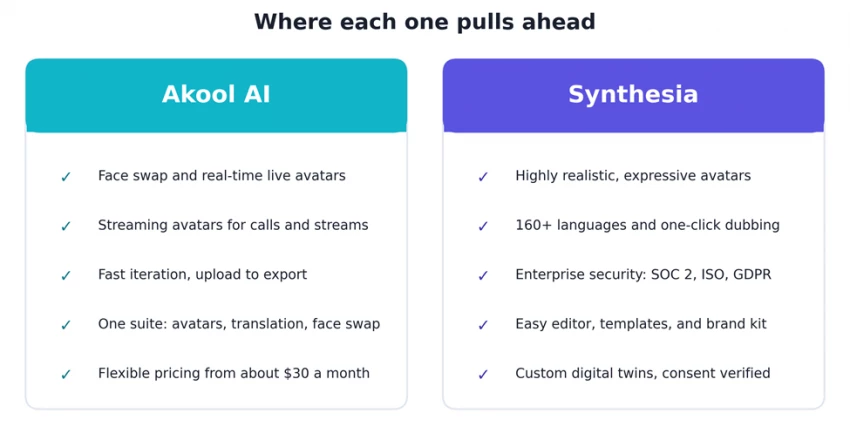
A quick look at where each tool leads.
Akool pulls ahead on face swap and real time live avatars, streaming avatars for calls and streams, fast iteration, the breadth of having avatars, translation, and face swap in one suite, and flexible pricing from around 30 dollars a month. Synthesia pulls ahead on the realism and expressiveness of its avatars, 160 plus languages with one click dubbing, an enterprise security and compliance stack, an easy editor with templates and brand kit, and consent verified custom digital twins.
No tool is all upside, so here is the other side of the ledger.
Akool comes up short on:
• Subtle emotional performance, where avatar tone can feel neutral.
• A credit system that is hard to predict and per seat pricing that punishes teams.
• A basic built in editor and limited in editor control for complex work.
• Billing and trial cancellation complaints, and a flagged Trustpilot history.
Synthesia has its own rough edges:
• No face swap and only emerging real time avatar features.
• Minute caps that do not roll over and get tight for multilingual or frequent revisions.
• Content moderation that can block legitimate business content with slow appeals.
• A re-render wait on small edits and higher costs at Creator and Enterprise tiers.
Strip it back and the choice comes down to what you are making and who signs off on it.
Go with Synthesia if your priority is the most realistic, expressive presenter avatars, multilingual training and corporate communication at scale, and enterprise security, compliance, and LMS support that IT and legal will approve.
Go with Akool if you want avatar video plus face swap, live and streaming avatars, and fast creative iteration in one suite, if you are in marketing or an agency, and if you value flexibility and API access over formal compliance.
So which one would I choose for AI avatars? Here is where I land.
For the specific question in the title, which tool makes the better AI avatars, I give Synthesia the edge. Its avatars are the most realistic and expressive of the two, its language coverage is deeper, and the enterprise foundation means the videos hold up for serious, customer facing and training use. The review data leans the same way once you weight it by volume, since a 4.7 on G2 from well over a thousand reviews is a sturdier signal than a higher score from a few dozen. If your job is presenter style avatar video that needs to look polished and pass in a professional setting, Synthesia is what I would reach for.
But better is not the same as right for everyone, and this is where Akool earns its place. If I needed face swap, real time avatars in a live call, or the ability to spin up many kinds of video from one tool without enterprise pricing, Synthesia simply cannot do those things, and Akool can, quickly and at a friendlier entry price. For marketing teams and creators who value speed and breadth over the last ten percent of avatar realism, Akool is the more practical pick.
My one line take: choose Synthesia for the most lifelike presenter avatars and enterprise grade training video, and choose Akool for face swap, live avatars, and fast, flexible creation across a whole suite. Since both offer free tiers, run the same script through each, judge the avatars with your own eyes, and let that decide it. That is the test that matters more than any rating.
New Claude Model Targets Agentic AI WorkflowsAnthropic has launched Claude Sonne...
Samuel Osei3 months ago
Gemini’s Image Tools Get a Wider RolloutGoogle is expanding access to Gemini’s p...
Alexander Hughes3 months ago
Two AI video generators, two very different first days. I ran PixVerse through i...
Alexander Hughes3 months ago
Two of the most talked-about AI chat platforms. I opened both, picked a characte...
Alexander Hughes3 months ago
The two-minute versionIf you only read one thing, read this. The rest of the doc...
Alexander Hughes3 months ago
Why Seedance 2.5 mattersSeedance 2.5 is the latest release in ByteDance’s Seedan...
Alexander Hughes3 months ago
Discussion