
HIX AI bundles more than 120 writing tools, ArticleGPT, HIX Chat, and HIX Bypass into a single workspace. It is a capable generalist, but credit caps that expire monthly, uneven long-form output, and shallow SERP analysis often push serious content teams to look at dedicated SEO writing platforms instead. This guide compares ten verified alternatives across SERP intelligence, NLP scoring, AI search visibility, long-form drafting, and total cost, with two comparison charts and three side-by-side tables.
Every tool below was cross-checked against its current public pricing page, recent user reviews on G2, Capterra, and Trustpilot, and product updates published through early 2026. Skim the comparison table for a fast answer, or read the deep-dive for each tool further down.
HIX AI works as a general writing assistant, yet several limitations surface in production SEO workflows. Reports across public review platforms in early 2026 highlight three recurring concerns:
• Credit caps that expire monthly. Even on the Pro plan, advanced credits run out quickly, and unused credits do not roll over. Public complaints about surprise charges remain a recurring theme on Trustpilot and Reddit.
• Output that needs heavy rewriting. Long-form drafts often arrive in a generic tone that requires manual restructuring before publication, which erodes the time savings the platform advertises.
• Shallow SERP-driven optimization. HIX AI lacks the live SERP scraping, NLP entity grading, and AI search visibility tracking that dedicated optimization platforms now treat as table stakes.
A fourth dimension matters in 2026 that traditional AI writers ignore: visibility inside large language models. Mentions and citations across ChatGPT, Claude, Perplexity, and Google AI Overviews now drive a measurable share of attention that never reaches a website through a classic blue link.
At Search Central Live in April 2026, Danny Sullivan confirmed that AI SEO and traditional SEO share the same fundamentals; what changed is how strictly Google enforces helpful, original, expertise-driven content. Google has also drawn a line between commodity content (generic listicles, standard advice, thin rewrites) and non-commodity content (original data, expert input, lived experience). Tools that help produce the second category are the ones worth investing in.
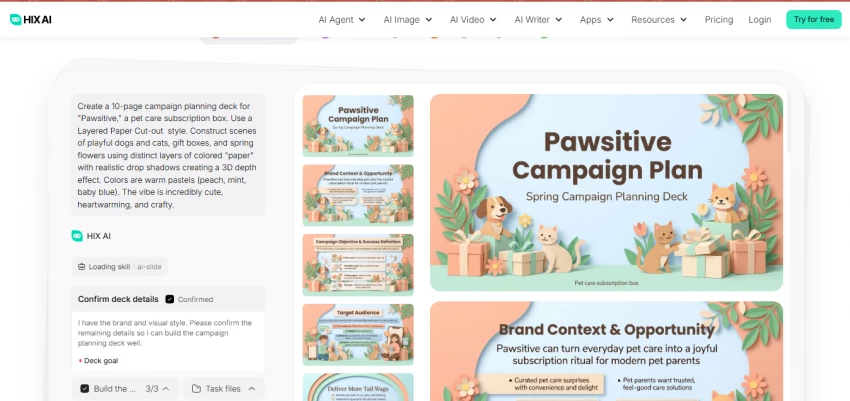
For a fair comparison, here is the current HIX AI footprint as listed on its 2026 pricing page:
• HIX Writer with 120+ AI templates across blogs, emails, ads, and product copy
• ArticleGPT for long-form articles that reference credible online sources
• HIX Chat with real-time web access and PDF, webpage, and video summarization
• HIX Bypass to rewrite AI-generated text for AI-detection workflows
• HIX Editor, browser extension, and one-click WordPress publishing
• Access to GPT-5.4, Gemini 3.1 Pro, Claude Opus 4.6, and Claude Sonnet 4.6 from a single dashboard
Pricing starts at $7.99/month for the Basic Writer plan (annual billing) and climbs to $39.99/month for the Unlimited tier. Each HIX product (Writer, Bypass, ArticleGPT) is sold as a separate subscription, so a full stack adds up quickly.
The ten apps below were filtered using six measurable criteria, weighted toward ranking outcomes rather than raw output volume:
1. Live SERP analysis that scrapes top-ranking results instead of relying on static training data
2. NLP-driven keyword and entity recommendations tied to topical coverage
3. Real-time content scoring correlated with ranking probability
4. Long-form drafting that holds context past two thousand words without drift
5. AI search visibility tracking across ChatGPT, Perplexity, Claude, and Google AI Overviews
6. Transparent pricing without aggressive credit expiry as the default
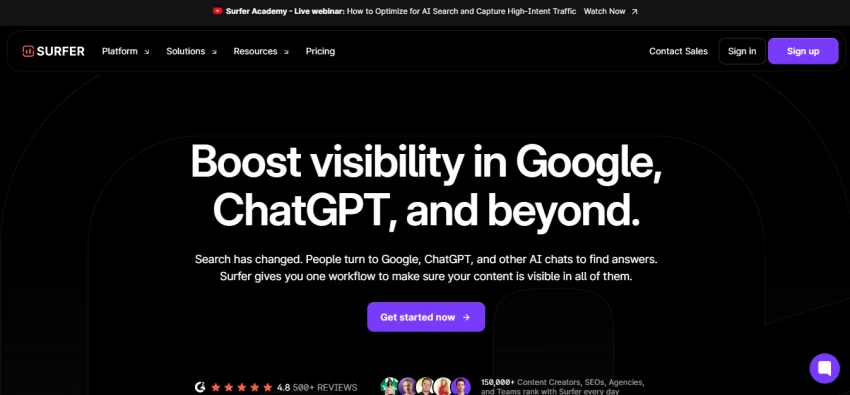
Surfer SEO remains the benchmark for content optimization. Its editor scrapes the top thirty SERP results for a target keyword, then grades draft content against NLP terms, structure depth, and search intent. The 2026 release added an AI Tracker that monitors brand mentions across ChatGPT, Perplexity, and Google AI Overviews, complete with a visibility score and sentiment breakdown.
• Best for: SEO specialists and agencies serious about SERP-aligned writing
• Starting price: $99/month Essential plan (30 articles in the Content Editor)
• Standout: Real-time content score, AI Tracker, Google Docs and WordPress add-ons
• Limitation: Hugging the optimization score too literally can push copy toward keyword stuffing; AI-generated articles cost extra credits
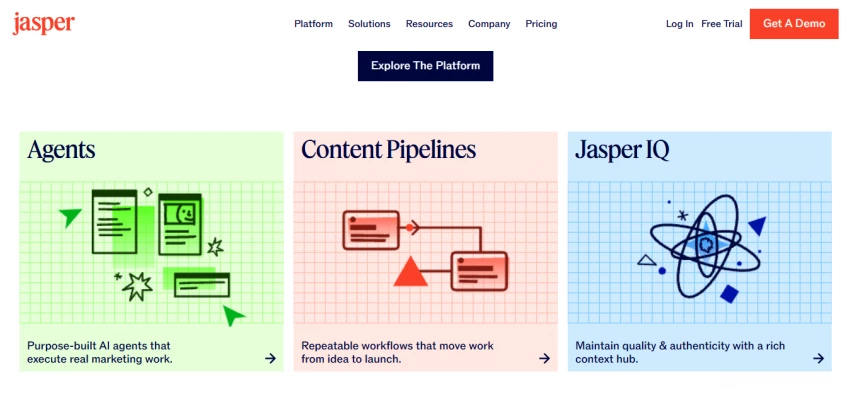
Jasper centers on brand voice and large-team production rather than SERP analysis. Its Brand IQ feature trains the model on existing brand assets so output stays on-brand across more than fifty templates, and Content Pipelines automate multi-channel campaigns. Most SEO teams pair Jasper with Surfer for the optimization layer, which raises the combined cost above $150 per month.
• Best for: Enterprise marketing teams managing high content volume across channels
• Starting price: $49/month Creator (1 seat), $69/month Pro, custom Business pricing
• Standout: Brand IQ, content pipelines, native Surfer integration
• Limitation: Native SEO depth is shallow; per-seat pricing scales fast for larger teams
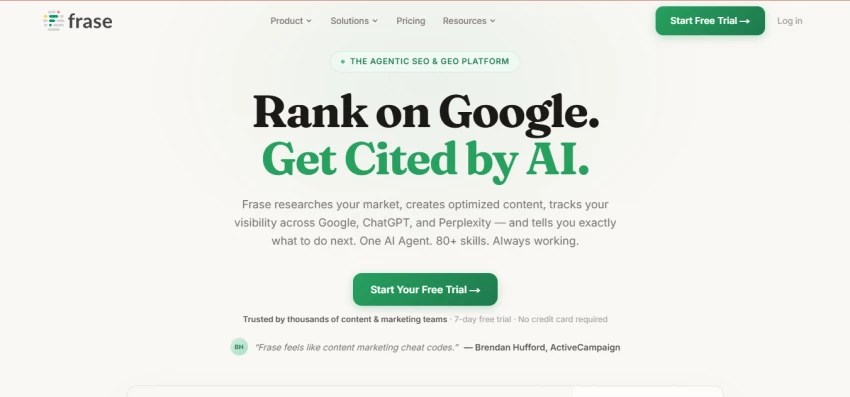
Frase compresses research, brief building, drafting, and content auditing into a single workflow. It analyzes the top twenty SERP results to auto-generate briefs that include headings, questions, statistics, and target keywords. In 2026, Frase introduced an AI Agent with more than eighty research and writing skills, plus AI Visibility Tracking for monitoring presence in generative engines.
• Best for: Small content teams that want an end-to-end pipeline at a controlled monthly cost
• Starting price: $45/month Starter (15 projects); roughly $38/month with annual billing
• Standout: Fastest brief-to-draft pipeline on this list
• Limitation: Native AI draft copy needs manual polishing; generative-engine optimization features sit behind higher tiers
Scalenut’s Cruise Mode guides users from a target keyword to a fully drafted long-form article in roughly ten minutes, with SERP analysis, NLP-graded content editor, and topic clustering built in. The 2026 GEO Action Center adds explicit checks for visibility in generative search.

• Best for: Agencies and SEO-led content teams scaling organic output
• Starting price: $39/month Essential, $79/month Growth, $149/month Pro
• Standout: End-to-end SEO pipeline, topic clustering, generative-engine insights
• Limitation: AI tone can drift across very long articles without manual edits
Writesonic combines templates, an SEO Optimizer, and Chatsonic, a multi-model AI assistant that can pull live data from Google Search Console, Ahrefs, Semrush, and Keywords Everywhere directly into prompts. The 2026 Professional tier focuses heavily on AI search optimization and visibility tracking.
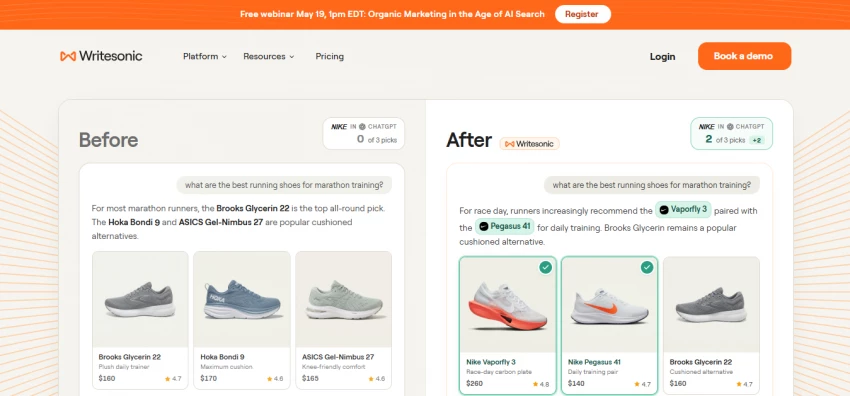
• Best for: Marketers wanting a single platform for blogs, ads, and AI search optimization
• Starting price: $20/month Individual, $49/month Lite, $99/month Standard, $249/month Professional
• Standout: 100+ templates, bundled AI image generation, AI visibility tracking on higher tiers
• Limitation: Output sometimes requires rewriting; Professional tier is a significant commitment for smaller teams
KoalaWriter is built for affiliate marketers and high-volume publishers. A single keyword input produces a long-form draft with SERP-aware structure, basic AI imagery, embedded YouTube references, and direct publishing to WordPress, Shopify, Webflow, and Ghost. KoalaLinks has reportedly built more than ten million internal links across customer sites since launch.
• Best for: Affiliate sites, bulk publishers, and product comparison content
• Starting price: From $9/month (Essentials); higher Scale plans for volume needs
• Standout: Bulk article generation, affiliate-focused templates, Amazon integration
• Limitation: Drafts need editing for tone and factual accuracy; advanced customization is limited
NeuronWriter delivers semantic SEO at a price most freelancers can absorb. It uses NLP to map entity coverage and grade content completeness against the top thirty SERP results, with E-E-A-T-aligned suggestions and schema markup hints.
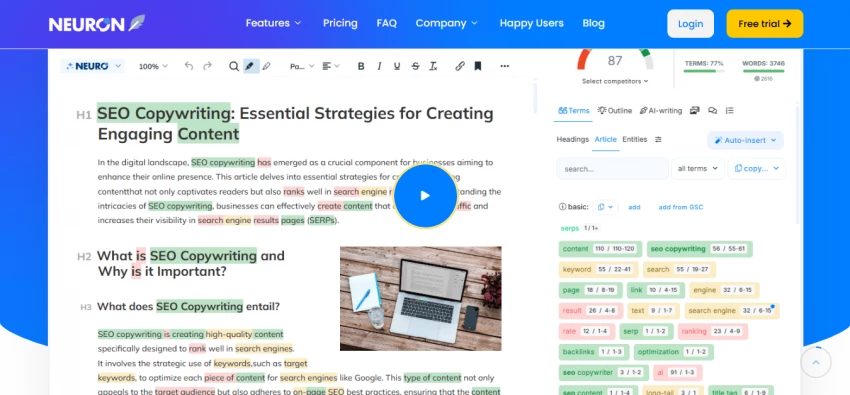
• Best for: Cost-sensitive bloggers and freelancers focused on ranking outcomes
• Starting price: $23/month Bronze, $69/month Gold
• Standout: Strong semantic recommendations at the lowest price in the serious-SEO tier
• Limitation: Native AI writer is functional but less polished than Surfer or Frase
Copy.ai centers on workflow automation and sales-leaning copy. Its Freestyle tool and ninety-plus templates support short-form output, while its automation builder routes generated content through approval workflows. Salesforce and HubSpot integrations make it a natural fit for go-to-market teams rather than long-form SEO writers.
• Best for: Go-to-market teams, sales-focused marketers, and short-form campaign copy
• Starting price: Free plan (2,000 words/month); $36/month Pro with annual billing
• Standout: Automation builder, CRM integrations, kanban project organization
• Limitation: Light on SEO depth; not designed for long-form ranking content
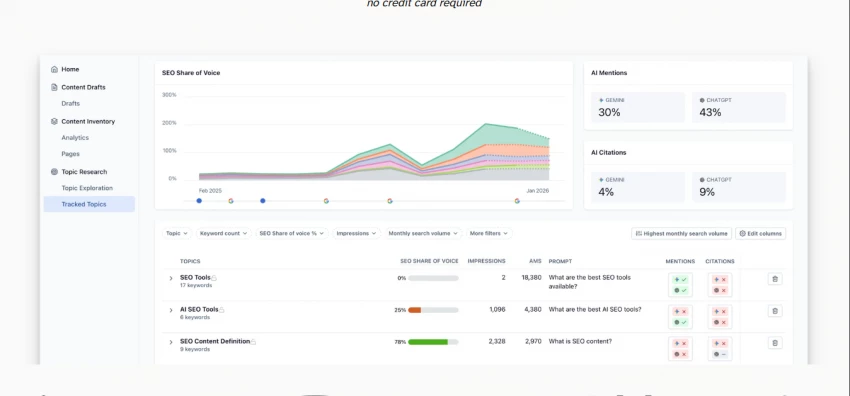
Clearscope is the premium content-grading platform of choice for enterprise teams. Its A++ to F grading system, IBM Watson and Google NLP–backed term recommendations, and AI Tracked Topics feature give content managers a tight quality control loop.
• Best for: Enterprise content teams with strict quality standards across many writers
• Starting price: From approximately $189/month for the Essential tier
• Standout: Industry-leading keyword and term recommendations, AI Tracked Topics
• Limitation: Premium pricing; lacks a built-in AI long-form drafter at the same depth as Scalenut or Writesonic
Rytr is the budget-tier general writer. Its forty-plus use cases, thirty-plus tones, and generous free plan make it a comfortable starter tool for short-form content and rough drafts, although it is rarely the right pick for serious organic ranking on its own.
• Best for: Solopreneurs, students, and casual bloggers exploring AI writing
• Starting price: Free (10K characters/month); $7.50/month Unlimited (annual billing)
• Standout: Easiest learning curve and lowest barrier to entry
• Limitation: No SERP analysis or NLP scoring; best paired with a dedicated SEO tool
The matrix below condenses each tool against the four criteria that affect ranking outcomes the most, plus its current entry price.
| Tool | SERP Analysis | NLP Scoring | Standout Feature | AI Search Tracker | Starting Price |
|---|---|---|---|---|---|
| Surfer SEO | Yes | Yes | AI Tracker + real-time score | Yes | $99/mo |
| Scalenut | Yes | Yes | Cruise Mode + GEO Action Center | Yes | $39/mo |
| Frase | Yes | Yes | Fastest brief-to-draft pipeline | Yes | $38/mo |
| Jasper AI | No | Light | Brand IQ voice training | No | $49/mo |
| Writesonic | Yes | Yes | Chatsonic + 100+ templates | Yes | $20/mo |
| Koala AI | Yes | Light | Bulk articles + Amazon publish | No | $9/mo |
| NeuronWriter | Yes | Yes | Semantic NLP at low price | Light | $23/mo |
| Copy.ai | No | No | Automation + CRM workflows | No | $36/mo |
| Clearscope | Yes | Yes | A++ to F grading system | Yes | $189/mo |
| Rytr | No | No | Free tier + simple templates | No | $7.50/mo |
| HIX AI | No | Light | 120+ tools + Bypass + ArticleGPT | No | $7.99/mo |
Table 1. Eleven AI writing apps compared on SERP analysis, NLP scoring, AI search tracking, and starting price (2026).
Pricing alone is not a buying decision, but it sets the floor. The chart below shows the lowest paid tier for each platform (annual billing where available), with HIX AI shown for reference.
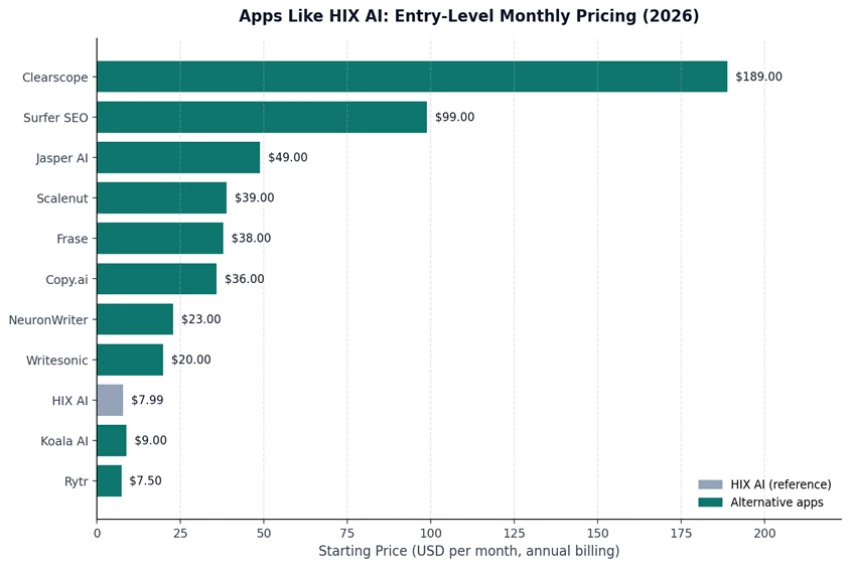
Chart 1. Entry-level monthly pricing across HIX AI and ten alternatives (annual billing). Source: vendor pricing pages, May 2026.
The chart below scores eight popular platforms across four ranking-relevant capabilities. Scores reflect documented feature depth in early 2026, not raw output volume.
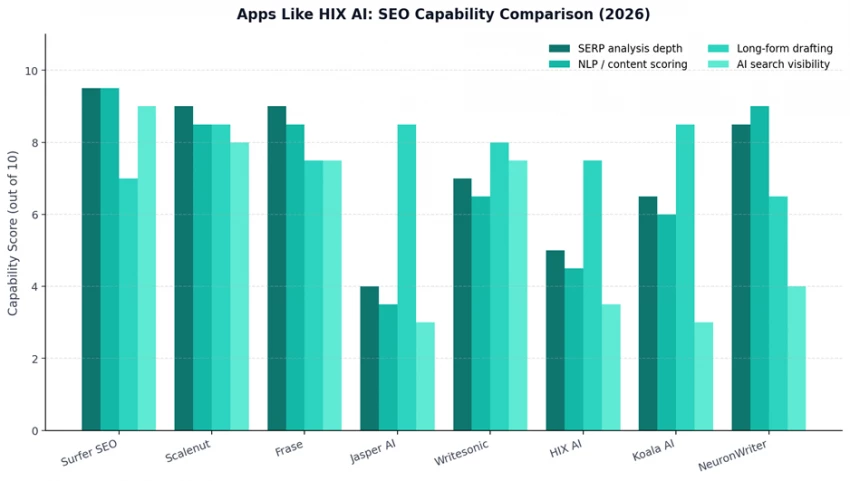
Chart 2. SEO capability score (out of 10) across SERP analysis, NLP scoring, long-form drafting, and AI search visibility. Higher is better.
The right tool depends on the bottleneck in the actual workflow. This mapping makes that explicit.
| Primary Use Case | Top Pick | Strong Alternative |
|---|---|---|
| Long-form SEO articles built around live SERP data | Surfer SEO | Scalenut |
| End-to-end brief, draft, and audit workflow | Frase | Scalenut |
| Brand-voice content at enterprise scale | Jasper AI | Writesonic |
| Affiliate sites and bulk product comparisons | Koala AI | Writesonic |
| Low-budget semantic SEO writing | NeuronWriter | Frase |
| Sales copy, ads, and short-form marketing | Copy.ai | Rytr |
| Enterprise content grading and QA | Clearscope | Surfer SEO |
| First-time AI users and casual blogging | Rytr | Koala AI |
| Brands tracking visibility in ChatGPT and Perplexity | Surfer SEO | Scalenut |
| All-in-one general writing workspace | HIX AI | Writesonic |
Table 2. Recommended primary pick and strong alternative for each common content workflow.
Three Google directions matter for any AI-assisted SEO workflow this year, and the chosen writing tool affects how easily a content team can meet them.
• xCommodity versus non-commodity content. Generic listicles and thin rewrites no longer rank reliably. Original data, expert quotes, and lived experience are now ranking prerequisites for competitive topics.
• Stricter E-E-A-T enforcement. Experience, expertise, authoritativeness, and trustworthiness signals are checked more aggressively. Author bios with credentials, source citations, and visible update dates are not optional.
• AI Overviews and LLM citations. Appearing inside Google AI Overviews, ChatGPT answers, and Perplexity responses now drives a measurable share of attention. Tools with built-in LLM visibility tracking (Surfer, Scalenut, Frase, Writesonic, Clearscope) address this gap directly.
AI-generated content is not penalized for being AI-generated. Google has repeatedly confirmed that helpful, accurate, original content is judged on its merits regardless of how it was drafted. The risk lies in publishing unedited, unsourced, or undifferentiated AI output.
Click-through rate from the SERP responds to a small set of repeatable practices that apply regardless of which writing app handles the draft.
• Titles between 50 and 60 characters that include a numeral, a year, and a concrete value promise. Comparison and listicle formats with the year in brackets continue to outperform vague titles in recent CTR studies.
• Meta descriptions that promise a deliverable inside the article, such as a comparison table, a checklist, a verdict, or a benchmark. Vague descriptions lose to specific ones at the same ranking position.
• Structured data with Article, FAQ, and HowTo schema remains the cheapest CTR uplift available. Rich result eligibility lifts CTR even when the ranking position is unchanged.
• Original visuals and charts (not stock photography) earn image-pack visibility and reduce bounce rate, both of which feed back into ranking signals over time.
• Internal linking with descriptive anchors is one of the few on-page levers that compounds. Tools like KoalaLinks and the internal link suggestions inside Frase and Scalenut speed this up.
Even strong platforms produce weak content under the wrong conditions. Four patterns show up repeatedly in published reviews and ranking case studies:
• Overoptimizing for content scores. Pushing every paragraph toward a perfect Surfer or Clearscope score produces keyword-stuffed prose that human readers reject.
• Single-pass drafting without source verification. AI-written statistics drift from their original sources roughly twenty percent of the time. Every cited figure deserves a manual check.
• Skipping the human edit pass. AI tells (repetitive transitions, generic phrasing, fence-sitting conclusions) survive untouched in unedited drafts and signal commodity content to readers and to Google.
• Chasing keywords without topical authority. A new site cannot rank for the same head term as a fifteen-year-old domain. Topic-cluster tools inside Scalenut and Frase help align effort with what a site can actually win.
HIX AI remains a capable generalist with one of the widest tool catalogs on the market, but it is rarely the strongest pick for SEO-led content production in 2026. Surfer SEO and Scalenut win on SERP-driven optimization. Frase wins on speed from keyword to brief. Jasper AI wins on brand voice at enterprise scale. NeuronWriter wins on price-to-feature ratio. Koala AI wins on affiliate-style volume. Rytr wins on accessibility for first-time users.
The right answer comes down to one question: what is the bottleneck the team is actually trying to fix? Pick the tool that solves that bottleneck, not the one with the longest feature list.

New Claude Model Targets Agentic AI WorkflowsAnthropic has launched Claude Sonne...
Samuel Osei3 months ago
Gemini’s Image Tools Get a Wider RolloutGoogle is expanding access to Gemini’s p...
Alexander Hughes3 months ago

Two AI video generators, two very different first days. I ran PixVerse through i...
Alexander Hughes3 months ago

Two of the most talked-about AI chat platforms. I opened both, picked a characte...
Alexander Hughes3 months ago
The two-minute versionIf you only read one thing, read this. The rest of the doc...
Alexander Hughes3 months ago
Why Seedance 2.5 mattersSeedance 2.5 is the latest release in ByteDance’s Seedan...
Alexander Hughes3 months ago
Discussion