
THE ONE PARAGRAPH VERDICT
| Cheaterbuster AI scans Tinder using a person’s name, age, location and an optional photo to reveal whether they have an active dating profile. It returns fast, easy to read results and works well when your search details are specific. The catch: it only covers Tinder, locks every result behind a paywall, and has drawn a steady stream of billing and cancellation complaints. Used as research support with good inputs, it can deliver. Treated as final proof, it overpromises. |
Cheaterbuster AI is an online dating profile search engine built for people who suspect a partner may be secretly active on Tinder. You enter a few basic details about the person and the platform returns any matching public Tinder profiles, including photos, bio text, last active timestamps and Tinder subscription status.
The service is not new. It launched in 2016 under the name Swipebuster, one of the first tools to publicly show that Tinder profiles could be looked up using basic demographic details without creating a Tinder account. It later rebranded to Cheaterbuster and added AI assisted features such as facial recognition.
Importantly, Cheaterbuster does not hack accounts or bypass privacy settings. It uses OSINT (open source intelligence) methods to query Tinder’s publicly accessible data. That means it can surface public, recently active profiles, but it cannot pull profiles that are private, deleted, or hidden behind Tinder’s Incognito Mode. The person being searched is never notified.
The search process is a guided, multi step form. Based on a hands on field test, here is exactly what the experience looks like from start to finish. The order matters, because the payoff arrives only at the very end.
STEP 01 First name
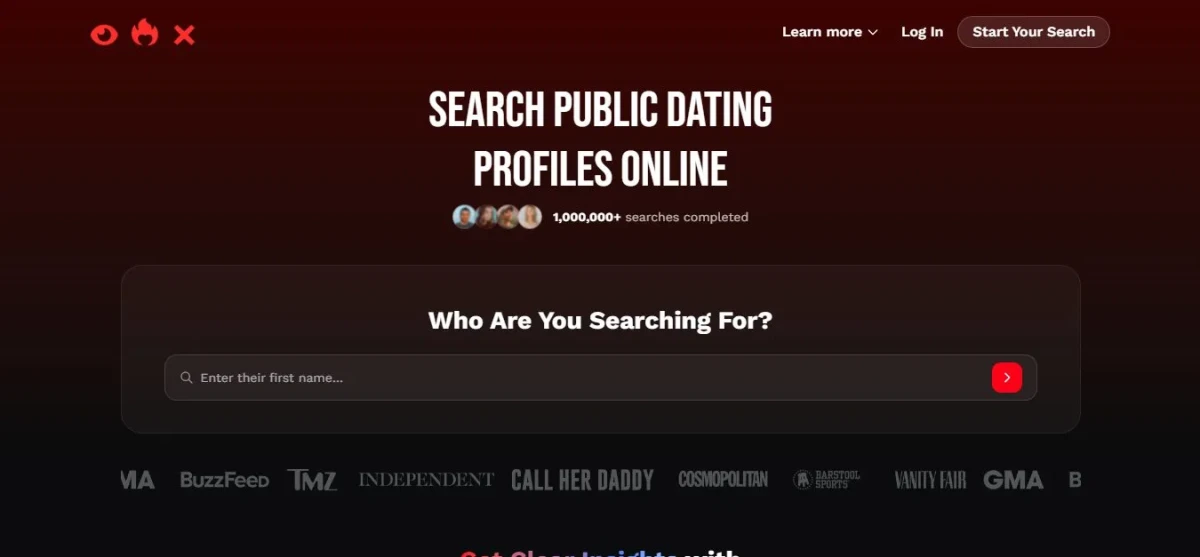
The home page only asks for a single first name to begin, with a “1,000,000+ searches completed” badge and a row of media logos under the field.
MY OBSERVATION
The moment I typed one name and watched the counter roll past a million searches, I felt that small pull of “okay, these people clearly know what they’re doing.” That badge lowered my guard more than anything the tool actually showed me later.
STEP 02 Age
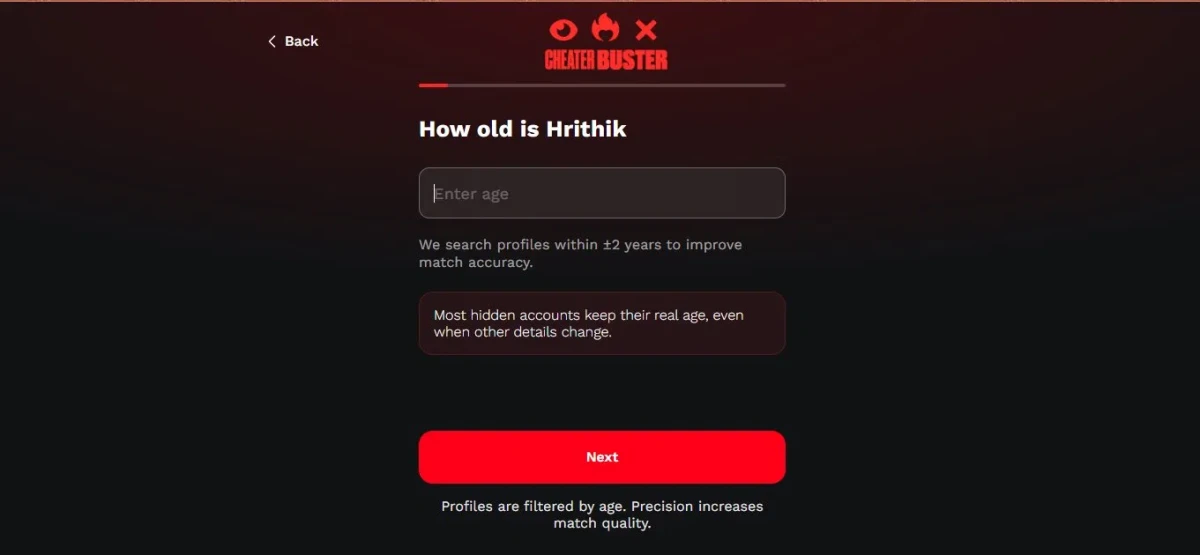
Next it asks for an age, searching profiles within roughly two years either side, and claims most hidden accounts keep their real age even when other details change.
MY OBSERVATION
Typing an age felt harmless, but the claim about hidden accounts keeping their real age stuck with me. It sounded so confident that I caught myself believing it before remembering I had no way to check whether it was even true.
STEP 03 Gender
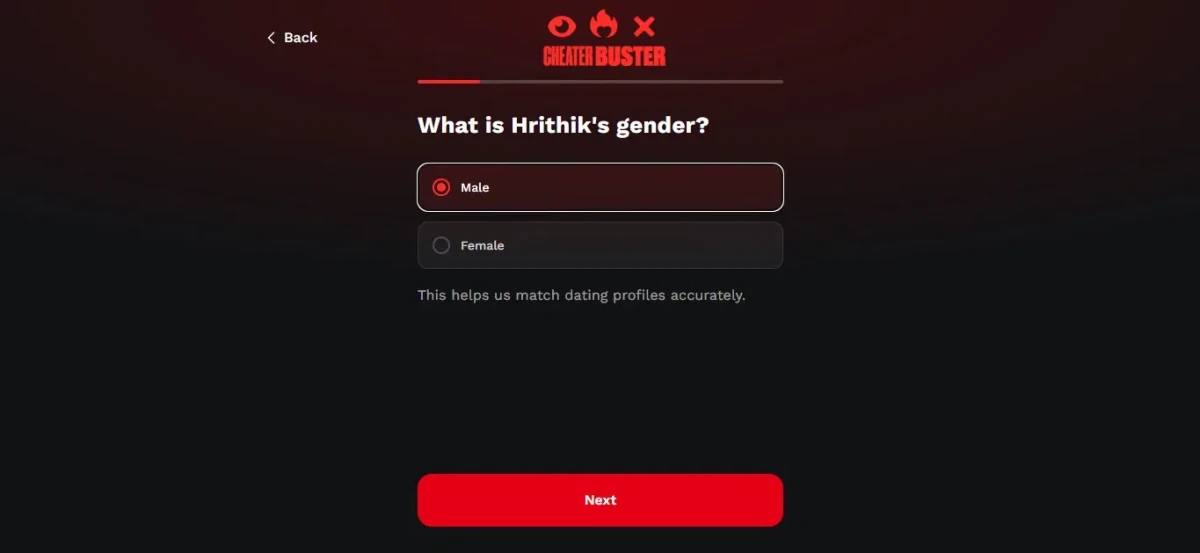
A simple Male or Female selection to narrow matches, framed as a way to match dating profiles more accurately.
MY OBSERVATION
This was the only step I didn’t think twice about. Two taps and I was through, which is probably why the heavier questions that came next felt more normal to me than they should have.
STEP 04 Location
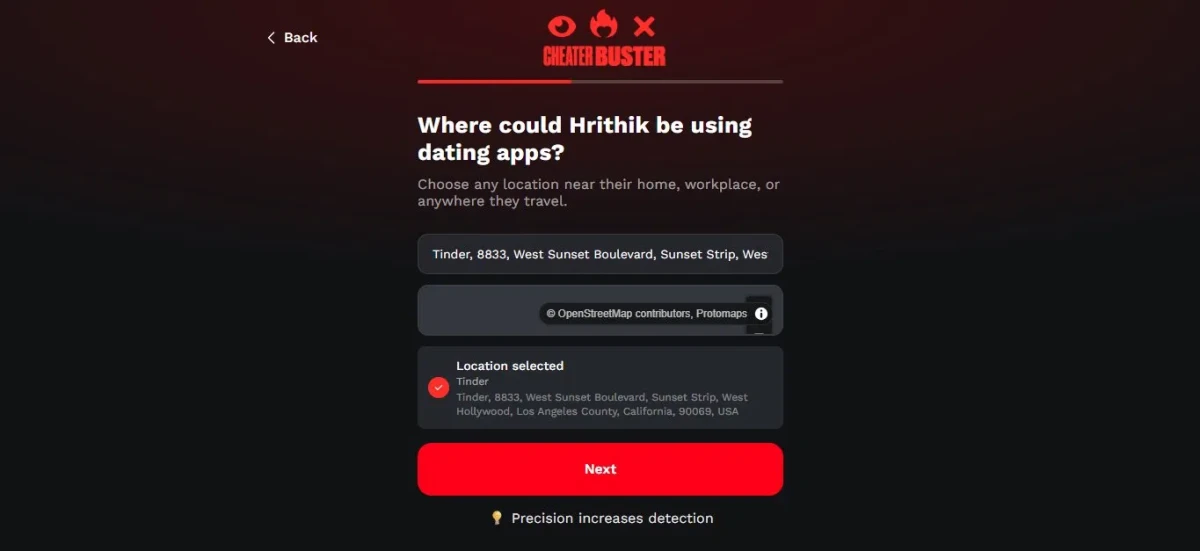
You drop a pin on a map where the person might use dating apps. The prompt pushes you to be precise, saying precision increases detection.
MY OBSERVATION
Dropping a pin on the map was the first time I actually paused. Pointing at a real place where someone “might use dating apps” made the whole thing feel concrete in a way the quick taps before it never did.
STEP 05 Travel frequency
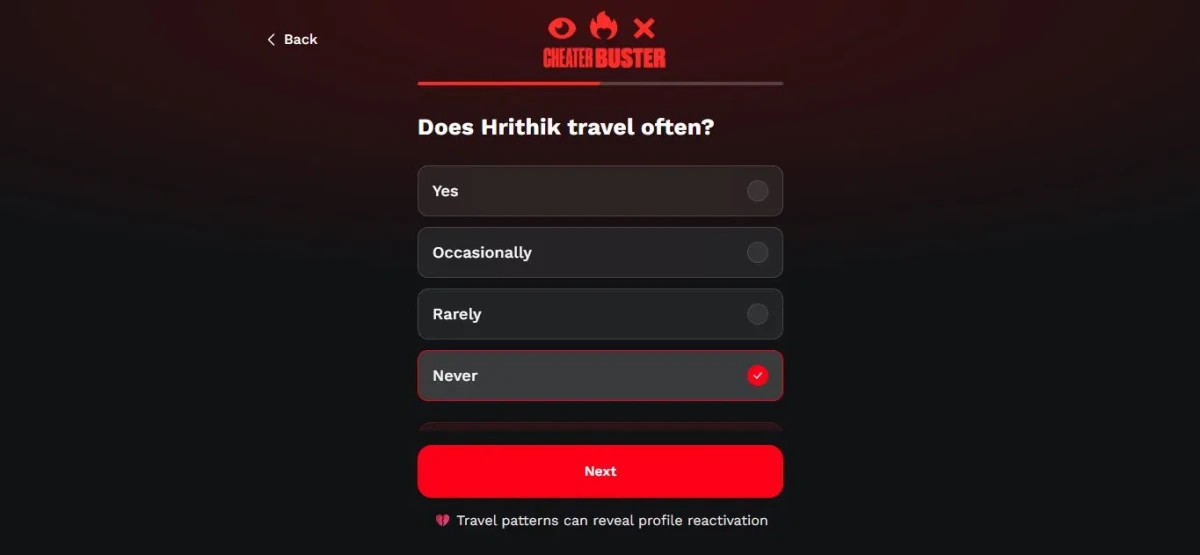
Four options (Yes, Occasionally, Rarely, Never), framed around the idea that travel patterns can reveal profile reactivation.
MY OBSERVATION
By this point I noticed how invested I already was. I’d handed over a name, an age and a location, and that quiet sunk-cost feeling was doing its job, nudging me to keep going rather than stop and ask why.
STEP 06 Active times
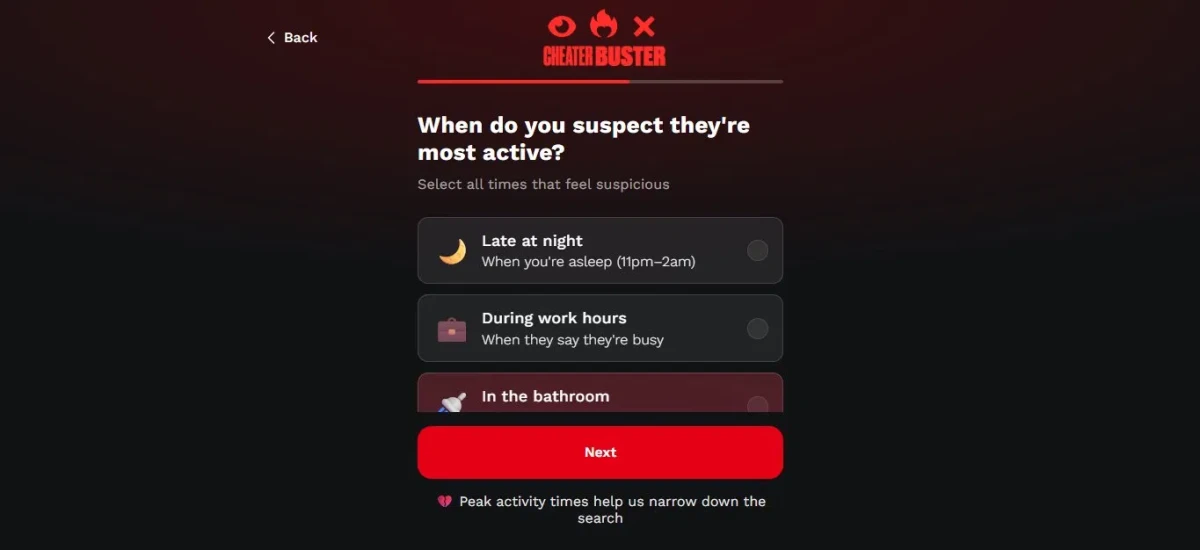
A multi select for when the person seems most active, including late at night, during work hours, and “in the bathroom.”
MY OBSERVATION
This is where it tipped from investigative to uncomfortable for me. I understand what “in the bathroom” is getting at, but it was the first moment the flow felt like it was coaching me to think about a person in a way I didn’t love.
STEP 07 Photo upload
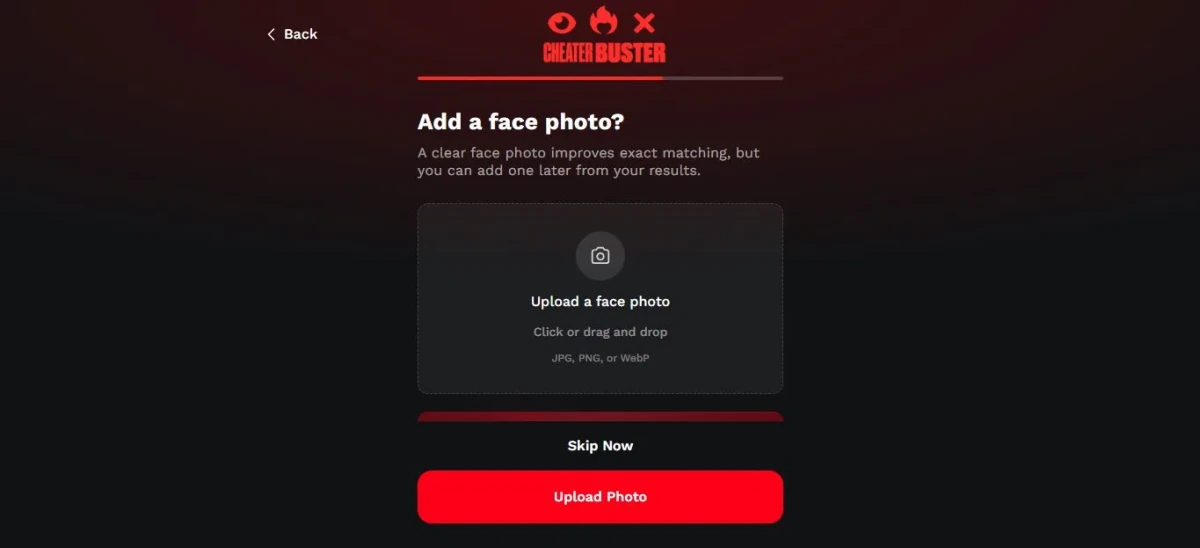
An optional face photo upload, pitched as improving exact matching, with a clear option to skip.
MY OBSERVATION
I was relieved I could skip the photo. After everything else, having one step that didn’t force my hand mattered, so I tested the skip just to see if it would push back. It let me straight through.
STEP 08 Starting the search
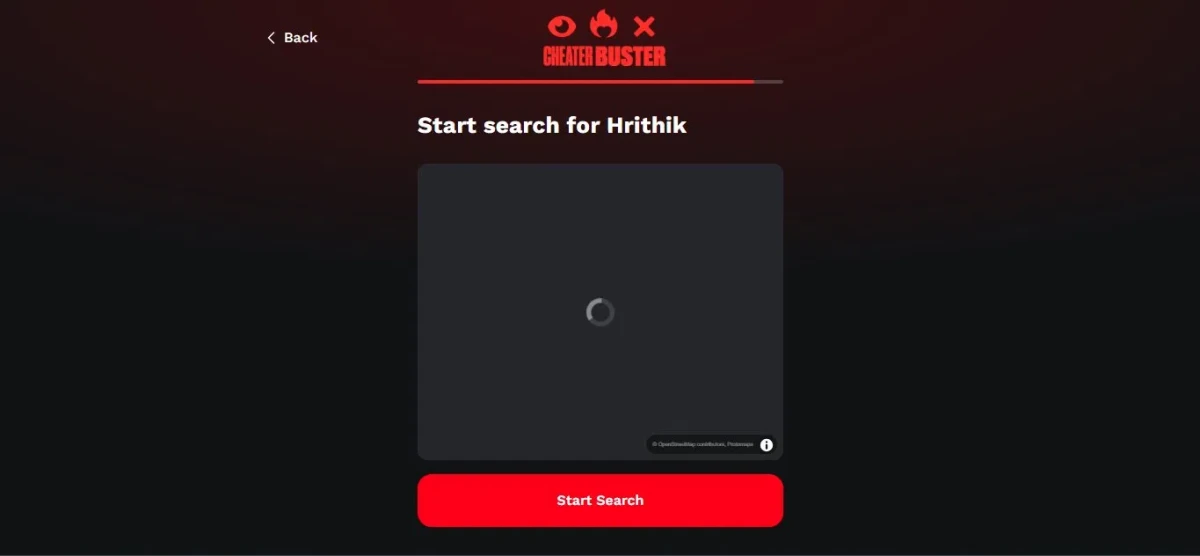
A loading map appears with a “Start Search” button, setting up the expectation of an answer.
MY OBSERVATION
Hitting Start Search was my most hopeful moment. The loading map made it feel like an answer was seconds away, and I fully expected the next screen to finally show me something real.
STEP 09 The paywall
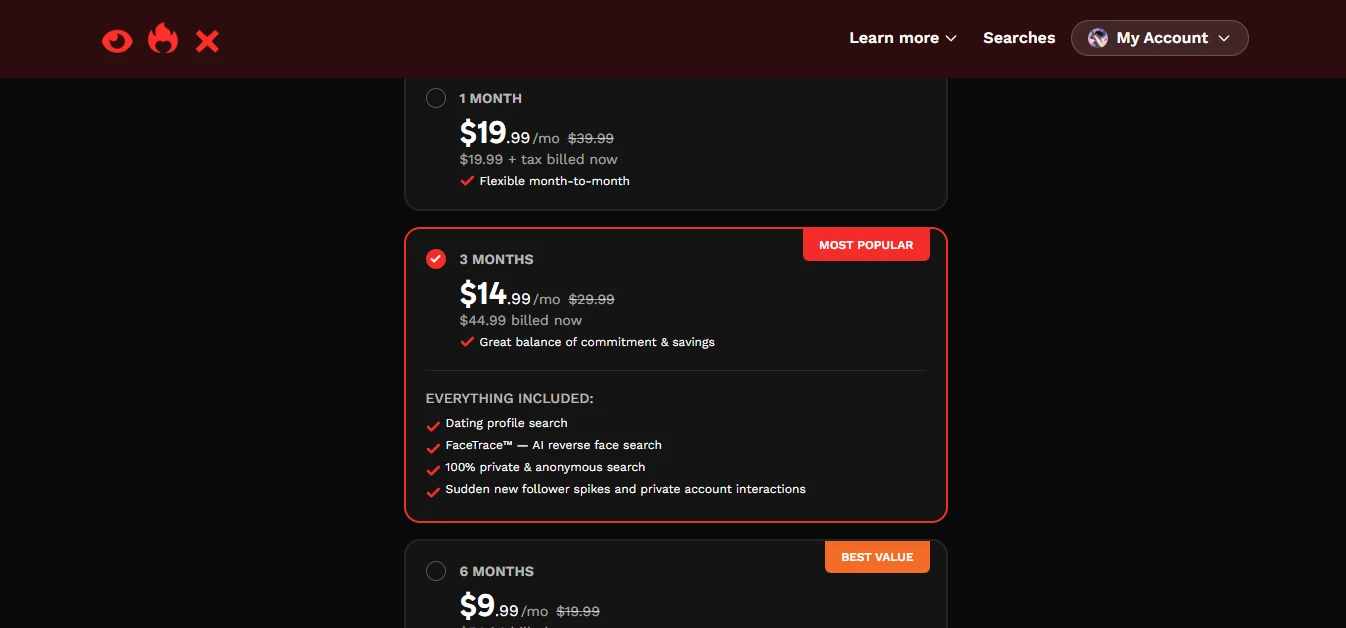
The search finishes and, instead of a result, everything is locked behind a paid subscription you have to buy first.
MY OBSERVATION
And then, nothing. The search “finished” and every result sat behind a payment screen. After all the personal detail I’d just handed over, being asked to pay before seeing a single thing was the exact moment my goodwill ran out.
WHAT THE FLOW DOES WELL Almost zero barrier to start: it only needs a first name. Every step explains itself, so the flow feels guided rather than random. The map pin location step feels interactive instead of just typing text. The photo upload is optional with a clear skip button. | WHAT THE FLOW DOES POORLY It is long and drawn out before you reach any result. Some prompts feel invasive, especially the bathroom option. It leans on confident, unverifiable claims about detection and reactivation. It collects a lot of personal data, then shows nothing until you pay. |
| Tinder profile search | Enter name, age and location to surface matching Tinder profiles. |
| FaceTrace matching | Uses an uploaded photo and facial recognition to find profiles manual searching might miss. |
| Following AI insights | Highlights following patterns and other activity flagged as suspicious. |
| Reverse phone lookup | Lets you search by phone number, mentioned less often than the core search. |
| Activity tracking | Shows last active timestamps when available. |
| Subscription status | Detects whether the profile uses Tinder Plus, Gold or Platinum. |
| Anonymous search | The target is never notified, and no Tinder account is required. |
| iOS app | A mobile version (v1.1) is available alongside the web interface. |
SUPPORTS THE CASE Speed. Its strongest dimension. Results arrive in 2 to 5 minutes, matching the marketing. Ease of use. A clean, intuitive interface with almost no learning curve. Accuracy with good inputs. AllAboutAI found 89% satisfaction with precise inputs versus 44% with vague ones. Anonymity. Searches are discreet, the target is never alerted, and no Tinder login is required. Readable reports. Photos, bio, last active time and subscription status are presented clearly. | RAISES CONCERNS Tinder only. If the person uses Bumble, Hinge or any other app, the search returns nothing and you still pay. Subscription trap. A one off purchase can auto renew weekly, producing surprise charges. Hard cancellation. Many users report the process as hidden or ineffective, with charges continuing after they try. Slow support. Emails frequently go unanswered for days or weeks. No refund, no free trial. No preview of results before paying and no clear refund policy. Vague inputs fail. Common names, rough ages or broad locations produce misses and false positives. |
Cheaterbuster uses a pay per search model. The headline numbers as of 2026:
| $17.99 to $19.99 single search | Bundles lower per-search rate | No free trial | No clear refund policy |
Some sources also reference monthly subscription tiers (Basic around $9.99, Premium around $19.99, Pro around $29.99). The coexistence of per search and subscription pricing is a major source of confusion. The practical takeaway is that the sticker price is not the real cost. Because failed searches lead to retries, and because each search can re run weekly, actual spending often climbs well past a single $18 charge before a user notices.
Cheaterbuster advertises a 97% to 99% accuracy rate with photo upload. Independent testing tells a more measured story. AllAboutAI put aggregate satisfaction near 73% across Reddit, Trustpilot and app store reviews, and several reviewers estimate real world accuracy closer to 80% to 90%, with misses rising for common names or incorrect age input. Profiles using Tinder Incognito Mode could not be pulled in controlled testing. Satisfaction also varies by geography, roughly 82% in large metro areas versus 61% in smaller towns and rural regions.
In short: the headline number is achievable under ideal conditions (uncommon name, exact details, clear photo), but everyday accuracy depends heavily on input quality.
| On G2: G2 is a B2B software review platform and does not host a listing for Cheaterbuster AI, which is a consumer relationship tool. The cross section below draws on the platforms that actually carry user feedback for it. |
Trustpilot 2.9 to 3.6 / 5 ~250 TO 390 REVIEWS · 2025 TO 2026 The largest pool of feedback, and it is strikingly polarized: reviews cluster at either 5 stars or 1 star with very little middle ground. Positive reviews praise how fast and easy it is and often follow the same arc of suspicion, discovery and relief. Notably, at least one reviewer reported the tool confirming a partner was not on dating apps, suggesting it does not simply fabricate matches. Negative reviews center on billing rather than bad results. One analysis of recent reviews found that about 73% of negatives were about subscription confusion, unexpected charges, refunds, cancellation or support. A separate analysis of 100 reviews found 56% negative and noted that none were marked Verified on either side. The company replies to the vast majority of reviews, often stating it believes the negative account may be fake, a pattern several reviewers have publicly questioned. |
Apple App Store 4.7 / 5 ~216 RATINGS The iOS app scores notably higher, with praise for ease of use, though some reviewers question how consistent the results are. |
Reddit ~65% skew negative COMMUNITY DISCUSSION Discussion is mixed to skeptical, with roughly 65% of posts leaning mixed to negative. The most common gripes are the per search cost and inconclusive results. On the positive side, some users report it surfacing genuine matches and sending useful email updates, while a recurring concern is login location data that does not seem to make sense. |
ScamAdviser Very Likely Safe SITE TRUST RATING ScamAdviser rates the website as Very Likely Safe, supporting the consensus that Cheaterbuster is a real, legitimate service. As reviewers repeatedly note, though, legitimate is not the same as consistently good. |
Independent hands-on tests Mixed / conditional MULTIPLE REVIEWERS Reviewers who ran controlled tests reached a similar verdict: it works as a structured suspicion checking tool, not a truth machine. The strongest use case is confirming a specific suspicion with good data, not discovering hidden activity from scratch, and definitely not as an emotional lie detector. |
Based on a structured 7 day hands on evaluation. The pattern is clear: high marks for the experience of searching, low marks for the experience of paying and managing the account.
| Speed of results How fast results appear | 9.0/10 |
| Ease of use Interface and workflow | 8.8/10 |
| Search accuracy Finds real profiles | 7.5/10 |
| Perceived value Value vs results | 6.8/10 |
| Customer support Responsiveness | 4.5/10 |
| Billing transparency Pricing clarity | 3.0/10 |
| Cancellation Difficulty stopping charges | 2.5/10 |
| OVERALL | 7.4/10 |
A GOOD FIT IF YOU Specifically need to check Tinder and nothing else. Have strong, specific inputs: an uncommon name, accurate age, precise location and ideally a clear photo. Want a fast, anonymous check and will monitor your bank statements closely. Treat the result as research support, not final proof. | NOT FOR YOU IF YOU Need to check multiple dating apps such as Bumble or Hinge. Only have vague details to search with. Want a guaranteed refund if the search comes back empty. Are not prepared to actively cancel to avoid recurring weekly charges. |
STANDING ADVISORY
| Tools like Cheaterbuster sit in a legally and ethically gray area. They search only public information and do not hack accounts, but running searches on someone without their knowledge still raises real privacy and consent questions. Several experts and reviewers stress the same point: open, honest communication generally beats covert checking, results should be verified independently before acting on them, and you should review local privacy laws before running a search. Whatever the outcome, it is wise to treat it as one input into a bigger conversation rather than a verdict on its own. |
After seven days with Cheaterbuster AI, here is where I personally landed. When I fed it a distinctive name, an accurate age, a tight location and a clear photo, it did one thing well and did it fast: it told me whether that person had an active, public Tinder profile. The search itself never frustrated me. It was quick, clean and genuinely easy.
What wore me down was everything around the search. It only looks at Tinder, so a clean result never fully settled my mind. It made me hand over a surprising amount of personal detail and then hid the result behind a paywall. And the billing is the part I would warn a friend about first: what reads like a one off charge can quietly turn into a weekly one, and getting it to stop is not as simple as it should be.
So would I rely on it? Personally, only in a narrow way. If I were sitting with that knot in my stomach again, I would use Cheaterbuster as one quick Tinder-specific check, not as my answer. I would go in with specific details, screenshot anything that mattered, cancel the moment I had what I came for, and watch my statement for a few weeks afterward. Most of all, I would treat whatever it showed me as the start of a conversation, not the end of one.
My bottom line: useful in the right corner, oversold as proof, and only worth it if I stay in control of both the search inputs and the billing. With those guardrails, I would use it again. Without them, I would not.
New Claude Model Targets Agentic AI WorkflowsAnthropic has launched Claude Sonne...
Samuel Osei1 month ago

The Quick verdictInSnoop is a free, browser-based tool that promises to let you...
Alexander Hughes1 month ago

Gemini’s Image Tools Get a Wider RolloutGoogle is expanding access to Gemini’s p...
Alexander Hughes1 month ago

Two AI video generators, two very different first days. I ran PixVerse through i...
Alexander Hughes1 month ago
Two of the most talked-about AI chat platforms. I opened both, picked a characte...
Alexander Hughes1 month ago
The two-minute versionIf you only read one thing, read this. The rest of the doc...
Alexander Hughes1 month ago
Discussion