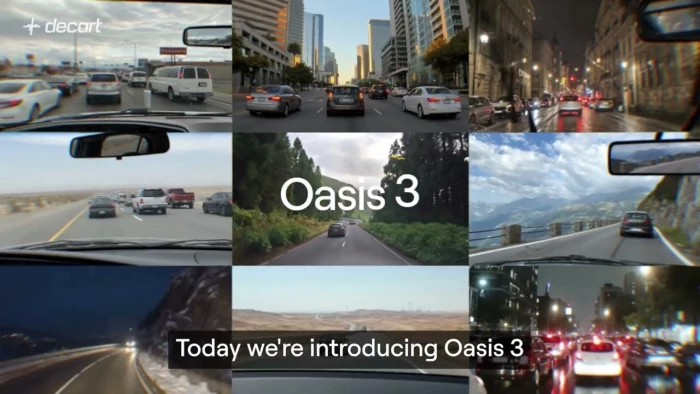
Decart has released Oasis 3, a real-time world model that can generate photorealistic driving environments for autonomous vehicle testing, giving developers a new way to simulate road scenarios without relying only on physical test fleets or traditional simulation tools.
The startup is making Oasis 3 available through an API from the start, positioning the model not only as a product for autonomous vehicle companies, but also as a platform developers can build on. The company says the model can generate interactive driving environments in real time, including multi-camera views and long-running scenarios that can be used to test how vehicle systems respond to changing road conditions.
The launch comes at a moment when world models are becoming one of the most active areas in artificial intelligence. These systems are designed to simulate environments and predict how those environments change when a user or machine takes an action. For autonomous driving, robotics, gaming, and physical AI, that kind of simulation could become extremely valuable.
Decart’s pitch is straightforward: the real world is expensive, slow, and risky to test in. A more flexible AI-generated world could let developers create and repeat rare scenarios at scale.
Oasis 3 is initially focused on autonomous vehicle testing. The model can generate photorealistic road environments that users can interact with in real time. It supports physically accurate multi-camera simulation, including one front-facing view and two side-facing views.
That matters because autonomous vehicles do not learn or validate behavior from a single camera angle. Real driving systems need to understand the environment from multiple viewpoints, track nearby objects, read road context, and respond to situations that change second by second.
Traditional simulation has long been used in autonomous driving, but high-quality simulation is difficult. Developers need realistic roads, lighting, traffic behavior, weather, pedestrians, lane markings, signs, and edge cases. They also need scenarios to run repeatedly so engineers can test whether a system improves or fails in consistent conditions.
Oasis 3 is Decart’s attempt to make that process more flexible. Instead of manually building every environment or collecting every edge case from real roads, developers can generate interactive scenarios and test systems against them.
The biggest opportunity for a tool like Oasis 3 is rare event simulation.
Autonomous vehicle companies need to prepare for unusual and dangerous situations: sudden lane changes, unexpected pedestrian movement, confusing construction zones, glare, bad weather, emergency vehicles, blocked roads, odd intersections, and unpredictable human behavior. These cases can be difficult to collect safely and repeatedly in the real world.
A world model can help by generating many versions of those scenarios. Engineers can test how a driving system reacts, adjust the system, and run the scenario again. If the simulation is realistic enough, this can accelerate development and reduce dependence on costly road testing.
That does not mean simulated miles replace real miles entirely. Physical testing remains essential because real roads contain endless complexity. But simulation can help companies find weaknesses before putting systems into public environments.
This is why autonomous driving is one of the clearest early markets for world models. The need is practical, the cost of real-world testing is high, and the value of better edge-case coverage is obvious.
Decart is not releasing Oasis 3 only as a closed enterprise tool. The company is offering API access from day one, with pricing at $0.02 per second for usage and enterprise pricing based on specific use cases.
That pricing model shows Decart wants developers to experiment. A startup, research team, or autonomous systems company can access the model programmatically and build tools around it rather than waiting for a limited demo or research preview.
This strategy mirrors what happened with language models. OpenAI, Anthropic, Google, and others created developer ecosystems by giving builders API access. Decart is trying to do something similar for world models.
The company already has a developer community of more than 100,000 people around its real-time video model Lucy. Many of those developers are building products in e-commerce and livestreaming. Oasis 3 extends that foundation into physical AI, where generated environments can become training, testing, and interaction layers for machines.
If the API gains traction, Decart could become more than a model provider. It could become part of the infrastructure layer for developers building simulations, robotics workflows, driving tools, or interactive physical environments.
One of Decart’s major claims is that Oasis 3 can generate long-running, photorealistic simulations efficiently. The company says this advantage comes from its Decart Optimization Stack, software designed to make models run more efficiently across Nvidia, Amazon, and Google hardware.
That matters because world models are expensive to operate. Generating realistic video in real time is already computationally demanding. Generating interactive, continuous, multi-camera driving environments is even harder.
If the system is too costly, developers may only use it for limited demos. If it is efficient enough, they can run longer simulations, test more scenarios, and build commercial products on top of it.
This is where Decart is trying to differentiate itself. Many AI companies can demonstrate impressive short clips. The harder task is turning those clips into long-running, controllable systems that developers can afford to use repeatedly.
Oasis 3’s “infinite generation” claim is central to the product. Decart wants the model to produce long scenarios instead of short, fixed demonstrations. For autonomous vehicle testing, that difference matters because road situations unfold over time.
Oasis 3 arrives shortly after Decart raised $300 million, pushing its valuation to nearly $4 billion. The round included strategic investors such as Toyota, Adobe, eBay, and Nvidia.
The investor list is notable because each company could benefit from real-time generative simulation in different ways. Toyota has obvious ties to mobility and autonomous driving. Adobe could use world models and video generation in creative workflows. eBay could apply interactive media to commerce. Nvidia benefits when more AI workloads run on its hardware ecosystem.
The funding gives Decart more room to build out its infrastructure, developer tools, and commercial relationships. It also puts pressure on the company to prove that world models are not only impressive research demos, but usable products.
That is the broader test for the category. World models have attracted attention because they suggest AI can move beyond text, images, and short videos into simulated environments. The next step is proving they can support real workflows.
Decart is entering a world model market that is becoming increasingly competitive.
Google has been advancing Genie, its general-purpose world model, and has connected it with Street View to create interactive real-world simulations. World Labs, founded by Fei-Fei Li, has launched Marble for commercial use cases. Runway, Luma, Odyssey, and other video generation companies are also moving toward physics-aware interactive models.
This competition shows that world models are becoming a strategic category. AI companies want systems that do more than generate static outputs. They want models that can simulate environments, understand action, and create interactive spaces for robots, agents, games, vehicles, and training systems.
Decart’s advantage is its focus on real-time generation and API access. The company is trying to move quickly from research-style demos to developer adoption. Its challenge is that larger competitors have deeper resources, stronger distribution, and existing relationships with major enterprise customers.
The market is still early, which means positioning matters. If Decart can become known as the developer-friendly world model company, it may carve out a strong role before the biggest players fully commercialize their systems.
Oasis 3 is impressive, but the caveats matter.
Photorealistic simulation is not the same as reality. A world model may produce convincing visuals while still getting physics, object behavior, road rules, or edge-case interactions wrong. For autonomous driving, that distinction is critical. A simulation that looks real but behaves incorrectly can create false confidence.
There is also the question of validation. Autonomous vehicle companies need to know whether a simulated scenario accurately reflects real-world driving conditions. They must test whether systems trained or evaluated in generated environments transfer safely to physical roads.
Another limitation is control. Developers need to create specific scenarios, repeat them, alter variables, and understand why the model behaves the way it does. A world model that generates beautiful environments but lacks precise control may be less useful for serious engineering.
Cost is another factor. At $0.02 per second, long-running simulations can add up. Enterprise customers may negotiate different pricing, but heavy use could still become expensive if teams rely on the model for large-scale testing.
These caveats do not weaken the importance of the launch. They define what Decart must prove next.
Oasis 3 is part of a larger move toward physical AI, where models help machines understand, simulate, and act in the real world.
Autonomous vehicles are an obvious first target, but Decart plans to expand into robotics and other physical AI applications. That could include warehouse robots, delivery systems, drones, manufacturing automation, smart cameras, or training environments for embodied agents.
The idea is that machines need better simulated worlds before they can operate more safely in real ones. If world models become reliable, developers could train and test systems in countless generated environments before deploying them physically.
That would be a major shift. Today, collecting real-world data is expensive and slow. Simulated data can help, but traditional simulation often requires manual design. A real-time world model could make environment generation more scalable and adaptable.
This is why investors are paying attention. World models could become one of the core infrastructure layers for robotics and autonomous systems.
Decart’s Oasis 3 launch shows where part of the AI market is heading. The industry is moving from models that generate content to models that generate environments.
For autonomous driving, that means roads, traffic, weather, and edge cases. For robotics, it could mean warehouses, homes, factories, and unpredictable human spaces. For gaming and media, it could mean interactive worlds created on demand.
The promise is powerful, but the bar is high. Generated worlds need to be realistic enough, controllable enough, and reliable enough to matter outside demos. For autonomous vehicles in particular, simulation quality can affect safety decisions.
Decart’s early focus on API access, real-time interaction, and long-running generation gives it a strong story. The company is not only showing a model. It is trying to create a developer platform for simulated physical environments.
If Oasis 3 works as promised, it could help autonomous vehicle teams test more scenarios faster and give developers a new layer for building physical AI tools. If the caveats prove too large, it may remain an impressive but limited simulation product.
For now, the launch is a clear sign that world models are moving from research curiosity to commercial infrastructure.
New Claude Model Targets Agentic AI WorkflowsAnthropic has launched Claude Sonne...
Samuel Osei3 months ago

Gemini’s Image Tools Get a Wider RolloutGoogle is expanding access to Gemini’s p...
Alexander Hughes3 months ago

Two AI video generators, two very different first days. I ran PixVerse through i...
Alexander Hughes3 months ago

Two of the most talked-about AI chat platforms. I opened both, picked a characte...
Alexander Hughes3 months ago

The two-minute versionIf you only read one thing, read this. The rest of the doc...
Alexander Hughes3 months ago
Why Seedance 2.5 mattersSeedance 2.5 is the latest release in ByteDance’s Seedan...
Alexander Hughes3 months ago
Discussion