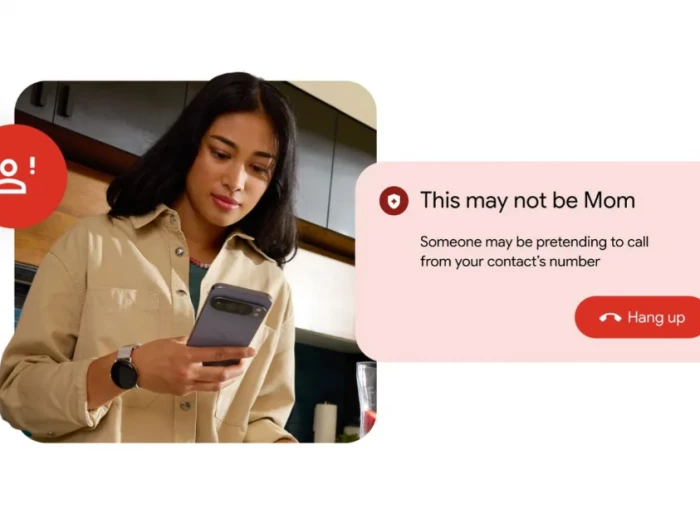
Google is rolling out a new fake call detection feature for Android as phone scams become more sophisticated in the age of AI voice cloning. The feature is designed to warn users when an incoming call may not actually be coming from the person it appears to be from, even if the caller ID looks familiar.
The feature is rolling out globally this month through the Phone by Google app on Android 12 and newer devices, starting with Pixel phones. According to TechCrunch, the system is designed to protect users from AI deepfake impersonation scams, where attackers spoof numbers or imitate trusted people to pressure victims into sending money, sharing sensitive information, or taking urgent action.
The timing matters. Voice cloning tools have become easier to access, and scammers no longer need a highly technical setup to create convincing impersonations. A short sample of someone’s voice, combined with caller ID spoofing and emotional pressure, can be enough to make a scam feel real in the moment. Google’s new feature is a direct response to that shift.
Google’s fake call detection is built into the Phone by Google app. When a call appears suspicious, the system can alert the user that the person on the other end may not be verified as the contact shown on the screen. Instead of relying only on what the caller ID displays, Android checks for verification signals that help confirm whether the call is genuinely coming from the expected device or account.
The feature uses end-to-end encrypted Rich Communication Services, or RCS, to support verification between devices. In simple terms, the phone is not just asking whether the number looks correct. It is checking whether the call has the right trust signals behind it.
This is important because caller ID alone is no longer reliable. Scammers can spoof phone numbers to make a call appear as if it is coming from a parent, friend, bank, employer, delivery service, or government agency. When that spoofed number is combined with an AI-generated voice, the victim may have little time to question what is happening.
The warning does not automatically block every suspicious call. Instead, it gives users a clearer signal at the moment they need it. That matters because many phone scams work by creating panic. A fake emergency involving a child, a financial account, a legal threat, or a hospital bill is designed to stop people from thinking slowly.
Deepfake impersonation scams are effective because they target trust, not technology. A victim may not know how the scam works, but they know the voice of a family member or colleague. That emotional familiarity gives criminals a shortcut.
In earlier phone scams, bad accents, robotic scripts, or obvious call-center noise could give victims a reason to hesitate. AI voice tools reduce some of those warning signs. A scammer can sound more natural, imitate a known person, and keep the call short enough to avoid obvious mistakes.
The danger is especially high in urgent scenarios. A caller claiming to be a loved one in trouble may ask for money immediately. A fake bank representative may warn of a frozen account. A supposed executive may ask an employee to approve a payment. In these cases, the scam depends on speed, fear, and authority.
Google’s new feature does not solve all of that. It cannot guarantee that every fake call will be detected, and it cannot stop scams that move through messaging apps, social media, or other calling platforms. But it gives Android users an extra layer of defense at one of the most vulnerable points: the moment the phone rings.
The technical foundation of Google’s feature matters because it points to a broader change in phone security. Instead of treating phone numbers as trusted identity signals, companies are starting to treat them as weak signals that need verification.
RCS allows richer and more secure communication features than traditional SMS and older phone infrastructure. By using encrypted verification signals, Google can help determine whether the caller is tied to the expected device or contact context.
That does not mean the system will work in every call situation. The feature is most effective when both sides are using compatible Android devices and the Phone by Google app. That limitation is important because phone networks are fragmented. Users receive calls across Android, iPhone, landlines, VoIP services, business systems, and international carriers.
Still, the direction is clear. Phone security is moving away from passive caller ID and toward active verification. If major platforms can make verified calling more common, spoofing may become harder to weaponize at scale.
The fake call detection rollout fits into Google’s broader effort to use AI and device-level protections against fraud. The company has already been adding scam detection features across Android and Chrome, including warnings for suspicious websites, spammy notifications, and risky messages.
This latest feature targets a particularly sensitive threat because it involves real-time human interaction. A suspicious email can be reread. A fake website can sometimes be checked. A phone call, especially one that sounds like someone familiar, is harder to evaluate calmly.
Google has also been working on scam protections involving banks and financial institutions. Earlier Android protections were designed to warn users when scammers impersonated financial institutions. The new fake call detection feature extends that logic to a wider and more personal category: calls that appear to come from people users already know.
That expansion reflects how scam tactics are changing. Criminals do not always need to impersonate a bank anymore. They can impersonate a child, a spouse, a manager, a coworker, or a friend. The more personal the impersonation, the harder it is for victims to ignore.
For Android users, the feature could become a useful safety signal, especially for people who are at higher risk of phone fraud. Older adults, busy professionals, and people who frequently receive calls from unknown or changing numbers may benefit most from clearer warnings.
The feature also encourages a safer habit: treat unexpected urgent calls with caution, even when the caller ID looks familiar. If a call is flagged, the safest move is to hang up and contact the person through a separate trusted channel. That may mean calling back using a saved number, sending a message through a known app, or checking with another family member or coworker.
The most important point is that users should not treat caller ID as proof of identity. In the AI era, a familiar number and a familiar voice may not be enough. Verification has to move beyond what appears on the screen.
Google’s fake call detection is a useful step, but it also shows how defensive technology is being forced to catch up with generative AI abuse. AI voice cloning has lowered the cost of impersonation, while spoofing tools have made it easier to fake where a call appears to come from.
That creates a difficult arms race. As platforms add detection tools, scammers will look for new ways around them. They may move to apps not covered by phone-level verification, use social engineering before the call, or rely on emotional manipulation that technology cannot fully detect.
This is why fake call detection should be seen as one layer of protection, not a complete solution. Carriers, device makers, app platforms, banks, and users all have a role to play. Better verification systems can reduce risk, but public awareness remains just as important.
Google’s rollout points to a future where phone calls may need the same kind of trust indicators that browsers and messaging apps already use. The question is no longer whether a number appears familiar. The question is whether the identity behind the call can be verified in real time.
That shift is overdue. For years, scammers have exploited the gap between what caller ID shows and who is actually calling. AI deepfakes have made that gap more dangerous by adding a convincing human voice to the deception.
If Google’s system works well and expands across more devices, it could make verified calling a more normal part of smartphone security. The bigger test will be whether the industry can make these protections broad enough to cover the messy reality of phone communication, where users move across devices, carriers, apps, and countries.
For now, Android’s fake call detection gives users a stronger warning system at a moment when the risks are becoming harder to hear. It does not end deepfake phone scams, but it raises the cost of impersonation and gives people one more reason to pause before trusting a voice on the line.
New Claude Model Targets Agentic AI WorkflowsAnthropic has launched Claude Sonne...
Samuel Osei3 months ago
Gemini’s Image Tools Get a Wider RolloutGoogle is expanding access to Gemini’s p...
Alexander Hughes3 months ago

Two AI video generators, two very different first days. I ran PixVerse through i...
Alexander Hughes3 months ago
Two of the most talked-about AI chat platforms. I opened both, picked a characte...
Alexander Hughes3 months ago

The two-minute versionIf you only read one thing, read this. The rest of the doc...
Alexander Hughes3 months ago

Why Seedance 2.5 mattersSeedance 2.5 is the latest release in ByteDance’s Seedan...
Alexander Hughes3 months ago
Discussion