The AI writing market split into two philosophies during the past year. One camp doubled down on breadth, folding dozens of generation tools into a single workspace that handles everything from ad copy to slide decks. The other narrowed its focus toward a problem that barely existed two years ago: getting a brand mentioned inside answers produced by ChatGPT, Perplexity, and Google AI Overviews. HIX AI and Writesonic now sit on opposite sides of that divide, which turns a head-to-head comparison into something more useful than a paragraph-quality contest.
The numbers frame the gap. Writesonic reports more than 200,000 users and monitors brand visibility across ten or more AI answer engines, positioning itself closer to a search analytics suite than a copy generator. HIX AI counters with a library of over 120 writing tools spanning more than 50 languages, plus modules for humanizing text, building presentations, and tutoring students. Both can draft a blog post in minutes. The deciding question is what happens before and after that draft exists.
This comparison evaluates output quality, pricing structure, workflow fit, and the increasingly important question of AI search visibility. The goal is a clear recommendation for distinct buyer types rather than a single trophy winner, because the two platforms increasingly compete for different budgets inside the same marketing department.
Scoring followed the Create-to-Rank Framework, a six-factor rubric built specifically for tools that promise both content production and search performance. Each platform earned a rating from zero to ten on every factor, drawn from hands-on testing, vendor documentation, and verified user reviews aggregated across G2, Capterra, and Trustpilot.
• Short-form draft quality. Speed and polish on emails, ads, product descriptions, and social posts.
• Long-form article depth. Structure, factual grounding, and editing load on pieces above 1,500 words.
• SEO and AI-search tooling. Keyword support, optimization cues, and visibility tracking across answer engines.
• Workflow and export. Editor experience, integrations, and how cleanly content moves toward publishing.
• Pricing transparency. Clarity of tiers, consistency over time, and value at the level most buyers need.
• Breadth of use cases. Range of formats and tasks a single subscription can realistically cover.
Pricing figures reflect published rates as of May 2026. Both vendors revise tiers frequently, so confirmation on each official site before purchase remains essential. No affiliate relationship influenced the scoring.
Launched in March 2023 under chief executive Camille Sawyer, HIX AI grew into an all-in-one assistant aimed at students, marketers, bloggers, and small teams. In any detailed HIX AI review, the platform’s biggest appeal is its model choice across GPT-5.1 and Claude Sonnet 4, layered over a modular toolkit that users enable as needed. The pitch is consolidation: drafting, summarizing, rewriting, and publishing inside one flow rather than across five subscriptions.
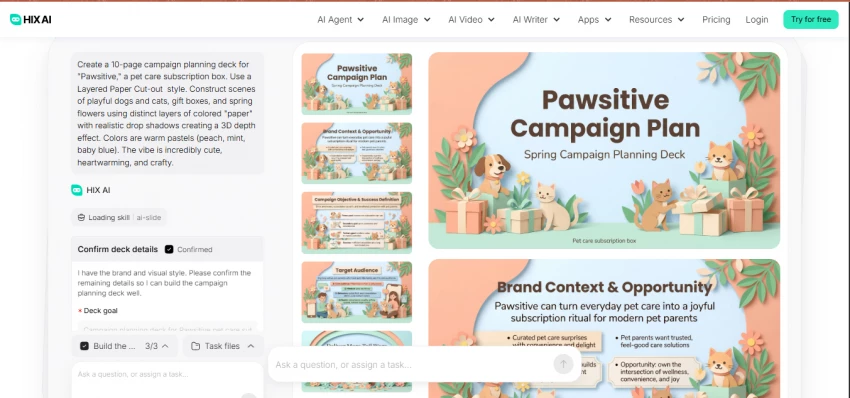
Breadth defines the product. The AI Writer covers more than 120 micro-tools, while ArticleGPT handles fact-based long-form articles with a one-click mode for speed and a high-quality mode for depth. ArticleGPT pulls from real-time sources including Wikipedia, Google News, and review platforms, then supports one-click export to WordPress and Google Docs. HIX Chat reads pages, PDFs, and YouTube links, and a browser extension extends those tools into Gmail, Docs, and social platforms. Specialized modules such as HIX Bypass for humanizing text, HIX Tutor for study help, and an AI presentation builder push the suite well past plain copywriting.
The pricing model is the recurring complaint. Several modules, including the AI Writer, ArticleGPT, HIX Bypass, and the browser extension, carry separate subscriptions rather than a single unified plan, which makes total cost harder to predict for anyone who wants the full suite. ArticleGPT markets hallucination-free output, yet independent reviewers still advise verifying claims in technical or specialized fields. Support responsiveness draws occasional criticism, and the sheer number of tools creates a learning curve before the workflow feels efficient.
Strengths
• Largest toolkit in the comparison, covering text, images, presentations, and study help
• Strong editor experience with WordPress and Google Docs export built in
• Genuine multilingual reach across more than 50 languages
Limitations
• Fragmented pricing spread across separate module subscriptions
• Long-form output still needs fact-checking despite accuracy claims
• No native tracking for brand visibility inside AI answer engines
Editor's Take. HIX AI rewards creators who value range over specialization. The suite replaces a stack of single-purpose tools, but the savings only hold up for users who actually use several modules. A buyer who needs one capability will likely overpay for the breadth around it.
Writesonic started in 2021 as an affordable alternative to Jasper and Copy.ai, then reinvented itself. The 2026 platform, headquartered in London, frames itself around managing the entire visibility lifecycle of a brand across both traditional search and AI answer engines. Its operating concept is multi-model orchestration, routing requests across GPT-4o, Claude, and Gemini rather than locking users into one model. The result reads less like a writing app and more like a Semrush competitor with a content engine attached.
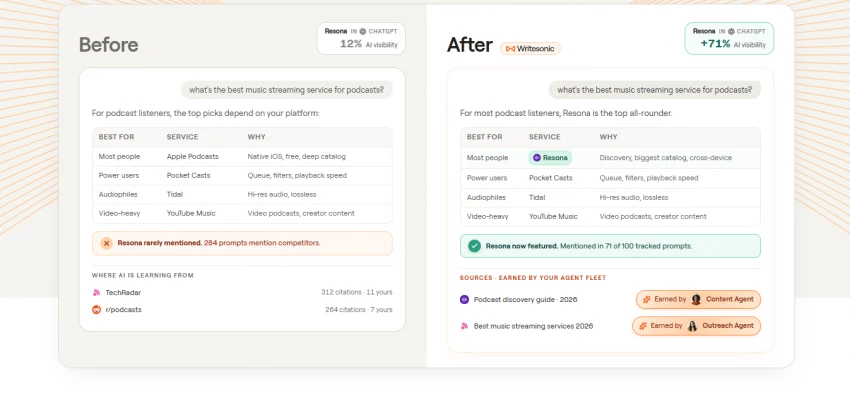
The flagship is the Generative Engine Optimization dashboard. It tracks how often a brand appears in responses from ChatGPT, Gemini, Perplexity, Google AI Overviews, Claude, Grok, DeepSeek, and Copilot, with no extra fee for each additional engine. Citation gap analysis surfaces sources that mention competitors but not the brand, then pairs those gaps with outreach templates and content recommendations. On the writing side, AI Article Writer 6.0 produces drafts up to 5,000 words with real-time web research and competitor analysis. Sentiment scoring, share-of-voice metrics, and prompt tracking round out a measurement layer that few writing tools attempt.
Output quality divides reviewers. Drafts arrive fast, yet longer pieces often read thin, with repeated ideas and a tone that shifts between sections, which forces editors to rebuild flow before publishing. The pricing structure is the larger friction point: tiers have been renamed and re-tiered repeatedly, and the signature GEO suite sits behind the Professional plan, reported around 249 dollars per month, well above where casual writers expect to land. Lower tiers carry article caps and a credit system that newcomers find confusing, and the platform still depends on a separate CMS to publish what it produces.
Strengths
• Most complete AI search visibility tracking in the comparison
• Multi-model output across GPT-4o, Claude, and Gemini in one workspace
• Strong third-party ratings near 4.7 out of 5 across major review platforms
Limitations
• Long-form drafts frequently feel thin and need heavy editing
• Frequent tier changes make budgeting unpredictable
• Core visibility features locked to a high-priced Professional plan
Editor's Take. Writesonic made a deliberate bet that measuring AI visibility matters more than polishing prose. For teams that share that belief, nothing in this comparison rivals its tracking depth. For teams that simply want clean drafts, the GEO machinery is expensive overhead aimed at a different job.
The table below maps the capabilities that most often decide a purchase. The pattern is consistent: HIX AI wins on creative range, while Writesonic wins on measurement and search performance.
| Capability | HIX AI | Writesonic |
|---|---|---|
| Primary identity | All-in-one content suite | AI search visibility platform |
| Writing tools | 120-plus micro-tools | 100-plus templates |
| Long-form writer | ArticleGPT, fact-based | Article Writer 6.0, up to 5,000 words |
| AI models | GPT-5.1, Claude Sonnet 4 | GPT-4o, Claude, Gemini |
| AI-search (GEO) tracking | Not available | 10-plus answer engines |
| Language support | 50-plus languages | Multilingual, fewer documented |
| Publishing export | WordPress, Google Docs | Manual export, no native CMS |
| Extra modules | Humanizer, tutor, slides, images | SEO audits, sentiment, citations |
| Free entry point | 3,000 words per month | 25 credits per month |
Raw speed is a tie. Both platforms turn a topic and a few keywords into a full draft within minutes, and both produce clean short-form copy that needs little cleanup for ads, captions, and product descriptions. The separation appears in long-form work, where structure and factual grounding matter more than fluent sentences.
HIX AI leans on ArticleGPT to anchor articles in cited sources, which reduces invented statistics and gives editors a verification trail. The tradeoff is that real-time sourcing favors topics with strong public coverage, and niche or highly technical subjects still demand manual review. Writesonic counters with deeper research integration in Article Writer 6.0, including competitor analysis that shapes the outline, but the longer the piece runs, the more reviewers report repetition and tonal drift across sections. In practice, both tools generate a usable scaffold rather than a finished article, and the editing burden on a 2,000-word piece lands in a similar range for each.
For teams measuring quality by time-to-publish, the model choice matters. HIX AI pairs its drafts with an inline editor and direct WordPress export, shortening the path from draft to live post. Writesonic produces a draft of comparable length but routes it back through manual export, adding a step that compounds across high publishing volumes.
Pricing is where the two products feel least alike. At the entry level they sit close together, which masks a far wider gap at the tier where each platform delivers its signature capability. HIX AI opens with a free plan of 3,000 words per month and a Basic paid plan near 20 dollars monthly on annual billing, climbing to an Unlimited plan around 40 dollars that covers the full writing workflow. Writesonic starts with a credit-limited free plan and a Lite tier near 16 dollars, yet its defining GEO tracking unlocks only on the Professional plan reported around 249 dollars per month.
| Tier | HIX AI | Writesonic |
|---|---|---|
| Free | 3,000 words per month | 25 credits per month |
| Entry paid | Basic, around 20 dollars per month | Lite, around 16 dollars per month |
| Mid tier | Pro, scaled word limits | Standard, around 39 dollars per month |
| Core-value tier | Unlimited, around 40 dollars per month | Professional, around 249 dollars per month, GEO unlocked |
| Top and custom | Add-on word packs | Advanced near 499 dollars, Enterprise custom |
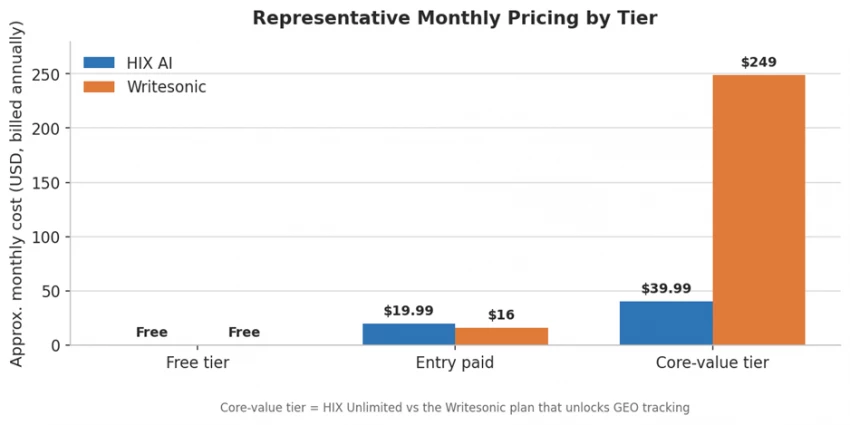
Figure 1. Representative monthly pricing. Tiers are not directly equivalent because each platform reserves its signature feature for a different price point.
The chart exposes the real decision. For pure content creation, HIX AI delivers more capability per dollar, since its full writing suite costs roughly what Writesonic charges for a mid tier. For brands that treat AI search visibility as a budget line, Writesonic justifies its Professional price by replacing several monitoring tools at once. The fragmentation works in reverse for each vendor: HIX AI scatters cost across modules, while Writesonic concentrates its most valuable feature behind a single steep gate.
This category has become the clearest dividing line in the AI writing market, and it is where Writesonic earns its repositioning. Traditional SEO tools were built to track blue-link rankings, not whether an answer engine cites a brand. Writesonic addresses that gap directly, monitoring mention frequency, sentiment, and citation patterns across ChatGPT, Perplexity, Gemini, Google AI Overviews, and several other engines. A practical example shows the value: a brand can learn that a chatbot recommends competitors for a key buying query the large majority of the time, then build content aimed precisely at that gap.
HIX AI takes a narrower approach. ArticleGPT produces SEO-friendly articles with target keywords placed throughout and an emphasis on originality, which helps content rank in conventional search. The platform does not, however, track or report how that content performs inside AI-generated answers. For teams whose strategy still centers on organic Google traffic, that omission may not matter. For teams preparing for a search landscape where answer engines intercept clicks before they reach a website, the absence is significant.
The honest summary: Writesonic offers a measurement layer that HIX AI does not attempt, and HIX AI offers a creation layer that Writesonic cannot match in breadth. Neither tool does both jobs at full strength, which is why many sophisticated content teams end up evaluating them as complements rather than substitutes.
Aggregated across the six framework factors, the two platforms finish nearly level, which reflects how cleanly their strengths and weaknesses offset. HIX AI edges ahead on breadth and workflow, while Writesonic dominates the search-visibility factor by a wide margin.
| Factor | HIX AI | Writesonic | Edge |
|---|---|---|---|
| Short-form draft quality | 8 | 8 | Even |
| Long-form article depth | 7 | 7 | Even |
| SEO and AI-search tooling | 5 | 9 | Writesonic |
| Workflow and export | 8 | 7 | HIX AI |
| Pricing transparency | 5 | 4 | HIX AI |
| Breadth of use cases | 9 | 6 | HIX AI |
| Total out of 60 | 42 | 41 | HIX AI |
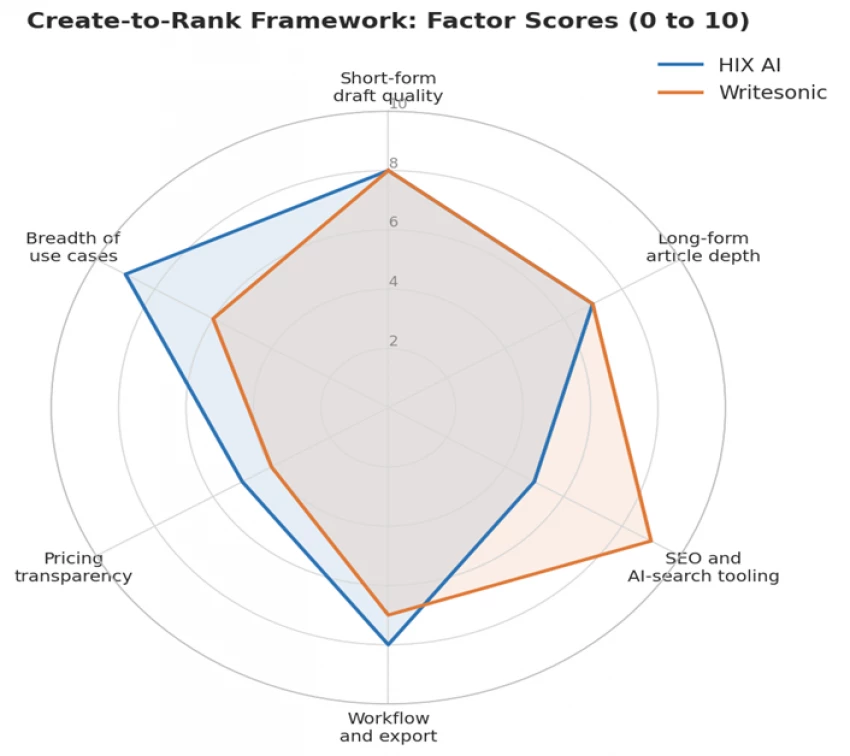
Figure 2. Factor scores plotted across the Create-to-Rank Framework. The shapes show two products optimized for different jobs rather than one clearly beating the other.
A near-tied total is useless without context, so the recommendation depends on the job at hand. The fit table below converts the scores into plain guidance.
| User type | Better pick | Reasoning |
|---|---|---|
| Solo blogger or creator | HIX AI | Full writing suite, direct WordPress export, and low entry cost |
| Multilingual content team | HIX AI | Strongest language coverage and broad format range in one plan |
| SEO and GEO agency | Writesonic | Visibility tracking across answer engines justifies the Professional tier |
| Marketing team tracking AI mentions | Writesonic | Citation gap analysis and sentiment scoring have no equal here |
| Student or casual user | HIX AI | Tutor module, humanizer, and free plan cover everyday needs cheaply |
| Brand watching competitor visibility | Writesonic | Prompt tracking reveals where rivals win inside AI answers |
Neither platform wins outright because they no longer compete for the same job. HIX AI is the stronger choice for content creation, offering the widest toolkit, the smoothest path to a published post, and the lower cost for anyone whose primary need is producing words across many formats and languages. Its weakness is a fragmented pricing model that punishes buyers who want only one piece of the suite.
Writesonic is the stronger choice for brands that have accepted a hard truth about modern search: ranking on Google is no longer enough when answer engines decide which companies get mentioned. Its Generative Engine Optimization tracking stands alone in this comparison, and the Professional price becomes defensible the moment that visibility data replaces several separate tools. The cost only stings for buyers who expected a simple writing app and found a search analytics platform instead.
The most accurate recommendation rejects the premise of a single winner. A team focused on output should choose HIX AI. A team focused on visibility should choose Writesonic. A team serious about both increasingly runs HIX AI for creation and Writesonic for measurement, treating the two as halves of one workflow rather than rivals for the same line in a budget.

New Claude Model Targets Agentic AI WorkflowsAnthropic has launched Claude Sonne...
Samuel Osei3 months ago
Gemini’s Image Tools Get a Wider RolloutGoogle is expanding access to Gemini’s p...
Alexander Hughes3 months ago
Two AI video generators, two very different first days. I ran PixVerse through i...
Alexander Hughes3 months ago
Two of the most talked-about AI chat platforms. I opened both, picked a characte...
Alexander Hughes3 months ago
The two-minute versionIf you only read one thing, read this. The rest of the doc...
Alexander Hughes3 months ago
Why Seedance 2.5 mattersSeedance 2.5 is the latest release in ByteDance’s Seedan...
Alexander Hughes3 months ago
Discussion