AI & ML
10 min read
How Businesses Are Using Redeepseek AI to Grow Faster in 2026

AI assistants have moved past the experimentation phase. By the first quarter of 2026, 72 percent of enterprises had at least one AI workload running in production, up from 55 percent in 2024 and only 20 percent in 2020. Inside that adoption curve, multi-purpose platforms like Redeepseek.io are being put to work across functions that were previously dependent on manual effort, fragmented tooling, or expensive specialist software.
This article examines how businesses are deploying Redeepseek-style AI assistants for measurable growth: the use cases where adoption is strongest, the departments leading the rollout, the operational changes that follow, and the patterns that separate successful implementations from abandoned pilots.
72% of enterprises run at least one AI workload in production | 5.8× average ROI on AI investment within 14 months | $7,800 annual productivity value per knowledge worker from GenAI | 20-40% productivity gains reported in year one of deployment |
Three forces are accelerating adoption of platforms like Redeepseek across mid-market and enterprise organizations.
First, cost. The average AI subscription for a single knowledge worker is roughly $20 to $30 per month, while the measured productivity uplift sits at $7,800 per employee per year according to Accenture. Even a partial capture of that value generates a return that no other software category currently matches.
Second, breadth. A single AI assistant covers writing, research, coding help, document analysis, web search with cited sources, and image analysis. Functions that once required separate tools, separate vendors, and separate training budgets now run inside one interface.
Third, accessibility. Modern AI assistants do not require an internal data-science team or a six-month integration. A business analyst with no technical background can extract insight from a 40-page contract, draft a multilingual product brief, or pull cited research into a slide deck within minutes.
The use cases below reflect where Redeepseek-style AI assistants are producing the highest reported impact across surveyed organizations in early 2026.
| 01 | Content Marketing at Scale Marketing teams use AI assistants to generate first drafts of blog posts, social copy, ad variants, and product descriptions in multiple languages. Output is then reviewed and refined by humans rather than written from scratch. | MEASURED IMPACT Content production speed typically increases 3 to 5 times. Content creation is the top reported GenAI use case at 71 percent of organizations (McKinsey, Q1 2026). |
| 02 | Customer Support Augmentation Support agents query the AI assistant for policy lookups, draft replies, and case summaries. The AI does not replace agents, it speeds them up. Customer service is the single largest department using AI in production at 56 percent of enterprises. | MEASURED IMPACT Agents resolve roughly 30 percent more tickets per shift, and average response times drop 25 to 40 percent (Deloitte 2026 AI report). |
| 03 | Research and Competitive Intelligence Sales, strategy, and product teams use cited web search to compile competitor analyses, market briefs, and customer research. The assistant returns sourced answers in minutes instead of the hours analysts previously spent compiling reports. | MEASURED IMPACT Decision speed improves up to 30 percent in organizations that integrate AI into research workflows (Capgemini Rise of Agentic AI report). |
| 04 | Code and Engineering Support Software developers use AI assistants for debugging, code explanation, refactoring, and documentation. With 30+ programming languages supported by Redeepseek, the tool fits inside most development stacks without language-specific licensing. | MEASURED IMPACT AI-assisted developers produce 40 to 55 percent more code per week (GitHub Copilot research). Code generation is the second-most adopted GenAI use case at 58 percent. |
| 05 | Document and Contract Analysis Operations, legal, and finance teams upload PDFs, vendor agreements, RFPs, or research papers and request summaries, risk flags, or extracted data points. Multi-hour reviews collapse into minutes of guided reading. | MEASURED IMPACT Document-heavy roles report 37 percent average productivity improvement when augmented with AI (Forrester 2026). Time per contract review drops by half in most observed deployments. |
| 06 | Multilingual Market Expansion Companies expanding into new regions use AI translation, localization, and cross-language summarization to enter markets without hiring native staff for every language. Redeepseek's 50+ language coverage supports the most common business languages. | MEASURED IMPACT Localization costs drop 60 to 70 percent versus traditional translation agencies for routine business content. Time-to-market for new regions shortens from quarters to weeks. |
Adoption is not evenly distributed inside organizations. The table below maps the departments leading deployment to their most common Redeepseek-style use cases and the operational outcomes reported in 2026 surveys.
| Department | Primary Use Cases | Reported Impact | Adoption Rate |
|---|---|---|---|
| Customer Service | Reply drafting, case summaries, policy lookup, FAQ deflection | 30% more tickets per shift | 56% |
| IT Operations | Incident triage, runbook lookup, log analysis, documentation | 28% faster MTTR | 51% |
| Marketing | Content drafts, ad copy variants, multilingual campaigns | 3-5× content speed | 48% |
| Sales | Lead research, email personalization, proposal drafting | 25% more outreach volume | 42% |
| Engineering | Code generation, debugging, code review, documentation | 40-55% more code/week | 38% |
| Finance & Ops | Contract review, invoice extraction, vendor comparison | 50% faster reviews | 34% |
| HR | Policy answers, JD drafting, candidate screening summaries | 40% faster screening | 29% |
| Legal | First-pass contract review, clause extraction, summarization | 60% time saved per doc | 22% |
Adoption rates reflect the share of enterprises using AI in production within each department (McKinsey 2026 Q1 data).
A direct comparison of how common business tasks change once an AI assistant becomes part of the workflow. Figures below represent typical observed outcomes, not vendor projections.
| Task | Before AI Assistant | With AI Assistant |
|---|---|---|
| Draft a 1,500-word blog post | 3-4 hours, single language | 30-45 minutes, multiple languages |
| Summarize a 40-page PDF report | 60-90 minutes, manual highlighting | 5-10 minutes, structured summary with quotes |
| Review a vendor contract | 2-4 hours of legal time | 30-45 minutes of guided review |
| Compile competitive market research | 1-2 working days across analysts | 1-2 hours with cited sources |
| Translate marketing copy (5 langs) | $400-$800 per piece via agency | Near-zero direct cost, human QA only |
| Debug a moderately complex bug | 1-3 hours of developer effort | 20-40 minutes with assistant |
| Generate first-draft sales emails (20) | 2-3 hours of manual writing | 10-15 minutes with personalization |
Successful Redeepseek deployments rarely happen overnight. The pattern observed across mid-market and enterprise rollouts in 2026 follows four sequential phases. Skipping phases is the most common reason pilots fail to scale.
PHASE 1 Weeks 1-4 | Pilot with One Department Select a single department with high-volume, low-risk workflows. Customer service and marketing are the most common entry points. Limit access to 5-10 power users and document their use patterns daily. |
PHASE 2 Weeks 5-10 | Establish Usage Patterns Build prompt libraries and reusable templates around the highest-impact use cases. Share what works internally. This is the phase where most organizations stop, capturing individual productivity but missing enterprise-wide ROI. |
PHASE 3 Weeks 11-20 | Expand to Adjacent Functions Extend access to second and third departments based on pilot learnings. Add governance, data-handling policies, and human-review checkpoints. Begin measuring department-level outcomes instead of just individual time savings. |
PHASE 4 Month 6+ | Embed into Core Workflows Integrate the AI assistant into the systems where work already happens: CRM, helpdesk, document repositories, project tools. Move from ad-hoc usage to embedded workflow. This is the phase where individual productivity becomes business growth. |
Industries with high-volume, repeatable workflows are deploying AI assistants fastest. Heavily regulated sectors move more slowly because governance and compliance overhead is higher.
| Industry | Common Use Patterns | Production Rate (Q1 2026) |
|---|---|---|
| Financial Services | Document review, regulatory summaries, client research, fraud pattern analysis | 47% deployed |
| Software & Tech | Code assistance, internal documentation, customer support automation | 42% deployed |
| Retail & E-commerce | Product descriptions, multilingual content, support chat, marketing copy | 38% deployed |
| Telecommunications | Customer service automation, network log analysis, technical documentation | 34% deployed |
| Professional Services | Client research, proposal drafting, contract review, knowledge management | 26% deployed |
| Manufacturing | Vendor analysis, technical documentation, multilingual operations manuals | 22% deployed |
| Healthcare | Clinical note assistance, research synthesis, administrative summaries | 18% deployed |
| Government & Public | Policy analysis, citizen service responses, document processing | 14% deployed |
Production rates compiled from S&P Global, NVIDIA State of AI 2026, and PwC industry surveys.
Across enterprise surveys, four factors consistently separate organizations that capture measurable ROI from those that do not. Tool selection is rarely the differentiator. Implementation discipline almost always is.
1. Vendor-Led Deployments Outperform Internal Builds
MIT NANDA initiative data shows vendor-led AI deployments succeed 67 percent of the time, while internal builds succeed roughly one-third as often. Buying a ready-made platform like Redeepseek and configuring it carries a much higher success rate than building a custom wrapper around a foundation model.
2. Outcome Accountability Beats Adoption Metrics
Tracking 'number of users' or 'queries per day' produces no business value on its own. The organizations capturing the strongest ROI tie AI usage to specific business outcomes: ticket-resolution rate, content output, contract turnaround time, leads qualified per week.
3. Governance Precedes Scale, Not the Reverse
Sixty-seven percent of executives report a data leak from unsupervised AI use, according to the 2026 Writer Enterprise AI report. Putting clear data-handling policies, retention rules, and human-review checkpoints in place before scaling is significantly cheaper than fixing breaches afterward.
4. Embedded Use Beats Standalone Use
AI assistants used as a separate browser tab produce individual productivity gains. AI assistants embedded into CRM, helpdesk, or document systems produce enterprise-wide ROI. The 5.8× return reported by McKinsey applies to embedded deployments, not standalone subscriptions.
Forty-two percent of companies abandoned the majority of their AI initiatives in 2025, more than double the previous year. The patterns below are the most common reasons.
✗ Treating AI as a Tool Selection Problem Most organizations spend months evaluating which AI platform to choose, then almost no time on how to use it. The success rate gap between tools is far smaller than the gap between organizations that train teams to use them well and those that do not. |
✗ Letting Shadow AI Spread Without Governance When employees use AI assistants without policy or approval, sensitive data flows into systems no one is auditing. Sixty-seven percent of executives believe their company has already suffered a data breach from unapproved AI tools (Writer 2026). Quiet permissiveness has a real cost. |
✗ Measuring Productivity Without Connecting to Revenue Individual time savings rarely translate to financial outcomes without a deliberate link. Only 29 percent of executives see significant ROI from generative AI deployments, despite 97 percent reporting personal benefit. The disconnect comes from missing instrumentation. |
✗ Skipping the Pilot Phase Rolling out AI to the entire organization in week one is the fastest path to abandonment. The four-phase implementation pattern works because each phase teaches what the next phase requires. Compressing the timeline removes the learning that makes scaling sustainable. |
✗ Ignoring the Brand-Name Confusion Risk Redeepseek and DeepSeek AI are independent platforms despite the similar names. Some teams have signed up to the wrong service, sent procurement requests through inconsistent channels, or generated internal confusion that slows adoption. A clear internal communication about which platform is in use prevents this entirely. |
The growth question for businesses adopting Redeepseek-style AI assistants in 2026 is not whether the technology delivers value. It does. The question is how much of that value the organization can actually capture.
Individual productivity gains are universal. Ninety-seven percent of executives report personal benefit from AI tools. Enterprise-wide ROI is far more selective: only 29 percent report significant organizational return. The 68-percentage-point gap is not a technology gap. It is an implementation gap.
Companies that close it share four observable habits. They pilot with one department before scaling. They put governance and data policy in place before broad rollout. They embed the AI assistant into the systems where work already happens, not as a side tool. And they measure outcomes tied to revenue or cost, not adoption metrics that flatter dashboards.
For organizations evaluating Redeepseek or any similar platform, the lesson from the 2026 data is consistent: the platform matters less than the process around it. A capable tool with disciplined adoption produces 5.8× returns. The same tool deployed without discipline produces another abandoned pilot.
Key Takeaway Businesses using AI assistants like Redeepseek are growing faster because they are concentrating adoption in high-volume, repeatable functions, then embedding the tool into existing workflows. The fastest-growing organizations treat AI deployment as an operational change, not a software purchase. |
New Claude Model Targets Agentic AI WorkflowsAnthropic has launched Claude Sonne...
Samuel Osei3 months ago
Gemini’s Image Tools Get a Wider RolloutGoogle is expanding access to Gemini’s p...
Alexander Hughes3 months ago
Two AI video generators, two very different first days. I ran PixVerse through i...
Alexander Hughes3 months ago
Two of the most talked-about AI chat platforms. I opened both, picked a characte...
Alexander Hughes3 months ago
The two-minute versionIf you only read one thing, read this. The rest of the doc...
Alexander Hughes3 months ago
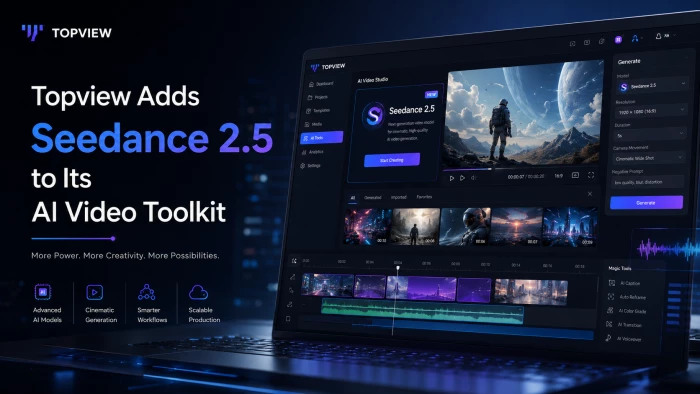
Why Seedance 2.5 mattersSeedance 2.5 is the latest release in ByteDance’s Seedan...
Alexander Hughes3 months ago
Discussion