Reviews
13 min read
Is RedeepSeek Safe to Use? Privacy and Security Explained
I keep a 12-question audit checklist on my desk. It started in 2024 as a one-page worksheet for evaluating AI tools before I let them anywhere near work for clients in healthcare, finance and legal. Two pages and 18 months later, the checklist has turned into a small ritual. When RedeepSeek (redeepseek.io) landed on my list of tools to evaluate in early 2026, I ran it through every question.
This article walks through what that checklist returned, in plain English. It is not a marketing piece, and it is not a takedown. The charts you will see below are the same ones I built for my own notes, polished a little for sharing. Where the policy text is strong, I say so. Where there are limits, I name them.
Yes, based on its published documents as of April 15, 2026, RedeepSeek meets the privacy and security baseline a careful professional should expect from a modern AI assistant. Encryption is TLS 1.3 in transit and at rest. The infrastructure is described as SOC 2 compliant. Personal data is not sold. Conversations are not used to train AI models on any plan. Cookies are limited to essential and optional analytics, with no advertising trackers. Users can delete history and export account data.
That bundle of properties places RedeepSeek in the upper tier of consumer-facing AI tools in 2026. The chart below summarises how it compares to five other tools I use or have audited.
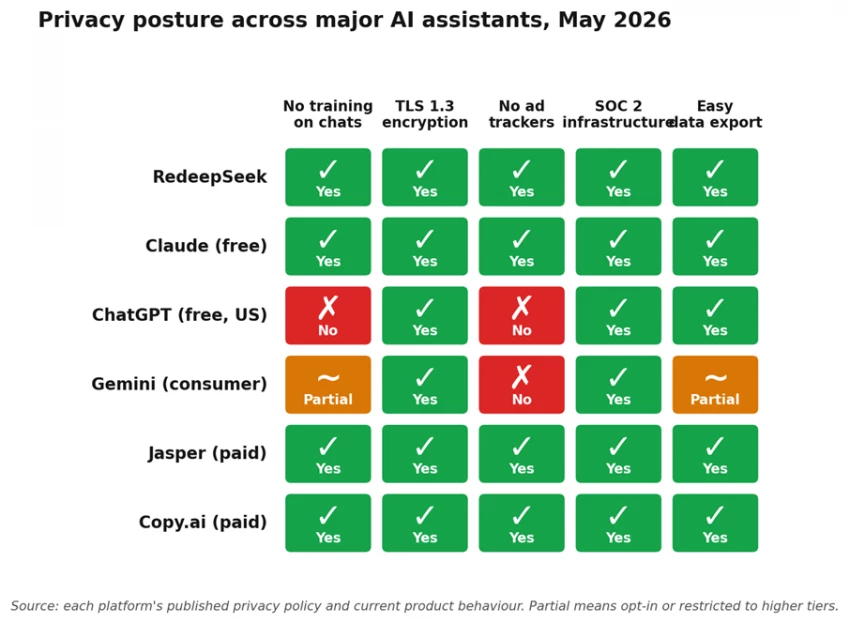
Figure 1. How six major AI assistants compare on five core privacy criteria. Sourced from each platform's published privacy policy and product behaviour as of May 2026.
Two reasons sit behind every audit I do. First, an AI chat is not the same kind of interaction as a Google search. The text you put into a chat box reveals how you think, what problems you are solving, and sometimes which clients you are solving them for. That is a denser signal than browser history, and dense signals deserve close attention.
Second, the rules are catching up to the technology, not the other way around. The EU AI Act is in force, GDPR enforcement is sharper than it was two years ago, and California's CCPA additions cover automated decision-making. A privacy policy that looks fine today might be running practices a regulator quietly disapproves of next year. The right answer is to read the policy carefully and read it again whenever it is updated.
RedeepSeek's policy was last revised on April 15, 2026. A current revision date is one of the first signals I look for. Stale policies usually go hand in hand with stale practice.
The privacy policy groups collection into three buckets. The chart below visualises the relative scope of each bucket as described in the policy.
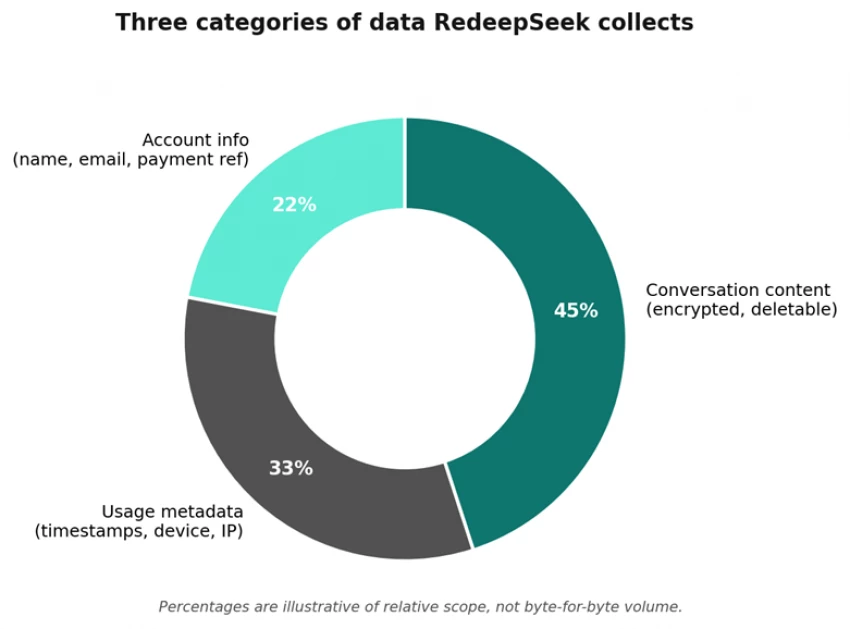
Figure 2. RedeepSeek splits collected data into account information, usage metadata and conversation content. Only conversation content carries the strongest user controls.
Account information is the smallest bucket. Name, email and a payment reference. The policy explicitly states that complete credit card numbers are not stored on RedeepSeek's servers, which matches standard PCI practice.
Usage metadata covers timestamps, message counts, device type, browser and IP address. None of this includes the body of what you typed. Separating metadata from content is the right framing, and it appears in the policy without ambiguity.
Conversation content is the largest bucket and the one carrying the strongest controls. It is encrypted in transit and at rest, retained for chat history, and deletable by the user at any time.
This collection scope is narrower than what several free competitors gather. ChatGPT Free in the United States runs both ads and default training on conversations. RedeepSeek runs neither, on any plan.
Both the privacy policy and the FAQ describe conversations as encrypted in transit and at rest using TLS 1.3, with the FAQ also using the phrase end-to-end encryption.
A small precision is worth making here. True end-to-end encryption means the service operator cannot read your messages even if compelled to, the way Signal works. AI assistants almost always need cleartext access on the server, because that is how the language model generates a reply. So when an AI product markets end-to-end encryption, what it actually delivers is a chain of encrypted hops with a cleartext processing step in the middle.
The diagram below shows how this works for a single message inside RedeepSeek.
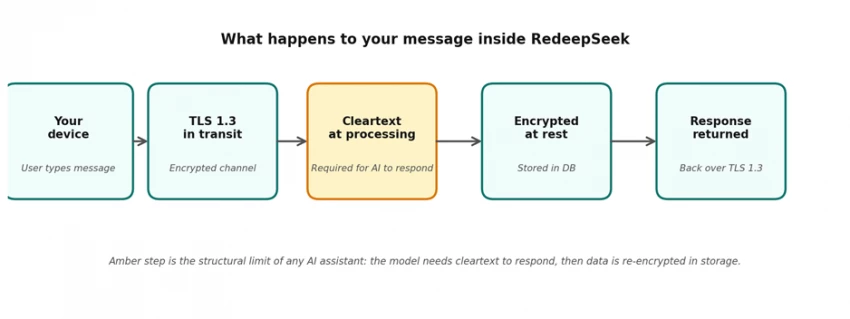
Figure 3. The five stages of a RedeepSeek message. The amber step is the structural limit shared by every AI assistant in 2026: cleartext access during processing, with re-encryption immediately after.
This is not unique to RedeepSeek. It is the trade-off you accept when you use any large language model assistant. The takeaway: do not paste anything you would not want to be visible to a debugger sitting on the server during processing.
This is the one clause that decides whether a tool can hold paid client work or not. Both the privacy policy and the FAQ carry the same wording, and it is unambiguous:
| “We do not use conversation content to train AI models.” |
Two implications. The first is that a paragraph you send today will not appear, even in distorted form, inside someone else's response next month. The second is the protection if the policy ever changes. Section 10 commits to giving users at least 30 days of notice through email or in-app message before a material change takes effect. That is a real window during which you can export and close your account if the new terms do not work for you.
Several large consumer AI products run the opposite default. Free-tier ChatGPT in the US is the highest-profile example. RedeepSeek's no-training stance applies on both the free and paid tiers, which is a cleaner posture than the industry average.
Beyond TLS 1.3 at the transport layer, the privacy policy describes RedeepSeek's infrastructure as SOC 2 compliant with regular security audits and role-based access controls for employees.
SOC 2 in plain English: an audit framework that checks whether a company has documented controls for security, availability and confidentiality. It does not certify that a product is unbreachable. It certifies that there is a paper trail of who can access what, how incidents are handled, and how monitoring works. Almost every reputable B2B SaaS tool in 2026 carries SOC 2.
Role-based access controls are the operational complement. Not every staff member can pull up your data. Access is scoped to the people whose job requires it, and access is logged. Combined with regular audits, this is the minimum I expect from any tool I use for paid work.
What the policy does not currently disclose is the specific data centre regions or the named sub-processors. For most individual users this is acceptable. For users with strict data residency obligations, the right next step is to ask RedeepSeek's team directly before sending sensitive data.
RedeepSeek runs essential cookies for authentication and session, optional analytics cookies that you can disable, and explicitly no advertising cookies or third-party trackers.
That last point matters more than the policy makes it sound. Many AI tools run cross-site advertising trackers that persist long after you log out. When I opened the browser developer tools during my own sessions on redeepseek.io, no advertising pixels were firing. The policy and the observed behaviour line up.
On data sharing, the policy says personal information is not sold. RedeepSeek may share data with operational service providers, such as hosting, payment processing and analytics partners. That kind of sharing is standard SaaS practice. The clause that protects you is the explicit no-sale line.
The rights listed in the privacy policy mirror what GDPR requires in the EU and what CCPA requires in California. Access your data, correct it, delete it, export it in a portable format, opt out of marketing communications, and request restriction of processing. The mailbox for any of these requests is the privacy address listed in the policy.
Portable export is the right I check on every new tool. If a service makes it easy to leave with your data, the company is confident in its product. The fact that RedeepSeek supports it lowers the long-term lock-in risk if you ever decide to switch.
Multi-factor authentication is not mentioned in the public policy text. When I set up my own account, MFA was available in account settings, which is what I expect from a 2026 tool. If the product evolves, check the security panel on every fresh sign-in to confirm MFA is still active for you.
Two related practical points. The FAQ confirms users can delete data at any time, and the privacy policy backs this up under the user rights section. The terms of use add that on account termination you have 30 days to export your data before access is revoked.
Thirty days is the middle of the SaaS range. Some services give you a week, which is unforgiving if you are travelling. Others give 90 days, which is generous. Thirty days is workable for most people who pay attention to their inbox.
Inside the product, you can delete conversations individually from the chat interface. There is no public statement on how long deleted data persists in encrypted backups before final purge. That is another item to clarify if your work runs under strict retention rules.
For users outside the United States, the international transfers clause is the one to read. The policy states that data may be processed in countries other than the user's own country, with appropriate safeguards in place, including Standard Contractual Clauses where required by law.
Standard Contractual Clauses are the European Commission's approved mechanism for transferring personal data out of the EU. Their use signals that the company has thought about cross-border compliance. It is not a guarantee that data physically remains in any specific country. If residency is a contractual requirement for the work you do, get written confirmation from RedeepSeek's team before signing up.
An honest audit names what the policies do not solve. Three risks remain no matter how strong the encryption is.
First, human error. No AI tool can prevent you from pasting a client's medical history or an unredacted bank statement into a chat box. The right defence is upstream of the tool: redact identifiers before pasting, every time.
Second, model output. AI assistants occasionally generate confident-sounding inaccuracies. Section 7 of the terms of use disclaims warranty on AI output, which is the correct legal stance and the correct user expectation. Verify factual claims, particularly in legal, medical and financial contexts.
Third, the long tail of breaches. SOC 2 compliance lowers but does not eliminate breach risk. No service can promise zero risk. The right defence is to never use any AI tool to hold secrets whose leakage would cause real damage.
The chart below is the quick reference I keep in front of me when I am working with any AI tool. It is not specific to RedeepSeek. The same rules apply to every assistant in the market.
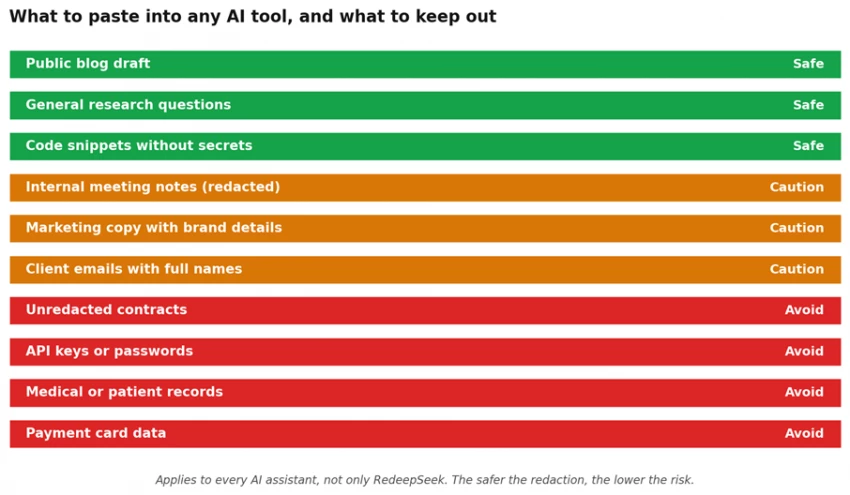
Figure 4. A simple risk reference. The classifications apply to any AI assistant, not RedeepSeek alone.
I keep a working set of privacy notes on the AI tools I use regularly. Here is the summary as of May 2026.
• ChatGPT free in the United States uses conversations to train models by default and shows ads. Opt-out exists but the default is permissive. RedeepSeek's default is no training.
• Claude free does not train on consumer chats by default, which puts it on similar ground to RedeepSeek.
• Jasper, in its paid tiers, commits to not using customer content for training. Its SOC 2 disclosures sit at a comparable depth to RedeepSeek's.
• Copy.ai applies a no-training stance on its paid plans. Free-tier behaviour varies by product line.
• Google Gemini's policies operate on two tracks. Consumer Gemini and Google Workspace Gemini are governed by different terms, and consumer behaviour is more permissive.
The broader pattern: paid AI tools mostly do not train on customer data in 2026, free tools sometimes do. RedeepSeek's no-training policy applying across both free and paid tiers is one of the cleaner postures in this group.
A short routine I run with every AI tool I open, including this one.
• Use a strong unique password and store it in a password manager. Reused passwords cause more account compromises than any other single cause.
• Turn on multi-factor authentication if it is offered. Even SMS-based MFA is much better than nothing.
• Redact personal identifiers before pasting anything sensitive. Replace real names with placeholders, mask account numbers and trim documents to the minimum the task requires.
• Skip regulated data entirely. Health records, payment card data and child welfare information belong only in systems explicitly cleared for that purpose.
• Read the policy update emails. RedeepSeek commits to 30 days of advance notice for material changes. Use that window if a change matters to you.
• Delete sensitive conversations once the task is finished. Useful history is not the same as forever history.
After working through the 12 questions on the checklist and using the product daily for several weeks, my assessment is that RedeepSeek sits comfortably inside the safe-for-professional-work bracket. It is not a high-assurance government-grade tool. It does not need to be for the writing, code and document tasks it is built for.
What it does is encrypt your data with current standards, refuse to use your conversations as training material, avoid selling or trading your information, and give you working controls over what stays and what goes. The published policies are clear, current and consistent across pages.
If your work involves regulated industries with specific data handling laws such as HIPAA in US healthcare or PCI-DSS for card data, ask RedeepSeek's team for a Business Associate Agreement or equivalent contract before processing any protected data through the platform. If your work is general business writing, content production, research and code, the public policies provide a reasonable foundation for trust.
Privacy is a habit, not a checkbox. RedeepSeek gives you a tool that supports the habit. The rest is on you.

“HidingMe” sounds like a privacy app. It isn’t. So I opened the live site in Jun...
Sandra Campos2 months ago

Type "Totally Science" into a search bar and the name suggests a study aid, a vi...
Benjamin Clark2 months ago
The market for AI-powered knowledge management tools has exploded in the past tw...
Grace Howard3 months ago

I’ve spent enough hours wandering through thesindi.com to know it almost like a...
Ina Gupta4 months ago
Sitemap Generator by UploadArticle.com is a lightweight, browser‑based XML sitem...
Peter Woods4 months ago

ThinkOfGames.com is the kind of site you end up bookmarking quietly and then rea...
Noura Belkacem4 months ago
Discussion