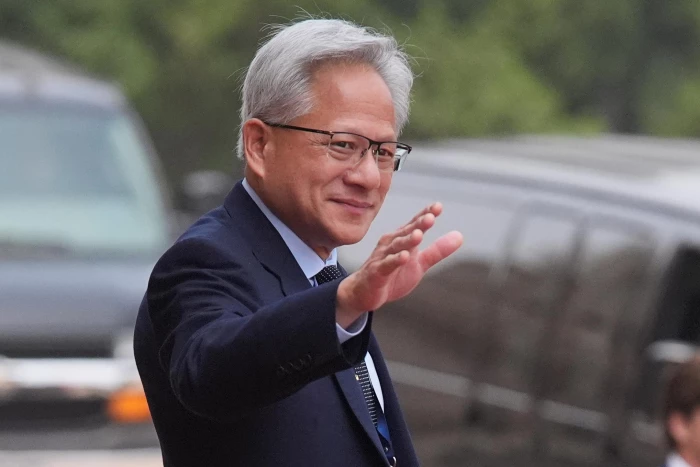
Nvidia’s next phase of AI growth is tied directly to Taiwan.
CEO Jensen Huang said the company’s annual spending in Taiwan could rise to about $150 billion, up from roughly $100 billion today and far above the $10 billion to $15 billion range Nvidia was spending there four to five years ago. The comment came in Taipei as Nvidia discussed plans for its new Taiwan headquarters, which is expected to break ground this year and begin operations around 2030.
The number is not just a spending update. It shows how much of the AI industry now depends on Taiwan’s chipmaking and hardware supply chain.
Nvidia’s Taiwan spending has expanded at a pace that mirrors the explosion in AI infrastructure demand. A few years ago, the company’s purchases in Taiwan were already large by normal technology-sector standards. Now they are approaching a scale usually associated with national industrial programs.
The rise is being driven by demand for AI chips, servers, networking systems, and other hardware needed to train and run advanced AI models. Nvidia designs the chips, but Taiwan’s manufacturing base helps turn those designs into finished products that can be deployed in data centers around the world.
Huang did not give a fixed timeline for how long Nvidia would spend at the $150 billion annual level. Still, the message was clear: Taiwan will remain one of the company’s most important production centers as AI demand continues to climb.
Taiwan is not just another supplier location for Nvidia. It is the center of one of the world’s most advanced semiconductor ecosystems.
TSMC is the most important name in that chain. The company manufactures many of Nvidia’s most advanced chips and remains the leading contract chipmaker for high-performance semiconductors. But Nvidia’s dependence on Taiwan goes beyond chip fabrication.
The island also has deep strength in server assembly, electronics manufacturing, advanced components, hardware engineering, and supply chain coordination. That cluster matters because modern AI systems are not built from chips alone. They require high-bandwidth memory, advanced packaging, circuit boards, networking, cooling, racks, and complete server systems.
This is why Nvidia cannot easily move its AI hardware engine somewhere else. Taiwan offers scale, speed, supplier density, and technical precision in one place.
Nvidia’s planned Taipei headquarters is more than an office project. It is a signal that the company wants a deeper operating presence close to its most important partners.
The facility is expected to start operations in 2030. By then, AI hardware is likely to be even more complex than it is today. Chips will be part of larger computing platforms that include data-center-scale networking, power management, and full-stack system design.
Being closer to Taiwanese partners could help Nvidia move faster from design to production. It may also help the company coordinate new AI platforms with manufacturers, suppliers, and hardware integrators before products reach global customers.
For Taiwan, the headquarters strengthens its position as a long-term base for Nvidia’s AI supply chain, not just a place where orders are placed.
The announcement underlines a reality that sometimes gets lost in AI discussions. The AI boom is not only about models, apps, and software companies. It is also about factories, wafers, packaging plants, servers, and logistics.
Every new generation of AI models needs more computing power. That demand turns into more orders for Nvidia chips. Those orders then flow into TSMC and the wider Taiwanese hardware network.
This is why Nvidia’s spending in Taiwan has become so large. The company is not just buying semiconductors. It is supporting an entire production chain that feeds the global AI market.
Nvidia’s commitment to Taiwan also highlights a major vulnerability in the AI economy.
Taiwan is strategically important, but it also sits inside one of the world’s most sensitive geopolitical zones. China claims Taiwan as its territory, while Taiwan is governed separately as a self-ruled democracy. Because so much advanced chip production is concentrated there, any serious disruption would affect Nvidia, cloud providers, AI startups, consumer electronics companies, and governments.
That risk has pushed countries like the United States, Japan, and others to encourage more chip manufacturing outside Taiwan. Even so, Taiwan remains extremely difficult to replace at the highest end of semiconductor production.
Nvidia’s spending plan shows that, despite geopolitical concerns, the company still sees Taiwan as essential to its future.
For Nvidia, this is about protecting its lead in AI infrastructure.
The company already dominates the market for AI accelerators used by cloud giants, research labs, and enterprises. But staying ahead requires more than designing better chips. Nvidia must also secure enough manufacturing capacity, manage complex supply chains, and deliver complete systems at enormous volume.
The Taiwan spending figure suggests Nvidia is planning for AI demand to remain strong. It also shows that the company is willing to keep investing heavily in the manufacturing network that made its current AI dominance possible.
For Taiwan, Nvidia’s expansion is another sign of how valuable the island has become to the global technology economy.
The AI boom has pushed Taiwan’s role beyond traditional chip manufacturing. It is now a core production hub for the hardware that powers generative AI, cloud AI, enterprise automation, and large-scale data centers.
Nvidia’s new headquarters and rising annual spending could bring more jobs, more supplier activity, and more international attention to Taiwan’s tech sector. It also reinforces the island’s influence in a market where governments and companies are racing to secure AI infrastructure.
Nvidia’s planned $150 billion annual spending in Taiwan is not just a corporate investment story. It is a map of the modern AI supply chain.
The software side of AI may get most of the attention, but the industry still depends on physical hardware built through highly specialized manufacturing networks. Taiwan is one of the few places capable of supporting that demand at the level Nvidia needs.
That is why this announcement matters. It shows that the next stage of the AI race will be shaped not only by who builds the best models, but also by who controls the factories, suppliers, and chipmaking capacity behind them.

New Claude Model Targets Agentic AI WorkflowsAnthropic has launched Claude Sonne...
Samuel Osei3 months ago

Gemini’s Image Tools Get a Wider RolloutGoogle is expanding access to Gemini’s p...
Alexander Hughes3 months ago

Two AI video generators, two very different first days. I ran PixVerse through i...
Alexander Hughes3 months ago

Two of the most talked-about AI chat platforms. I opened both, picked a characte...
Alexander Hughes3 months ago

The two-minute versionIf you only read one thing, read this. The rest of the doc...
Alexander Hughes3 months ago

Why Seedance 2.5 mattersSeedance 2.5 is the latest release in ByteDance’s Seedan...
Alexander Hughes3 months ago
Discussion