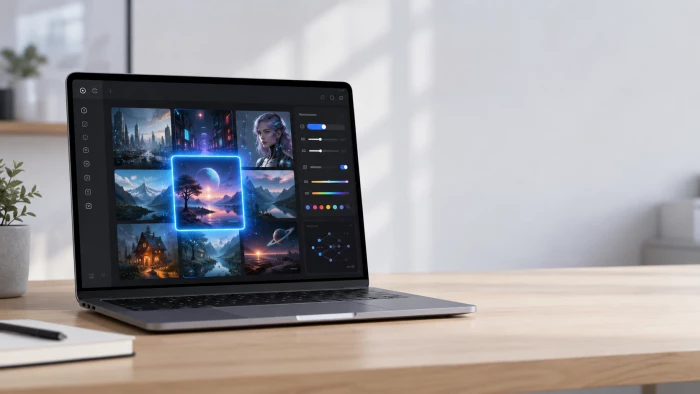
AI image generation tools multiplied through 2025 and 2026, and the gap between hobbyist-friendly and pro-grade platforms widened noticeably. PicLumen sits firmly on the accessible side, marketed as a free-first generator with commercial licensing on every tier, multiple specialized art models, and a Relax Mode that lifts the cap on slow generations entirely. Whether that combination actually delivers depends heavily on use case and expectations.
This review covers PicLumen’s feature set, current pricing across Basic, Standard, and Pro tiers, commercial usage rights, output quality across image styles, and the real strengths and weaknesses that surface during practical use. Pricing was verified against vendor documentation between February and May 2026, and feature claims were cross-checked across multiple independent reviews to keep the picture accurate.
The short version sits in the quick verdict block below. The detailed reasoning unfolds in the sections that follow.
| Quick Verdict | |
|---|---|
| Best for | Beginners, hobbyists, social media creators, and marketers needing fast AI visuals with commercial rights from day one |
| What it does | AI image generation across realistic, anime, line art, and sketch styles, plus inpainting, outpainting, pose, texture, avatar, tattoo, and short video tools |
| Free access | Yes. 10 daily Lumens plus unlimited Relax Mode generations and a commercial license on every tier, including the free plan |
| Entry paid plan | Standard at $10 per month, 1,800 monthly Lumens, two concurrent jobs, advanced editing tools |
| Where it shines | Free tier with commercial license, multiple specialized art models, Relax Mode for unlimited slow generation |
| Where it slips | Inconsistent prompt following on complex scenes, no dedicated mobile app, animation and video tools stay basic |
| Editor’s read | Strong starting point for non-professional creators. Pro designers will hit ceilings quickly on advanced or studio-grade work. |
PicLumen is a web-based AI image generation suite built around the FLUX AI model for prompt comprehension, paired with a set of specialized models for different art styles. The platform converts text prompts into images, transforms existing images through image-to-image workflows, and adds a small set of adjacent tools for short AI video, character poses, textures, cartoon styling, tattoo concept design, and avatars.
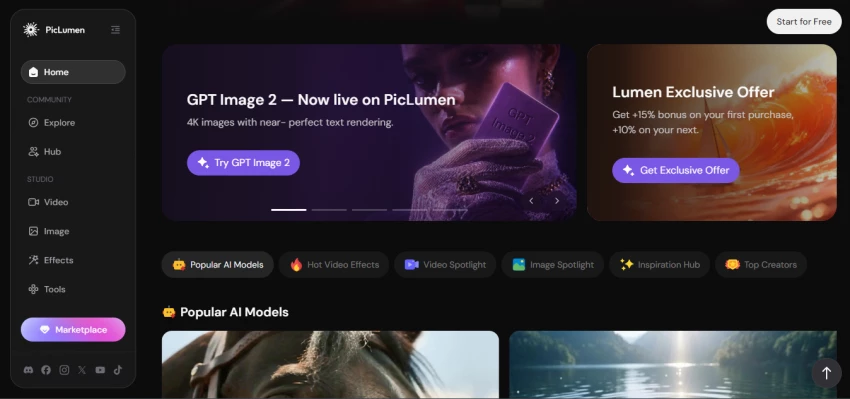
The platform sits in the accessible tier of AI image generators. Output favors casual creators, social media producers, marketers needing quick visuals, and hobbyists experimenting with AI art rather than professional designers shipping client-grade work. The free tier carries a commercial license, which is uncommon in this category and remains the single most attractive feature for budget-conscious creators.
Text-to-image generation is the platform’s center of gravity. Prompts run through the FLUX AI model, with output options across photorealistic, anime, line art, sketch, and stylized illustration modes. Multiple specialized models including Pony Diffusion V6 and PicLumen Anime V2 allow creators to match generation to specific aesthetic targets without retraining a base prompt for every style switch.
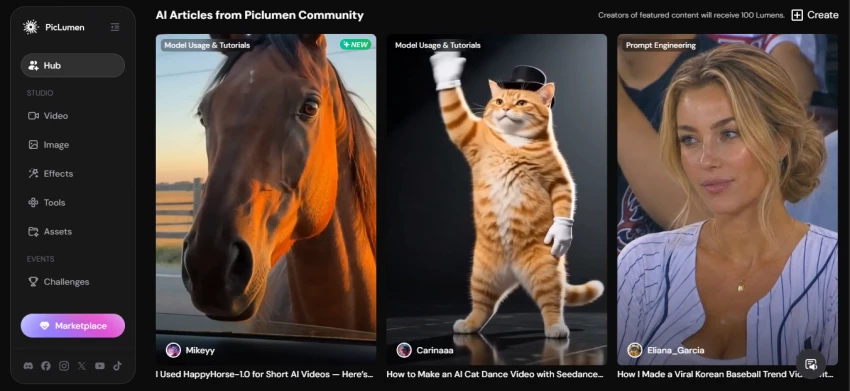
Image-to-image transformation accepts an uploaded reference and modifies it through prompts, supporting style changes, character reference editing, and reference-based composition. AI inpainting refines specific regions of an existing image without regenerating the entire frame, and AI outpainting extends images beyond their original borders. These editing tools close the gap between pure generation and traditional photo editing workflows, which matters for creators who need targeted touch-ups rather than a full rerun.
Specialized generators round out the suite. A pose generator extracts skeletal references from uploaded images, a texture generator produces patterns for digital art and game assets, a cartoon converter handles stylization, a tattoo concept generator helps artists prototype before committing to ink, and an avatar maker handles social and gaming profile images. Short AI video generation is included on paid tiers but reviewers consistently describe it as basic compared with dedicated AI video platforms like Runway or Pika.
PicLumen runs on a freemium subscription model with credit-based generation. Lumens are the platform’s credit currency, and each tier provides a different monthly allowance plus 10 daily Lumens that reset every day. The structure spans four tiers: a free Basic plan, an entry-level Mini plan, a mid-tier Standard plan, and a Pro plan for heavy users. Both monthly and annual billing options exist, with annual subscriptions discounted significantly.
| Plan | Monthly billing | Annual billing | Monthly Lumens | Relax Mode | Concurrent tasks |
|---|---|---|---|---|---|
| Basic | Free | Free | 10 daily | Limited (PicLumen models) | 1 |
| Mini | $3.00 / mo | $2.40 / mo | 600 monthly + 10 daily | Limited (PicLumen models) | 1 (queue up to 3) |
| Standard | $11.99 / mo | $6.30 / mo | 2,000 monthly + 10 daily | Unlimited (image) | 2 (queue up to 5) |
| Pro | $28.99 / mo | $11.00 / mo | 5,000 monthly + 10 daily | Unlimited image + video | 5 (queue up to 10) |
Pricing verified directly against the official PicLumen pricing page. Annual billing reduces monthly cost by roughly half on Standard and Pro, and by 20 percent on Mini.
Two practical pricing notes matter for buyers. First, the Basic free tier remains genuinely usable for casual exploration, but Relax Mode (the slower, no-cost generation queue) is limited rather than unlimited on the free plan. Unlimited Relax Mode generation kicks in only at the Standard tier and above, with Pro adding unlimited Relax Mode for video as well. Second, annual billing changes the value calculus significantly: Standard at $6.30 effective per month and Pro at $11.00 effective per month on yearly commitments move PicLumen into the most affordable bracket of paid AI image tools that still grant commercial rights.
Two extra perks land on the higher tiers and matter for heavy users. Standard subscribers receive a 15 percent bonus on every Lumen pack purchased on top of their monthly allowance. Pro subscribers get a 25 percent bonus on Lumen packs, plus the only tier with unlimited video generation in Relax Mode. Subscription Lumens reset each billing cycle and do not roll over, while purchased Lumens (including bonuses) stay valid for a full year from issue date.
Output quality is strongest on the platform’s headline styles. Photorealistic portraits and landscapes produced from clean, well-described prompts hold up well for social media and casual professional use. Anime and line art outputs through PicLumen Anime V2 and similar specialized models render cleanly enough to serve as concept art, profile graphics, or starting points for further illustration work.
Two consistent quality issues surface in practical testing and reviewer coverage. The first is prompt fidelity. Complex multi-subject prompts, scenes with specific spatial relationships, or prompts requiring nuanced lighting and material descriptions sometimes return outputs that diverge from intent. The practical fix is iterative prompting or switching to image-to-image mode with a reference, both of which work but consume more Lumens. The second issue is consistency across regenerations: the same prompt run twice can produce noticeably different compositions, which makes batch workflows for branded content harder than on tools with stronger character locking.
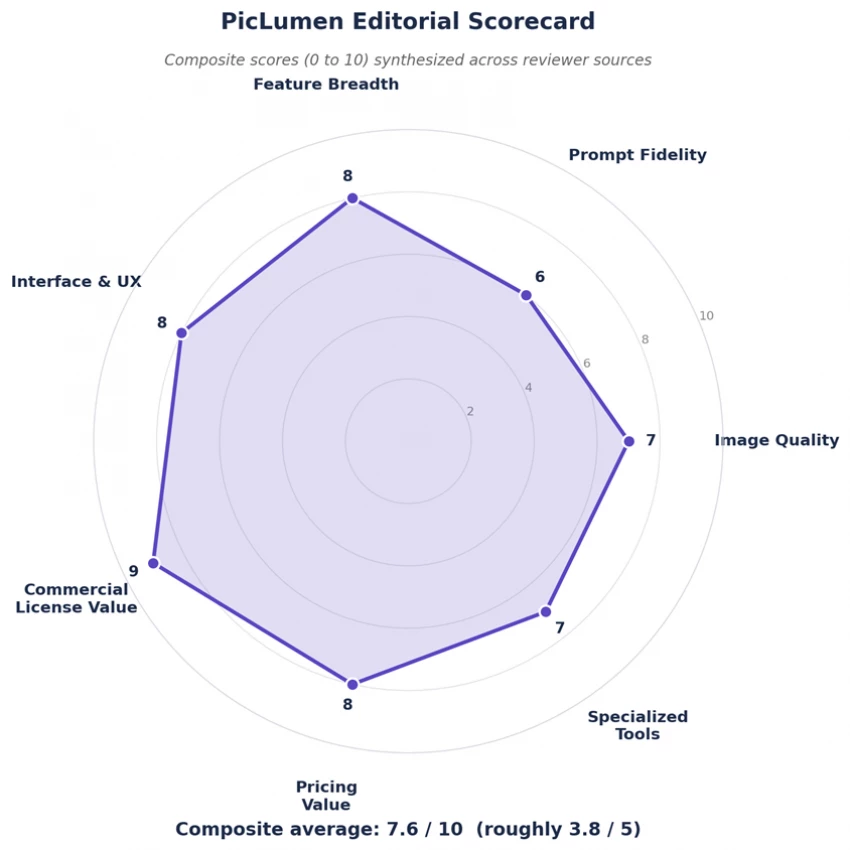
The platform’s specialized tools (pose, texture, avatar, tattoo) produce competent but not standout outputs. Pose generation extracts usable skeletal references for animators and game designers. Texture generation works for game environments and 3D model surface work. Avatar and tattoo tools serve their narrow use cases without rivaling dedicated specialists in either category, which is a reasonable trade given they are included rather than charged separately.
PicLumen’s commercial license terms are unusually open for a free-first platform. The Basic tier includes a commercial license, which means images generated on the free plan can be used in advertising, on monetized social channels, in client work, and in commercial products without additional licensing fees. That positioning differs sharply from tools like Midjourney where commercial rights gate behind paid subscriptions only.
Two practical checks still apply before commercial deployment. First, verify the current terms at sign-up since AI platform licensing terms shift periodically and what was permitted last quarter may carry new restrictions. Second, confirm that AI-generated imagery is suitable for the target use case since Spotify, YouTube, ad networks, and stock platforms apply different policies around AI content disclosure and labeling. PicLumen’s license grants permission to use; downstream platform policies still control where AI imagery can be published.
✓ Pros • Free plan includes a commercial license, which is uncommon in this category • Unlimited Relax Mode generations on every tier, including Basic • Multiple specialized models for realistic, anime, line art, and sketch styles • FLUX AI improves prompt understanding compared to base diffusion models • Inpainting and outpainting included on all tiers, not gated to Pro • Generous monthly Lumens on Pro at $20 per month, with annual billing cutting cost further • Cloud storage scales to 50,000 images on Pro for ongoing workflows | ✗ Cons • Inconsistent prompt following on complex multi-subject or spatially specific scenes • Mobile experience runs through browser only, with no dedicated app • Video, animation, and short clip tools stay basic compared to dedicated AI video platforms • Advanced control surface limited compared to ComfyUI or Stable Diffusion workflows • Independent reviewer ratings hover around 3.8 of 5 rather than 4.5 or higher • Free tier batch size limited to 2 images per generation, slowing exploration on free plan • Pro designers chasing studio-grade results will hit the ceiling on demanding briefs |
PicLumen’s strongest fit is everyday content production where speed and accessibility matter more than studio-grade fidelity. Social media creators producing daily thumbnails and post graphics benefit from the Standard plan’s 1,800 monthly Lumens and four-image batches. Marketing teams generating campaign visuals get value from the multiple style models and the cleared commercial license. Hobbyists exploring AI art lean on the free tier’s unlimited Relax Mode without ever needing to pay.
The platform also fits specific niche workflows. Tattoo artists previewing designs before committing them to skin use the tattoo generator as a sketching tool. Game developers extract pose references and surface textures during early concept work. Bloggers and educators produce thumbnail and illustration imagery without contracting designers. None of these workflows match what a professional designer with Photoshop and Stable Diffusion could produce, but the time-to-output advantage is meaningful for non-specialists working under deadline pressure.
The closest direct competitors split into two camps. Tools with stronger raw image quality but stricter commercial terms (Midjourney, DALL-E 3) outperform PicLumen on advanced prompts but lock commercial use behind paid tiers and tighter content rules. Tools with comparable freemium models and creator-friendly licensing (Leonardo AI, Ideogram, Bing Image Creator) compete more directly on the same axis PicLumen occupies. Open-source workflows (Stable Diffusion via ComfyUI or Automatic1111) offer the most control but require technical setup, GPU access, and significant learning time.
| Tool | Best for | Free tier | Commercial use | Standout |
|---|---|---|---|---|
| PicLumen | Free-first creators, multi-style image generation | 10 daily Lumens + Relax Mode | All tiers | Free commercial license |
| Midjourney | Premium image quality and artistic depth | None (paid only) | Paid plans only | Output quality benchmark |
| Leonardo AI | Mixed image and AI art workflows | Daily free tokens | Paid tiers | Strong character consistency |
| Ideogram | Text rendering inside generated images | Limited free | Paid tiers | Best in class for typography |
| Stable Diffusion (ComfyUI) | Power users wanting full control | Free, self-hosted | Self-managed | Total model and pipeline control |
PicLumen lands as a solid pick for the use case it actually targets. Creators who want fast AI images with commercial rights at no upfront cost, hobbyists experimenting with multiple art styles, and marketers producing campaign visuals on a tight budget all find genuine value in the platform. The free tier with its commercial license is the standout asset and the reason PicLumen earns its place in the AI image generation conversation, even with the quality gaps that show up on complex prompts.
Professional designers, studios needing photorealistic perfection on the first try, and anyone whose work involves complex multi-subject scenes will find PicLumen frustrating compared to higher-tier alternatives. Midjourney’s output quality, ComfyUI’s control depth, and Leonardo AI’s character consistency all exceed what PicLumen consistently delivers. For those workflows, PicLumen sits as a useful side tool rather than the primary platform.
The honest read on the platform: PicLumen is the right starting point for anyone exploring AI image generation without committing money upfront, and a reasonable ongoing pick for casual to mid-volume creator workflows. Heavy-volume professionals should treat it as one tool inside a broader visual production stack rather than the only tool in that stack. The composite 3.8 of 5 rating from public reviewer testing reflects that honest position well: above average where it matters for the target audience, not best in class on every dimension.

New Claude Model Targets Agentic AI WorkflowsAnthropic has launched Claude Sonne...
Samuel Osei1 month ago
The Quick verdictInSnoop is a free, browser-based tool that promises to let you...
Alexander Hughes1 month ago

Gemini’s Image Tools Get a Wider RolloutGoogle is expanding access to Gemini’s p...
Alexander Hughes1 month ago
Two AI video generators, two very different first days. I ran PixVerse through i...
Alexander Hughes1 month ago
Two of the most talked-about AI chat platforms. I opened both, picked a characte...
Alexander Hughes1 month ago
The two-minute versionIf you only read one thing, read this. The rest of the doc...
Alexander Hughes2 months ago
Discussion