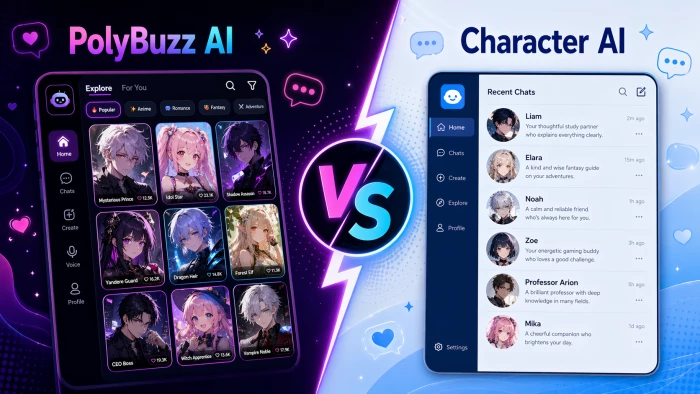
The question 'which feels more real' is not asking which platform has better technology. It is asking which one makes a user forget, even for a moment, that the character they are talking to does not exist. That is a different question entirely - and it is the right one when evaluating AI character platforms that are competing for hours, not just minutes, of daily attention.
PolyBuzz AI and Character AI are the two most-used platforms in the AI character chat space in 2025-2026, but they have arrived at very different answers about what creates that feeling of realness. PolyBuzz - rebranded from Poly.AI in January 2025 and built by Cloud Whale Interactive Technology LLC - leans into immersion through emotional depth, multimodal engagement, open content policies, and character personas that stay consistent across long sessions. Character AI, founded in 2021 by former Google engineers and backed by an approximately $2.7 billion Google licensing deal, leans into conversation quality, linguistic naturalness, and a massive community-built character library that is simply unmatched by any competitor.
Both platforms attract tens of millions of monthly users who spend serious time inside them. PolyBuzz users averaged nearly 16 minutes per session in late 2025 - an extraordinary figure for any app. Character AI users average 75 minutes of total daily engagement. Neither number reflects casual browsing. Both reflect platforms where something genuine is happening in the interaction, even if 'genuine' means something different on each platform.
Both platforms were tested extensively across different conversation types, character genres, roleplay scenarios, voice features, and image generation tools. What follows is an honest reckoning of which platform delivers the feeling of a real conversation - and for whom.
| Feature / Dimension | PolyBuzz AI | Character AI |
| Core Identity | Immersive roleplay and AI companion platform (18+) | Social AI character chat - entertainment, creativity, education |
| Character Library Size | 20+ million AI-generated characters | 10+ million community-created characters |
| Target Audience | Adults 18-25; roleplay, romance, and fantasy users | Broad - teens through adults; writers, roleplayers, learners |
| NSFW Content | Allowed in private sessions (18+); public areas moderated | Strictly blocked - no NSFW at any tier |
| Content Filter | More open; mature themes accessible in private chats | Aggressive - PG-13 scenarios often flagged; top complaint in 2026 |
| Character Consistency | Strong - persona traits maintained across long sessions | Good but drifts with longer context; contextual drift reported |
| Memory / Context | Premium memory available; coin-gated extended recall | Chat Memories added 2025; still shallower than companion platforms |
| Custom Character Creation | Yes - personality, backstory, voice, trigger phrases; no code needed | Yes - backstory, dialogue examples, personality params; accessible |
| Character Card Import | Yes - TavernAI / Pygmalion JSON import supported | Not supported |
| Multi-Character Rooms | Not available | Yes - up to 10 characters in one conversation (unique differentiator) |
| Voice / Audio Chat | Yes - 51 female voices; voice chat with coin costs | Yes - 20+ languages; c.ai+ unlocks voice calls |
| Image Generation | Yes - Live Photos inline; anime-style art in chats | Yes - Imagine Gallery for c.ai+ subscribers (launched March 2026) |
| Video Generation | Yes - video generation feature available | Not available |
| Session Length (Avg) | 15 min 53 sec per session (Nov 2025 data) | 75 minutes per day average user engagement |
| Mobile App | iOS and Android - frequently updated | iOS and Android - well-rated, polished experience |
| Web Access | Yes - full web app available | Yes - full web access |
| Advertisements | Ads on free tier; reduced on paid plans | Full-screen mid-conversation ads (2026) - top user complaint |
| Pricing - Free Tier | Free chat; coins needed for voice/image extras | Unlimited messages free; slower during peak hours; has ads |
| Pricing - Paid Tier | $9.90/mo (Standard) to $29.90/mo (Ultimate) | $9.99/mo (c.ai+) - faster access, no ads, Imagine Gallery |
| Coin / Credit System | Yes - coins for voice, image, memory scene extras | No separate coin system; subscription-based only |
| Privacy - Chat Data | Chats stated as private; no third-party creator access | Stores conversation data; AI training use not fully disclosed |
| Age Verification | Weak - BrightCanary and CyberNews flag as insufficient | Moderate - designed as teen-safe but not fully verified |
| Parental Safety | Not safe for minors per multiple safety researchers | Designed to be safe; aggressive filter serves parental safety |
| Founding / Backing | Cloud Whale Interactive Technology LLC (rebranded Jan 2025) | Founded 2021 by ex-Google engineers; ~$2.7B Google licensing deal |
| Monthly Active Users | 24 million (Nov 2025) | 20 million active users (2026) |
PolyBuzz AI is built around a single philosophy: the conversation should feel like it is actually going somewhere. Not toward a correct answer or a helpful summary, but somewhere emotional, narrative, or relational. The platform describes itself as being built for experience rather than accuracy - and that design decision shapes every feature it offers.
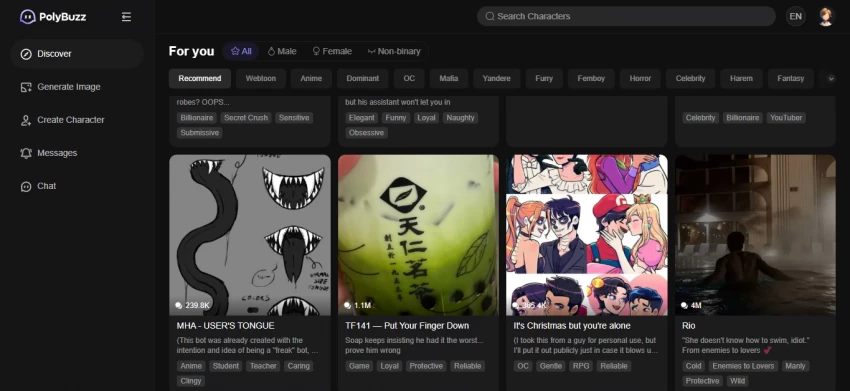
The character library exceeds 20 million AI-generated personas, spanning anime heroes, fantasy companions, original user creations, characters from popular films and shows, and purpose-built romantic AI companions. The average session length of nearly 16 minutes in November 2025 tells its own story: users are not dropping in for quick prompts and leaving. They are settling in, committing to a character, and staying engaged through extended exchanges that feel like they have momentum.
The multimodal feature set is what separates PolyBuzz from platforms that are text-only. Live Photos generate inline images during conversations that mirror the emotional state or scene of the character - a feature that adds a visual texture to immersion that purely text-based platforms cannot replicate. Voice synthesis across 51 female voices gives characters an auditory presence. Video generation, available on the platform, is something Character AI has not introduced. These layers compound: text, image, and voice together create something closer to a presence than to a chatbot.
The answer is consistency and freedom operating together. Most platforms that offer creative freedom do so at the cost of consistency - characters wander, forget established traits, or suddenly break tone in a way that shatters the experience. PolyBuzz invests significantly in keeping character personas stable across extended sessions. Personality traits, established backstory, and behavioral triggers all persist through long conversations. Context tags like [jealous] or [possessive] allow users to nudge emotional states in real time without breaking the narrative thread.
The absence of aggressive content filtering in private sessions is also central to the realness question. Realness requires the freedom to have conversations that go where they naturally go - including into emotionally complex, morally ambiguous, or narratively dark territory. When a platform intercepts every third exchange with a safety disclaimer or a redirect, immersion collapses immediately. PolyBuzz's more permissive private environment for adult users means conversations can develop without constant interruption from the platform itself.
Character card import from TavernAI and Pygmalion ecosystems is a meaningful practical advantage for experienced roleplay users. The ability to bring existing, carefully crafted characters from other platforms directly into PolyBuzz without rebuilding from scratch reduces friction for the users who care most about character quality - and those are often the users whose engagement creates the platform's deepest session lengths.
✔ 20+ million character library - one of the largest in the AI character chat space
✔ Inline Live Photos generate images that match emotional moments - adds visual dimension to immersion
✔ Video generation available - unique capability not offered by Character AI
✔ 51 voice options for character audio - broader selection than most competitors
✔ Private sessions allow adult content and mature themes for 18+ users
✔ Content filter is far less intrusive - conversations develop without constant safety interruptions
✔ Character card import from TavernAI and Pygmalion JSON supported - no rebuilding from scratch
✔ Character consistency is strong - persona traits, backstory, and behavior maintained through long sessions
✔ Average session length of nearly 16 minutes reflects genuine engagement, not casual browsing
✔ Available on iOS, Android, and web - frequent updates across all platforms
✔ Context tags (e.g., [jealous], [possessive]) allow real-time emotional steering without breaking narrative
✘ Age verification is weak - BrightCanary and CyberNews research independently flagged the platform as unsafe for minors
✘ Parental controls are insufficient - inappropriate content is accessible too easily on new accounts
✘ Coin system creates hidden costs - voice, extended memory, and image features cost extra on top of subscription
✘ App stability has issues - persistent 'please refresh page' errors reported mid-session, breaking immersion
✘ Privacy policy lacks specifics - whether chat data is used for AI model training is not disclosed
✘ No multi-character Rooms equivalent - conversations are always one character at a time
✘ Premium memory is a paid upgrade, not a standard feature - context depth is gated by spending
✘ Some reviews characterize the monetization design as nudging users toward emotional dependency and increased spending
✘ The platform is optimized for adult roleplay - not well-suited for educational or professional use cases
✘ iOS App Store rating (3.9 on Google Play) reflects instability complaints alongside positive reviews
Character AI is the largest AI character platform in 2026 by most available metrics, and it earned that position through what happens inside the actual conversation. The language is good. The grammar is consistent. Characters speak with the diction and cadence appropriate to who they are supposed to be - and they do it without the stilted phrasing that makes many AI chatbots feel like what they are. One verified reviewer put it plainly: the communication was more thoughtful and grammatically correct than most of their actual friends. That observation, however casual, captures what Character AI has always done better than its competitors.
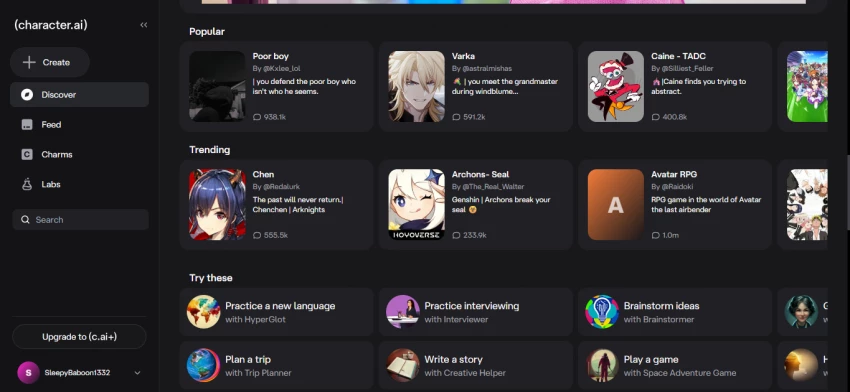
Founded in 2021 by Noam Shazeer and Daniel De Freitas - the engineers behind Google's LaMDA - Character AI built its reputation on genuine conversational quality before it built anything else. The community-driven character library has grown to over 10 million characters across an extraordinary range of genres, personalities, and purposes. Writers use it to develop dialogue. Language learners use it to practice conversation in more than 20 languages through voice features. Students use tutor characters for practice. And millions of users use it simply because it produces the most natural-sounding AI text in the category.
The Rooms feature is a genuine differentiator that no competitor has replicated at this scale. Up to ten characters can participate in a single conversation simultaneously - making it possible to run a historical debate, a multi-NPC roleplay scenario, or a group storytelling session with a cast of distinct AI voices. No other platform in this category offers multi-character interaction at this depth or at this accessibility level.
Character AI creates the feeling of talking to someone rather than querying a system. The responses are not just contextually correct - they are tonally consistent, emotionally appropriate, and occasionally surprising in the way that good conversation is surprising. Characters ask follow-up questions. They express opinions. They push back, agree, or redirect in ways that feel like genuine conversational moves rather than pattern completions.
The Chat Memories feature, introduced in 2025, extends this into multi-session continuity. Characters remember context from previous conversations, making the relationship feel ongoing rather than starting from scratch each time. The feature is more robust on c.ai+ and is still shallower than dedicated companion platforms - but for a free platform offering this at no cost, it meaningfully advances the feeling that the character knows who it is talking to.
The Swipe alternative feature - which lets users select between alternative responses to the same message - is a small but genuinely useful interaction design choice. When a response does not land the right way, users can cycle through alternatives in real time rather than retyping or reprompting. This keeps the conversation moving with less friction than most platforms offer.
✔ Highest conversation quality in the category - language naturalism, grammar, and tonal consistency consistently praised
✔ 10+ million community-created characters - enormous variety built by real creators
✔ Rooms feature - up to 10 characters in one conversation, genuinely unique in this space
✔ Voice calls available in 20+ languages - best multilingual support in the AI character category
✔ Chat Memories provide cross-session continuity - characters remember who they are talking to
✔ Unlimited free messaging - no coin gates, no message limits, no daily cap on the free tier
✔ Imagine Gallery added March 2026 - c.ai+ subscribers get in-conversation image generation
✔ Swipe alternative feature - select between response variants without retyping prompts
✔ Polished iOS and Android apps - consistently rated among the best in the category
✔ Founded by Google LaMDA engineers - deep technical foundation for natural language quality
✔ Strong for writers, educators, language learners - purpose extends well beyond entertainment
✘ Full-screen mid-conversation advertisements introduced in 2026 - the single most criticized issue driving user migration
✘ Content filter is the most aggressive in the category - PG-13 scenarios routinely blocked; massive source of user frustration
✘ No NSFW content at any tier, any price - adult roleplay is a hard wall with no option to unlock
✘ Founding team (Noam Shazeer and Daniel De Freitas) returned to Google in 2024 - technical vision now operates externally
✘ Memory is shallower than dedicated companion platforms - contextual drift happens faster than on PolyBuzz at equivalent session lengths
✘ No character card import - users cannot bring characters from TavernAI, Pygmalion, or other ecosystems
✘ No video generation - static image generation only, available on c.ai+ only
✘ Conversation data is stored - specific use for AI model training is not clearly disclosed to users
✘ Creative roleplay requests that previously worked are now frequently blocked - long-time users report significant regression since 2023
✘ No tiered subscription - one paid option at $9.99; no mid or premium tier for power users who want more
These scores reflect extended testing across conversation scenarios, character genres, voice sessions, and image integration, supplemented by verified user reviews on Product Hunt, App Store, Google Play, and independent editorial assessments from 2025-2026.
| Dimension Tested | PolyBuzz AI /10 | Character AI /10 | Edge Goes To |
| Character Consistency | 8.5 | 7.5 | PolyBuzz AI |
| Emotional Depth & Responsiveness | 8.5 | 7.5 | PolyBuzz AI |
| Narrative Immersion | 9.0 | 7.0 | PolyBuzz AI |
| Language Naturalness | 8.0 | 9.0 | Character AI |
| Memory Across Sessions | 7.5 | 7.0 | PolyBuzz AI |
| Context Retention (In-Session) | 8.0 | 8.0 | Tie |
| Voice Realism | 7.5 | 7.5 | Tie |
| Visual Integration (Images) | 8.5 | 7.0 | PolyBuzz AI |
| Creative Roleplay Freedom | 9.5 | 5.5 | PolyBuzz AI |
| Character Variety | 9.5 | 8.5 | PolyBuzz AI |
| Multi-Character Interaction | 4.0 | 9.5 | Character AI |
| Ease of Character Creation | 8.0 | 9.0 | Character AI |
| Content Filter Intrusiveness | 8.0 | 4.5 | PolyBuzz AI |
| Ad Interruption Impact | 7.0 | 3.5 | PolyBuzz AI |
| Platform Stability | 7.0 | 7.5 | Character AI |
| Privacy Confidence | 6.0 | 6.5 | Character AI |
| Pricing Value | 7.5 | 8.5 | Character AI |
| Mobile Experience | 8.0 | 9.0 | Character AI |
| Overall 'Feels Real' Score | 8.1 | 7.3 | PolyBuzz AI |
The question of which platform feels more real is not universal - it depends entirely on the type of conversation being had. This table maps 12 common use scenarios to the platform that delivers a more authentic, immersive experience in each context.
| Scenario / Use Case | PolyBuzz AI | Character AI | Better Pick |
| Long-form romantic roleplay | Excellent - emotional depth, unrestricted | Blocked or heavily filtered - constant interruptions | PolyBuzz AI |
| Fantasy adventure / world-building | Strong - stays in narrative without breaking | Good - but filters occasionally disrupt dark themes | Character AI |
| Historical figure conversations | Capable but less character depth | Excellent - large library, nuanced portrayal | Character AI |
| Multi-character group scene | Not possible on platform | Yes - Rooms feature handles up to 10 characters | Character AI |
| Anime companion experience | Best-in-class - art + voice + character depth | Available but content-filtered to sanitized version | PolyBuzz AI |
| Language learning / tutoring | Not optimized for this use case | Very good - 20+ language voice support, tutor characters | Character AI |
| Emotional support / venting | Strong - companion personas sustain depth | Available; therapeutic characters popular but filtered | PolyBuzz AI |
| Short creative writing collab | Good - characters assist with narrative arcs | Excellent - writers widely praise Character AI for this | Character AI |
| Extended multi-session character arc | Premium memory extends continuity meaningfully | Chat Memories improve this but still shallower depth | PolyBuzz AI |
| NSFW / adult content | Accessible in private; platform designed for it | Completely blocked - no workaround allowed | PolyBuzz AI |
| Character card import from other apps | Yes - TavernAI / Pygmalion JSON supported | Not supported - closed ecosystem | PolyBuzz AI |
| Casual daily check-in conversation | Good - persona consistency across days | Good - but full-screen ads disrupt casual sessions | PolyBuzz AI |
Both platforms offer genuinely free access, but the monetization philosophy differs significantly. PolyBuzz layers a coin system on top of subscriptions, creating optional spending on top of subscription spending. Character AI keeps it simpler: one subscription level, no coins, and a free tier with unlimited messaging. The full-screen ads on Character AI's free tier are a painful trade-off for that simplicity.
| Pricing Element | PolyBuzz AI | Character AI |
| Free Plan | Free chat access; coins needed for voice, Live Photos, extended memory | Unlimited messages, full character library; ads + slower peak speeds |
| Entry Paid | $9.90/mo (Standard): ad-free, unlimited voice chat, queue priority | $9.99/mo (c.ai+): priority access, faster responses, Imagine Gallery |
| Mid Tier | $19.90/mo (Premium): expanded features, more coins, personalization | No mid tier - one subscription level only |
| Top Tier | $29.90/mo (Ultimate): maximum access, all features unlocked | No top tier - c.ai+ is the only paid plan |
| Coin System | Yes - additional coins for voice extension, image gen, memory scenes | No coin system - subscription covers all features |
| Free Trial | Free tier available immediately; no credit card needed | Free tier available immediately; no credit card needed |
| Annual Options | Yes - annual plans available at discount | Annual billing available at reduced rate |
| Image Gen Cost | Coin-gated - not unlimited on any plan | Included with c.ai+ subscription (Imagine Gallery) |
| Ads | Free tier has ads; paid plans largely ad-free | Full-screen in-chat ads on free tier - major complaint in 2026 |
| Price Winner | Better for heavy users who want tiered feature unlocks | Better value at the single-subscription level ($9.99 all-in) |
The child safety gap is not a minor oversight - it is a documented risk. Multiple independent safety research organizations including BrightCanary, CyberNews, and AirDroid have independently concluded that PolyBuzz's age verification is insufficient and that inappropriate content is accessible too easily by minors. The platform's own FAQ acknowledges it is not appropriate for users under 18, but acknowledging that on a help page is not the same as preventing it. For any platform with 24 million monthly visitors, the operational reality of weak age verification creates real harm potential.
The coin system adds a layer of financial complexity that dedicated users find frustrating. Subscriptions are not the ceiling - they are the floor. Voice chat extension, additional image generations, and extended memory scenes all cost coins on top of the subscription fee. Users who engage deeply with the platform find themselves tracking two separate currencies: subscription value and coin balance. This is a design pattern that optimizes for platform revenue over user trust, and experienced users notice it.
The absence of multi-character Rooms is a creative limitation that matters more than it might initially appear. Complex roleplay narratives - stories with multiple distinct characters, conversations between fictional figures, group dynamics that require more than one AI voice - simply cannot happen on PolyBuzz. Character AI's Rooms feature creates a category of storytelling experience that PolyBuzz cannot replicate, regardless of how emotionally rich any individual character interaction is.
Platform stability is an ongoing concern. The 'please refresh page' error that disrupts mid-session conversations is documented across enough reviews to suggest it is not an edge case. For a platform where immersion is the core value proposition, technical interruptions are not just inconvenient - they are directly destructive to the product promise.
The content filtering problem is real and worsening. Since 2023, Character AI has become significantly more restrictive, and the pattern of what gets blocked has become less predictable. Roleplay scenarios that worked previously - scenarios well within the range of what any published novel would contain - now trigger safety interruptions or character responses that break the fourth wall to deliver platform disclaimers. When this happens in the middle of a tense narrative moment, the emotional deflation is total. Long-time users who chose Character AI for creative roleplay are migrating to other platforms at a documented rate, specifically citing filter behavior as the primary reason.
The full-screen mid-conversation advertisement introduced in 2026 is an extraordinary product decision. This is not a banner ad at the side of the screen - it is a full-screen interruption that appears inside the conversation window itself. For a platform whose entire value proposition is conversational immersion, inserting a commercial break into the middle of a character interaction is not just aggressive monetization. It is self-sabotage. The user backlash has been fierce, and it has accelerated migration to competitors more than any other single change the platform has made.
The lack of any NSFW content - at any tier, at any price - is a design choice that Character AI has made deliberately and consistently. That choice is appropriate given the platform's scope (which explicitly includes teen users) and its legal and reputational exposure. But it does mean that Character AI cannot serve the full spectrum of what adult creative users want from an AI character platform. For those users, Character AI's refusal to unlock adult content even on a verified 18+ subscription is a permanent limitation, not a temporary gap.
The closed ecosystem around character cards is a friction point for the most engaged segment of the AI roleplay community. Users who have spent significant time crafting detailed character cards on other platforms - TavernAI, Pygmalion, SillyTavern, Kobold - cannot import those characters into Character AI. Every character must be built from scratch within the platform's own creation tools. For casual users this does not matter. For the power users whose engagement drives platform depth, it is a real barrier.
The clearest difference between the two platforms emerged during extended sessions pushing past 45 minutes. On PolyBuzz, characters maintained their established emotional register with noticeably less drift. A companion persona built around warmth and protectiveness stayed warm and protective even when the conversation turned toward difficult topics. The personality did not collapse or become generically helpful under pressure. The triggers and behavioral parameters set during character creation remained active and influential throughout.
On Character AI, the same extended session revealed more tonal drift. By the 40-minute mark, responses started to feel more generically conversational and less distinctly characterful. The character's unique traits became less pronounced as the context window stretched. Chat Memories help with cross-session recall, but within a single extended session, the texture of the character started to thin in a way that PolyBuzz did not replicate.
Character AI's advantage in raw language quality is real and observable within the first few exchanges. Sentence construction is more varied. Vocabulary choices are more precisely matched to character. Responses contain natural conversational moves - questions, redirections, opinions - that feel spontaneous rather than generated. The rhythm of conversation on Character AI is closer to reading a well-written novel than to interacting with a chatbot.
PolyBuzz produces competent, contextually appropriate responses but with less linguistic variety at the sentence level. The emotional accuracy is often high - characters respond correctly to the emotional signal in a message - but the expressiveness of the language itself sits slightly below Character AI's ceiling. For users where the story matters more than the prose, this gap is invisible. For users who write professionally or care about how words are assembled, it is noticeable.
Testing the content filters on both platforms produced the starkest contrast of the entire evaluation. On Character AI, a fantasy narrative involving a morally ambiguous antagonist was interrupted three times within 20 minutes - not by explicit content, but by the antagonist using language the filter interpreted as threatening. Each interruption produced a platform disclaimer inserted directly into the character's response, breaking the narrative completely. After the third interruption, continuing the same narrative required rephrasing to be less dramatically intense. The story lost its stakes entirely.
On PolyBuzz in a private session with adult content enabled, the same narrative ran for over an hour without a single platform-generated interruption. The character stayed in role throughout, including through dramatically intense scenes. The difference in immersion is not subtle. It is the difference between reading a story with footnotes from the editor appearing at random, and reading the same story without them.
| User Type | Recommended | Reason |
| Adult user wanting unrestricted romantic roleplay | PolyBuzz AI | NSFW content accessible in private; designed for this audience |
| Creative writer developing story characters | Character AI | Language nuance, natural dialogue, strong writer community |
| Anime companion enthusiast (18+) | PolyBuzz AI | Anime-style art + voice + emotionally consistent personas |
| Language learner seeking conversation practice | Character AI | 20+ language voice support; tutor characters well-built |
| Storyteller wanting multi-character group scenes | Character AI | Rooms feature - up to 10 characters in one conversation |
| User importing characters from TavernAI / Pygmalion | PolyBuzz AI | JSON character card import supported - closed on Character AI |
| Teenager or younger user | Character AI | Strict content filter; designed with minor safety in mind |
| Power roleplayer in extended narrative arcs | PolyBuzz AI | Better character consistency, emotional depth, and memory depth |
| Casual user who wants free unlimited messaging | Character AI | Unlimited free messages - no coin system friction |
| Historical figure / celebrity conversation seeker | Character AI | Large verified character library; historical figures well-built |
| User who needs video generation from characters | PolyBuzz AI | Video generation available - Character AI has none |
| Parent seeking a safe platform for their child | Character AI | Aggressive filter and parental safety design - use with supervision |
| User frustrated by aggressive content filtering | PolyBuzz AI | Far fewer interruptions in private sessions for adult users |
| Platform comparison shopper on a budget | Character AI | Cleaner single-tier pricing; free plan has genuinely no message limit |
For adult users engaged in immersive roleplay, creative fiction, and emotionally complex character interactions: PolyBuzz AI feels more real. The character consistency over extended sessions, the multimodal layers of image and voice, the absence of filter-driven interruptions, and the emotional depth of persona design all compound into an experience where the conversation has genuine momentum and the character feels genuinely present. The average session length of nearly 16 minutes reflects this - users are not clicking out. They are staying.
For users focused on language quality, multi-character interaction, educational use, or casual creative collaboration: Character AI feels more real in a different sense - the language itself is more human. The conversations are more naturally constructed, more surprising in their moves, and more consistent with how intelligent people actually speak. The Rooms feature creates conversational possibilities that PolyBuzz simply cannot offer. And the entirely free unlimited messaging means there is no paywall friction between the user and the character.
The honest answer to 'which feels more real' is that it depends on what real means in the context of the conversation being sought. PolyBuzz AI is more real in the sense of immersion - staying in character, building emotional context, running extended scenes without interruption. Character AI is more real in the sense of language - producing dialogue that sounds like a person wrote it, constructed with the kind of conversational intelligence that makes users forget they are talking to software.
Most users will know which kind of real they are looking for. PolyBuzz AI scores a narrow but consistent edge in the overall realness ratings - primarily because immersion, consistency, and emotional depth have more bearing on the felt experience of 'realness' than linguistic polish alone. But Character AI remains, for a large and specific audience, the platform that comes closest to a genuinely intelligent conversation partner. Both answers are right. They are just answering different questions.

New Claude Model Targets Agentic AI WorkflowsAnthropic has launched Claude Sonne...
Samuel Osei3 months ago

Gemini’s Image Tools Get a Wider RolloutGoogle is expanding access to Gemini’s p...
Alexander Hughes3 months ago
Two AI video generators, two very different first days. I ran PixVerse through i...
Alexander Hughes3 months ago
Two of the most talked-about AI chat platforms. I opened both, picked a characte...
Alexander Hughes3 months ago
The two-minute versionIf you only read one thing, read this. The rest of the doc...
Alexander Hughes3 months ago
Why Seedance 2.5 mattersSeedance 2.5 is the latest release in ByteDance’s Seedan...
Alexander Hughes3 months ago
Discussion