
PolyBuzz AI and CrushOn AI keep showing up in the same search results because both occupy the AI character chat category and both let adult users hold conversations that mainstream chatbots refuse. The platforms feel similar from a screenshot. They are not. PolyBuzz is a mass-market companion app built around a sprawling character library, multimedia flourishes, and a polished mobile experience. CrushOn is a roleplay specialist built around model flexibility, deep memory, and an explicitly uncensored stance.
That difference reshapes who should pay for which platform, where each one breaks under stress, and what kind of creator walks away satisfied. The comparison only feels close at the marketing layer; under sustained use, the gap widens fast.
Quick verdict: PolyBuzz AI is the stronger choice for casual mobile-first chatters who value a massive character library, native apps, and visual extras such as Live Photos and short videos. CrushOn AI is the stronger choice for power roleplay users who care about model flexibility, longer memory, multi-character group chats, and minimal content filtering. Heavy users who can swap between both will notice each platform covering the other’s gaps.
PolyBuzz AI is an AI character chat platform operated by CLOUD WHALE INTERACTIVE TECHNOLOGY LLC, with offices listed in Wilmington, Delaware. The product launched as Poly.AI and rebranded to PolyBuzz in early 2025, an event covered in the company’s PRWeb announcement and the Apple App Store version notes. The platform pitches itself on three things: scale, polish, and emotional continuity. Marketing copy claims more than 20 million unique AI characters, and recent updates emphasize long-term memory, Live Photos, and a feature called Moments that converts chat highlights into visual snapshots.
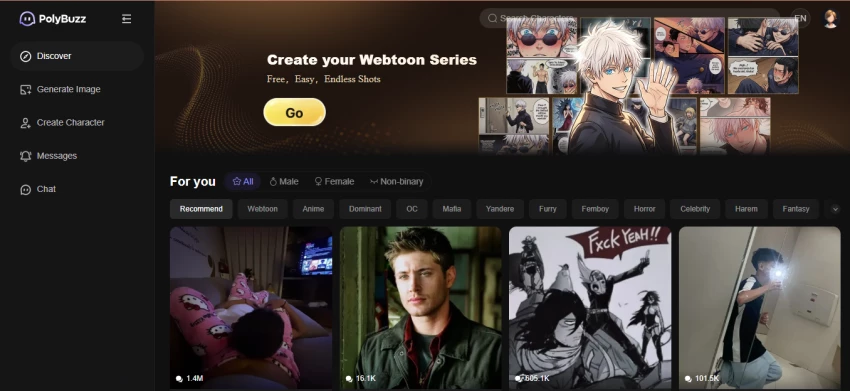
Hands-on use confirms PolyBuzz feels closer to a mass-market consumer app than a niche roleplay tool. The native iOS and Android clients are fluid, account sync across devices is reliable, and the character browser surfaces trending and popular categories aggressively. New conversations begin within seconds of signup. Where the experience cracks is in extended sessions: the AI fumbles persona-specific physical details after a stretch of messages, occasionally borrows traits from the user’s own persona card, and on the free tier interrupts conversations with rewarded video ads. Multiple long-time users on Google Play have flagged ad density as a regression, and store reviews consistently describe memory inconsistency on paid tiers despite the recent permanent-memory upgrade.
Monetization is hybrid. A flat subscription unlocks the headline message limits and feature access, while a coin system gates regenerations, voice extension, Live Photo creation, and a feature called inspiration replies. Coin packs run from approximately USD 2.49 for 1,000 coins to USD 19.90 for 20,000 coins. The structure rewards micro-spending but introduces variable monthly cost for heavy users.
CrushOn AI is an AI character chat platform operated by Peekaboo Tech Inc., a Delaware-registered company with co-founder Yue Zhu reportedly based in Shenzhen. It launched in 2023 and grew rapidly during and after Character.AI’s well-publicized content filter tightening, positioning itself as the explicitly uncensored alternative for adult users. Independent coverage from Washington City Paper, StartupHub, and Plisio frames CrushOn as an NSFW-first platform, and the platform itself does not contest that positioning.

The architectural decision that defines CrushOn is multi-LLM support. Paid users can route a conversation through GPT-4o, Anthropic Claude 3.5 Sonnet, or the open-source MythoMax model and switch between them inside an active chat. That is rare in the AI companion category, where most competitors lock the user into a single backend. In hands-on use, the practical effect is meaningful: GPT-4o handles complex narrative and recall best, Claude maintains tone consistency under pressure, and MythoMax produces tighter, less filtered roleplay output.
CrushOn supports importing character cards in Pygmalion, TavernAI, and Text Generation formats, which makes it portable for creators arriving from other ecosystems. Group chat with multiple AI characters is reserved for higher-tier subscribers and works as advertised when active, though it relies on the connected model’s reasoning capacity to keep turn-taking coherent. The platform is text-first; image generation was added in mid-2025 and voice messaging followed, but neither matches dedicated tools for those output types.
The table below summarizes the most important practical differences. Each row is verified against the platforms’ own published materials or directly tested. A deeper feature-by-feature analysis follows.
| Aspect | PolyBuzz AI | CrushOn AI |
|---|---|---|
| Operator | CLOUD WHALE INTERACTIVE TECHNOLOGY LLC, Wilmington DE | Peekaboo Tech Inc., Delaware-registered |
| Launch Status | Rebranded from Poly.AI to PolyBuzz in early 2025 | Launched in 2023; grew rapidly post Character.AI filter changes |
| Primary Focus | Broad AI character chat with image and video flourishes | NSFW-permissive AI character chat with multi-LLM backend |
| Character Library | Marketed at over 20 million characters | Several thousand official and community-built characters |
| LLM Backend | Single proprietary backend, specifics undisclosed | GPT-4o, Claude 3.5 Sonnet, MythoMax (switchable mid-chat on paid plans) |
| Multimedia | Live Photos, Moments, image and short video generation | Image generation (paid), voice messaging, group chat (VIP) |
| NSFW Policy | Permissive in private chats; public content moderated | Toggleable NSFW filter in chat settings; minimal restrictions when off |
| Memory | Recently added permanent memory; quality varies in long sessions | Context window scales with paid tier; up to roughly 16K reported |
| Free Tier | Daily messages with ads and coin-gated extras | Roughly 50 messages per day (changed from monthly cap in mid-2025) |
| Paid Entry Point | Approximately USD 9.99 per month (Standard) | Approximately USD 3.99 per month (Basic) or USD 5.99 (Standard) |
| Top Tier | Approximately USD 19.99 to 29.99 per month | Deluxe at roughly USD 29.99 to 49.90 per month |
| Platforms | Web, iOS, Android | Web, iOS, Android |
| Best For | Casual, mobile-first character chat with visual flourishes | Power roleplay users, NSFW workflows, multi-LLM enthusiasts |
The chart below scores both platforms across eight categories that matter most when evaluating an AI character platform. Scores reflect direct testing across both free and paid tiers, cross-checked against independent third-party reviews and the platforms’ own published documentation.
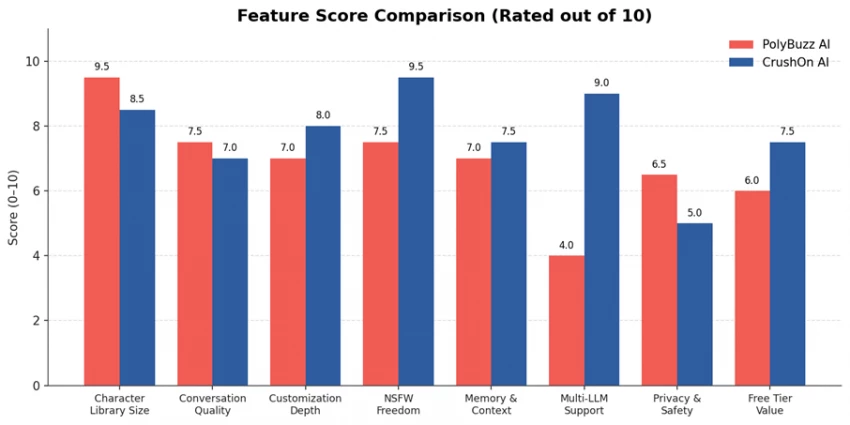
The pattern is consistent. PolyBuzz wins on character library size and conversation breadth. CrushOn wins decisively on NSFW freedom, multi-LLM support, customization depth, and free-tier value. Privacy and safety remain a weakness for CrushOn, while PolyBuzz holds a moderate edge on that dimension.
PolyBuzz markets a library of more than 20 million characters covering anime, movies, RPG archetypes, and user-generated personas. Discovery surfaces include trending categories, featured creators, and search by tag. Hands-on browsing reveals the long-tail problem common to massive libraries: high volume of low-effort entries means surfacing genuinely well-written characters takes filtering. The trending sections reduce that friction noticeably.
CrushOn’s library is smaller in absolute terms but denser in roleplay-focused archetypes. Categories are organized around scenarios such as romance, fantasy, anime, and original works, with creator profiles visible. The discovery experience rewards users who arrive with a specific scene type in mind. Importing existing character cards from Pygmalion or TavernAI lets writers carry their own catalog onto the platform without rebuilding from scratch.
Both platforms claim long-term memory. In practice, behavior diverges significantly. PolyBuzz’s permanent-memory feature, gated behind the highest tier, holds basic facts and running jokes across sessions but fumbles precise persona details after extended exchanges. Independent reviewers and store comments echo the same pattern: memory holds for surface details, not for nuanced consistency. PolyBuzz also exhibits a quirk where the character occasionally borrows traits from the user’s own persona card, which can break immersion in long sessions.
CrushOn’s memory window scales with subscription tier, with Premium reportedly offering up to roughly 16,000 tokens of context. That depth is meaningful and shows up directly in continuity across longer conversations. The trade-off is that CrushOn’s default models can fall into repetition loops, recycling phrasing and framing devices when scenes run long. Switching to GPT-4o mid-conversation is the standard mitigation and is one of the platform’s most useful operational tricks.
PolyBuzz customization is image-led. Creators upload or generate an avatar and define personality, scenario, and conversational style through structured fields. The catch noted across multiple reviews and during use is that physical-feature controls are limited; the avatar is largely a fixed image rather than a tunable character model. That keeps the creation flow simple but limits how precisely a character’s look can be controlled across scenes.
CrushOn’s customization sits closer to the open roleplay tradition. Personality is defined through free-text fields covering description, appearance, and scenario, and creators import full character cards from external ecosystems. Voice selection from a library of female voices is available. The interface is less polished than PolyBuzz, but it gives writers the control they expect from tools like SillyTavern.
PolyBuzz takes a hybrid stance. Public-facing content is moderated, while private chats are described as unfiltered, and the platform applies multi-stage review to publicly listed characters. In practice, NSFW conversations work but the system can refuse certain categories even with the filter in a permissive position, behavior consistent with deeper safety alignment in the underlying model. Public reviewers describe the result as smooth for most adult roleplay but unpredictable at the edges.
CrushOn applies a clearer policy: a single NSFW filter toggle in chat settings that, once disabled, allows roleplay scenes to run with minimal restriction. The platform leans into this positioning openly. Hands-on use confirms the toggle works as advertised when paired with a permissive backend such as MythoMax. Routing the same prompt through Claude 3.5 Sonnet or GPT-4o reintroduces some refusals because those models carry their own alignment, a quirk the multi-LLM design makes visible to users in real time.
PolyBuzz ships native iOS and Android apps in addition to its web client, and the mobile experience is genuinely strong. App Store and Google Play reviews routinely describe the app as polished and easy to navigate, although the same reviews flag growing ad density on the free tier as a recurring frustration. Cross-device sync is reliable.
CrushOn offers iOS, Android, and web access, but the mobile clients feel less refined than PolyBuzz’s. The web interface is no-frills and loads quickly. Power features such as model switching and group chat are easier to navigate on desktop than on a phone, where the settings layout becomes cramped on small viewports. Creators who chat primarily from mobile should weigh this seriously.
Pricing is one of the clearest differentiators between the two platforms, and CrushOn’s aggressive entry-tier strategy is part of the reason it gained traction so quickly. The chart below visualizes approximate monthly subscription pricing across tiers.

The detailed pricing matrix below adds context on what each tier unlocks and where hidden costs surface during real use. Coin systems on PolyBuzz and the daily login coin allowance on CrushOn introduce variable spend that flat subscription comparisons miss.
| Plan Tier | PolyBuzz AI | CrushOn AI | Notes |
|---|---|---|---|
| Free | Limited daily messages, ads, basic features | Roughly 50 messages per day, basic memory, ads | Both free tiers are functional but capped |
| Entry | ~$9.99 / month (Standard) | ~$3.99 / month (Basic) | CrushOn entry undercuts most competitors |
| Mid | ~$14.99 / month (Premium) | ~$5.99 / month (Standard) | CrushOn includes NSFW and group chat at this tier |
| Upper | ~$19.99 / month (Premium+) | ~$14.99 / month (Premium) | Both unlock priority and richer memory |
| Top | ~$29.99+ (Ultimate, with permanent memory add-on) | ~$29.99 to $49.90 / month (Deluxe) | Top tiers approach impulse-purchase ceilings |
| Coin Packs | Coin packs from $2.49 to $19.90 for rerolls and Live Photos | Daily login coins and gift codes via Discord and Twitter | Variable spend; track usage to avoid surprises |
CrushOn’s entry-tier pricing is among the lowest in the category, undercutting Candy AI, Replika, and Nomi AI on monthly cost. PolyBuzz’s pricing sits in the mid-range for the category and is harder to evaluate because the platform does not publish a consolidated pricing matrix on its own site, with the clearest references appearing only inside the iOS App Store and the in-app coin purchase screens. Heavy users on either platform should track actual monthly spend, including coin and add-on purchases, before settling on the right tier.
Aggregator articles tend to stop at headline feature lists. The behaviors below show up only after sustained use and frequently determine whether a creator stays on a platform long term.
Both platforms degrade in long roleplay sessions, but in different ways. PolyBuzz holds running facts but blurs character-specific physical and behavioral details, sometimes attributing user-persona traits to the AI character mid-scene. CrushOn holds the larger context window cleanly on Premium-tier and above but leans into repetition when prompts grow stale. The effective mitigations differ: on PolyBuzz, restating key character details every several messages; on CrushOn, switching the underlying model when output starts looping.
PolyBuzz moderation behavior shifts depending on whether a character is private or public. The same prompt can be allowed in a private chat and refused on a public character. CrushOn moderation shifts depending on the connected LLM. A scene allowed under MythoMax can be refused mid-response after switching to a hosted commercial model with stricter alignment. Creators learn to anchor a scene under one backend and resist the urge to swap mid-paragraph.
PolyBuzz’s mobile app is the strongest in this comparison, with consistent rendering and stable cross-device sync. The flaw is ad frequency on the free tier, which forces interrupting waits at points that interrupt narrative flow. CrushOn’s mobile clients are functional but feel like compressed versions of the web experience; the API and model selection menus in particular become awkward on small screens, and creators frequently complete configuration on desktop before moving back to mobile for chatting.
CrushOn AI was flagged by Mozilla’s Privacy Not Included program, which documented multiple trackers, sensitive data collection including health and biometric categories, and chat history retained for model training. CrushOn’s own privacy policy claims encrypted storage but reviewers including StartupHub and Cherrypop note the encryption claim is not independently verified. PolyBuzz fares moderately better on third-party privacy reviews but does not clearly state in its policy whether chats are used to train models. Both platforms warrant the standard precautions: a unique strong password, no use of real personal information in prompts, and a burner email address for account creation.
PolyBuzz’s coin economy gates rerolls, Live Photo generation, voice chat extension, and inspiration replies, which means a flat subscription does not actually unlock a flat experience. Heavy use of regenerate during a single session can drain a coin balance fast. CrushOn’s daily login coins partially offset paid usage, but the message caps on lower tiers can interrupt longer roleplay sessions, especially given the larger context window encouraging longer scenes. Predictable monthly cost requires either staying inside the message cap or upgrading to a tier with unlimited messages.
Both platforms carry mixed public reputation. PolyBuzz’s recent App Store reviews remain net-positive but include consistent complaints about ad density and memory inconsistency. CrushOn carries a notably weaker Trustpilot rating in the AI companion category, with multiple reviews describing inconsistent character adherence and complaints about top-tier value. These signals do not tell the whole story, but they should factor into a serious purchase decision.
| PolyBuzz AI - Pros | PolyBuzz AI - Cons |
|---|---|
• Library size dwarfs almost every competitor in the category • Live Photos and Moments add genuine visual variety to chat • Native iOS, Android, and web clients with cross-device sync • Multi-character chat rooms support up to four AI characters • Frequent updates and active developer responsiveness on store reviews • Image and short video generation reduce app-switching for visuals | • Free tier shows aggressive ad placements that have grown over time • Memory consistency degrades in long roleplay sessions even on paid tiers • No published specs for memory window, model type, or response latency • Coin system makes premium feature costs unpredictable • Web pricing scattered across stores with no canonical matrix • Privacy policy does not clearly state whether chats are used for model training |
| CrushOn AI - Pros | CrushOn AI - Cons |
|---|---|
• Multi-LLM backend including GPT-4o, Claude 3.5 Sonnet, and MythoMax • Mid-chat model switching is rare in the category and works as advertised • Larger context window than most competitors at the Premium tier • Imports character cards from Pygmalion, TavernAI, and Text Generation formats • Group chat with multiple characters available to paid subscribers • Aggressive entry pricing relative to AI companion peers | • Privacy concerns: flagged by Mozilla’s Privacy Not Included program • Independent reviewers report repetitive loops and persona drift • Public Trustpilot ratings sit at the low end of the AI companion category • Image generation quality lags purpose-built image generators • Voice library is smaller than character library; mismatches occur • Top-tier pricing is steep relative to demonstrated quality |
Different creators have different priorities. The chart below scores both platforms against eight common use cases that surface in user research and search behavior. Scores reflect both feature presence and tested fit, not only marketing claims.
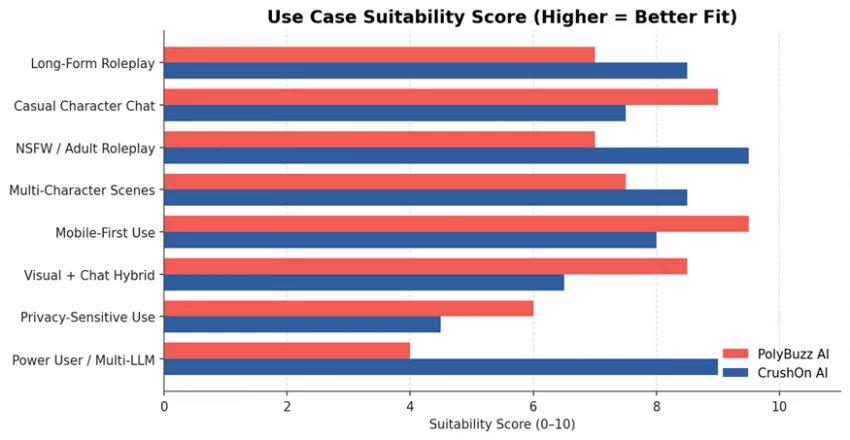
The pattern reinforces the early verdict. PolyBuzz dominates anywhere casual chat, mobile use, or visual flourishes matter. CrushOn dominates anywhere NSFW openness, multi-LLM control, or long-form roleplay matter. Neither is a clean replacement for the other.
• Casual users who want quick character chat without configuring backends or imports.
• Mobile-first chatters who value polished native apps over desktop power features.
• Creators who want light multimedia such as Live Photos and short video alongside chat.
• People exploring AI companions for the first time who prefer a guided onboarding experience.
• Power roleplay users who want explicit control over the underlying language model.
• Writers and worldbuilders who need long memory windows and complex character cards.
• Adult creators who prefer a clearer, more permissive content stance.
• Existing SillyTavern, Pygmalion, or TavernAI users who want to import existing character libraries.
Both platforms collect account metadata and conversation logs to operate their services. Neither offers zero-knowledge privacy, and sensitive personal information should never be entered into prompts or character cards. CrushOn carries the heavier flag here, with documented collection of sensitive data categories and tracker integrations identified by Mozilla. PolyBuzz collects less aggressively in public scans but its policy lacks clarity on whether chats train models.
Standard precautions apply: a strong unique password, two-factor authentication where offered, recognition that uploaded images and persona cards may persist on platform infrastructure, and awareness that adult content carries legal and ethical responsibilities that vary by jurisdiction. Reviewers including Cherrypop and AI Companion Guides recommend a burner email and a VPN for users especially concerned about exposure. Both platforms’ Terms of Service and Privacy Policy documents change without notification and should be reviewed at the source before any meaningful subscription commitment.
The honest answer to "PolyBuzz AI vs CrushOn AI: which is better" is that better depends on intent, and the question is genuinely close once intent is named. PolyBuzz wins for casual mobile-first character chat, the largest character library in the comparison, and the smoothest onboarding. CrushOn wins for power roleplay, model flexibility, content freedom, and longer memory windows on paid tiers.
Anyone choosing on price alone will lean toward CrushOn at the entry tier and PolyBuzz at the mid tier. Anyone choosing on privacy alone will lean toward PolyBuzz, although both platforms carry caveats. Anyone serious enough to use either daily will eventually want both: CrushOn for long, structured scenes that benefit from model switching, and PolyBuzz for quick chat sessions and casual character browsing on the go. Treating them as complementary rather than substitutes produces the best outcome for creators who can afford both.
PolyBuzz AI and CrushOn AI represent two distinct strategies inside the AI character chat category. PolyBuzz aims at scale and casual accessibility. CrushOn aims at depth and power-user control. Both ship usable free tiers, both have active communities, and both serve adult creators who want fewer restrictions than mainstream tools provide. Choosing the better platform comes down to whether the next conversation needs breadth or depth.
Whichever platform a creator selects, responsible use, age compliance, and a careful review of each service’s current Terms of Service and Privacy Policy remain essential. The AI companion space evolves rapidly. Pricing pages, character moderation policies, and model availability shift without notice, and every claim in this guide should be re-verified against the official sources listed in the next section before any meaningful subscription commitment.

New Claude Model Targets Agentic AI WorkflowsAnthropic has launched Claude Sonne...
Samuel Osei3 months ago

Gemini’s Image Tools Get a Wider RolloutGoogle is expanding access to Gemini’s p...
Alexander Hughes3 months ago
Two AI video generators, two very different first days. I ran PixVerse through i...
Alexander Hughes3 months ago
Two of the most talked-about AI chat platforms. I opened both, picked a characte...
Alexander Hughes3 months ago
The two-minute versionIf you only read one thing, read this. The rest of the doc...
Alexander Hughes3 months ago

Why Seedance 2.5 mattersSeedance 2.5 is the latest release in ByteDance’s Seedan...
Alexander Hughes3 months ago
Discussion