Short on time? The four picks below answer the most common student question for each major use case. A full breakdown of all seven alternatives follows further down.
BEST FREE ALTERNATIVE Knowt offers the same AI flashcard generation Gizmo charges for, with full Learn mode, practice tests and spaced repetition included at zero cost. |
BEST ALL-IN-ONE STUDY APP Mindgrasp converts uploaded lectures, PDFs and slides into structured notes, flashcards, quizzes and an AI tutor session in a single workflow. |
BEST FOR LONG-TERM RETENTION Anki paired with modern AI card generators (such as AnkiPilot) combines the most-trusted spaced-repetition engine with one-click PDF-to-deck creation. |
BEST FOR RESEARCH-HEAVY COURSES Google NotebookLM grounds every answer in uploaded source documents, eliminating the AI hallucination problem that plagues most generic study chatbots. |
The table below summarises the seven Gizmo AI alternatives across the dimensions students search for most often: pricing, free-tier strength, AI generation depth, and primary use case.
| Tool | Best For | Free Tier | Premium Cost | Standout Feature |
|---|---|---|---|---|
| Knowt | Free Quizlet alternative | Generous | Free for most users | AI flashcards from PDFs and videos |
| Quizlet | Pre-made study sets | Limited | $7.99 / month | Q-Chat AI tutor and practice tests |
| Anki + AI | Long-term retention | Fully free | Free (open source) | FSRS algorithm spaced repetition |
| Mindgrasp | All-in-one workflow | Limited daily caps | $9.99 / month | Lecture to study materials in one click |
| NotebookLM | Source-grounded research | Fully free | Free (Google account) | AI podcast overview from documents |
| Khanmigo | K-12 personalised tutor | School plans | From $4 / month | Curriculum-aligned Socratic tutoring |
| RemNote | Note-takers and grad students | Limited cards | $8 / month | Notes and spaced repetition combined |
Table 1: Seven Gizmo AI alternatives ranked by core student-facing dimensions, last updated May 2026.
Gizmo AI earned its place by automating the worst part of studying: making flashcards by hand. The Cambridge-built platform now serves more than 13 million users and recently closed a $22 million Series A. Even so, third-party reviews from TechPoint Africa, AI Journal and SmartPostly consistently flag the same five limitations that drive students to seek alternatives.
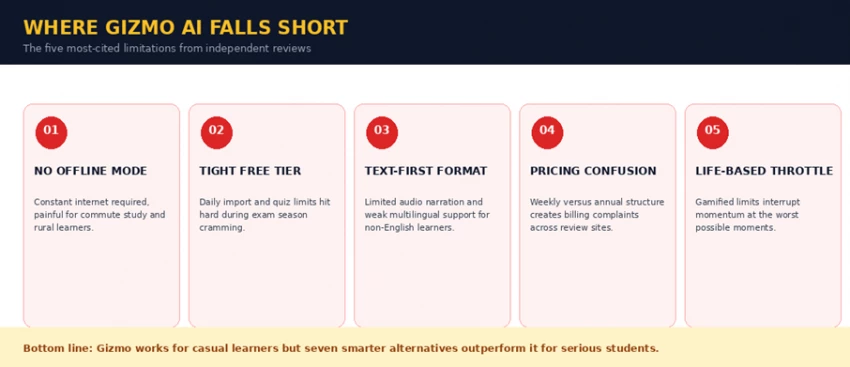
Beyond those five issues, the bigger structural concern is value for money. Gizmo Unlimited bills at $13.99 per week, which compounds to roughly $52 per month for full access. Several alternatives on this list offer comparable AI features at half the price, and three offer them entirely free. The remainder of this guide breaks down each option in detail, starting with the strongest free pick.
Each tool below was evaluated on five criteria: AI feature depth, free-tier usability, value for money, supported input formats (PDF, video, audio, text) and primary use case fit. The order reflects overall student-fit rather than absolute feature count.
| #1 Knowt | |||
PRICE Free for most features | BEST FOR Budget-conscious students | INPUTS PDFs, videos, notes | MOBILE iOS + Android apps |
Knowt emerged as a direct response to Quizlet moving Learn mode and practice tests behind a paywall. The platform offers AI-generated flashcards from uploaded PDFs, lecture videos and pasted notes, plus Quizlet imports, completely free of charge. As of 2026 it serves more than five million students and teachers globally.
Three reasons stand out. First, every AI feature available on Knowt is free, while Gizmo locks the same features behind a $13.99 weekly subscription. Second, Knowt natively imports existing Quizlet sets, instantly multiplying available study material. Third, the full study-mode suite, including learn mode, matching games, spaced repetition and practice tests, is included for free.
| STRENGTHS | TRADE-OFFS |
|---|---|
| ✓ Genuinely free flagship features with no card limit | ✗ Younger platform with smaller pre-made library than Quizlet |
| ✓ Native iOS and Android apps with full feature parity | ✗ AI quality occasionally lags behind premium paid tools |
| ✓ Quizlet import keeps existing study sets useful | ✗ No native AI tutor chatbot for concept explanations |
| ✓ Multiple study modes including spaced repetition | ✗ Spaced repetition algorithm less sophisticated than Anki FSRS |
| ✓ AI flashcard generation from PDFs and YouTube videos |
| #2 Quizlet | |||
PRICE $7.99 / month Plus | BEST FOR Pre-made study sets | INPUTS Text, images, AI generation | MOBILE iOS + Android apps |
Quizlet remains the household name in flashcard study, with a library of more than 500 million user-created sets and 60 million monthly active learners. The 2025 to 2026 update cycle added Q-Chat (a conversational AI tutor that asks adaptive questions) and AI-generated practice tests that simulate exam conditions from any study set.
Scale and adaptive intelligence are the two clear wins. Where Gizmo focuses on AI generation from a single user input, Quizlet pairs AI features with the largest pre-made study library in education. The Learn mode adapts to weak points and resurfaces material the student is getting wrong, while practice-test generation turns any deck into a mock exam, the single most-supported study technique in cognitive-science research.
| STRENGTHS | TRADE-OFFS |
|---|---|
| ✓ Largest pre-built study library in the category (500M+ sets) | ✗ Most AI features now require Plus subscription at $7.99 / month |
| ✓ Q-Chat AI tutor asks Socratic questions instead of flipping cards | ✗ Free tier has been progressively reduced since 2024 |
| ✓ Practice test generation from any flashcard set | ✗ Less suited to processing long-form academic PDFs |
| ✓ Polished mobile experience with offline study support | ✗ No native lecture audio capture or transcription |
| ✓ Adaptive Learn mode targets weak topics automatically |
| #3 Anki + AI Add-Ons | |||
PRICE Free (open source) | BEST FOR Long-term retention | INPUTS Manual or AI-generated | MOBILE iOS paid, Android free |
Anki has been the gold standard for spaced repetition since 2008, particularly among medical students, language learners and exam-prep candidates. The 2025 wave of AI add-ons (notably AnkiPilot and AI-powered card generators) finally solved the platform's biggest historical weakness: time-consuming manual card creation. Lectures, PDFs and even YouTube transcripts can now be converted into ready-to-review decks in minutes.
The FSRS (Free Spaced Repetition Scheduler) algorithm is the single most important reason. Independent research consistently shows FSRS produces better long-term retention than fixed-interval systems used by most consumer apps. For students preparing for cumulative exams (USMLE Step boards, bar exams, GCSEs), Anki retention curves remain unmatched. The AI add-on ecosystem now makes Anki nearly as fast as Gizmo for initial card creation while keeping the retention advantage.
| STRENGTHS | TRADE-OFFS |
|---|---|
| ✓ FSRS algorithm produces best-in-class long-term retention | ✗ Steeper learning curve than consumer-friendly alternatives |
| ✓ Completely free on desktop and Android (paid iOS app) | ✗ iOS app costs $24.99 (one-time) |
| ✓ Massive community library, including AnKing for medical students | ✗ Stock interface looks dated compared to modern competitors |
| ✓ Open-source with extensive add-on ecosystem | ✗ Best AI features require third-party add-on configuration |
| ✓ AI add-ons close the historical card-creation speed gap |
| #4 Mindgrasp | |||
PRICE $9.99 / month Pro | BEST FOR Lecture-heavy semesters | INPUTS PDFs, audio, video, slides | MOBILE iOS + Android apps |
Mindgrasp positions itself as a single platform that handles every step of the study workflow. Uploaded materials (recorded lectures, PDF readings, slide decks, articles) are converted in one click into structured notes, summaries, flashcards, quizzes and an interactive AI tutor session. The tool is particularly popular in US college markets and has earned consistent four-star-plus ratings on app stores.
Workflow consolidation is the headline benefit. Where Gizmo focuses primarily on flashcards and quizzes, Mindgrasp combines five output formats from a single upload. The AI tutor chat is also more capable than Gizmo's offering, supporting follow-up questions and concept explanations grounded in the uploaded source material. For students juggling four or more courses with weekly lectures and assigned readings, the consolidation effect saves several hours per week.
| STRENGTHS | TRADE-OFFS |
|---|---|
| ✓ Single upload generates notes, summaries, flashcards and quizzes | ✗ Free tier has notable daily caps that hit during exam season |
| ✓ AI tutor available 24/7 with source-grounded answers | ✗ Spaced repetition is less refined than Anki FSRS |
| ✓ Strong support for lecture audio and video transcription | ✗ Newer platform with smaller community library |
| ✓ Progress tracking across study sessions | ✗ Output occasionally needs manual editing for technical topics |
| ✓ Mobile apps with full feature parity |
| #5 Google NotebookLM | |||
PRICE Free with Google account | BEST FOR Research and synthesis | INPUTS PDFs, Docs, websites, YouTube | MOBILE Mobile-friendly web app |
NotebookLM is Google's entry into the AI study category and arguably the most differentiated tool on this list. The platform allows users to upload up to 50 sources per notebook (PDFs, Google Docs, websites, YouTube transcripts) and then asks questions answered exclusively from those sources, with citation links back to the original material. The audio overview feature generates a surprisingly natural podcast-style discussion of the uploaded content, ideal for commute-time review.
Source grounding is the killer feature. Generic AI chatbots (including Gizmo's tutor) frequently hallucinate facts when asked about niche academic topics. NotebookLM physically cannot answer outside the uploaded sources, eliminating that risk. For research-heavy courses, dissertations or any topic requiring synthesis across multiple papers, NotebookLM produces dramatically more reliable answers than tools that pull from general web data.
| STRENGTHS | TRADE-OFFS |
|---|---|
| ✓ Free with any Google account, no subscription required | ✗ Not designed for traditional flashcard or quiz workflow |
| ✓ Source grounding eliminates AI hallucination on academic content | ✗ Spaced repetition not built in |
| ✓ Audio overview turns notebooks into a 10-minute podcast | ✗ Mobile experience is web-only, no native app |
| ✓ Citation links connect every answer to the original source | ✗ Source upload limit (50 per notebook) can be restrictive |
| ✓ Excellent for synthesising across multiple papers |
| #6 Khanmigo (Khan Academy) | |||
PRICE From $4 / month | BEST FOR K-12 and curriculum support | INPUTS Khan Academy curriculum | MOBILE iOS + Android apps |
Khanmigo is Khan Academy's AI tutor, built on top of the platform's extensive curriculum-aligned content library. The tool uses a Socratic teaching approach: rather than handing the answer to the student, it asks guiding questions that lead toward independent problem-solving. Khanmigo is now offered free for teachers and most US public school students, with affordable parent plans starting around $4 per month.
Pedagogy and curriculum alignment are the wins. Gizmo's strength is converting student-supplied content into flashcards. Khanmigo's strength is teaching from a structured K-12 curriculum that millions of educators have already vetted. For younger learners, parents seeking homework support, and students working through standard maths or science syllabi, Khanmigo provides scaffolded explanations grounded in age-appropriate pedagogy rather than open-ended AI generation.
| STRENGTHS | TRADE-OFFS |
|---|---|
| ✓ Socratic tutoring approach builds independent problem-solving | ✗ Less useful for university and graduate-level coursework |
| ✓ Aligned to validated K-12 curriculum content | ✗ No native flashcard or PDF upload workflow |
| ✓ Free for teachers and many US public school students | ✗ Limited support for non-US curricula |
| ✓ Strong parental controls and child-safety features | ✗ Cannot ingest user-supplied lecture or textbook content |
| ✓ Integrates with the broader Khan Academy practice library |
| #7 RemNote | |||
PRICE $8 / month Pro | BEST FOR Note-takers and grad students | INPUTS Notes, PDFs, web clips | MOBILE iOS + Android apps |
RemNote treats every bullet point as a "Rem" (a piece of knowledge) inside a structured note-taking environment. Any line of notes can be turned into a flashcard with a simple keyboard shortcut, automatically pulling the surrounding context into the card. This solves the "isolated fact" problem that plagues most flashcard apps: cards stay connected to the broader concept they came from. The platform is particularly popular among medical students, law students and philosophy graduates.
Conceptual context is the differentiator. Gizmo creates standalone flashcards from uploaded material. RemNote keeps every flashcard connected to the original note, meaning students can always trace a fact back to its surrounding concept. This matches how genuine understanding is built in cognitive science: facts retained as part of a structured knowledge graph stick longer than facts memorised in isolation. For complex disciplines (anatomy, case law, philosophy of mind), the difference is significant.
| STRENGTHS | TRADE-OFFS |
|---|---|
| ✓ Combines structured note-taking with spaced repetition | ✗ Steeper learning curve than purpose-built flashcard apps |
| ✓ Cards retain context from surrounding notes | ✗ Pro tier required for unlimited cards and advanced features |
| ✓ Strong PDF annotation with one-click flashcard creation | ✗ Less polished mobile experience than competitors |
| ✓ Knowledge-graph linking helps interconnect concepts | ✗ AI generation features less mature than dedicated tools |
| ✓ Generous free tier covers casual student use |
For students balancing multiple subscriptions across the academic year, pricing structure matters as much as feature depth. The chart below compares effective monthly costs across all seven alternatives plus the Gizmo AI baseline.
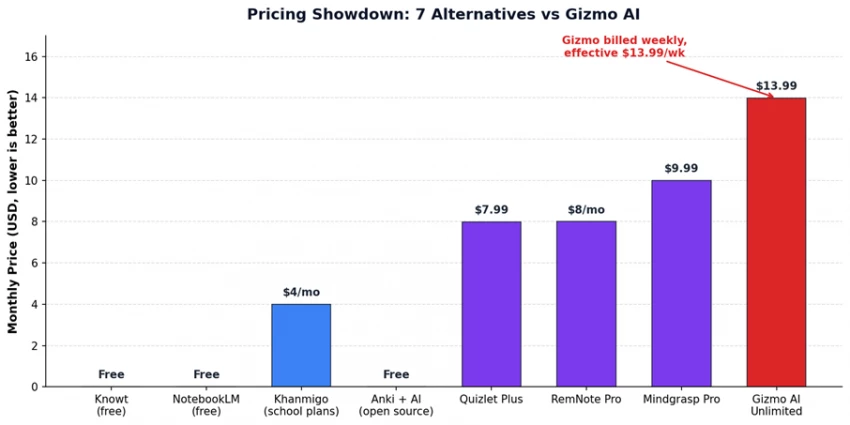
Three of the seven alternatives are completely free for full functionality (Knowt, NotebookLM, Anki). Four sit between $4 and $10 per month for premium tiers, all of which undercut Gizmo Unlimited's $13.99 weekly billing. Khanmigo offers the lowest paid pricing at $4 per month, while the most feature-complete paid alternative, Mindgrasp, remains roughly 30 percent cheaper than Gizmo.
No single AI tool covers every part of the study workflow well. The most consistent advice from independent education-tech reviewers is to combine two or three tools, each handling its strongest phase. The diagram below outlines the optimal three-tool stack for university students preparing for cumulative exams.
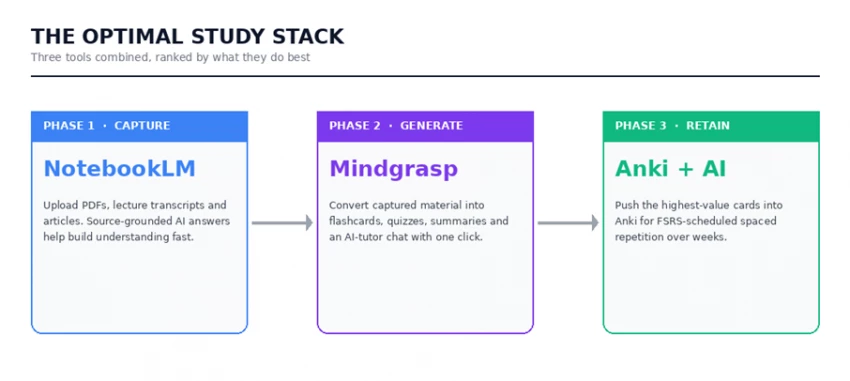
The logic is straightforward. NotebookLM ingests course materials into a source-grounded research environment that builds initial understanding without hallucination. Mindgrasp converts the same material into structured study assets (notes, flashcards, quizzes) for active recall. Anki then takes the highest-value flashcards into a long-term spaced-repetition rotation that survives weeks beyond the initial cram. Total monthly cost: approximately $9.99, which covers the only paid tier required (Mindgrasp Pro).
Different study styles call for different tools. The following decision matrix maps the six most common student scenarios to the single best-fit pick from the seven alternatives.
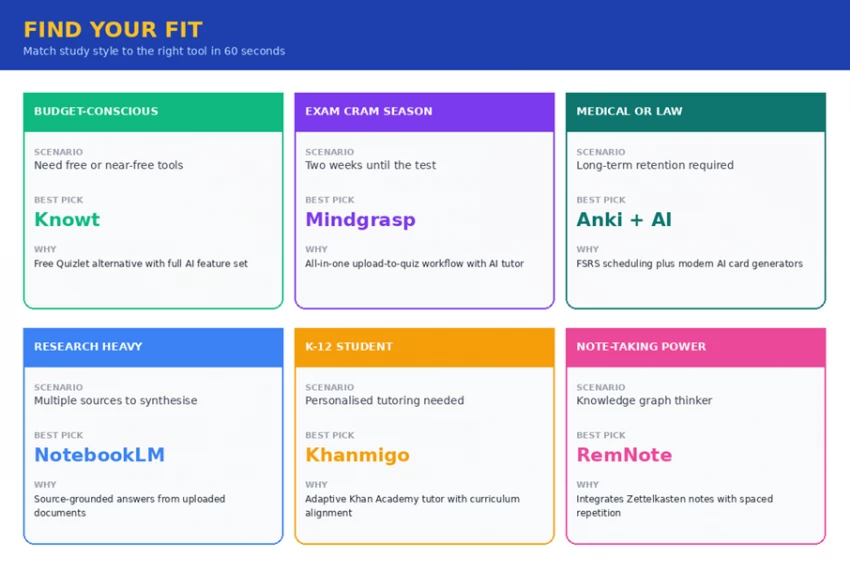
After weighing feature depth, pricing transparency and student-fit across the seven alternatives, the table below names a single winner in each major category.
| Category | Winner | Runner-Up | One-Line Reason |
|---|---|---|---|
| Best Free Tool | Knowt | NotebookLM | Full feature set without a subscription |
| Best All-in-One App | Mindgrasp | Knowt | Lecture, PDF and slide ingestion in one workflow |
| Best for Retention | Anki + AI | RemNote | FSRS algorithm leads in cognitive-science research |
| Best AI Tutor | Khanmigo | Quizlet Q-Chat | Curriculum-aligned Socratic teaching method |
| Best for Research | NotebookLM | Mindgrasp | Source grounding eliminates hallucination risk |
| Best Mobile Experience | Quizlet | Knowt | Polished native app with offline mode |
| Best for Note-Takers | RemNote | Mindgrasp | Notes and flashcards live in the same workspace |
| Best Value Overall | Knowt | Mindgrasp | Most features at the lowest effective cost |
THE OVERALL WINNER
For most students looking to replace Gizmo AI in 2026, Knowt is the strongest single pick. It matches Gizmo on every core feature, runs entirely free, and adds Quizlet imports plus deeper study modes. Power users seeking the best long-term retention should pair Knowt with Anki for spaced-repetition rotation.

New Claude Model Targets Agentic AI WorkflowsAnthropic has launched Claude Sonne...
Samuel Osei3 months ago

Gemini’s Image Tools Get a Wider RolloutGoogle is expanding access to Gemini’s p...
Alexander Hughes3 months ago
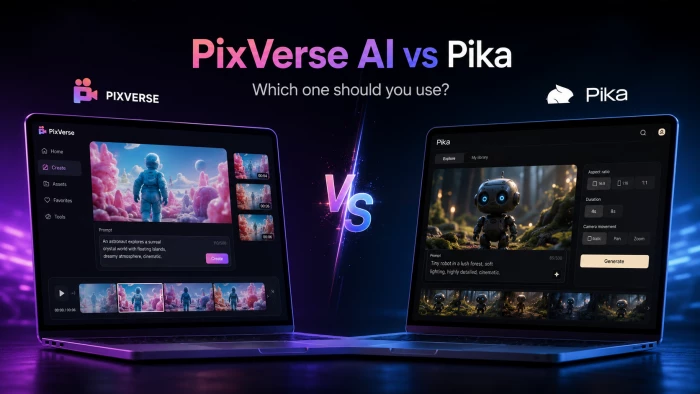
Two AI video generators, two very different first days. I ran PixVerse through i...
Alexander Hughes3 months ago
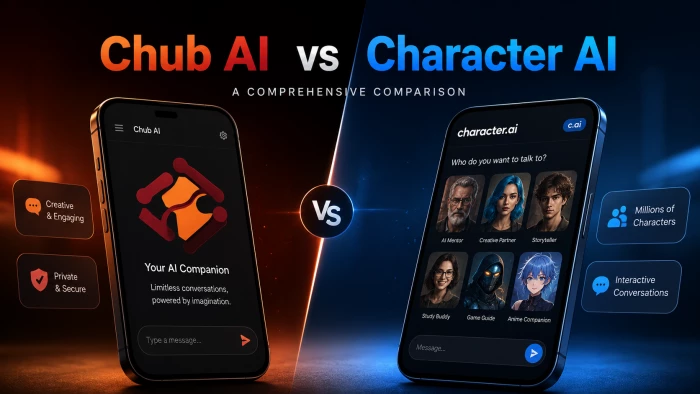
Two of the most talked-about AI chat platforms. I opened both, picked a characte...
Alexander Hughes3 months ago
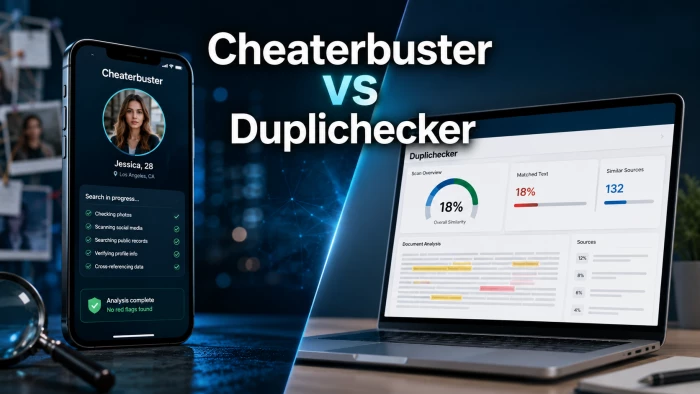
The two-minute versionIf you only read one thing, read this. The rest of the doc...
Alexander Hughes3 months ago
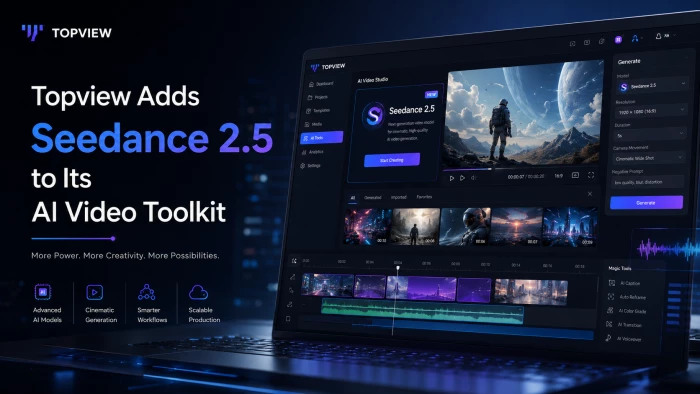
Why Seedance 2.5 mattersSeedance 2.5 is the latest release in ByteDance’s Seedan...
Alexander Hughes3 months ago
Discussion