PolyBuzz AI wins this comparison four rounds to three. It dominates on library size, voice technology, memory depth, and app stability. Dopple AI takes the rounds that matter most to budget-minded users: conversation quality, content safety, and pricing power, where its $5.99 monthly annual plan undercuts everything PolyBuzz sells. The short version: pick PolyBuzz for a deep multimedia roleplay ecosystem, pick Dopple for polished dialogue at the lowest full-premium price in the category. Seven scored rounds, two judged ties, a yearly cost model, and four original charts back that call below.
| Question | Answer |
|---|---|
| Overall winner | PolyBuzz AI, four rounds to three |
| Best value | Dopple AI, $5.99 per month on annual billing |
| Best for voice chat | PolyBuzz AI |
| Tightest moderation | Dopple AI |
| Biggest library | PolyBuzz AI, 20 million plus characters |
| Riskiest long-term pick | Dopple AI, given app instability and falling traffic |
Table 1: The verdict at a glance.
Every figure below comes from sources published between late 2025 and mid 2026: official app store listings, Semrush and other traffic trackers, platform policy pages, and hands-on reviews from independent testing outlets. Seven categories receive an editorial score out of 10, weighted equally, and the winner of each round gets declared on the spot. All charts in this article were built from that same dataset, so publishers can restyle or reproduce them freely. Categories that finished too close to call, such as creator tools, sit outside the scored rounds.
One platform is a boutique; the other is a megamall. As explained in our Dopple AI Review, Dopple AI launched in 2023 from a Miami startup carrying $1.88 million in seed funding and a team of roughly 11 people, betting everything on a proprietary language model tuned for natural dialogue. PolyBuzz AI, operated by Cloud Whale Interactive Technology LLC and formerly known as Poly.AI, went the opposite direction: open the gates, let the community build, and scale past 20 million characters.
| Profile | Dopple AI | PolyBuzz AI |
|---|---|---|
| Origin | 2023, Miami, Florida | Rebranded from Poly.AI, US-based operator |
| Engine | Proprietary in-house LLM | Multiple models, including Passion and Tale on paid tiers |
| Library | Thousands, curated by category | 20 million plus, community driven |
| Reach | About 170,000 monthly visits, early 2026 | 18 to 40 million plus monthly visits, tracker estimates |
| Session length | About 7 minutes 45 seconds | About 17 minutes |
| Platforms | Web, iOS, Android | Web, iOS, Android |
Table 2: Contender profiles built from 2025 to 2026 public data.
Sheer scale decides this one quickly. PolyBuzz hosts a community catalog counted in the tens of millions, refreshed daily by creators uploading anime heroes, movie figures, RPG archetypes, musicians, and original personas. Dopple offers thousands of characters in a curated, category-driven layout spanning anime, games, film, helpers, philosophers, and historical figures. Curation buys consistency: Dopple's featured and trending sections surface well-built profiles fast, while PolyBuzz quality swings wildly between personas and rewards anyone who tests several characters before judging. Volume still takes the round, because discovery tools tame the chaos and the long tail covers fandoms Dopple never will.
Round winner: PolyBuzz AI. Score: 9.5 to 6.5.
Dopple's entire pitch lives here. Its proprietary model, with an advanced version reserved for Dopple+ subscribers, earns consistent praise for emotional tone and in-character voice, and a company-run blind study of more than 1,000 users reported a preference for it over rival systems. PolyBuzz answers with variety: free-tier output feels like a standard chatbot, while the Premium-only Passion and Tale models bring expressive roleplay and longer storytelling arcs. Both platforms draw an identical complaint, bots occasionally recycling the same phrases across separate chats. Judged on out-of-the-box dialogue without paying extra, Dopple edges ahead.
Round winner: Dopple AI. Score: 8.5 to 7.5.
No contest on audio. PolyBuzz runs real-time voice conversations, limited for free users and unlimited on Premium, backed by a coin system that extends duration and unlocks special memory scenes. Dopple's voice features remain experimental, described by reviewers as atmospheric but inconsistent. Images land much closer: Dopple generates context-aware, anime-styled scenes inside chats, unlimited for Dopple+ members, while PolyBuzz produces anime and realistic character art plus 30 daily avatar generations on Premium. Working voice combined with competitive image tools settles the round.
Round winner: PolyBuzz AI. Score: 8.5 to 5.5.
Memory separates a casual chatbot from a roleplay engine. Dopple holds core traits, backstory, and stated preferences reasonably well, yet long timelines drift: names get swapped, and forgotten plot points resurface as new facts. PolyBuzz reserves its deepest context window for Premium subscribers, which keeps multi-week storylines coherent, at a price. One tip applies to both services: characters built from short, repeatable profile facts survive far longer than profiles stuffed with sprawling paragraphs. Paid depth beats free drift.
Round winner: PolyBuzz AI. Score: 8.0 to 6.5.
Both run on web, iOS, and Android with cross-device sync. Execution diverges sharply from there. Dopple's mobile apps carry sustained complaints about crashes, slow loading, lost chats, and failed avatar uploads, with recent testing citing a rating near 2.7 stars on Android and Trustpilot reports of billing confusion when premium features failed to activate. PolyBuzz reviews skew far more positive on raw performance, although aggressive coin prompts and uneven character quality create friction of a different kind. Reliability is table stakes, and only one contender clears the bar comfortably.
Round winner: PolyBuzz AI. Score: 7.5 to 4.5.
The platforms sit at opposite ends of the moderation spectrum. Dopple polices content actively; its rules have shifted more than once since launch, with 2026 reviews describing an SFW-leaning service and earlier documentation pointing to a mature mode gated behind Dopple+, manual activation, and adult verification. PolyBuzz permits mature roleplay in private chats for adults, bans public NSFW display, and screens public characters with AI plus human review before recommendation.
The weak point is the front door. PolyBuzz shows a 17+ rating on the Apple App Store and Teen or 18+ on Google Play depending on region, yet parental-safety researchers found its age checks rely on self-reported birthdates and judged the built-in Teen Mode and Pure Mode filters ineffective. With California's SB 243, the first US state law regulating AI companion apps, in force since January 2026, weak gates carry real legal exposure. Neither product suits minors; Dopple simply fails less badly.
Round winner: Dopple AI. Score: 7.5 to 5.0.
Entry prices sit a dime apart, then the paths split completely.
| Plan | Platform | Price and Contents |
|---|---|---|
| Free | Both | $0. Roughly 125 messages per session plus peak-time queues on Dopple; daily limits, ads, and short voice durations on PolyBuzz |
| Dopple+ Annual | Dopple AI | $5.99 per month, billed at $71.88 per year, full premium access |
| Standard | PolyBuzz AI | $9.90 per month, full chat and image access |
| Dopple+ Monthly | Dopple AI | $9.99 per month, same benefits as annual |
| Premium | PolyBuzz AI | $19.90 per month: Passion and Tale models, long memory, ad-free, 30 daily avatars, unlimited voice |
| Ultimate | PolyBuzz AI | $29.90 per month, top allowances per iOS listings |
| Coins | PolyBuzz AI | $2.49 for 1,000 up to $19.90 for 20,000, for voice time and extras |
Table 3: Every paid option across both platforms, 2026 app store listings.
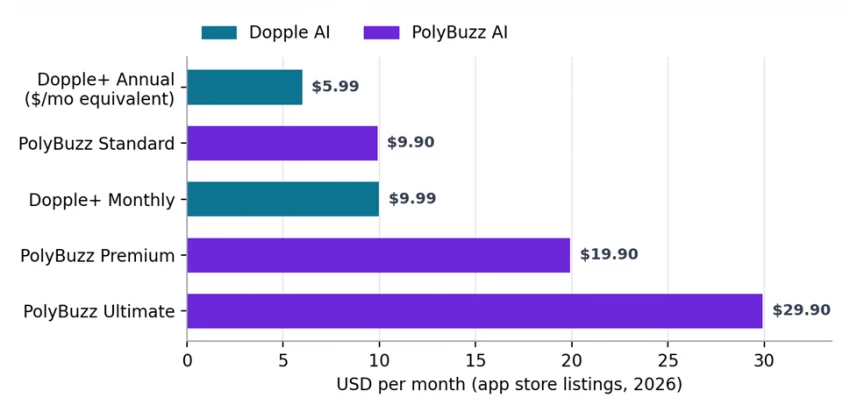
Figure 1: Monthly subscription prices across all paid tiers.
Dopple sells its complete experience for $5.99 per month on annual billing, the cheapest full-premium ticket in this category, though some premium characters and image chats still consume extra credits. Reaching everything PolyBuzz offers costs $19.90 per month before a single coin. Weekly and annual PolyBuzz options exist too, and regional pricing shifts often, so the app store always gets the final word. Value runs one way.
Round winner: Dopple AI. Score: 8.5 to 6.5.
Subscription pages hide the number that matters: total annual spend.
| User Type | Dopple AI Yearly | PolyBuzz AI Yearly | Gap |
|---|---|---|---|
| Casual, free tiers only | $0 | $0 | None |
| Regular, entry paid plan | $71.88 (annual billing) | $118.80 (Standard) | $46.92 |
| Power, top features | $119.88 (monthly billing) | $238.80 (Premium), coins extra | $118.92 plus coins |
Table 4: Twelve-month cost by usage pattern, before optional coin or credit purchases.
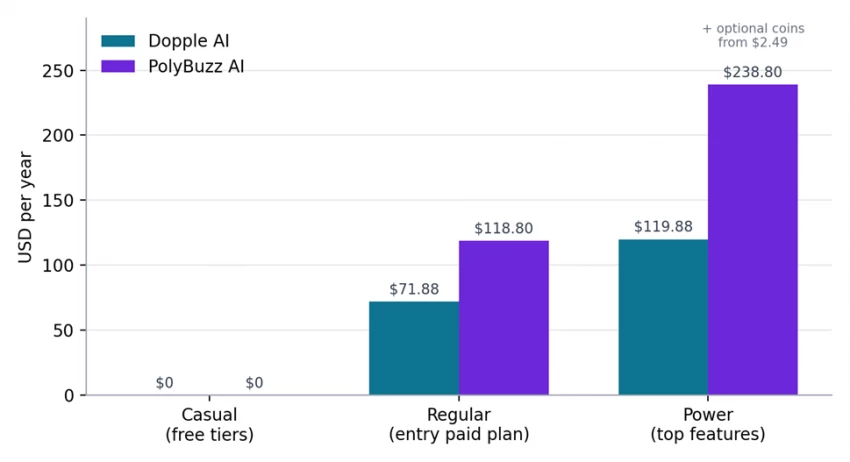
Figure 2: Annual spend by user type. Coin purchases sit outside the base bars.
The gap compounds. A regular user keeps $46.92 a year by choosing Dopple; a power user keeps at least $118.92, more once coins enter the picture. The catch hides in earlier rounds: that saved money buys weaker voice, shallower memory, and shakier apps. Cheap only counts when the missing features were never wanted in the first place.
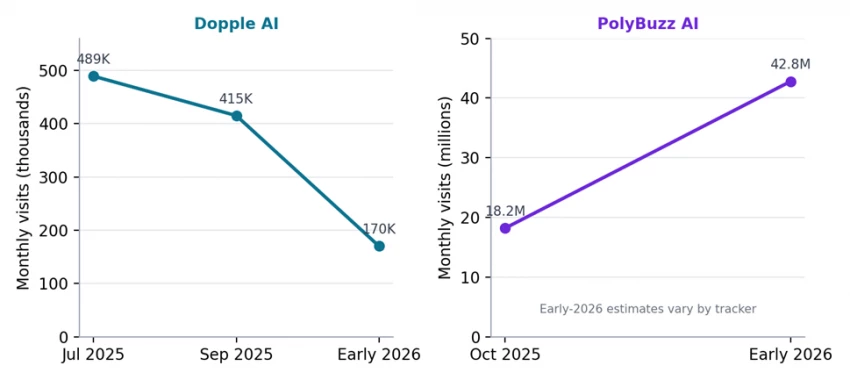
Figure 3: Monthly web visits. Note the panels use different scales: thousands versus millions.
Momentum points in opposite directions. Dopple peaked near 489,000 monthly visits in July 2025, slipped to about 415,000 by September, and reached roughly 170,000 by early 2026, a 65 percent decline in six months according to Quantumrun analysis. Semrush measured PolyBuzz at 18.2 million monthly visits in October 2025, separate early-2026 estimates topped 40 million, and sessions average around 17 minutes. Scale feeds itself: more visitors attract more creators, more creators publish more characters, and fresh content pulls visitors back again.
Neither side charges for building a character, and both reward effort over budget. Dopple's builder focuses on the writing itself: personality descriptions, backstories, and a defined speaking style, with finished Dopples publishable straight into the community catalog. PolyBuzz covers identical ground and then adds plumbing, accepting JSON files and character cards so personas built elsewhere migrate in minutes rather than hours. Traffic flows the other way far less easily, since Dopple offers no equivalent import path and every transplanted character means a manual rebuild. PolyBuzz creators also decide whether a character stays private or enters the public feed, where AI screening plus human review stands between submission and recommendation. For fiction writers testing dialogue, Dopple's model quality gives drafts a better read; for creators chasing an audience, tens of millions of monthly PolyBuzz visitors settle the question. Call it a split decision that never reached the scorecard.
PolyBuzz states that private chats stay confidential, protected by encryption and unreadable to character creators and staff. Its published policies also confirm the other half of the story: account details, conversation data, audio, and behavior patterns flow into moderation, analytics, and model training. Dopple secures traffic with HTTPS and offers sign-up through Google, Apple, or email, yet recurring user reports of disappearing chats and disputed charges point to operational growing pains. Neither company publishes a transparency report, leaving policy pages as the only window into retention practice. One habit protects users on both services: treat every message as something that may be stored, analyzed, and used to train future models, and keep personal identifiers, financial details, and sensitive photos out of the chat window.
1. Weak age gates. Self-reported birthdates pass for verification on both services, and web sign-ups ask for even less.
2. Data hunger. Conversations, audio, and behavior patterns feed moderation, analytics, and model training under both privacy policies, so private from other users never means private from the company.
3. Hidden extras. Dopple charges credits for certain premium characters and image chats; PolyBuzz layers coins on top of subscriptions. Sticker price rarely equals real price.
4. Repetition fatigue. Long-term users on both platforms report bots recycling identical phrases, a known limit of current character models.
5. Shifting rules. Moderation policies on both services have changed with little notice, and content acceptable one month has vanished the next.
| If the Priority Is | Choose | Because |
|---|---|---|
| Lowest cost for full premium | Dopple AI | $5.99 per month on the annual plan |
| Voice conversations | PolyBuzz AI | Real-time voice, unlimited on Premium |
| Huge fandom coverage | PolyBuzz AI | 20 million plus characters |
| Tighter content policing | Dopple AI | Active moderation and SFW-leaning defaults |
| Long, coherent storylines | PolyBuzz AI | Extended memory context on Premium |
| Importing existing characters | PolyBuzz AI | JSON and character card support |
Table 5: Fast decision paths by priority.
Still torn? Switching costs almost nothing. Run both free tiers for one week, note which limits sting, and the answer writes itself.
Three forces could reshuffle this scorecard. Regulation comes first: SB 243 set a template, and stricter age-verification mandates would hit PolyBuzz's weak gates hardest. Survival pressure comes second: a 65 percent traffic slide gives Dopple limited runway to fix its apps, and a platform shutdown turns any cheap subscription into a worthless one, which makes monthly billing or refundable annual plans safer than long prepayment. Model upgrades come third: both platforms iterate constantly, and one strong release on either side could flip the conversation-quality round overnight. Revisit prices and ratings in the official app stores before committing.
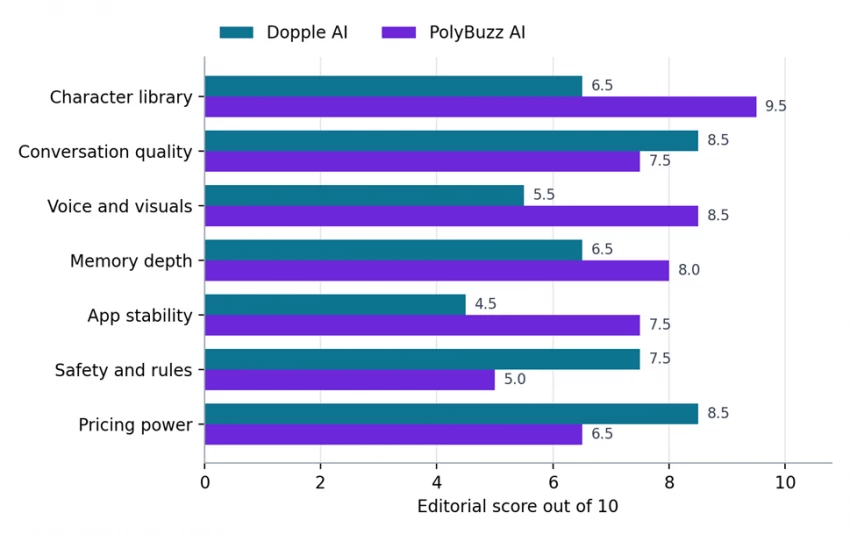
Figure 4: Editorial scores across all seven rounds on a 10-point scale.
| Round | Category | Winner | Score |
|---|---|---|---|
| 1 | Character library | PolyBuzz AI | 9.5 to 6.5 |
| 2 | Conversation quality | Dopple AI | 8.5 to 7.5 |
| 3 | Voice and visuals | PolyBuzz AI | 8.5 to 5.5 |
| 4 | Memory depth | PolyBuzz AI | 8.0 to 6.5 |
| 5 | App stability | PolyBuzz AI | 7.5 to 4.5 |
| 6 | Safety and rules | Dopple AI | 7.5 to 5.0 |
| 7 | Pricing power | Dopple AI | 8.5 to 6.5 |
Table 6: Round-by-round results. Totals: PolyBuzz AI 52.5, Dopple AI 47.5.
PolyBuzz AI takes the decision, 52.5 points to 47.5, on the strength of scale, voice, memory, and reliability. Dopple AI leaves with the three rounds that define a budget pick: better default conversations, tighter moderation, and the cheapest complete subscription in the category at $5.99 per month. Neither verdict is permanent in a market moving this fast, which is exactly why the one-week free-tier test remains the smartest first step.

New Claude Model Targets Agentic AI WorkflowsAnthropic has launched Claude Sonne...
Samuel Osei3 months ago

Gemini’s Image Tools Get a Wider RolloutGoogle is expanding access to Gemini’s p...
Alexander Hughes3 months ago
Two AI video generators, two very different first days. I ran PixVerse through i...
Alexander Hughes3 months ago
Two of the most talked-about AI chat platforms. I opened both, picked a characte...
Alexander Hughes3 months ago
The two-minute versionIf you only read one thing, read this. The rest of the doc...
Alexander Hughes3 months ago
Why Seedance 2.5 mattersSeedance 2.5 is the latest release in ByteDance’s Seedan...
Alexander Hughes3 months ago
Discussion