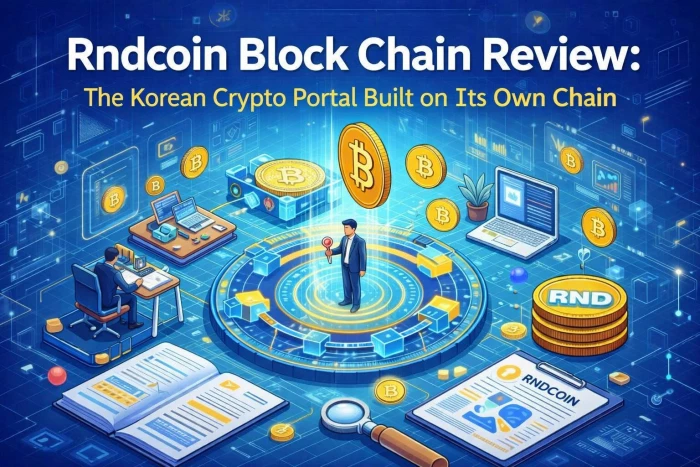
Rndcoin block chain is positioning itself as Korea‑first crypto ecosystem that blends a native blockchain, a utility token, and a full‑fledged education and news portal under one brand. Instead of starting from a coin and building content around it, the project effectively starts from content, learning, and market information, then layers its blockchain and token on top.
At its heart, the rndcoin block chain project (often referred to as RndCoin KR) aims to be a “block chain total service” for South Korean users. The initiative emerged in 2019 with a clear domestic focus, building out of Incheon and speaking directly to Korean traders, investors, and learners in their own language.
The vision is straightforward but ambitious:
● Turn rndcoin.kr into a one‑stop crypto dashboard for Korean users.
● Use localized education and curated news to lower the learning curve for newcomers.
● Back the platform with a native blockchain and token that can power payments, staking, and future dApps.
This makes rndcoin different from “token‑first” projects that push speculative narratives before offering real information or tools.
When you land on rndcoin.kr, you are not greeted by a simple token landing page, but by a structured portal. Several elements jump out that are central to the rndcoin block chain strategy.
● Top 30 Crypto Prices by Market Cap : a live board that tracks leading cryptocurrencies, designed to give Korean users a quick sense of the market at a glance.
● Crypto Latest News & 외신뉴스 (foreign news) : curated streams of global and domestic headlines, often focused on Bitcoin, altcoins, and market narratives relevant to Korean traders.
● 코인강의 (coin lectures) : an education section anchored by a 12‑episode lecture series called “Breaking Bitcoin”, which breaks down Bitcoin and blockchain fundamentals in Korean.
The result is that rndcoin is as much about discovery and learning as it is about its own token. For new users, that combination of dashboards and lectures provides a softer, more guided entry into crypto than jumping straight into an English‑only exchange interface.
One of the most distinctive features of the rndcoin block chain ecosystem is the “Breaking Bitcoin” lecture series. Rather than offering a random collection of blog posts, RndCoin KR organizes its core Bitcoin education into a clear 12‑part curriculum.
The series typically covers:
● Why decentralized systems like Bitcoin emerged, framed around financial crises and limitations of traditional banks.
● How databases and blocks work, and why blockchain represents a different way of storing and validating information.
● The basic mechanics of Bitcoin transactions and security, explained with Korean examples and analogies.
For rndcoin block chain as a brand, this matters a lot: it signals that the project wants users who understand what they are doing, not just short‑term speculators chasing hype.
Under the hood, rndcoin is built around a hybrid consensus mechanism that combines Proof of Stake (PoS) with Delegated Proof of Stake (DPoS). In PoS, token holders lock their coins to validate transactions; in DPoS, holders select a smaller group of delegates who actually produce blocks, allowing the network to achieve higher throughput and lower energy usage than Proof of Work.
From a design perspective, this hybrid approach is meant to deliver:
● Fast confirmations and support for “everyday payment” use cases.
● Low fees, which are critical if the token is to be used for small, frequent transactions.
● A base layer for staking and governance, giving holders economic and potentially voting power in the ecosystem.
Rndcoin block chain also supports smart contracts, meaning developers can create programmable applications on the network. That opens the door to future DeFi, games, and tokenized assets, although the publicly visible dApp ecosystem is still relatively small at this stage.
It’s important when reviewing rndcoin to distinguish between what the technology can theoretically support (fast PoS+DPoS chain with contracts) and what is actually deployed and widely used today.
The rndcoin block chain narrative revolves around two main use‑case clusters:
1. Everyday payments and transfers: The project emphasises the potential for low‑fee, fast transactions that can handle routine payments and person‑to‑person transfers. In practice, this would mean using RND not just for speculative trading but for small purchases, remittances, or on‑chain micro‑transactions.
2. Smart‑contract‑driven applications: With smart contracts available, it can, in principle, host:
● DeFi protocols (lending, staking, yield‑bearing products).
● Game or NFT‑style applications that require programmable logic.
● Tokenization of real‑world assets, particularly those tied to the Korean market.
These use cases are more visible in the project’s messaging than in large‑scale public adoption data, so a critical article should present them as future potential rather than established reality.
One of the most compelling angles for rndcoin block chain is its deep localisation. South Korea is a major crypto market, but many of the tools and narratives are still shaped by global players.
Rndcoin block chain’s response is to build around three pillars:
● Language and culture : all core education and much of the site is written in Korean, with examples, metaphors, and tone that resonate with domestic users.
● Regulatory awareness : the project’s guidance acknowledges the importance of KYC and AML compliance in South Korea’s tightly regulated environment, nudging users toward compliant pathways like verified wallets and exchanges.
● Local identity : the “KR” suffix and country‑specific framing make it clear the project is designed with Korean users as the primary audience, not as an afterthought.
For international readers, that means rndcoin may feel niche or less accessible; for Korean users, it can feel like a more tailored, familiar starting point.
Although detailed on‑chain tokenomics data is not exhaustively documented in public sources, external reviews highlight several economic concepts around rndcoin’s native token.
Core elements include:
● Staking role : given the PoS/DPoS hybrid, staking is central. Holders can, in principle, stake RND to help secure the network and earn rewards.
● Fee utility : RND is expected to be used to pay transaction fees on the rndcoin block chain network, giving it natural demand if on‑chain activity grows.
● Ecosystem currency : as dApps and services emerge, RND can become a base asset for those applications, from DeFi pools to service payments.
External tokenomics analyses of rndcoin also discuss typical small‑cap risks:
● Limited transparency around detailed supply schedules compared with top‑10 coins.
● Potential concentration of holdings early on, with implications for price swings and governance power.
From an investment and trading perspective, rndcoin exhibits many of the patterns common to niche, regionally focused tokens.
Typical characteristics include:
● High volatility : prices can move aggressively in both directions because order books are thinner than for major assets like Bitcoin or Ethereum.
● Limited liquidity : the token is usually listed on fewer exchanges, and trading volumes may be concentrated on one or two platforms, which can amplify price impact when larger orders hit the market.
● Narrative‑driven moves : local news, community activity, and Korean‑market sentiment can have outsized effects on the token’s short‑term behaviour.
On the user‑experience front, rndcoin block chain distinguishes itself more through its portal and content than through flashy app interfaces. The site layout is straightforward, with obvious navigation to news, education, and tools, which is valuable for beginners who might otherwise be overwhelmed.
Community‑wise, rndcoin leans on:
● Korean‑language forums and social channels where its content is shared and debated.
● An emphasis on question‑and‑answer style learning and commentary in Korean.
● A content‑driven community model: users come for the lectures and news, then gradually explore the token and blockchain aspects.
In ecosystem terms, the project feels more like a “content plus infra” platform than a massive dApp ecosystem today. That is not a flaw, but a sign of stage: rndcoin is still early in building out the developer and application layer that would fully exploit its smart‑contract capabilities.
Contextualising rndcoin block chain against giants such as Bitcoin and Ethereum helps clarify its niche.
● Versus Bitcoin: Bitcoin is primarily a global, censorship‑resistant store of value and settlement network, with extremely high security and conservative changes. Rndcoin block chain instead targets localised education, daily usability, and programmatic flexibility, at the cost of lower network effects and a smaller security budget.
● Versus Ethereum: Ethereum is the dominant smart‑contract platform with a huge global developer community and thousands of dApps. Rndcoin offers smart contracts too, but with a far narrower, Korea‑centric scope and a much younger ecosystem.
Rather than competing head‑on, rndcoin carves out a space as a Korean‑focused, education‑driven project that can coexist with global infrastructure.
Any honest discussion of rndcoin block chain needs to underline the risks, especially for readers considering financial exposure.
● Transparency gaps : smaller projects often provide less detail on team structure, audits, and governance processes than blue‑chip protocols.
● Security posture : without widely publicised third‑party audits and long operating histories, security assumptions should be treated cautiously.
● Regulatory shifts : changes in South Korean crypto regulation could impact domestic projects faster than global giants.
● Adoption vs narrative : rndcoin’s messaging leans into everyday payments and dApps, but on‑chain usage and ecosystem breadth should be scrutinised with data.
A practical due‑diligence checklist before interacting with rndcoin block chain might include:
● Verifying that you are on the official domain (rndcoin.kr) and not a look‑alike.
● Checking independent explorers for transaction counts and address distribution.
● Reviewing available audits or code analyses, if any.
● Evaluating exchange liquidity, slippage, and counterparty risk on each venue.
From a fit‑perspective, Rndcoin is likely to appeal most to:
● Korean users who prefer a localized, Korean‑language hub for crypto information and fundamentals.
● Learners who want structured content like the “Breaking Bitcoin” series before diving into trading or DeFi.
● Users who like the idea of a utility token embedded in a content‑ and education‑driven ecosystem.
By contrast, it may not be ideal for:
● Users who only want ultra‑liquid, multi‑exchange, institutionally audited assets.
● International users with no interest in Korean‑language content or local market context.
Rndcoin block chain is a Korea-first crypto project that emphasizes education over hype, combining Korean-language content and structured lectures with a PoS/DPoS blockchain and utility token. Its main strengths are strong localization, learning resources, and an integrated crypto information platform.
It remains a small, early-stage ecosystem with limited transparency, liquidity, and on-chain adoption, so many of its performance and use-case claims should be seen as aspirational. It may appeal to Korean users seeking an education-focused entry into crypto, while international or risk-averse participants should approach it as a niche, higher-risk project requiring careful due diligence.
I keep a 12-question audit checklist on my desk. It started in 2024 as a one-pag...
Grace Howard2 weeks ago

The market for AI-powered knowledge management tools has exploded in the past tw...
Grace Howard1 month ago
I’ve spent enough hours wandering through thesindi.com to know it almost like a...
Ina Gupta1 month ago
Crypings.com is one of those domains that keep popping up in crypto searches, ye...
Grace Howard1 month ago
Sitemap Generator by UploadArticle.com is a lightweight, browser‑based XML sitem...
Peter Woods1 month ago

ThinkOfGames.com is the kind of site you end up bookmarking quietly and then rea...
Noura Belkacem1 month ago
Discussion