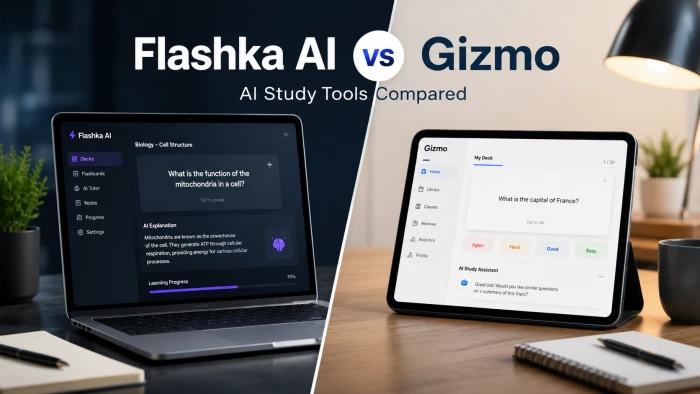
Two AI flashcard apps promise the same thing: upload your notes, get study material in seconds. But they pull in opposite directions when the exam is close. Here's how to pick the right one for the way you actually study.
THE 30-SECOND VERDICT Choose Flashka if you study from your own messy material (handwritten notes, lecture PDFs, diagrams) and want deep, focused review without distractions. Choose Gizmo if you're motivated by streaks, points and friends, want a huge library of ready-made decks, and like learning that feels like a game. |
Flashcard apps used to be simple: you typed a question, you typed an answer, you reviewed. AI changed the bottleneck. Now the hard part isn't reviewing cards. It's deciding which tool turns your specific material into the kind of practice that actually sticks before exam day.
Flashka and Gizmo are two of the most talked-about AI study apps right now, and on a feature checklist they look almost identical. Both generate flashcards from your uploads. Both use spaced repetition and active recall. Both include an AI tutor. The real differences are in philosophy, and that's what decides which one fits you.
Flashka is built around one idea: turn your own study material into effective practice, then get out of your way. In the Flashka AI review context, the appeal is clear: you upload handwritten notes, PDFs, photos or lecture slides, and its AI generates flashcards and quizzes directly from that content, with no manual typing.
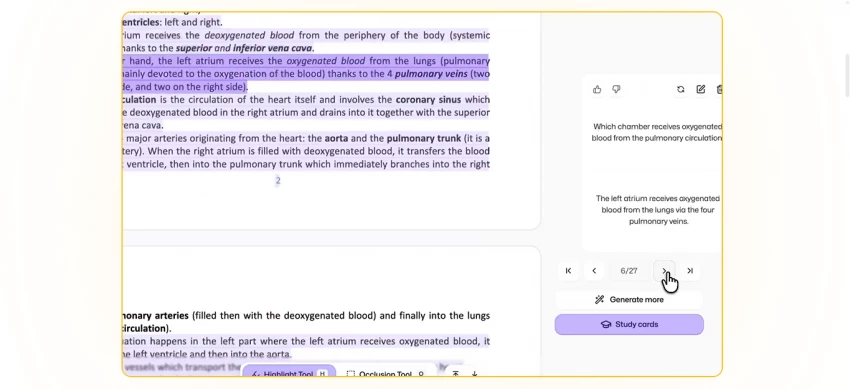
Its standout feature is Image Occlusion: upload a diagram, mask the labels, and Flashka turns it into recall cards. For anatomy, biology, maps or any visual subject, that is a genuine advantage. It also ships a spaced-repetition engine, a "Type to Answer" mode that forces active recall, and an AI tutor called Professor Ka that explains concepts in context and answers in over 100 languages.
FLASHKA AT A GLANCE Best for: Studying from your own notes, PDFs and diagrams Signature feature: Image Occlusion for visual subjects Platforms: iOS, iPad, Mac (Apple-focused), plus Android Free tier: ~50 AI credits per day + spaced repetition Paid: roughly $4/month entry level, up to about $7-8/month for heavier use |
Gizmo is built around motivation. It also generates flashcards and quizzes from your material, and goes wider on imports, pulling content from PDFs, YouTube videos, lecture recordings, Quizlet and Anki decks through its "Magic Import" feature. You can even record a lecture directly in the app.
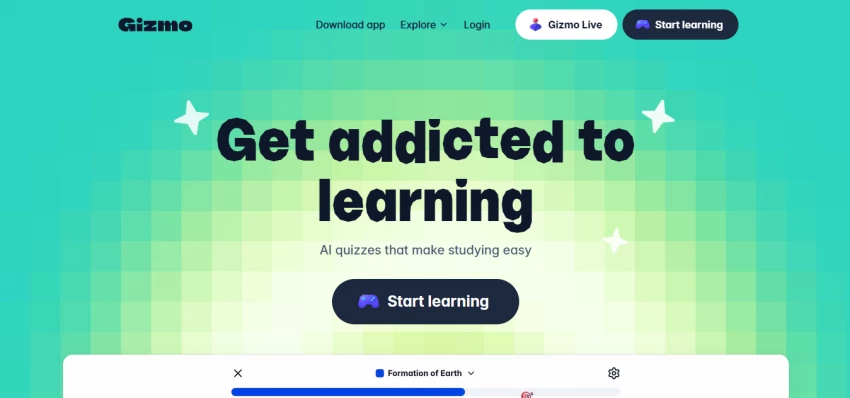
Where Gizmo really leans in is engagement: quizzes feel like games, you earn XP, climb leaderboards, and study alongside friends. It also opens up a library of more than a million public decks made by other students, so you can start reviewing a topic without creating a single card yourself.
GIZMO AT A GLANCE Best for: Staying motivated and studying socially Signature feature: Gamified quizzes, XP, leaderboards + 1M+ public decks Platforms: Web and iOS (also Android listings) Free tier: 15 daily "lives" + up to 10 AI quizzes per day Paid: student-discounted plans roughly halve the price; pricing varies widely by plan |
Here's where the two apps line up on the things students care about most when an exam is on the horizon.
| What you care about | Flashka | Gizmo |
|---|---|---|
| Turn your notes into cards | Yes: notes, PDFs, photos, slides | Yes, plus YouTube, audio, Quizlet, Anki |
| Visual / diagram study | Image Occlusion (standout) | Limited |
| Spaced repetition | Yes, adaptive | Yes, adaptive |
| Quizzes & mock exams | Yes, with explanations | Yes, gamified |
| AI tutor | Professor Ka, 100+ languages | Step-by-step explanations |
| Pre-made decks | Limited | 1M+ public decks |
| Motivation / gamification | Minimal, focus-first | XP, leaderboards, social |
| Free tier | ~50 AI credits/day | 15 lives + 10 AI quizzes/day |
Pricing and limits shift with promotions, region and student discounts, so check each app's current plans before subscribing.
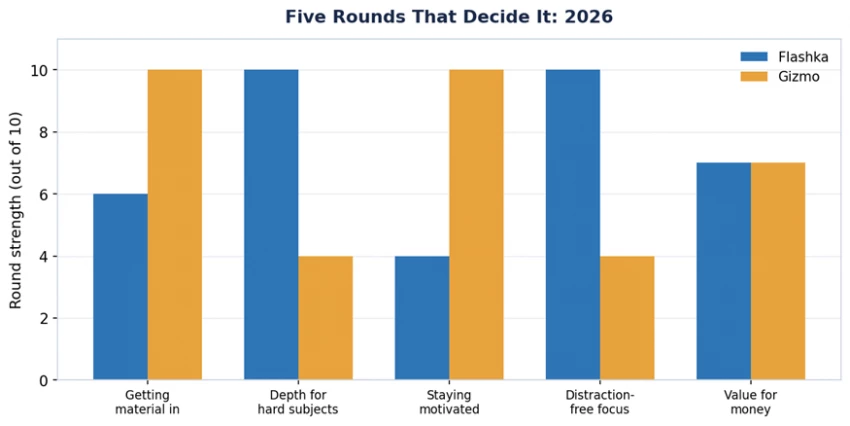
Both apps make uploading painless, but Gizmo casts a wider net. If your study material lives in YouTube lectures, recorded classes, or existing Quizlet and Anki decks, Gizmo's Magic Import pulls it all in. Flashka focuses on the core student inputs (handwritten notes, PDFs, photos and slides) and handles them cleanly.
WINNER: GIZMO For sheer range of import sources, especially video and lecture recordings. |
This is Flashka's territory. Image Occlusion makes it the stronger choice for anatomy, biology, chemistry and any diagram-heavy subject, because you recall structures in their visual context instead of memorising text in a vacuum. Reviews note that AI-generated cards can lack depth on highly specialised topics in both apps, so cross-checking with textbooks still matters either way.
WINNER: FLASHKA Visual occlusion and focused recall give it the edge for technical and medical material. |
If you struggle to keep going, Gizmo is engineered for you. XP, leaderboards, game-like quizzes and studying with friends turn revision into something you'll actually return to. The flip side: its free tier uses a "lives" system, and some users find that running out of lives interrupts a study session at exactly the wrong moment.
WINNER: GIZMO Gamification and social features make consistent studying far easier, with one caveat on the free-tier lives system. |
The same gamification that motivates some students distracts others. Flashka's deliberately minimal, focus-first design keeps your attention on the material rather than on points and rankings. If you already have the discipline and just want efficient review, that simplicity is a feature, not a limitation.
WINNER: FLASHKA A calmer, content-first experience for self-motivated studiers. |
Both follow a freemium model. Flashka's entry pricing has been reported around $4/month, climbing to roughly $7-8/month for heavier usage. Gizmo's pricing varies more widely across plans, but its student discounts can roughly halve the cost. The bigger question isn't the headline price. It's whether the free tier's daily limits (Flashka's credits vs Gizmo's lives) get in your way.
WINNER: TOO CLOSE TO CALL Both are affordable; the right value depends on how heavily you study and which free-tier limit annoys you less. |
Feature lists only go so far. To see how the two apps hold up in daily use, here is what students report across the App Store, Google Play, Trustpilot, and independent review sites in 2026. Ratings move over time and vary by store and region, so treat these as a snapshot and check the current scores before you decide.
| Source | Flashka | Gizmo |
|---|---|---|
| App Store / Play (average) | Mid-4s out of 5 (one listing cites 4.7/5) | ~4.73/5 from ~95,000 ratings |
| Trustpilot | ~3.9/5 (“Great”), few reviews | Mid-range, few reviews |
| Independent review synthesis | 8.6/10 in one in-depth analysis | Generally positive, “still growing” sentiment |
| Review volume | Smaller, newer app | Larger, more established base |
Figures compiled from public store listings, Trustpilot, and independent 2026 reviews. They are approximate and change frequently.
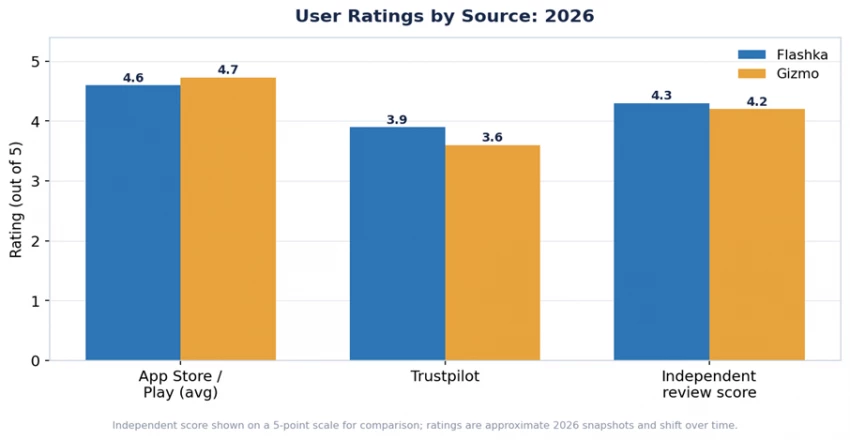
Across reviews, the recurring positives are speed and the sense that flashcards finally feel manageable. Students describe it as fast and efficient, frequently mentioning the time saved versus building decks by hand, and visual learners single out Image Occlusion for diagram-heavy subjects. STEM and medical students in particular report that it suits concept-heavy material, and the roughly 50 free daily credits are widely appreciated for light use.
★★★★☆ App Store review One reviewer called it an amazing app overall, while noting it still needs bug fixes. |
That mixed-but-positive tone is typical: praise for the core idea, with honest notes on rough edges.
Critics point mostly to early-product issues rather than the concept. Common complaints include occasional bugs, AI cards that are sometimes wrong, and frustration with the credit rules on the free tier. One reviewer hit a language mix-up where generated questions came out in the wrong language, and the developer publicly responded that a language selector was being added. The broad consensus from review syntheses is that Flashka boosts efficiency, but you should verify what the AI produces rather than trust it blindly.
★★★☆☆ App Store review A student wanted to switch from Gizmo; cards generated fast but appeared in the wrong language. |
Gizmo’s reviews skew strongly positive on motivation and breadth. Students repeatedly credit Magic Import for turning a revision list into a full set of cards and quizzes almost instantly, and many highlight the AI tutor and explanation feature for understanding why an answer is correct. The gamified, social angle comes up again and again, with students saying it makes them study more and even compete with classmates.
★★★★★ App Store review A nursing student loved it, saying classmates compete because studying feels like a game. |
★★★★★ Trustpilot review A student said Magic Import instantly produced 100 flashcards and questions from a revision list. |
The most common complaints are technical rather than conceptual. After one update, several users reported the app becoming laggy when moving through cards or lessons, and slow or failed imports. Others described being stuck on the login screen after an update across multiple devices. On the free tier, the “lives” system draws criticism for interrupting a session at an inconvenient moment. As an app whose review base is still growing, sentiment is described by some analysts as forming rather than fully settled.
★★★☆☆ App Store review A user loved the app but said imports sometimes get stuck on loading. |
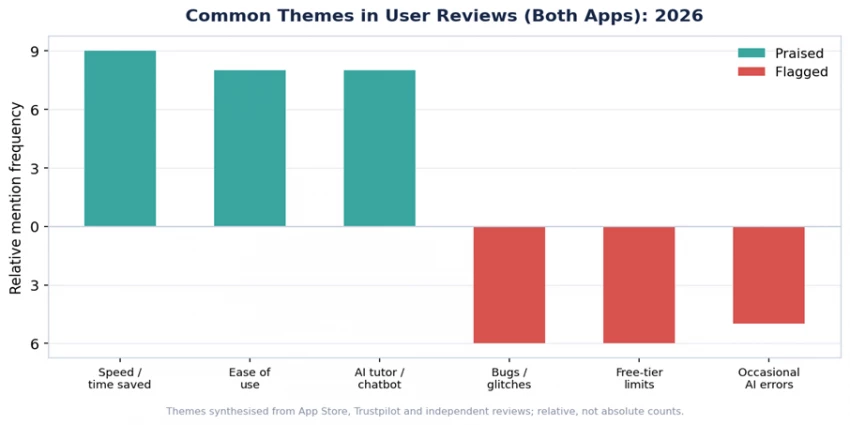
Read together, the two review profiles tell a consistent story. Both apps win on speed and on lowering the barrier to starting spaced repetition. Both attract complaints about bugs, occasional AI errors, and free-tier limits, the credits-versus-lives trade-off the rounds above describe. Gizmo carries a larger, more established rating base and a slightly higher raw store average; Flashka is newer, with fewer reviews but strong scores and visible, responsive developer engagement in its review threads.
How to read these numbers A higher store average does not automatically mean a better fit for you. Gizmo’s ~4.7 reflects a large, motivated, gamification-friendly user base; Flashka’s smaller sample skews toward focus-first and visual learners. Match the review themes to how you actually study rather than chasing the bigger number. |
Forget the feature checklist for a second. The honest answer comes down to how you study and what keeps you going.
✓ Most of your studying comes from your own notes, PDFs and lecture slides.
✓ You study visual subjects like anatomy, biology or geography, and want diagram-based recall.
✓ You're already self-motivated and find points and leaderboards distracting.
✓ You're in the Apple ecosystem and want smooth sync across iPhone, iPad and Mac.
✓ You want to import from YouTube, recorded lectures, Quizlet or Anki.
✓ You study better with streaks, XP, leaderboards and friends keeping you accountable.
✓ You'd rather start from a huge library of ready-made decks than build your own.
✓ You like learning that feels like a game rather than a grind.
THE SMART MOVE Both apps have genuinely usable free tiers. Before paying for either, spend a few days running the same real exam topic through both: upload one chapter, generate cards, and do a couple of quiz sessions. Whichever one you actually keep opening is your answer. The best study app isn't the one with the longest feature list. It's the one you'll use the night before the exam. |
New Claude Model Targets Agentic AI WorkflowsAnthropic has launched Claude Sonne...
Samuel Osei3 months ago
Gemini’s Image Tools Get a Wider RolloutGoogle is expanding access to Gemini’s p...
Alexander Hughes3 months ago
Two AI video generators, two very different first days. I ran PixVerse through i...
Alexander Hughes3 months ago
Two of the most talked-about AI chat platforms. I opened both, picked a characte...
Alexander Hughes3 months ago
The two-minute versionIf you only read one thing, read this. The rest of the doc...
Alexander Hughes3 months ago
Why Seedance 2.5 mattersSeedance 2.5 is the latest release in ByteDance’s Seedan...
Alexander Hughes3 months ago
Discussion