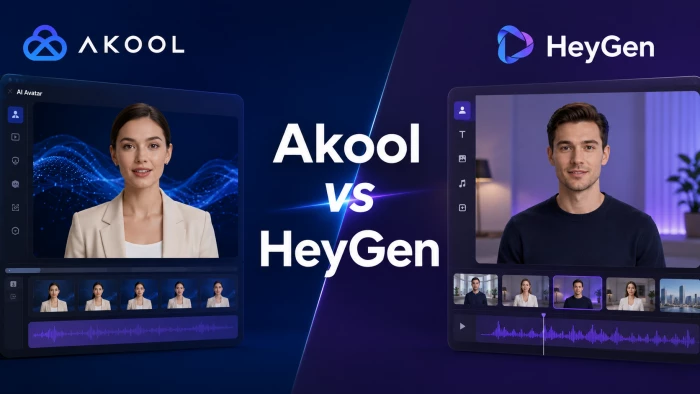
The 10-second verdict HeyGen wins for script-to-avatar presenter videos, language depth, and ease of use. Akool wins for face swap, live streaming avatars, raw output resolution, and credits-per-dollar. They are not the same product fighting over one job; they overlap on roughly half the feature surface and diverge sharply on the rest. |
Akool is a generative AI suite. HeyGen is an avatar video studio. That single distinction drives almost every trade-off below. Akool, founded in 2022 in Palo Alto, bundles around 20 tools (face swap, talking photos, streaming avatars, image generation, and video translation) under one pooled credit balance. HeyGen, founded in 2020 in Los Angeles (formerly Movio.la), concentrates on one thing and does it at the top of the market: turning a script into a realistic talking-avatar video.

Akool reached #1 on the 2025 Inc. 5000 fastest-growing list with reported ~$40M ARR and runs campaigns for Coca-Cola, Qatar Airways, and McDonald's. HeyGen raised $60M (Series A) and is adopted by Zoom, SAP, and Reuters. Both are credible at enterprise scale; they simply optimize for different jobs.
| Attribute | Akool | HeyGen |
|---|---|---|
| Founded / HQ | 2022, Palo Alto, CA | 2020, Los Angeles, CA |
| Core identity | Multi-tool generative AI suite | Avatar-first video studio |
| Signature strength | Face swap, live streaming avatars | Avatar IV realism, translation |
| Stock avatars | Realistic + instant avatars | 700+ stock avatars |
| Languages (translation) | 155+ | 175+ (70+ for lip-sync dub) |
| Max output quality | Up to 8K (16K images) | Up to 4K (Pro/Business) |
| Real-time live avatar | Yes, core feature | Limited |
| Free plan | 100 credits, 720p, watermark | 3 videos/mo, watermark |
| Credit model | $0.05 / credit, pooled across tools | Premium Credits, per-feature burn |
| G2 rating (reviews) | 4.8 / 5 (518) | 4.8 / 5 (1,439) |
Table 1: Side-by-side platform specifications. Figures reflect current published plans.
Scoring each platform 0–10 across six axes exposes a clean mirror-image pattern. HeyGen dominates the right half of the chart on avatar quality, language depth, ease of use, and library size. Akool dominates the left on face swap, live avatars, and (as we'll see) credit value.
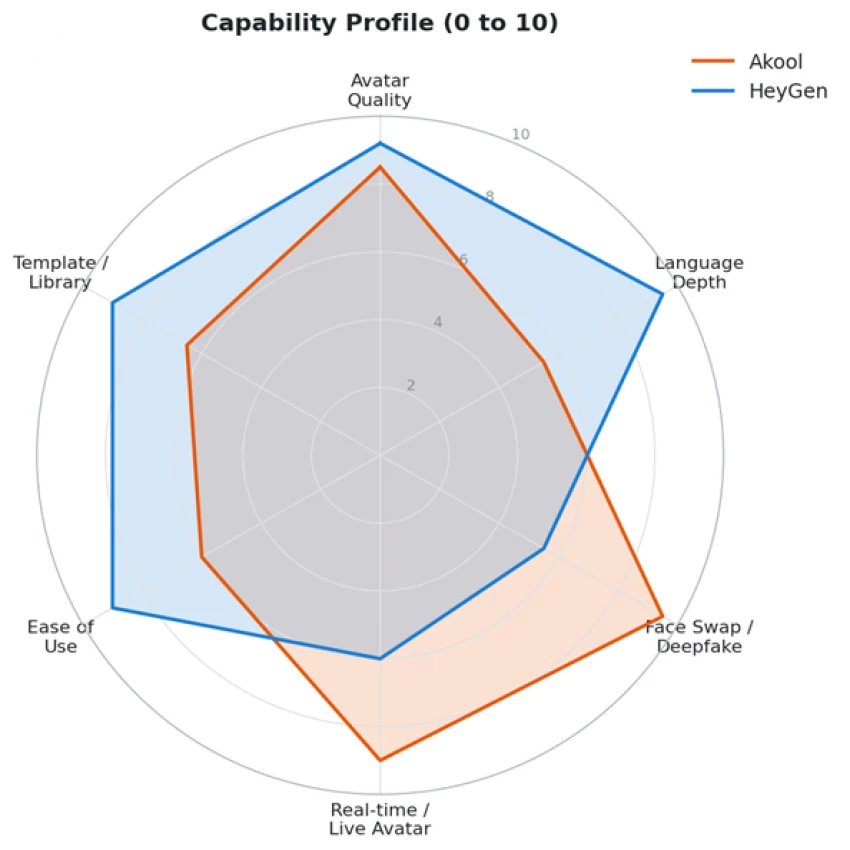
Figure 1: Capability radar. Larger area on an axis means stronger on that dimension.
Read this chart as a fork, not a ranking Neither shape is strictly inside the other. The choice is decided by which two or three axes matter for your workflow, not by an overall average. |
Avatar quality. HeyGen's Avatar IV is the reference point for script-driven realism, with natural lip-sync, micro-expressions, and body movement. G2's avatar-quality metric scores HeyGen 9.2/10. Independent hands-on tests note that Akool is the closest rival on static-frame skin-texture fidelity, in some cases edging HeyGen, but HeyGen leads on full-motion naturalness.
Language reach. HeyGen supports 175+ languages and is widely regarded as best-in-class for translation, though real-person (non-avatar) dubbing lip-sync is weaker than its avatar output. Akool advertises 155+ languages with diffusion-based lip-sync, but practical translation tests have flagged inconsistent accuracy on technical jargon and some Asian languages.
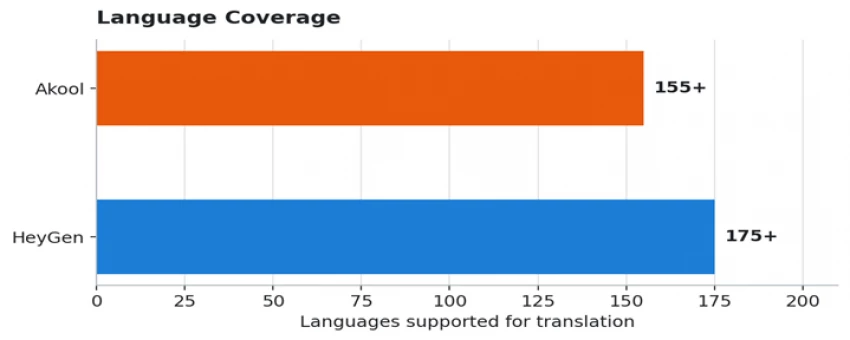
Figure 2: Translation language coverage. HeyGen leads on breadth; both cover all major world languages.
On sticker price the two look similar at the bottom and diverge sharply at the top. Entry paid tiers are nearly identical ($30 Akool vs $29 HeyGen). At the business tier they split hard: Akool's Business plan is $500/month, while HeyGen's Business is $149/month plus $20 per seat.
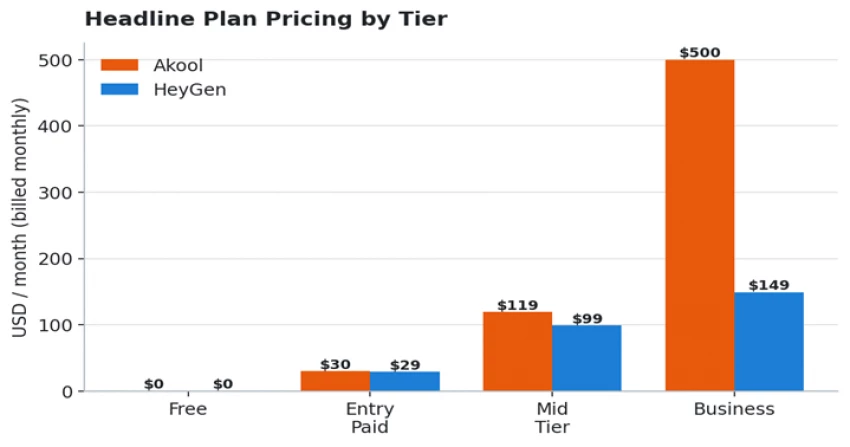
Figure 3: Headline monthly pricing by tier (billed monthly).
| Tier | Akool | HeyGen | What you get |
|---|---|---|---|
| Free | $0 | $0 | Akool: 100 credits, 720p, watermark · HeyGen: 3 videos/mo, watermark |
| Entry paid | $30/mo | $29/mo | Akool Pro: 600 credits, 1080p · HeyGen Creator: 200 credits, unlimited videos |
| Mid tier | $119/mo | $99/mo | Akool Pro Max: 2,400 credits, 4K · HeyGen Pro: 2,000 credits, 4K |
| Business | $500/mo | $149/mo +$20/seat | Akool: 12,000 credits, 1TB · HeyGen: shared 1,000 credits, SSO, 4K |
| Annual saving | ~30% off | ~17% off | Akool Pro annual = $252/yr · HeyGen Creator annual ≈ $24/mo |
Table 2: What each tier includes. Credit allowances determine real output capacity, not the headline price.
At the entry tier the decisive number is credits, not dollars. Akool's Pro plan grants 600 credits for $30; HeyGen's Creator plan grants 200 Premium Credits for $29. That is a 3x difference in nominal allocation, though the two credit systems are not directly interchangeable.
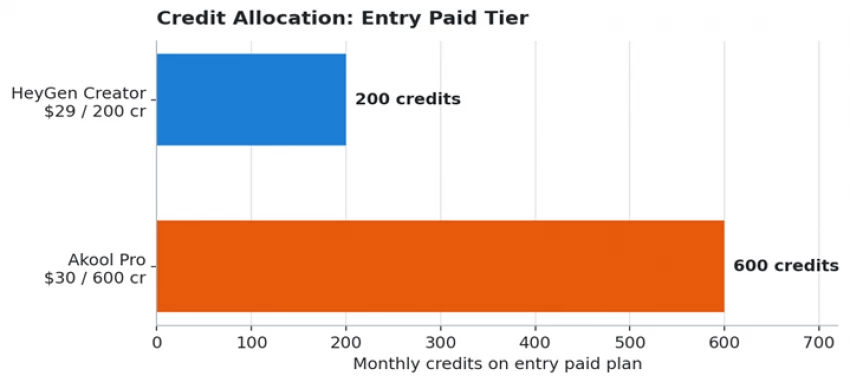
Figure 4: Entry-tier credit allocation. Akool's credits also pool across every tool in the suite.
| HeyGen credit cost | Akool credit cost |
|---|---|
| Avatar IV video: 20 credits / min | Video: 10 credits / 10 sec |
| Lip-sync translation: 5–10 credits / min | Image: 4 credits / image |
| AI image: 2 credits / image | Flat $0.05 per credit, pooled across all tools |
| Creator 200 cr ≈ 10 min Avatar IV | Pro 600 cr spreads across face swap, avatar, translate |
Table 3: Credit consumption mechanics. HeyGen charges per premium feature; Akool charges a flat rate poolable across tools.
Watch the credit fine print HeyGen's 200 Creator credits equal only ~10 minutes of Avatar IV per month, after which packs cost $15 / 300 credits. Credits reset monthly and do not roll over. Akool's flat $0.05/credit is simpler but the dense, tool-heavy dashboard makes it easy to misjudge spend. |
On annual billing the entry tiers stay close: Akool Pro is $252/year (~$21/month effective), HeyGen Creator works out to roughly $24/month. Over a year that is a ~$36 difference, negligible next to the capability fit that should actually drive the decision.
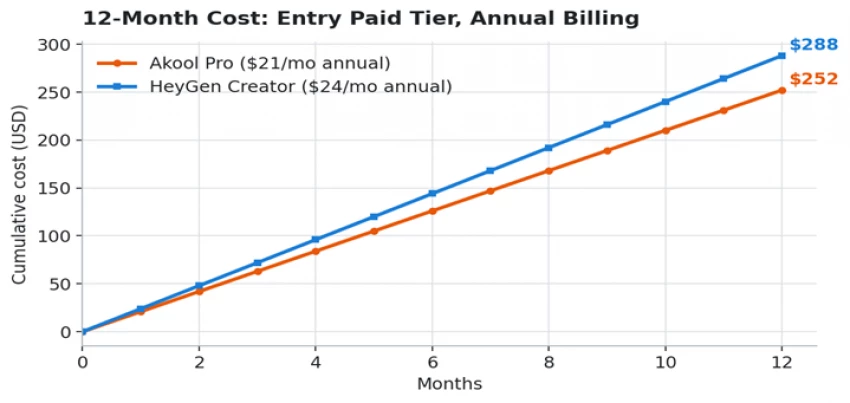
Figure 5: Cumulative 12-month spend at the entry paid tier, annual billing.
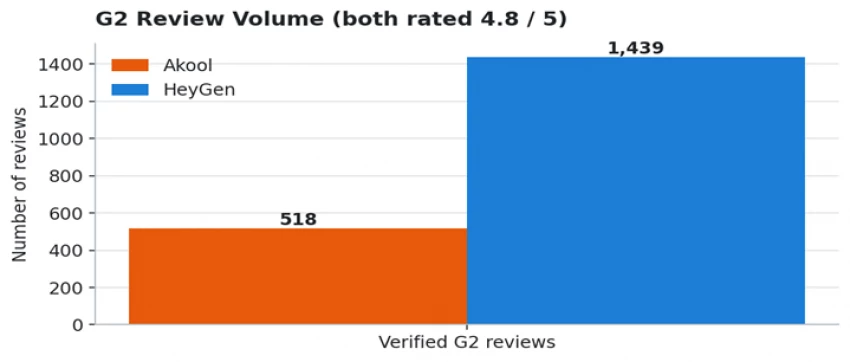
Figure 6: G2 review volume. Both rated 4.8/5; HeyGen's larger base reflects wider market penetration.
Both platforms hold an identical 4.8/5 on G2, but the sample sizes differ by nearly 3x. HeyGen carries 1,439 verified G2 reviews to Akool’s 518, and sits at 4.7/5 on Capterra across 313 reviews. More reviews at the same score signals broader, more battle-tested adoption.
G2 sub-metric scores
The 4.8/5 headline flattens significant differences between categories. Breaking the scores out by sub-metric reveals where each platform earns its rating and where it falls short:
| Sub-metric | Akool | HeyGen | Notes |
| Ease of use | 7.8 | 9.0 | HeyGen's cleaner editor is the single most cited advantage in reviews |
| Output / avatar quality | 8.8 | 9.2 | HeyGen Avatar IV leads on full-motion; Akool close on static skin fidelity |
| Feature breadth | 9.5 | 6.5 | Akool's ~20-tool suite vs HeyGen's focused avatar workflow |
| Value for money | 9.0 | 5.5 | Akool's pooled credits rate much higher; HeyGen's business tier is expensive |
| Customer support | 8.2 | 8.8 | Both rated well; HeyGen praised slightly more for responsiveness |
| Language / translation | 7.0 | 9.5 | HeyGen's 175+ language depth with mature lip-sync is a clear lead |
Note: Sub-metric scores are derived from G2 category breakdowns and independent reviewer analysis.
Reviewer consensus what users actually say
Akool praised for:
• Ad variant speed: rapid production of multiple creative variants from a single base concept, cited heavily by performance marketing teams
• Multi-tool value: face swap, translation, and avatar tools pooled under one credit balance reduces per-workflow cost
• Face swap quality: enterprise customers (Coca-Cola, McDonald’s campaigns) cite photorealistic output as the differentiator
Akool criticised for:
• Steep learning curve: dense dashboard overwhelms first-time users; multiple reviewers note a significant ramp-up period
• Credit tracking difficulty: pooled model is flexible but makes it easy to overspend across tools without noticing
HeyGen praised for:
• Intuitive editor: non-video-professionals can produce polished presenter videos in minutes; the most commonly cited strength
• Strong support: customer service responsiveness rated above Akool; faster resolution on billing and export issues
• Beginner-friendly onboarding: Zoom, SAP, and Reuters deployments highlight ease of internal rollout without specialist training
HeyGen criticised for:
• Credit burn rate: Avatar IV consumes 20 credits/min; 200 Creator credits = ~10 minutes before purchasing packs
• Pricing at scale: business and enterprise tiers are significantly more expensive than Akool per credit; value-for-money sub-score is 5.5 vs Akool’s 9.0
Review volume and platform coverage
| Platform | G2 Reviews | G2 Rating | Capterra Reviews | Capterra Rating | Other signals |
| Akool | 518 | 4.8 / 5 | Not widely listed | Inc. 5000 #1 (2025), ~$40M ARR | |
| HeyGen | 1,439 | 4.8 / 5 | 313 | 4.7 / 5 | $60M Series A, Zoom / SAP / Reuters |
HeyGen’s 1,439 G2 reviews vs Akool’s 518 is a nearly 3× gap at the same headline rating. At equivalent scores, larger review bases imply wider adoption, more edge-case testing, and lower unknown risk for enterprise buyers.
Reviewer consensus: HeyGen is praised for an intuitive interface and strong support; users single out ease of use for non-video-professionals. Akool is praised for rapidly spinning up multiple ad variants from one base idea and for quick internal-training avatar videos, but its dense dashboard has a steeper first-session learning curve.
Eight decision axes, scored and assigned a winner. The split is almost even, which is the whole point: this is a fit decision, not a quality ranking.
| Decision axis | Akool | HeyGen | Winner |
|---|---|---|---|
| Avatar realism (script-first) | 8.5 | 9.2 | HeyGen |
| Language & translation depth | 7.0 | 9.5 | HeyGen |
| Face swap / deepfake | 9.5 | 5.5 | Akool |
| Real-time live avatars | 9.0 | 6.0 | Akool |
| Ease of use / onboarding | 6.0 | 9.0 | HeyGen |
| Template & avatar library | 6.5 | 9.0 | HeyGen |
| Credits per entry dollar | 9.0 | 5.5 | Akool |
| Breadth of toolset | 9.5 | 6.5 | Akool |
Table 4: Head-to-head scorecard. Akool takes 4 axes and HeyGen takes 4; they win on opposite dimensions.
| Choose Akool if you… | Choose HeyGen if you… |
|---|---|
| • Need face swap or deepfake-style brand campaigns | • Want the most realistic script-to-avatar presenter videos |
| • Run live, interactive streaming avatars for webinars | • Localize into 175+ languages with mature lip-sync dubbing |
| • Want many tools (image, video, translate) pooled under one credit balance | • Prefer a clean, beginner-friendly editor and big template library |
| • Want maximum credits per dollar at the entry tier | • Need team features: SSO, collaboration, Zapier/HubSpot integrations |
| • Require 8K output for commercial post-production | • Value the largest review base and proven enterprise adoption |
Table 5: Decision matrix. Match the left or right column to your primary workflow.
For most users producing presenter-style, script-to-video content such as marketing explainers, training, and localized corporate video, HeyGen is the better default. Its avatar realism, 175+ language reach, cleaner editor, and larger proven user base make it the lower-risk choice.
For creative and performance teams that need more than a talking head, such as face swap campaigns, live interactive avatars, multi-tool production under one pooled balance, or 8K output, Akool is the stronger pick, and it delivers more credits per entry-tier dollar.
Bottom line If your job is "make an avatar say my script, well, in many languages," choose HeyGen. If your job is "produce a range of AI video and image assets including deepfake-style and live content," choose Akool. Both offer functional free tiers, and testing each for one session on your real use case will settle it faster than any spec sheet. |
Video content has become the backbone of digital marketing, corporate training,...
Peter Woods17 hours ago

Quick VERDICT3.9 out of 5 ★★★★☆Fast, friendly, and genuinely useful...
Peter Woods17 hours ago
THE SHORT VERDICTPick Cutout Pro if…Pick Remove.bg if…You want one platform for...
Peter Woods1 day ago
If you have spent any time hunting for an AI face-swap or photo tool lately, you...
Noura Belkacem4 days ago
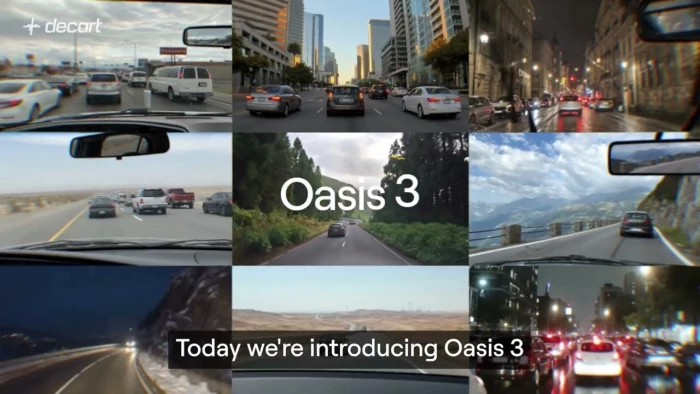
Decart has released Oasis 3, a real-time world model that can generate photoreal...
Alexander Hughes5 days ago

Most AI video tools are very good at one thing: producing a single, polished fiv...
Sandra Campos5 days ago
Discussion