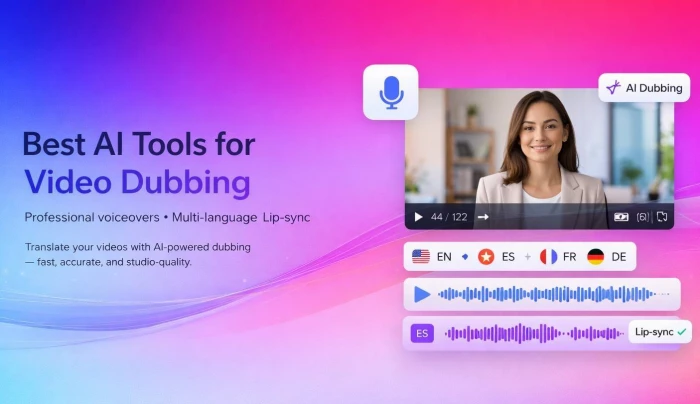
AI video dubbing has moved from “nice to have” to core growth strategy. Nowadays, one well‑produced video can quietly become ten, each speaking to a different market in its own language and voice. The magic no longer lives in recording booths and agency retainers; it lives in a new wave of AI‑first platforms that translate, re‑voice, and even lip‑sync your content in a fraction of the time.
In this guide, we’ll walk through seven standout AI dubbing tools, how they differ in philosophy and workflow, and a simple way to decide which one actually deserves a place in your stack.
HeyGen is that hyper‑efficient manager who lives in your browser, juggling scripts, avatars, and translations without breaking a sweat. Give it a talking‑head video and it will reinterpret it in another language, reshaping mouth movements so the on‑screen person doesn’t look like a badly dubbed soap opera.
What makes HeyGen interesting is its appetite for doing everything itself. It can help you create the original video (via avatars), then turn around and dub that same piece into new languages, with audio‑only or lip‑synced results. For a solo YouTuber, ed‑tech founder, or agency working on explainer after explainer, that “one roof” feeling is addictive because you don’t spend your life exporting and re‑importing files.
There is a catch: you pay in minutes. A Creator‑tier subscription gives you a generous supply of audio dubbing and a finite bucket of lip‑synced translation minutes; as your appetite grows, you move up into more expensive bands with higher limits and resolution upgrades. Think of HeyGen as the studio manager you keep on retainer when content is your daily job, not an occasional experiment.
If HeyGen is the manager, Synthesia is the polished body double who never misses a brand guideline. It’s built for environments where the on‑screen person matters, a CEO, a trainer, a subject‑matter expert and where that person should still feel like themselves even when they suddenly “speak” Italian, Japanese, or Portuguese.
Synthesia’s dubbing magic is less about “any voice” and more about continuity. It tries to keep the speaker’s vocal identity intact across 130+ languages, while also aligning lip movements and pacing with the new track. That’s invaluable if you’re localizing training academies, onboarding content, or internal town halls where authenticity matters more than novelty.
You can dip a toe into the product for free, but the real action happens in paid and enterprise plans, where watermark‑free output, volume, and governance features live. This is the tool that blends into LMS systems, review workflows, and legal approvals, not the one you casually open on a Sunday afternoon to dub a meme.
Rask AI walks into the room with a clipboard and a calendar. It’s less “cool gadget” and more “production line for localization.” If your world is full of webinars, podcasts, long explainers, and course videos, Rask’s entire pitch is: stop treating multilingual versions as special projects; make them part of your routine.
The workflow is unapologetically systematic. You upload your video, it transcribes, then you select languages, review translations if needed, and spin out dubbed versions. It keeps track of multi‑speaker content and invites teammates into the same space so you’re not drowning in shared drives and random file names. The value isn’t in one spectacular feature; it’s in the relief of seeing localization behave like a predictable process.
Pricing is aligned with that mindset. Lower tiers give you a modest pool of minutes to test; Creator and business plans are built for teams who know they’ll be churning out localized episodes every month. If your editorial calendar looks like a small TV station, Rask feels less like a tool and more like infrastructure.
ElevenLabs doesn’t pretend to be your all‑in‑one video environment. It’s the mysterious audio engineer in the corner, obsessed with how every syllable sounds. Its specialty: voices that feel unsettlingly real, and cloning that lets a particular speaker follow you across languages.
The trade‑off is control vs. convenience. ElevenLabs usually handles the speech translation, dubbing, voice generation while you bring that audio into your editor to marry it to the visuals. It’s not a one‑click “upload video, get finished dub” story. Instead, it’s “give me your script or track, I’ll give you the best voice I can, and you decide how it sits over your timeline.”
Because it uses a character/minute model, it starts cheap and grows with your ambition. For narrative channels, branded content, and agencies who care about building a recognizable sonic identity, ElevenLabs becomes the beating heart of the audio, while the video side stays in familiar tools like Premiere or DaVinci.
Papercup doesn’t show up for one‑off YouTube experiments. It arrives with pallets of content and a logistics team. Its natural habitat: TV networks, large YouTube libraries, streaming platforms. The question it answers is, “How do we re‑voice hundreds or thousands of episodes without losing the emotional nuance that made them work in the first place?”
Under the hood, Papercup analyzes the performance where a speaker slows down, where they stress a word, how a joke lands and then recreates that arc with synthetic voices designed to sound like professional dubbing artists. To the viewer, it feels far closer to traditional human‑done dubbing than the flat tone many TTS systems still suffer from.
You won’t find neat little self‑serve tiers laid out for Papercup. Instead, pricing tends to be project‑ or contract‑based, reflecting the fact that it’s solving catalog‑level problems. If you primarily serve broadcasters, OTT platforms, or big media clients in your work, Papercup is the “industrial equipment” in this list.
Dubverse walks in with regional slang, multiple Indian languages on tap, and a clear understanding that not every creator sits in New York or Berlin. It’s built with Indian realities in mind: creators move between Hindi, English, Tamil, Bengali and more; newsrooms need quick multilingual clips; ed‑tech companies want lessons that make sense beyond Tier‑1 cities.
The interface leans towards social video. You can push short or long clips through it, get instant translations, generate voices, and layer subtitles that are usable for Shorts and Reels as well as standard horizontal videos. It’s optimized less for giant corporate workflows and more for “I need this out today, in three languages, for real people who don’t all speak English at home.”
The business model is friendly to experimentation: a free tier to play with, then relatively affordable paid layers that scale based on minutes and features. If your metrics live inside Indian YouTube Studio dashboards or you’re building campaigns for regional audiences, Dubverse feels like someone who actually grew up in the neighborhood.
Wavel AI is not the loudest tool in the room, but agencies and marketing teams often gravitate toward it because it solves an unglamorous problem: “We have multiple brands, multiple languages, and we’d like one place that understands them all.”
It offers dubbing, translation, subtitles, transcripts, and, importantly, the ability to craft and reuse brand‑specific voices. Once you lock in how a brand “sounds,” you can roll that across multiple campaigns and markets, which does a lot of heavy lifting for consistency. Multi‑speaker situations and lip‑sync are part of the package rather than an afterthought.
Pricing starts low enough for small teams and scales via credits and tiers as your throughput grows. Wavel rarely tries to dazzle you with gimmicks; its charm is that it slots neatly into agency life, where deadlines, brand guidelines, and client approvals define reality.
| Tool | Strength area | Typical user type | Indicative starting cost/month* |
| HeyGen | Lip‑synced multilingual creator videos | YouTubers, educators, small teams | ~24–29 USD (Creator) |
| Synthesia | Voice‑preserving pro dubbing | L&D, B2B brands, enterprises | Custom, paid tiers only |
| Rask AI | End‑to‑end localization workflows | Growing channels, agencies, SMEs | ~19–60 USD+ depending on plan |
| ElevenLabs | Hyper‑realistic voices & cloning | Audio‑focused creators, brands | From ~5 USD |
| Papercup | Broadcast‑level localization | Media, TV, large YouTube networks | Custom/enterprise |
| Dubverse | Indian & regional language dubbing | Indian creators, publishers | ~27 USD+ for paid tiers |
| Wavel AI | Dubbing + translation + branding | Agencies, marketers, educators | ~18 USD+ entry plans |
One way to choose is to stop thinking in terms of features and think in terms of roles:
● The creator or lean team who ships regularly will usually be happiest with HeyGen, Rask AI, or Dubverse tools that respect time, budget, and messy upload schedules.
● The enterprise or media organization with brand guardians and legal sign‑offs in the loop will often gravitate toward Synthesia and Papercup. They play nicely with structure.
● The audio purist, narrative storyteller, or brand‑building agency tends to start from voice quality and land on ElevenLabs or a branding‑oriented environment like Wavel AI.
A practical litmus test: pick one representative from your “tribe,” run the same two sample videos through it, and judge only three things does the voice sound human, do the lips distract you, and how long did it actually take from upload to publishable output?
AI video dubbing is no longer about chasing a single “number one” tool; it’s about building the right stack for the way you actually create and distribute content. The strongest platforms have already specialized: some make weekly YouTube uploads and course drops easier, others are built to protect enterprises from off‑brand or inaccurate translations, and a few obsess purely over how your voice feels in another language. Instead of asking “Which AI dubbing tool is the best?”, the smarter question is “Which one behaves like a natural extension of my workflow, my audience, and my brand voice?”
When I sat down to seriously compare InVideo and Pictory, I wasn’t just testing...
Grace Howard5 months ago

AI background removal has quietly become the “first edit” step for almost every...
Benjamin Clark5 months ago
AI photo enhancement has quietly become the “secret sauce” behind sharp Instagra...
Funke Ogunleye5 months ago
Looking Beyond Canva: What Are You Really Missing?Canva is brilliant for getting...
Grace Howard5 months ago
A few years ago, “chatbot” meant a rigid decision tree that collapsed as soon as...
Benjamin Clark5 months ago
ElevenLabs has set a high bar for lifelike AI voice generation, but it’s no long...
Grace Howard6 months ago
Discussion